Phone:
(701)814-6992
Physical address:
6296 Donnelly Plaza
Ratkeville, Bahamas.

Phone:
(701)814-6992
Physical address:
6296 Donnelly Plaza
Ratkeville, Bahamas.

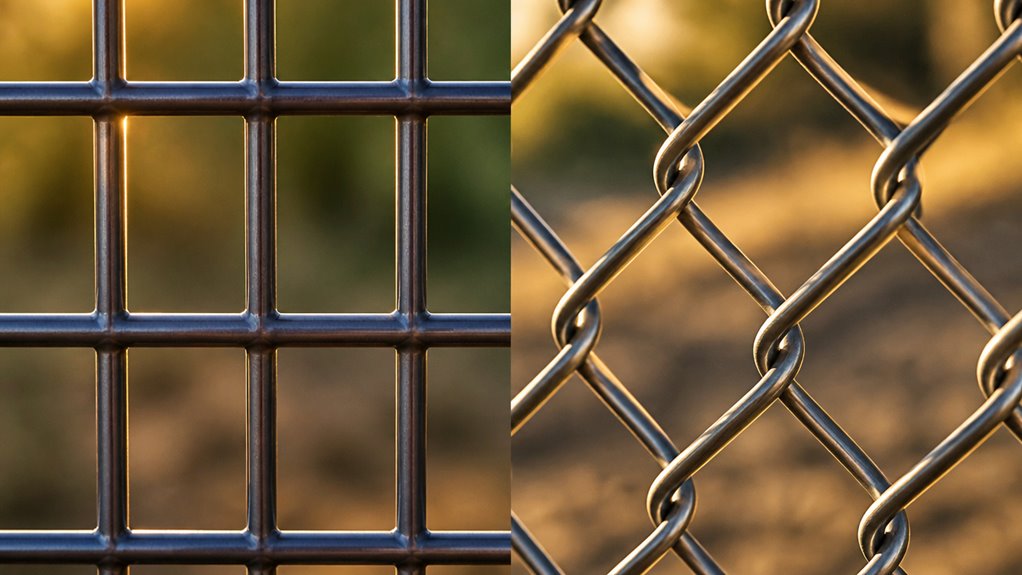
You’ll find welded wire formed by spot-welding intersections, giving you rigid, uniform panels with high stiffness but low flexibility.
Woven wire, on the other hand, mechanically interlaces strands, offering greater flexibility and impact absorption, ideal for uneven terrain.
Welded joints corrode and fatigue faster under stress, while woven wire resists those but risks unraveling if cut.
Your choice depends on strength, flexibility, environmental factors, and application needs. Exploring further reveals most suitable uses and installation tips.
| Feature | Welded Wire | Woven Wire |
|---|---|---|
| Manufacturing Method | Wires joined at intersections by spot welding | Wires mechanically interlaced or twisted |
| Joint Construction | Fixed, fused joints | Flexible, interlocked joints |
| Structure | Rigid, uniform grid | Flexible mesh |
| Rigidity | High | Lower |
| Flexibility | Low | High |
| Shape Retention | Excellent under static loads | Moderate; bends and rebounds |
| Strength Focus | Structural stiffness and stable shape | Flexibility and impact absorption |
| Stress Distribution | Concentrated at weld points | Distributed across interlaced strands |
| Impact Resistance | Can permanently bend under heavy impact | Absorbs impacts and flexes under pressure |
| Uneven Terrain | Less suitable for slopes and irregular ground | Adapts well to uneven terrain |
| Fatigue Resistance | Welds may crack under repeated stress | Flexible joints better tolerate repeated flexing |
| Corrosion Resistance | Weld points can rust faster, especially outdoors | Avoids weld-related corrosion |
| Long-Term Durability | Best in static applications requiring shape retention | Better for dynamic loads and irregular environments |
| Cutting and Damage | Generally retains edge stability after cuts | May unravel if strands are cut |
| Maintenance | Requires monitoring welds for cracks and corrosion | Cut ends may need reinforcement |
| Mesh Precision | Uniform spacing and fixed openings | Can provide finer mesh and smaller apertures |
| Cost | Generally less expensive | Generally more expensive |
| Available Formats | Uniform panels or rolls | Flexible mesh with varied aperture options |
| Installation | Easier to handle on flat, controlled surfaces | More adaptable but needs careful tensioning and securing |
| Recycling | Easier handling due to rigid construction | Interlaced strands may complicate sorting |
| Best Applications | Security barriers, animal cages, concrete reinforcement, plant supports | Fine screening, uneven terrain, impact-prone fencing |
| Main Advantage | Rigidity, shape retention, and affordability | Flexibility, terrain adaptability, and impact absorption |
| Main Limitation | Weld-point fatigue and localized corrosion | Risk of unraveling if cut |
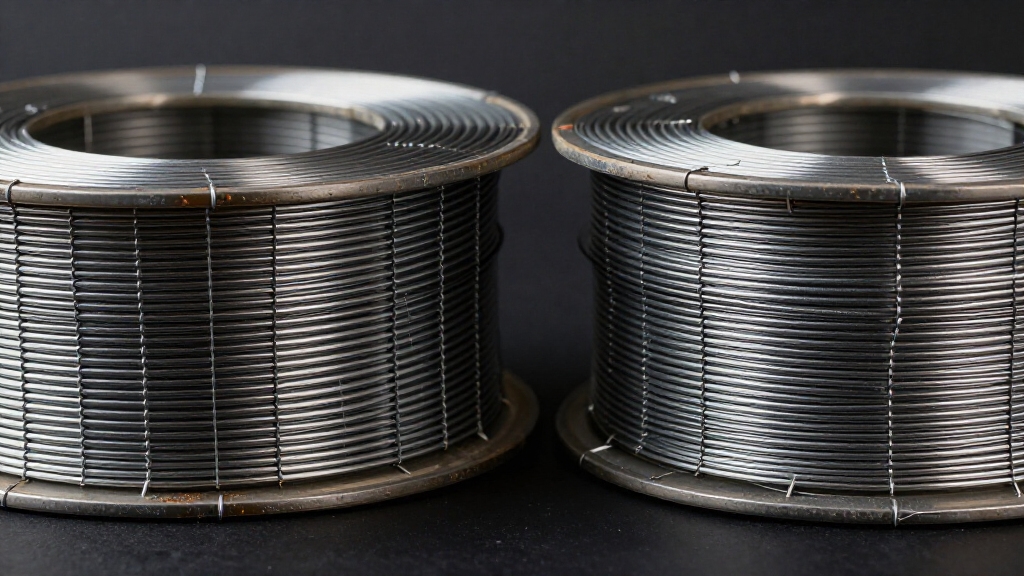
Understanding how welded and woven wire are made is key to grasping their differing performance characteristics.
Knowing the manufacturing differences of welded and woven wire reveals their unique performance traits.
When you examine welded wire, you’ll see that it forms a rigid grid by joining wires at each intersection with spot welds. This process results in uniform spacing and produces panels or rolls with fixed shapes.
In contrast, woven wire is created by interlacing or twisting wires over and under without welding, forming mechanically connected joints. These interlocked joints remain flexible rather than fused, allowing the wire to move slightly under stress.
This fundamental difference in joint construction governs how each wire behaves under load, impacting their rigidity, durability, and application suitability.
You’ll find that welded wire emphasizes structural integrity, while woven wire prioritizes mechanical flexibility.
Additionally, choosing between welded and woven wire often depends on factors like corrosion resistance, with galvanized or vinyl-coated welded wire offering enhanced durability in outdoor environments.
When it comes to wire, welded wire really shines in terms of strength and rigidity. It holds its shape well under load, which is great, but there’s a catch: if you put it under really heavy stress, the weld points can end up permanently deformed.
On the flip side, we’ve woven wire, which is all about flexibility. It can easily adapt to uneven terrain and does a fantastic job of absorbing impacts. This is because it distributes the force across its interlaced strands, making it a solid choice for dynamic situations.
Now, when we talk about long-term durability, each type of wire reacts differently to repeated stress and environmental factors. That’s something to keep in mind, as it can really influence where each type is best suited for use.
Welded wire is typically secured to posts at multiple heights using clips, ties, or staples to maintain tension and prevent sagging, which enhances its overall performance and longevity.
When comparing strength and rigidity, welded wire provides a high level of structural stiffness by securely fusing each intersection with spot welds. This ensures the grid maintains its shape under load.
This fixed grid design allows welded wire to resist deformation effectively, making it ideal when you need a rigid barrier or reinforcement. However, the concentrated stress at weld points means it can permanently deform under heavy impact.
In contrast, woven wire spreads force across flexible interlocked strands. This enhances durability in dynamic conditions but reduces overall rigidity.
Consider these factors:
Welded wire offers superior shape retention under static loads.
Woven wire excels in impact absorption due to flexible joints.
Heavy forces may cause welded wire welds to fail or deform permanently.
Proper weld strength depends on factors like weld size, throat area, and loading direction, which influence how well welded wire can withstand applied stresses and avoid failure at weld points weld strength factors.
Understanding these differences helps you select the appropriate wire for your application.
Although welded wire guarantees a rigid, fixed structure, it lacks the flexibility needed to conform to uneven terrain or curved surfaces. When you work on sloped or irregular ground, woven wire outperforms by bending and adapting without losing integrity.
Welded wire panels resist deformation but struggle with grade changes, making them suitable only for flat, controlled environments.
| Property | Welded Wire | Woven Wire |
|---|---|---|
| Flexibility | Low, rigid fixed grid | High, interlaced springy |
| Terrain Adaptation | Poor, limited to flat ground | Excellent, conforms to slopes |
| Shape Retention | High, maintains form | Moderate, can flex and rebound |
| Stress Distribution | Concentrated at welds | Spread across strands |
| Application Focus | Security, reinforcement | Impact resistance, uneven terrain |
For applications requiring enhanced durability and strength, choosing the right pipe dimensions and wall thickness is essential to ensure long-lasting performance.
Because long-term durability hinges on the joint design and material response to stress, welded and woven wires exhibit distinct failure behaviors under repeated load and environmental exposure.
Welded wire is rigid with fixed spot welds that maintain shape but may fail at weld points from cyclic stress or corrosion.
Woven wire, lacking welds, flexes under load, distributing stress and reducing localized failures, but it can unravel if cut.
Consider these factors:
Welded wire resists permanent deformation but is vulnerable to weld fatigue and early rust at joints.
Woven wire endures flexing and impact better, with no heat-affected zone, enhancing resilience.
Woven wire’s mechanical joints favor longevity in dynamic or uneven environments, while welded wire suits static settings needing shape retention.
Choose based on your application’s stress profile and environmental conditions.
Proper installation techniques, including tensioning process and brace selection, are critical to maximizing the durability of welded wire fences.
Handling uneven terrain and withstanding impact demands specific wire characteristics that influence performance and longevity.
Woven wire excels in flexibility, adapting to slopes and uneven ground by bending and springing back under pressure. Welded wire, however, maintains a rigid shape, making it less forgiving on rough terrain but ideal for flat, controlled installations.
When impact occurs, woven wire distributes force across flexible joints, reducing permanent deformation. Welded wire concentrates stress at weld points, risking permanent bends.
In applications requiring durable frames that resist twisting and warping, using rectangular or square tubing materials can complement welded wire’s rigidity for enhanced structural integrity.
| Terrain Adaptability | Impact Resistance | Shape Retention |
|---|---|---|
| Woven wire: High | Woven wire: Flexible | Welded wire: Rigid |
| Welded wire: Low | Welded wire: Concentrated stress | Woven wire: Flexible |
| Bends easily | Springs back | Fixed grid |
| Adapts to slopes | Absorbs shock | Maintains form |
| Ideal for uneven ground | Resists repeated flex | Best for flat terrain |
Sure! Here’s a more conversational version of the text:
You might notice that welded wire often has a tendency to fail right at the weld points when it’s under repeated stress. This creates weak spots that are more likely to crack. On the other hand, woven wire behaves a bit differently. If it gets cut, it can unravel since its strands rely on mechanical interlocking instead of being fused together.
And let’s not forget about environmental factors! Rust can really affect those welded wire welds, especially in outdoor settings. This can influence the wire’s long-term durability, making it something to keep in mind when you’re choosing between the two options. Additionally, using low-hydrogen electrodes during welding can help reduce cracking and improve weld strength in carbon steel wire applications.
Although welded wire offers excellent shape retention and rigidity, its durability has specific weaknesses you should consider.
The fixed weld points provide structural stiffness but create stress concentration zones vulnerable to fatigue and failure under repeated flexing or heavy impact. Over time, these welds may crack or separate, compromising the wire’s integrity.
Additionally, welded wire tends to rust faster at the welds, especially in outdoor environments, accelerating deterioration.
Key weaknesses include:
These issues are often exacerbated by porosity, which introduces internal voids that weaken the weld’s structural integrity.
Understanding these limitations helps you choose welded wire appropriately for applications demanding rigidity over flexibility.
Woven wire’s interlaced construction allows it to flex under pressure, but this design also introduces a key durability concern: unraveling.
Since woven wire relies on mechanical interlocking rather than fused joints, cutting or breaking a strand can cause adjacent wires to loosen and progressively separate.
This unraveling behavior compromises the mesh’s integrity, reducing its load-bearing capacity and structural cohesion over time.
Unlike welded wire, which maintains edge stability after cuts, woven wire demands careful handling to avoid initiating failure points.
However, woven wire’s lack of heat-affected welds eliminates a common corrosion and brittleness issue seen in welded joints.
To mitigate unraveling, you must ensure proper edge reinforcement or use specialized locking techniques, especially in applications subject to frequent mechanical stress or cutting.
Proper surface preparation and reinforcement techniques, such as using metal mesh reinforcement, can improve repair strength and durability in woven wire applications.
When exposed to environmental factors, both welded and woven wire face distinct durability challenges that influence their failure modes. You’ll notice welded wire often corrodes faster at weld points since these heat-affected zones are prone to rust, especially outdoors.
On the other hand, woven wire avoids weld-related corrosion but can unravel if cut, compromising structural integrity.
Consider these key environmental impact effects:
Welded wire’s fixed joints concentrate stress, making it vulnerable to fatigue cracks under repeated loading or weather cycles.
Woven wire’s flexible interlacing distributes stress, enhancing resistance to impact but risking strand slippage or unraveling over time.
Moisture and temperature fluctuations accelerate corrosion in welded wire welds. In contrast, woven wire’s mechanical joints better tolerate thermal expansion.
Using appropriate low-hydrogen electrodes during welding can improve structural toughness and reduce cracking, enhancing durability in harsh environments.
Understanding these effects helps you select the right wire type for durable, long-lasting applications.
Picking the right wire depends heavily on the specific demands of your project and environment.
If you require a rigid, stable structure such as security barriers, animal cages, or concrete reinforcement, welded wire is ideal due to its fixed grid and high structural rigidity.
Conversely, when flexibility and adaptability to uneven terrain matter, woven wire excels because its interlaced design absorbs impact and conforms to irregular surfaces without permanent deformation.
For applications needing fine mesh or precision screening, woven wire’s ability to provide small apertures and mechanical joint resilience is advantageous.
Consider the mechanical stresses and environmental conditions your installation will face.
Welded wire maintains shape under load but may fail at weld points under repeated stress.
Woven wire resists fatigue through flexible joints but risks unraveling if cut.
Your choice hinges on balancing rigidity, flexibility, and durability requirements.
Although cost often drives material selection, understanding size options and installation nuances is equally crucial for optimizing performance and efficiency.
Welded wire typically costs less due to simpler manufacturing and comes in uniform panels or rolls, easing handling and installation.
Welded wire’s simpler production makes it more affordable and convenient with uniform panels or rolls for easy installation.
Woven wire, while pricier, offers finer aperture ranges and better flexibility for irregular terrain or impact resistance.
When installing, keep these tips in mind:
Choose welded wire for flat, controlled surfaces to maintain rigidity and shape.
Opt for woven wire when working on uneven ground or requiring mesh precision.
Secure cut ends of woven wire carefully to prevent unraveling.
Balancing cost with application requirements guarantees you select the appropriate wire type for durability and installation ease.
You’ll find welded wire easier to recycle because its fixed, rigid grid doesn’t unravel, simplifying handling and processing.
Woven wire’s interlaced strands can come apart when cut, complicating collection and sorting.
Although both are metal-based and recyclable, welded wire’s spot-welded joints reduce material loss and contamination risk during recycling.
You’ll find welded wire better for DIY home projects if you need rigid, easy-to-handle panels that maintain shape under load.
It’s simpler to cut and install, making it ideal for fences, cages, or plant supports.
However, if your project requires flexibility to contour uneven surfaces or absorb impact, woven wire suits you better despite higher cost and complexity.
Choose based on rigidity versus adaptability needs in your project.
Oh, sure, just melt and fuse your way to environmental bliss!
Welding demands energy-intensive heat, boosting carbon footprints and releasing pollutants.
Weaving, though less thermally taxing, involves complex machinery that sips electricity and churns out waste fibers.
So, if you’re eco-conscious, remember: welding’s high-energy sparks clash with green ideals, while weaving’s mechanical dance quietly conserves but isn’t entirely guilt-free.
Choose wisely; both leave a trace in Earth’s ledger.
You’ll find welded wire maintains structural integrity better in extreme cold due to its rigidity. However, weld points can corrode faster in wet, salty environments.
Woven wire, with flexible joints, adapts to thermal expansion and contraction without cracking. This makes it more resilient under fluctuating temperatures and repeated stress.
However, it risks unraveling if damaged. In harsh weather, choose welded for static strength and woven for durability under dynamic environmental forces.
You can custom fabricate both wire types for unusual shapes, but woven wire offers greater flexibility. Its interlaced strands bend and adapt smoothly to complex curves or irregular forms without breaking.
Welded wire, being rigid, requires careful cutting and bending and may risk joint damage or permanent deformation.
When choosing between welded and woven wire, consider strength versus flexibility, terrain adaptability versus impact resistance, and durability versus failure modes.
Welded wire offers rigid support and easy installation, while woven wire provides greater flexibility and resilience.
Match your wire choice to your specific application, budget, and size needs.
By weighing these factors carefully, you’ll guarantee peak performance, longevity, and cost-efficiency in your fencing or reinforcement project.