Phone:
(701)814-6992
Physical address:
6296 Donnelly Plaza
Ratkeville, Bahamas.

Phone:
(701)814-6992
Physical address:
6296 Donnelly Plaza
Ratkeville, Bahamas.

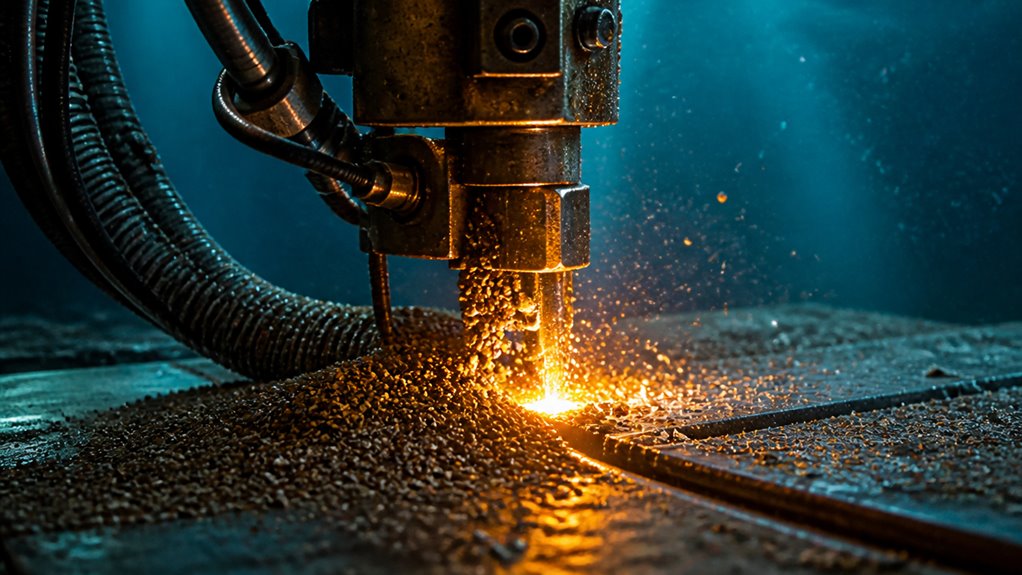
A Sub Arc Welder uses submerged arc welding to deliver deep, consistent welds by feeding a continuous wire electrode beneath a protective flux layer.
You’ll get stable high-current arcs with minimal spatter, sparks, or fumes. The flux shields the weld pool from contamination while enabling precise control of heat and deposition rates.
This makes it ideal for thick steel plates in flat or horizontal positions. If you want to understand its components, applications, and limitations, there’s more to explore.
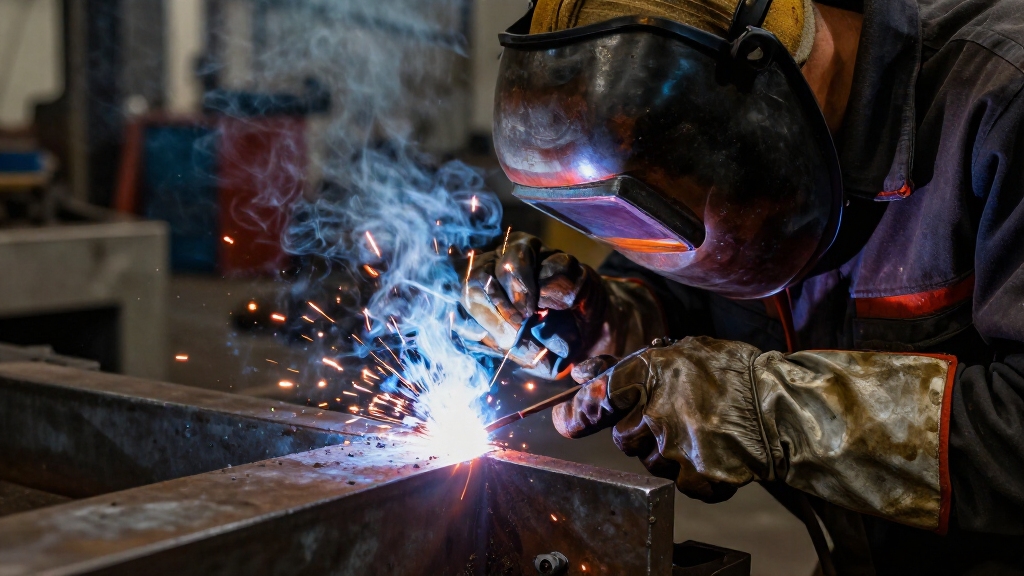
Understanding what a sub arc welder entails starts with recognizing it as a machine used in submerged arc welding (SAW).
A sub arc welder is a machine designed specifically for submerged arc welding (SAW).
In this process, a continuously fed wire electrode generates an electric arc beneath a protective granular flux layer.
You feed the wire into the joint while the flux powder covers the weld path, melting to form a slag that shields the weld pool from atmospheric contamination.
This slag also helps conduct current between the electrode and workpiece, eliminating the need for external shielding gas.
The arc remains submerged under the flux, reducing visible light, sparks, and fumes.
This method guarantees deep penetration and consistent weld quality, especially on thick materials, by maintaining a stable, high-current arc in a controlled, self-shielded environment.
The flux blanket also stabilizes the arc and provides thermal insulation, promoting efficient metal fusion and minimizing spatter.
Setting up a sub arc welder? You’ll want to start with a reliable wire electrode feed. This part is super important because it continuously supplies the consumable electrode and gives you precise control over the process.
Next up, let’s talk about the flux delivery system. This system needs to accurately deposit granular flux, which helps maintain that protective blanket over the arc and the weld pool. It’s all about keeping everything safe and sound while you work.
Finally, don’t forget about the power supply unit. It’s crucial for delivering a stable current to keep the submerged arc going strong. Consistent penetration is key, and a good power supply will make sure you get that every time.
Additionally, the wire feeding mechanism ensures a continuous feed to maintain a consistent arc length and steady deposition rate throughout the welding process.
The wire electrode feed system forms the backbone of a submerged arc welder, continuously delivering the consumable electrode into the weld zone with precise control.
You rely on a motorized drive mechanism to push the wire at a consistent speed, ensuring stable arc length and ideal penetration.
The feed rate directly influences deposition rate and weld quality, so fine adjustments are critical.
The system typically includes wire guides and tension controls to prevent feed interruptions or wire deformation.
Proper synchronization between wire feed speed and welding current is essential to maintain arc stability and prevent defects.
As you operate, monitoring the feed mechanism’s performance helps avoid common issues like wire slipping or jamming, which can compromise weld integrity and process efficiency.
Additionally, selecting the correct wire electrode diameter is crucial to optimize deposition rate and penetration for different material thicknesses.
Alongside the wire electrode feed, the flux delivery system plays an essential role in maintaining the submerged arc welding environment.
It precisely deposits granular flux over the weld path, ensuring the arc remains shielded from atmospheric contamination. You’ll rely on an efficient flux hopper and controlled feeding mechanism to maintain consistent coverage. This is critical to slag formation and weld quality.
| Component | Function | Importance |
|---|---|---|
| Flux Hopper | Stores and supplies flux | Continuous flux feed |
| Feed Mechanism | Controls flux flow rate | Ensures consistent flux layer |
| Distribution Nozzle | Directs flux to weld zone | Maintains arc coverage |
| Recovery System | Collects unused flux | Reduces waste, cost efficiency |
This system optimizes arc stability and weld integrity by supplying flux precisely where needed. Proper coordination of the flux delivery with the wire feed mechanism is essential to prevent interruptions and maintain consistent weld quality.
Power supply units drive the submerged arc welding process by delivering a stable and controllable current essential for arc formation and weld penetration.
You rely on either a constant voltage (CV) or constant current (CC) power source, with CV being more common to maintain arc stability during continuous wire feed.
The power supply must handle high amperage demands, often ranging from hundreds to thousands of amps, depending on the application.
It provides direct current (DC) typically, as DC guarantees deeper penetration and consistent arc characteristics.
You also need to adjust voltage and current precisely to match the wire feed speed and base material thickness.
The power supply’s robustness directly influences weld quality, deposition rate, and overall process efficiency in submerged arc welding setups.
Additionally, the use of a granular flux layer in SAW shields the molten weld pool, reducing contamination and improving weld integrity.
Materials suited for submerged arc welding (SAW) primarily include thick steel plates, as the process excels at handling heavy, high-strength metals with deep penetration requirements.
You’ll find SAW most effective on carbon steel, low alloy steel, and certain stainless steels, where its high deposition rates and flux shielding optimize weld integrity.
The process is ideal for butt, groove, and fillet joints, especially those with simple geometries and long, straight weld paths.
You should avoid complex joint configurations or thin materials, as SAW’s flux and arc characteristics limit its adaptability.
SAW’s limitation to flat or horizontal positions further confines its joint suitability, so you’ll typically apply it to structural steel fabrication, pressure vessels, and heavy plate welding where joint access and orientation are controlled.
Precise control of current, pressure, and timing is essential in electric welding processes to ensure consistent weld quality and avoid defects.
The controlled environment created by the flux blanket in submerged arc welding markedly contributes to the superior quality of welds. This flux layer shields the molten weld pool from atmospheric gases such as oxygen and nitrogen, preventing contamination and reducing porosity.
You benefit from a slag layer that stabilizes the arc and controls cooling rates. This promotes a refined microstructure and reduces weld defects. The continuous wire feed and consistent current guarantee uniform heat input, resulting in deep penetration and strong fusion.
Additionally, the molten flux’s conductivity maintains stable arc characteristics, minimizing spatter and undercut. This precise thermal and chemical control allows you to achieve high repeatability and mechanical integrity in heavy-duty applications. This makes SAW a preferred method for producing robust, defect-free welds on thick materials.
Controlling heat input and welding parameters is essential to manage the heat-affected zone (HAZ) and ensure joint integrity in fusion welding processes.
Submerged arc welding is a go-to method in structural steel fabrication. It’s really impressive how it can create deep, consistent welds on thick plates, ensuring strong structures.
Then, when we look at shipbuilding, it shines even brighter. The high deposition rates and the protective slag make it super efficient for joining large hull components, and the best part? It does this with minimal defects, which is crucial in that industry.
And let’s not forget about pressure vessel manufacturing. This process is vital here too, thanks to its precision and ability to tackle heavy-duty welds, all while meeting those stringent quality standards. It really covers all bases!
Its ability to deliver high deposition efficiency and deep penetration makes it ideal for welding very thick low-carbon steel sections.
Structural steel fabrication demands welding processes that combine strength, precision, and efficiency. Submerged arc welding (SAW) reliably delivers these qualities.
When you use SAW in this setting, you benefit from its high deposition rates and deep penetration. This guarantees robust joints in thick steel plates.
Its flux blanket shields the weld pool from atmospheric contamination. This maintains weld integrity and reduces defects.
You’ll appreciate the process’s automation compatibility, allowing consistent, repeatable welds across large structural components.
However, keep in mind SAW’s limitation to primarily flat or horizontal positions. This suits the mainly planar joints typical in structural fabrication.
For applications involving thinner materials or root passes, alternative processes like Regulated Metal Deposition offer precise control and reduced spatter to enhance weld quality.
When working on shipbuilding projects, submerged arc welding (SAW) stands out for its ability to produce strong, high-quality welds on thick steel sections.
You rely on SAW’s consistent penetration and high deposition rates to efficiently join large hull plates and structural components.
The granular flux blanket shields the weld pool from atmospheric contamination, ensuring weld integrity essential for marine environments.
Because shipbuilding demands long, straight welds on flat or horizontal surfaces, SAW’s process limitations align well with your fabrication needs.
Additionally, automation compatibility boosts productivity and repeatability during repetitive weld runs.
Though you won’t use SAW for complex joint geometries or delicate parts, its precision and robust welds make it ideal for constructing durable, heavy-duty ship structures that must withstand harsh operational stresses.
Proper equipment setup and safety measures are essential to achieve consistent quality and protect welders during the SAW process.
Fabricating pressure vessels demands welding methods that guarantee high strength, leak-tight joints, and consistent quality under intense operating conditions.
Submerged arc welding (SAW) suits this task perfectly due to its deep penetration and high deposition rates. When you use SAW in pressure vessel manufacturing, you:
Although submerged arc welding (SAW) offers exceptional efficiency and quality for heavy fabrication, it comes with several practical limitations you need to take into account.
SAW is largely restricted to flat or horizontal welding positions, limiting your ability to work on vertical or overhead joints.
Submerged arc welding mainly works on flat or horizontal positions, restricting vertical and overhead applications.
The process suits long, straight welds rather than complex or contoured geometries, so you’ll find it less versatile for intricate assemblies.
Handling flux and specialized equipment confines SAW to industrial environments, making it impractical for small-scale or field repairs.
Additionally, since the arc and weld pool remain submerged beneath flux, you can’t directly visually monitor the weld zone during operation.
This requires you to rely on indirect cues and instrumentation.
Finally, SAW isn’t effective on thin or delicate materials, as its high heat input risks distortion or burn-through.
The limitations in positioning and complexity inherent to submerged arc welding have driven significant advances in automation to optimize its use in industrial fabrication.
As you engage with SAW, automation enhances precision, repeatability, and efficiency while mitigating human error.
Key technological trends shaping its future include:
To prepare flux for submerged arc welding, you first make certain it’s dry and free of moisture by drying it at recommended temperatures, typically around 230–260°C.
Then, sift the flux to remove contaminants and achieve uniform granule size.
Store it in sealed containers to prevent humidity absorption.
Before welding, you calibrate flux feed rates for consistent coverage.
Proper preparation guarantees stable arc conditions, ideal slag formation, and high-quality welds.
Think of submerged arc welding safety as your armor in a battlefield. You must wear flame-resistant clothing, gloves, and a welding helmet with appropriate shading to protect against intense heat and UV radiation.
Make certain proper ventilation to avoid inhaling flux fumes and dust. Keep your workspace dry to prevent electrical hazards. Always follow equipment guidelines and never bypass safety interlocks.
These precautions shield you from the hidden dangers beneath the flux blanket.
You generally won’t use submerged arc welding on non-ferrous metals because the process is optimized for ferrous materials like steel.
The flux chemistry and arc characteristics don’t suit metals like aluminum or copper, which require different shielding and electrode types.
While theoretically possible with specialized flux and electrodes, it’s impractical and uncommon.
You’ll find SAW most effective on thick steel components, not on non-ferrous or thin materials.
Imagine scraping ice off your windshield. The slag on a submerged arc weld is similar, solidified and protective but needs removal.
You remove slag after submerged arc welding by using a chipping hammer or wire brush to chip away the hardened flux layer. This exposes the clean weld beneath, ensuring inspection and further processing.
Proper slag removal maintains weld quality and prevents defects like inclusions or surface irregularities.
You’ll need to regularly clean the flux delivery and recovery systems to prevent clogging.
Inspect and maintain the wire feeder and drive rolls to guarantee smooth electrode feeding.
Check electrical connections and cables for wear or damage.
Calibrate voltage and current settings frequently for welding accuracy.
Also, clean the welding head and check cooling systems to avoid overheating.
Proper lubrication of moving parts keeps the machine operating efficiently and prolongs its service life.
Now that you understand what a sub arc welder is and how it operates, you’re equipped to appreciate its precision and efficiency.
While it isn’t a one-size-fits-all solution, its ability to deliver high-quality welds consistently makes it a valuable tool in many industries.
Don’t put all your eggs in one basket; consider its specific applications and limitations carefully to maximize your welding outcomes and stay ahead in this evolving field.
[…] processes such as submerged arc welding, FSW does not require a flux blanket or continuous wire feed, simplifying the welding setup and […]