Phone:
(701)814-6992
Physical address:
6296 Donnelly Plaza
Ratkeville, Bahamas.

Phone:
(701)814-6992
Physical address:
6296 Donnelly Plaza
Ratkeville, Bahamas.

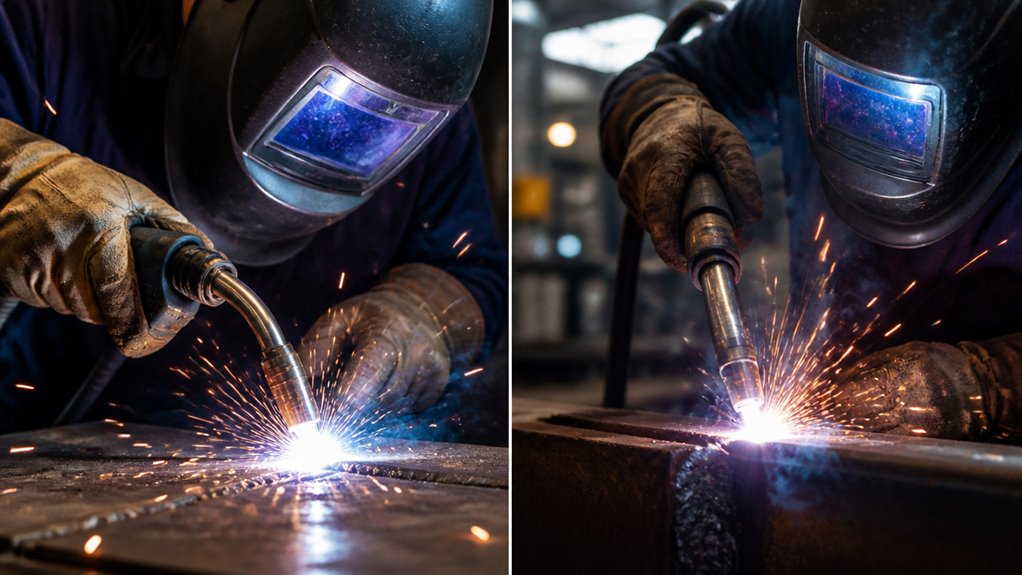
You’ll find that Gas Metal Arc Welding (GMAW) and Flux-Cored Arc Welding (FCAW) are the two primary semiautomatic welding processes.
Both combine manual torch control with automated wire feeding for precision and efficiency.
GMAW uses an external shielding gas and suits thinner metals.
FCAW relies on a flux core for shielding, excelling outdoors and with thicker materials.
Understanding these distinctions helps optimize welding quality and productivity in various industrial settings.
Explore further to see which process fits your application best.
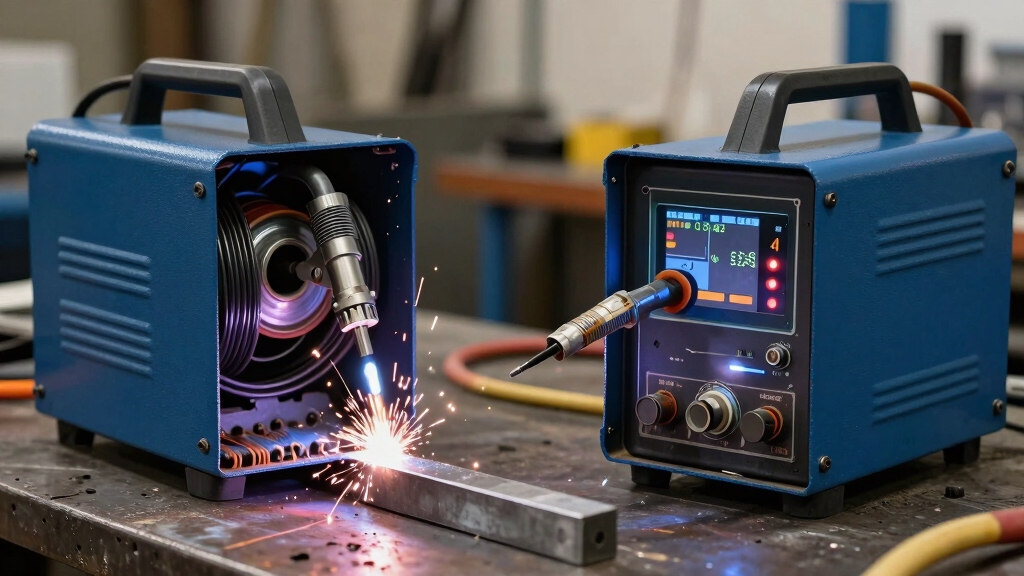
When you look into semiautomatic welding processes, you’ll find they combine manual skill with automated control to boost efficiency and consistency.
In these processes, the equipment automatically feeds the wire or filler material while you manually control the torch’s position and movement.
This hybrid approach defines semiautomatic welding as manual welding enhanced by automated welding conditions.
It balances your expertise with machine consistency, improving speed and precision over fully manual methods.
Common examples include Gas Metal Arc Welding (GMAW) and Flux-Cored Arc Welding (FCAW), where the electrode wire is continuously fed to the arc.
Semiautomatic welding is widely used in industrial applications like automotive and structural fabrication because it offers faster operation and cleaner welds while maintaining your direct control over the welding path.
A key component in these processes is the wire feed mechanism, which ensures consistent feed rate essential for stable arc conditions and uniform deposition.
In semiautomatic GMAW, you get to control the torch while the equipment takes care of feeding a continuous wire electrode. This setup helps maintain a stable arc, which is pretty crucial for a successful weld.
Now, let’s talk about the shielding gas. It flows around the weld pool, acting like a protective shield. This protects the weld from contamination and ensures that you end up with a strong, reliable joint.
The power source also regulates the wire feed and arc length to ensure consistent heat input and optimal welding performance.
The wire feed mechanism drives a continuous wire electrode through the welding gun at a controlled speed, maintaining a stable arc in Gas Metal Arc Welding (GMAW).
You’ll find a motorized drive roll assembly that grips and pushes the wire from the spool, feeding it steadily into the weld pool.
Adjusting the feed speed directly influences the welding current and deposition rate, so precise control is critical.
The mechanism includes tensioners to prevent wire slip or tangling and guide tubes to guarantee smooth delivery to the contact tip.
As you operate the gun manually, the automated wire feed guarantees consistent material supply, reducing arc interruptions.
This integration of manual torch control with automated wire feeding optimizes welding efficiency and weld quality in semiautomatic GMAW.
Spools can hold approximately one mile of wire, minimizing reload frequency and supporting uninterrupted welding cycles.
Alongside the automated wire feed, shielding gas plays a pivotal role in Gas Metal Arc Welding (GMAW) by protecting the weld pool from atmospheric contamination.
It prevents oxygen, nitrogen, and hydrogen from reacting with molten metal, which could cause porosity and weld defects. You control the torch, but the shielding gas guarantees a clean, stable arc and strong welds.
Proper selection and control of gas blends, such as argon+CO₂ mixtures, help reduce spatter and improve weld appearance while maintaining penetration.
| Shielding Gas Type | Role in Welding |
|---|---|
| Argon | Provides inert atmosphere, stabilizes arc |
| CO₂ | Adds heat, deeper penetration |
| Argon + CO₂ Mix | Balances arc stability and penetration |
Choosing the right gas mix impacts weld quality and process efficiency directly in semiautomatic GMAW.
When you’re using FCAW in semiautomatic welding, the tubular flux core electrode is super important. It helps stabilize the arc and gives you that necessary slag protection. You’ll also find that an automatic wire feeding mechanism is in play, which makes sure you get consistent deposition rates and smooth operation.
Now, let’s talk about something else that matters: the differences between self-shielded and gas-shielded variants. Understanding these will help you choose the right shielding method based on your environment and the specific application you’re working on. It’s all about making the right choices for the best results!
The flux core process offers high deposition rates even on contaminated surfaces, making it highly efficient for various welding tasks.
Flux core electrodes combine a tubular metal sheath filled with flux to guarantee efficient welding in semiautomatic processes.
This design allows the electrode to serve both as a filler metal and a source of shielding agents, which protect the weld pool from atmospheric contamination.
The flux core generates slag and gas upon melting, providing a self-shielding effect or supplementing external shielding gas, depending on the electrode type.
You’ll find two main variations: self-shielded electrodes for outdoor or windy conditions and gas-shielded electrodes for cleaner welds indoors.
The tubular construction guarantees a continuous feed of both metal and flux, supporting high deposition rates and consistent arc stability.
Understanding this electrode design helps you optimize weld quality and adapt to different environmental challenges in FCAW.
Self-shielded wires are especially advantageous in windy environments where external gas shielding is impractical.
Understanding the wire feeding mechanism is essential to mastering how Flux-Cored Arc Welding (FCAW) operates in semiautomatic welding.
In FCAW, a motorized wire feeder continuously supplies the flux-cored electrode through a drive roll system. This maintains consistent feed rates controlled by the welder.
You adjust the feed speed to match welding parameters, ensuring stable arc performance and optimal deposition rates. The wire feeding mechanism works in tandem with the welding power source, delivering a steady electrode to the arc.
You manually guide the torch along the joint. This automation reduces wire burnback and enhances weld quality by providing uniform filler metal delivery.
The drive rolls must be compatible with tubular flux-filled wire to prevent crushing and ensure smooth wire feeding.
Semiautomatic welding processes often rely on two primary shielding variants in FCAW: self-shielded and gas-shielded.
In self-shielded FCAW, the wire’s flux core generates protective gases and slag, eliminating the need for an external shielding gas. This makes it ideal for outdoor or windy environments where gas shielding might be compromised.
Gas-shielded FCAW uses an external inert or semi-inert gas to protect the weld pool, offering cleaner welds with less slag and spatter.
You’ll find gas-shielded FCAW better suited for controlled indoor conditions, providing higher weld quality and ease of slag removal.
Both variants use an automatic wire feed, but your choice depends on environmental factors, material thickness, and desired weld finish.
Understanding these differences helps optimize semiautomatic FCAW applications efficiently.
The flux composition in self-shielded FCAW provides excellent arc stability and low spatter, enhancing weld quality in challenging environments.
While both Gas Metal Arc Welding (GMAW) and Flux-Cored Arc Welding (FCAW) automate wire feeding, they differ significantly in shielding methods and application environments.
GMAW uses external shielding gas, making it ideal for controlled indoor settings. In contrast, FCAW relies on flux inside the wire, allowing for self-shielding and better performance outdoors or in windy conditions.
Here are three key differences to note:
Understanding these distinctions helps you select the right semiautomatic process for your welding needs. Always ensure proper ventilation and use appropriate safety gear to reduce exposure to harmful fumes during welding.
Choosing between GMAW and FCAW depends largely on your project’s environment and material requirements. Both methods bring significant advantages to industrial welding.
You gain faster deposition rates compared to fully manual welding, increasing your productivity without sacrificing weld quality. Semiautomatic processes offer consistent wire feed and stable arc conditions, reducing defects and rework.
You maintain control over torch positioning, allowing precise weld placement essential for complex joints. Additionally, these methods minimize operator fatigue by automating repetitive tasks, improving safety and efficiency.
GMAW provides cleaner welds with minimal post-weld cleanup. In contrast, FCAW excels in outdoor or windy environments due to its flux core shielding.
Ultimately, semiautomatic welding balances automation and human skill, delivering reliable, cost-effective results suited for diverse industrial applications.
GMAW and FCAW welding processes serve a wide range of industries, thanks to their adaptability and efficiency. You’ll find these semiautomatic methods ideal for applications demanding speed, consistency, and quality welds.
Here are three common applications where you can apply GMAW and FCAW effectively:
Both methods benefit from continuous wire feed and shielding gas, enabling semi-automatic operation that reduces spatter and cleanup time.
Several factors will guide your decision between FCAW and MIG semiautomatic welding methods.
Consider the environment first: FCAW, with its flux-cored wire, excels outdoors or in windy conditions where shielding gas may dissipate.
MIG requires a stable gas shield, making it better suited for controlled indoor settings.
Material thickness also matters. FCAW supports higher deposition rates ideal for thicker metals, while MIG offers cleaner welds for thin to medium gauges.
Additionally, evaluate post-weld cleanup. MIG produces less slag, reducing finishing time.
Productivity needs and equipment costs factor in as well. FCAW often yields faster welds but may require more cleanup.
You need to wear proper PPE, including a welding helmet with the correct shade, gloves, and flame-resistant clothing.
Make sure good ventilation to avoid harmful fumes from the wire feed and flux core.
Keep a fire extinguisher nearby and clear flammable materials.
Always check equipment for damage before use and ground the workpiece properly.
Maintain awareness of your surroundings to prevent accidents from sparks and hot metal during semiautomatic welding.
Think of wire feed speed as the heartbeat of your weld. If it races or slows too much, your weld’s quality suffers.
Too fast, and you risk spatter and weak fusion.
Too slow, and your weld bead becomes thin and porous.
You need to dial in the speed precisely to maintain stable arc conditions, ensuring consistent penetration and smooth bead formation.
Adjusting it correctly keeps your weld strong and visually sound.
You generally can’t use semiautomatic welding on non-metal materials because the processes rely on electric arcs and filler metals that bond metal surfaces.
These methods, like GMAW or FCAW, require conductive metals to create and maintain the arc.
For plastics or composites, you’d need specialized techniques like plastic welding or adhesive bonding since semiautomatic arc welding doesn’t suit non-metal substrates.
You need to regularly clean and inspect the wire feed system, including rollers and drive motor, to prevent jams.
Check and replace contact tips, nozzles, and liners as they wear to maintain consistent arc stability.
Make sure shielding gas flow is adequate and leak-free.
Lubricate moving parts per manufacturer guidelines.
Calibrate wire feed speed and voltage controls periodically.
Proper maintenance maximizes equipment reliability, weld quality, and extends service life.
Ambient temperature affects your semiautomatic welding by influencing wire feed consistency, arc stability, and shielding gas behavior.
Cold conditions can stiffen cables, slow wire feed, and cause gas density changes, leading to poor weld quality.
High heat increases wire softness, risking feed jams and altering gas flow.
You must adjust parameters, guarantee proper equipment warming, and monitor gas flow to maintain precise, stable welds regardless of temperature fluctuations.
When choosing semiautomatic welding, remember that “a stitch in time saves nine.”
Both GMAW and FCAW offer efficient, reliable options tailored to different materials and environments.
GMAW excels in clean conditions, while FCAW handles outdoor or dirty settings better.
By understanding their distinct benefits and applications, you’ll optimize your welding process, reduce downtime, and improve quality.
Semiautomatic welding truly bridges manual skill and automation for precise, consistent results.