Phone:
(701)814-6992
Physical address:
6296 Donnelly Plaza
Ratkeville, Bahamas.

Phone:
(701)814-6992
Physical address:
6296 Donnelly Plaza
Ratkeville, Bahamas.

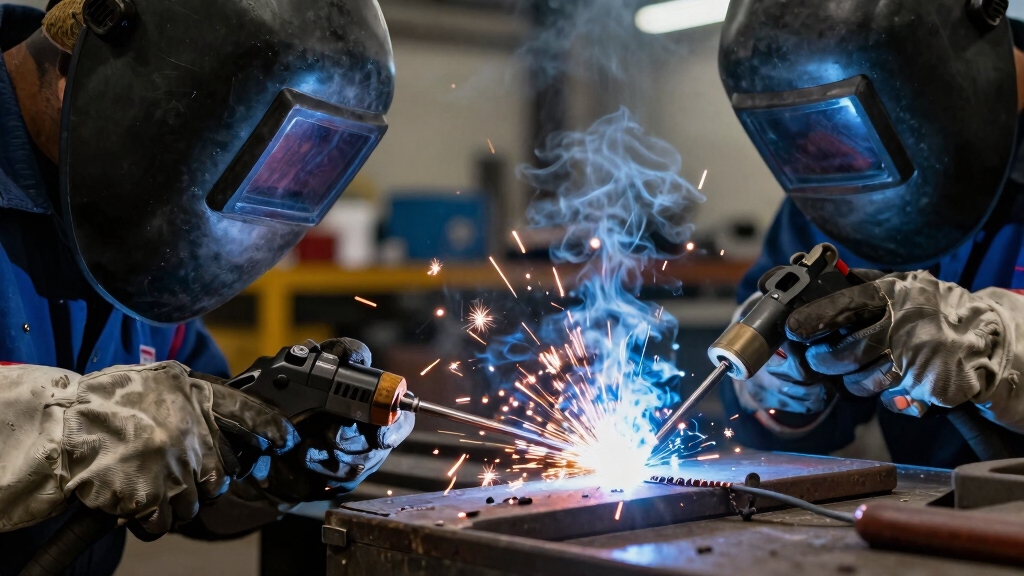
When choosing between flux core and MIG welding, consider your environment and material thickness.
Flux core uses tubular wire with internal flux, self-shields without external gas, and excels outdoors or on thicker metals.
It offers deeper penetration and higher deposition rates.
MIG employs solid wire and external gas, providing cleaner welds with less spatter.
It’s ideal for thin metals in controlled settings.
Operational complexity, cleanup, and cost trade-offs also influence your choice.
Explore further to understand which process suits your needs best.

| Feature | Flux Core Welding | MIG Welding |
|---|---|---|
| Wire Type | Tubular wire with internal flux | Solid wire with external shielding gas |
| Shielding Method | Self-shielding (no gas needed) | Requires external shielding gas |
| Weld Strength | Stronger penetration on thick metal | Smooth welds on thin metal |
| Welding Speed | Faster deposition rate | More controlled speed |
| Outdoor Performance | Excellent in windy conditions | Poor in wind without protection |
| Weld Appearance | More spatter and slag | Cleaner and smoother finish |
| Cleanup Required | More cleanup needed | Minimal cleanup |
| Best Metal Thickness | Thick steel and heavy-duty work | Thin sheet metal and precision jobs |
| Setup Cost | Lower initial cost | Higher due to gas cylinder setup |
| Best For | Outdoor repair and structural welding | Indoor fabrication and clean finishing |
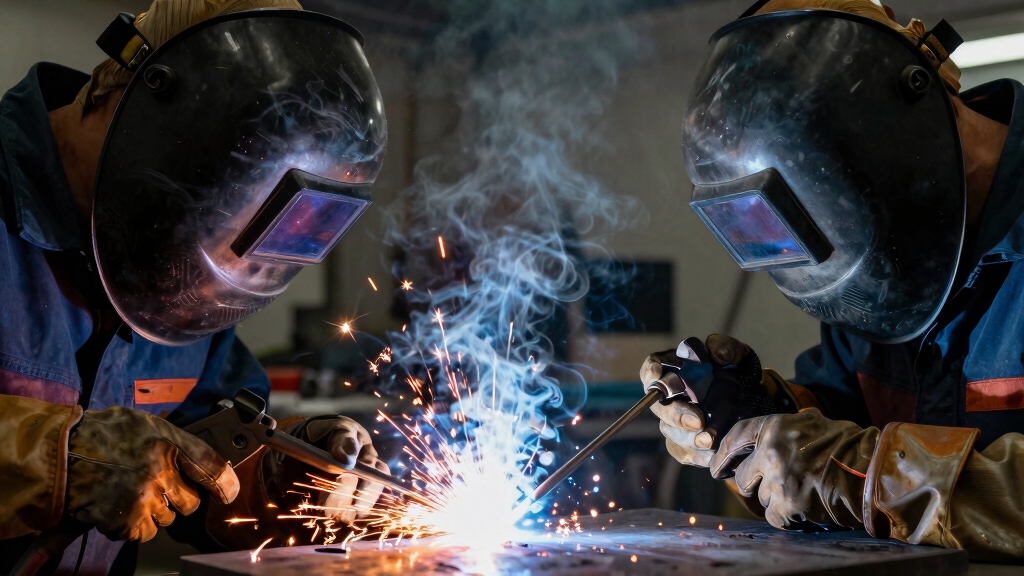
Although both flux core and MIG welding use wire-fed systems, their fundamental differences lie in wire composition and shielding methods. These differences directly affect performance and application.
You’ll find that MIG welding employs solid copper-plated wire, ensuring stable electrical conductivity and minimal oxidation. In contrast, flux core welding uses tubular wire filled with powdered flux, which produces its own shielding gas through arc-induced chemical reactions.
This distinction means you must use external shielding gas with MIG, while flux core eliminates that need. Additionally, flux core wire contributes extra steel to the weld, enhancing penetration and deposition rates.
These differences impact your choice based on environment, material thickness, and desired weld quality. It’s essential to understand wire construction when selecting between flux core and MIG welding.
Flux-cored wires are especially preferred for outdoor and windy conditions due to their self-shielding capabilities that eliminate the reliance on external gases.
How does shielding gas influence the performance and practicality of flux core versus MIG welding?
MIG welding demands an external shielding gas, typically a 75% argon and 25% carbon dioxide mix, to protect the molten weld pool from atmospheric contamination.
This requirement makes MIG welding sensitive to wind, as gas displacement can cause porosity, mandating controlled environments or windshields outdoors.
Conversely, flux core welding generates its own shielding flux internally through a chemical reaction, eliminating the need for external gas.
This self-shielding makes flux core welding more viable in outdoor and windy conditions, enhancing practicality.
However, reliance on shielding gas in MIG welding yields cleaner welds with minimal spatter.
In contrast, flux core’s flux produces more spatter and slag, necessitating additional cleanup despite its operational flexibility.
Selecting the appropriate gas mixture can further optimize weld quality by balancing penetration and spatter control.
Mastering the setup and operation of flux core and MIG welders requires understanding their distinct equipment configurations and welding techniques.
When setting up, you’ll configure polarity: flux core needs electrode negative, while MIG uses standard polarity.
Wire feed rolls differ too; solid wire for MIG, tubular flux core wire for the other.
Technique varies; you push the MIG torch but drag the flux core torch to ensure proper slag coverage.
This precision guarantees peak weld quality and equipment performance tailored to each process. Pulse MIG welding, with its precise heat input and controlled droplet transfer, can further enhance weld quality and reduce spatter compared to conventional MIG.
When evaluating welding methods for penetration and speed, flux core welding clearly stands out due to its enhanced sidewall penetration and superior deposition rates.
Its tubular wire, containing flux, creates a chemical shielding reaction that enables deeper weld pool fusion and faster metal deposition compared to MIG’s solid wire and external gas shielding.
This results in quicker welding cycles and stronger joints, especially on thicker materials.
MIG welding, while providing adequate penetration for thinner metals, generally delivers slower deposition rates and less robust sidewall fusion.
However, MIG’s smoother weld appearance often requires less cleanup.
Ultimately, if your priority is maximizing penetration and productivity, flux core welding offers a distinct advantage through higher deposition efficiency and better heat transfer during the welding process.
Proper wire feed speed adjustment in MIG welding is crucial to avoid spatter and ensure consistent weld quality.
Although both flux core and MIG welding share similar wire-fed mechanisms, their distinct characteristics make each method better suited for specific applications.
You’ll find flux core welding excels outdoors or in windy conditions, thanks to its self-shielding flux that eliminates the need for external gas.
MIG welding, with its solid wire and external gas shielding, works best indoors on thinner materials where clean, spatter-free welds are vital.
Consider these application points:
Use flux core welding for thick, hot rolled steel and outdoor repair work requiring deep penetration.
Opt for MIG welding when working on thin metals indoors, ensuring smooth welds with minimal cleanup.
Choose flux core for faster material deposition when production speed outweighs post-weld finishing.
Additionally, MIG welding provides precise control and repeatability for complex geometries and diverse thicknesses, making it ideal for projects requiring consistent quality.
Since weld quality directly impacts both the structural integrity and appearance of your project, understanding the differences between flux core and MIG welding is crucial.
MIG welding produces smooth, clean weld beads with minimal spatter, requiring little to no post-weld cleanup.
Flux core welding, however, generates considerably more spatter and leaves slag that you’ll need to chip away, increasing cleanup time.
The weld surface finish of MIG is superior, making it ideal when appearance matters.
Flux core excels in penetration and deposition rates but demands extra effort for slag removal.
Proper selection of shielding gas mixtures and welding parameters in MIG welding can significantly reduce spatter and improve overall weld quality.
| Aspect | MIG Welding | Flux Core Welding |
|---|---|---|
| Weld Bead | Smooth, clean | Spattered, slag-covered |
| Cleanup Needed | Minimal | Requires slag removal |
| Surface Finish | Superior | Rougher, less refined |
Understanding the cleanup demands of flux core versus MIG welding naturally leads to taking into account their cost and maintenance differences.
You’ll find flux core welding generally has higher wire costs due to the tubular flux-filled wire but saves money by eliminating the need for external shielding gas.
MIG welding requires purchasing and maintaining gas cylinders, adding to long-term expenses.
Maintenance-wise, flux core welders tend to accumulate more spatter on nozzles, requiring frequent cleaning or ceramic nozzle upgrades.
MIG setups demand more attention to gas flow systems and regulator upkeep to prevent leaks.
Flux core wire costs more but avoids gas bottle expenses.
MIG welding needs consistent gas supply and regulator maintenance.
Flux core equipment requires more frequent nozzle cleaning due to spatter buildup.
Choosing between them depends on balancing consumable costs against upkeep complexity.
Additionally, the shielding gases used in MIG welding provide a cleaner arc environment, which can improve weld quality but also increases system complexity.
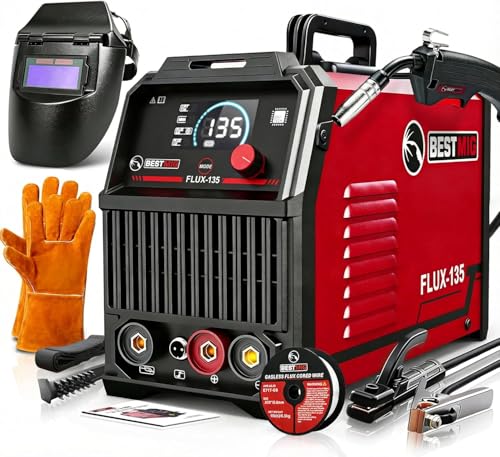
Yes, you can use flux core wire with standard MIG welding machines, but you’ll need to adjust your setup.
Switch your polarity to electrode negative (DCEN) and remove any shielding gas since flux core wire generates its own gas.
Also, use drive rolls compatible with tubular wire to prevent crushing.
You need to set your machine to electrode negative polarity (DCEN) for flux core welding.
Some welders adjust polarity automatically, but others require manual switching. This polarity guarantees proper arc stability and penetration by directing electrons from the workpiece to the electrode.
Using electrode positive polarity would cause excessive spatter and poor weld quality.
Always verify your machine’s polarity settings before starting flux core welding to maintain peak performance and weld consistency.
When welding outdoors, you know “a stitch in time saves nine.”
Wind disrupts the shielding gas in MIG welding, blowing it away from the weld pool.
This causes contamination, porosity, and weak welds.
You’ll need windshields or work in sheltered areas to maintain gas coverage.
Without proper shielding, your weld quality suffers substantially.
Controlling wind exposure is vital for consistent, structurally sound MIG welds in outdoor environments.
Flux core welding is called “gasless MIG” because you don’t need an external shielding gas.
The tubular wire contains powdered flux that produces shielding gas through a chemical reaction when heated.
This self-generated gas protects the weld pool from atmospheric contamination, eliminating the need for pressurized gas bottles.
This makes flux core welding more practical outdoors or in windy conditions, where maintaining external gas coverage would be difficult or costly.
You should use the drag technique when welding with flux core wire. This means you pull the torch backward, opposite the direction of travel, to guarantee proper slag coverage and penetration.
Dragging helps maintain a stable arc and controls spatter better. Unlike MIG welding, which typically uses a push technique, flux core demands this approach to achieve peak weld bead formation and proper slag entrapment.
This improves weld quality and strength.
Choosing between flux core and MIG welding is like picking the right tool from a craftsman’s belt. Each shines under specific conditions.
Flux core’s self-shielding acts like a portable fortress, ideal for outdoor work. MIG’s gas shield offers a cleaner, precise strike in controlled settings.
Understanding their distinct penetration, speed, and maintenance demands guarantees you wield the best method. This ensures you turn complex metal challenges into smooth, reliable welds every time.
Last update on 2026-10-20 / Affiliate links / Images from Amazon Product Advertising API