Phone:
(701)814-6992
Physical address:
6296 Donnelly Plaza
Ratkeville, Bahamas.

Phone:
(701)814-6992
Physical address:
6296 Donnelly Plaza
Ratkeville, Bahamas.

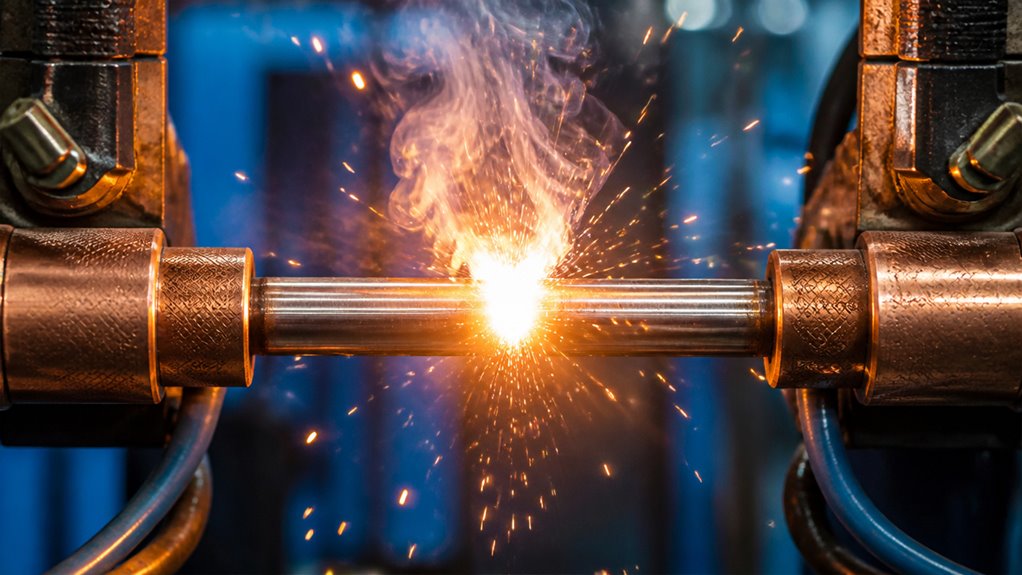
Electric resistance welding joins metal parts by passing controlled electrical current and applying pressure to generate localized heat through resistance.
This heat softens or melts the metals at contact points, forming a solid bond without filler metals or shielding gases.
Precise control of current, force, and timing guarantees consistent, high-quality welds, ideal for rapid, high-volume production.
You’ll also find various ERW types suited for different joint designs and industry needs as you explore further details.
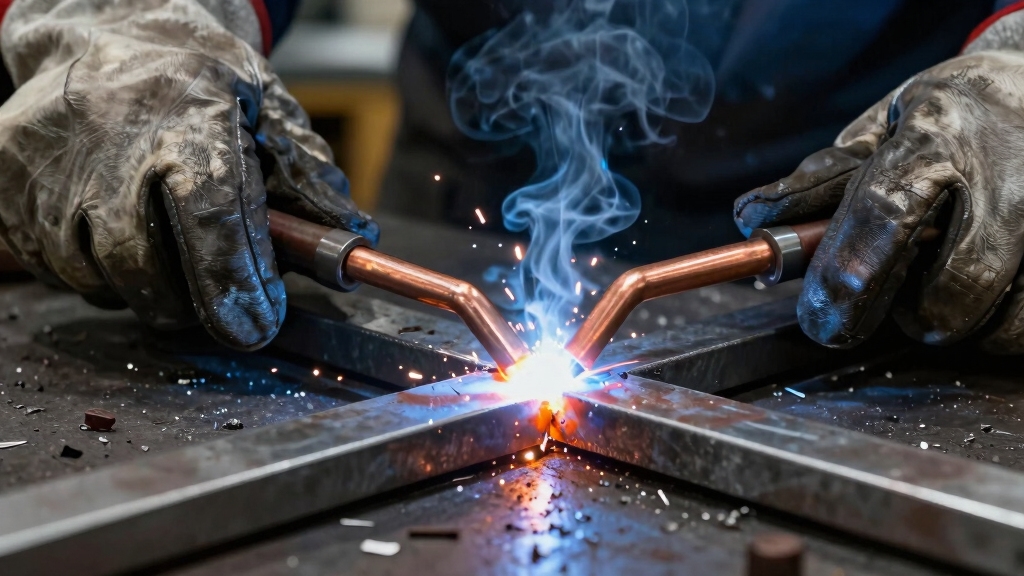
Although electric resistance welding (ERW) may seem complex, it fundamentally joins metal parts by passing electrical current through their contact surfaces. This generates heat through resistance.
Electric resistance welding joins metal by passing current through contact surfaces, generating heat through resistance.
You place the metal pieces in contact and hold them firmly between electrodes. When you apply a strong electrical current for a controlled, brief period, resistance at the interface produces heat, especially at the faying surfaces.
This localized heating, known as Joule heating, softens or melts the metal. You also apply pressure during or after current flow, forcing the materials together to form a solid bond.
Because ERW is a pressure welding process, it usually doesn’t require filler metals, flux, or shielding gases. By carefully controlling current, force, and time, you achieve efficient, high-quality welds suitable for many industrial applications.
Unlike processes such as GMAW, ERW does not rely on a shielding gas to protect the weld area from atmospheric contamination.
You’ll come across a few main types of electric resistance welding, and each one is tailored for different joint designs and production requirements.
For instance, spot and seam welding are pretty popular; spot welding focuses on joining sheets at discrete points, while seam welding creates continuous welds along the edges.
Then there’s projection and flash welding. These methods use concentrated current and unique heating techniques to efficiently forge parts together.
It’s fascinating how each type has its own strengths, making them ideal for specific applications! Proper electrode pressure and current control are essential to ensure consistent weld quality across different welding methods.
Spot welding and seam welding stand out as two primary electric resistance welding methods, each designed to join metal sheets efficiently under controlled pressure and current.
Spot welding joins overlapping sheets at discrete points, using electrodes to apply force and pass current briefly. This generates heat at the interface, creating localized weld nuggets ideal for automotive body panels and thin sheets.
Seam welding, in contrast, produces continuous or overlapping welds along a joint by employing rotating wheel electrodes that apply current and pressure as the sheets move. This method guarantees a leak-tight, uniform bond, commonly used in manufacturing fuel tanks and containers.
Both methods rely on precise control of current, force, and timing to optimize weld quality and minimize defects. This makes them indispensable for high-speed production environments.
Spot welding typically involves four key steps—squeeze time, weld time, hold time, and off time—to ensure strong and consistent welds through controlled heat and pressure application (weld time control).
While spot and seam welding focus on joining overlapping sheets through point or continuous welds, projection and flash welding handle different joint configurations and applications by concentrating heat and pressure in targeted areas.
Projection welding directs current through raised projections on one workpiece, localizing heat precisely. Flash welding heats and melts the ends of parts by creating an arc, then forges them under pressure to form a solid bond.
| Welding Type | Key Feature |
|---|---|
| Projection Welding | Localized heating at projections |
| Flash Welding | Heating by arcing and forging |
| Joint Type | Projection: complex shapes |
| Flash: butt joints | |
| Application | Heavy sections, rods, wires |
You’ll find these methods ideal for joining parts with varied geometries efficiently. Both projection and flash welding utilize concentrated heat and pressure to achieve strong welds with minimal filler material, making them highly efficient electric resistance welding processes.
Because electric resistance welding relies on the controlled application of current, pressure, and time, you must carefully balance these parameters to guarantee peak weld quality.
The electrical current generates heat through resistance, so setting the correct magnitude and duration ensures sufficient melting at the joint without excessive expulsion or distortion.
Applying appropriate electrode force concentrates heat and maintains intimate contact, preventing voids or incomplete fusion.
Timing plays a critical role; too brief a current application results in weak welds, while excessive time risks overheating.
Additionally, surface cleanliness and alignment affect contact resistance and weld consistency.
Optimizing these factors is essential to maintain weld pool stability and prevent defects during the welding process.
You know, one of the best things about ERW is how quickly it can work.
The process wraps up welds in just fractions of a second! Isn’t that impressive?
Plus, the way it manages current, force, and timing really helps ensure that the weld quality stays consistent, even when it’s moving at high speeds.
That’s why ERW really shines in high-volume production settings.
It’s like having a reliable partner that keeps things running smoothly!
ERW efficiency is enhanced by precise control over electrical output and process parameters, similar to how multi-process welders optimize welding performance.
Electric resistance welding frequently achieves rapid cycle times, making it highly suitable for high-volume production environments.
You benefit from welds formed within fractions of a second, thanks to the concentrated heat generated at the joint interface through electrical resistance.
The brief current application combined with precise electrode force accelerates the heating and solidification phases, minimizing downtime between cycles.
This speed directly translates to increased throughput and efficiency, especially when producing consistent welds on repetitive parts like automotive panels or steel pipes.
Since ERW doesn’t require filler metals or additional consumables, you avoid delays linked to material handling.
Effective electrode cooling is essential in maintaining weld quality during these rapid cycles, preventing overheating and prolonging electrode life.
When you need consistent, high-quality welds at scale, precise control over current, force, time, and temperature is essential.
Electric resistance welding (ERW) excels here by allowing you to finely tune these parameters for each application.
You can adjust the electrical current to generate the exact heat required, while electrode force guarantees proper contact and nugget formation.
Timing controls the duration of current flow, preventing overheating or weak welds.
Temperature monitoring guarantees the interface reaches peak melting without excess.
This precision minimizes defects and maximizes repeatability, making ERW ideal for high-volume production.
Automated systems maintain these controls cycle after cycle, enabling you to achieve uniform weld strength and quality.
This is essential for industries like automotive and pipe manufacturing where reliability and speed are paramount.
Moreover, the use of constant current welding power supplies enhances stability in manual adjustments during the process, ensuring consistent heat input and weld quality.
Although various welding methods exist, resistance welding stands out for its efficiency in joining thin metal sheets and overlapping components.
You’ll find it widely used in automobile body assembly, where spot welding quickly fuses sheet metal parts with minimal distortion.
Steel pipe manufacturing also relies heavily on electric resistance welding, especially seam welding, to produce continuous, strong joints.
When working with overlapping wires or plain metal pieces, projection welding offers precise, localized welds that save time.
Additionally, aviation and sheet-metal fabrication industries apply specific resistance welding techniques to achieve consistent, high-quality joints.
By controlling parameters like current and electrode force, you can efficiently produce repeatable welds in high-volume production settings.
This makes electric resistance welding a versatile choice for various industrial applications involving thin or overlapping metals.
As a key welding method within the broader fabrication workflow, resistance welding ensures strong, permanent metal bonds critical for structural integrity.
Since ERW relies heavily on precise control of electrical current, pressure, and timing, material properties and equipment capabilities directly limit weld quality and process efficiency.
You must consider material thickness because excessive thickness reduces heat concentration, impairing weld formation.
Surface conditions like contamination or oxidation increase contact resistance unpredictably, causing inconsistent heating.
Additionally, certain alloys with low or highly variable electrical resistance challenge stable welding.
On the equipment side, your welding machine must deliver controlled high current pulses with precise timing and force application.
Inadequate electrode design or wear affects current distribution and pressure uniformity, degrading weld quality.
High-capacity or specialized systems can incur significant costs, limiting accessibility.
Ultimately, balancing these material and equipment constraints is critical to achieving repeatable, defect-free ERW joints in your manufacturing process.
Proper selection and maintenance of welding consumables also play a vital role in ensuring consistent electrical contact and weld integrity in ERW.
You’ll find ERW has a lower environmental impact compared to many traditional welding methods because it typically doesn’t use filler metals, flux, or shielding gases, minimizing waste and emissions.
Its fast cycle times reduce energy consumption per weld.
However, ERW requires precise control and clean surfaces to avoid defects, which might increase prep efforts.
Think of electric resistance welding like handling lightning restrained within a tool. It demands strict safety measures.
You must wear insulated gloves and eye protection to shield against electric shock and intense light.
Guarantee proper grounding of equipment, maintain clean contact surfaces, and avoid loose clothing to prevent burns.
Always follow lockout-tagout procedures during maintenance. Keep the workspace ventilated to reduce exposure to fumes generated during welding.
You can’t use ERW effectively on non-metallic materials because the process relies on electrical resistance heating, which requires conductive metals.
Non-metals like plastics or ceramics don’t conduct electricity well, so they won’t generate the necessary heat at the joint.
If you need to join non-metallic materials, you’ll want to explore alternative methods like adhesive bonding, ultrasonic welding, or thermal welding designed specifically for those materials.
You might think electrode maintenance is a hassle, but it’s essential for ERW performance and lifespan.
Keeping electrodes clean and properly shaped guarantees consistent current flow and heat generation, leading to reliable welds.
Neglecting this causes increased resistance, overheating, and premature electrode wear, reducing efficiency and increasing costs.
Regular dressing and inspection prevent deformation and contamination, so your equipment runs smoothly.
Weld quality stays high, and downtime decreases markedly.
To troubleshoot common ERW defects, first check electrode condition and alignment for wear or contamination.
Next, verify current, force, and welding time settings match material specs.
Inspect surface cleanliness and joint fit-up to guarantee proper contact.
Monitor cooling and electrode pressure during the cycle.
If defects persist, examine equipment calibration and replace worn components.
Consistent maintenance and precise parameter control help you quickly identify and correct welding issues.
Electric resistance welding is the heartbeat of efficient metal joining, where electric current and pressure dance in perfect harmony to fuse materials seamlessly.
Understanding its types and critical parameters lets you control the welding symphony, ensuring strong, consistent results.
Ideal for high-volume production, ERW powers industries by delivering speed and precision. Just remember its material and equipment limits to keep your welds flawless.
Master ERW, and you’ll be shaping metal with electric precision every time.