Phone:
(701)814-6992
Physical address:
6296 Donnelly Plaza
Ratkeville, Bahamas.

Phone:
(701)814-6992
Physical address:
6296 Donnelly Plaza
Ratkeville, Bahamas.

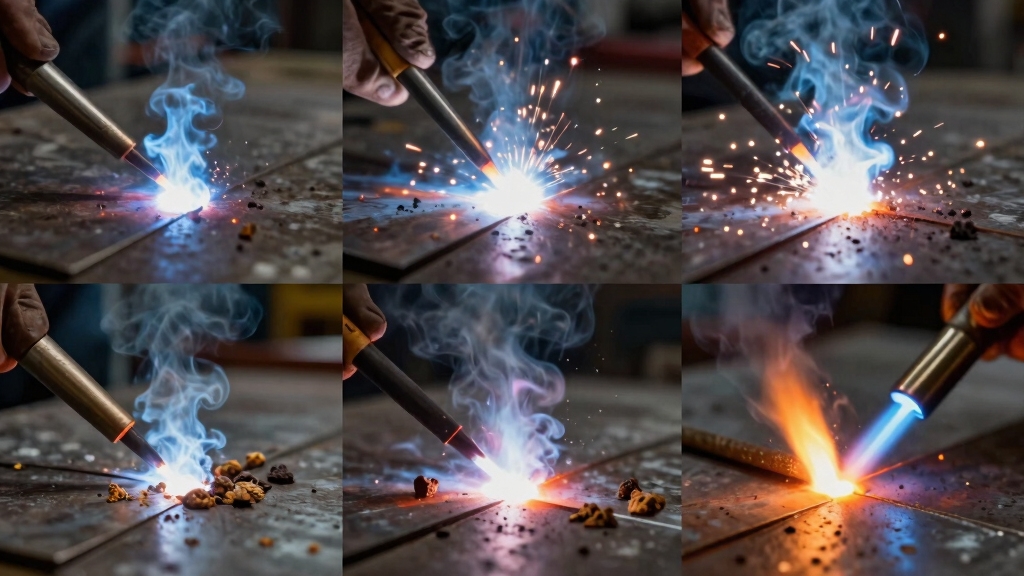
You’ll find welding methods vary by material, thickness, and environment.
MIG (GMAW) suits faster work on thin to medium metals but needs controlled atmospheres.
TIG (GTAW) offers precise, clean welds for thinner, sensitive materials, requiring skill.
SMAW excels outdoors and on rough surfaces, ideal for field repairs.
FCAW and SAW handle thick, heavy sections with high deposition rates.
Specialized options like laser or atomic hydrogen welding provide precision with minimal distortion.
Explore how each technique matches your project demands.
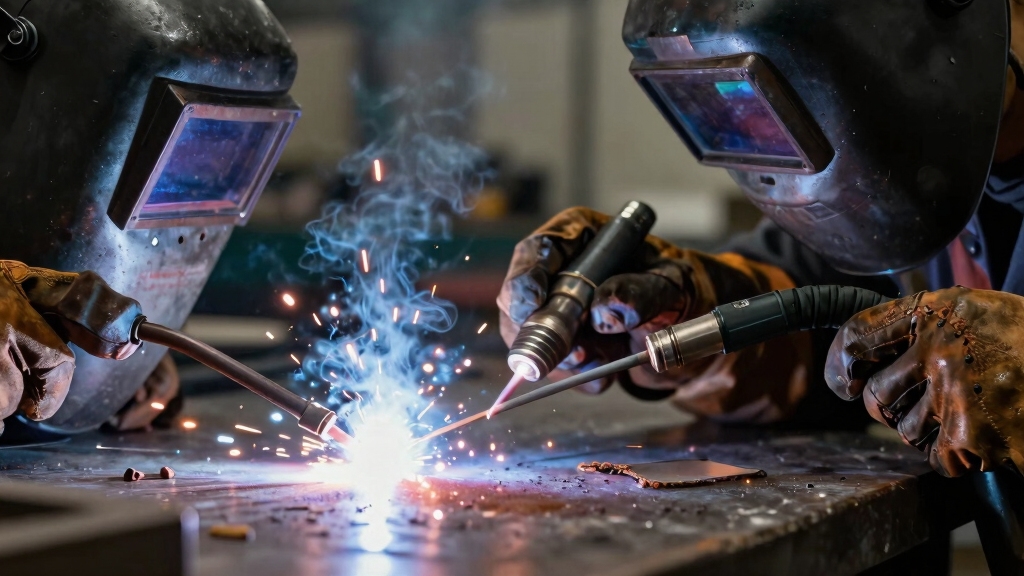
Gas Metal Arc Welding (GMAW), commonly known as MIG welding, uses a continuous wire electrode and a shielding gas to create a stable arc that melts and joins metal components.
You’ll find GMAW especially effective for welding thin to medium-thickness metals due to its high deposition rates and minimal post-weld cleanup.
It accommodates different transfer modes: globular for thick horizontal plates, short-circuiting for positional welding with low spatter, and pulsed-spray for versatility across thicknesses.
This process suits large industrial applications like plate fabrication and large bore pipe welding.
It offers faster speeds and easier learning curves compared to other methods.
However, you should avoid GMAW for thick metals or overhead welding due to shielding gas limitations and gravity effects on molten metal control.
The choice of shielding gas is critical to optimize weld quality and minimize spatter in GMAW welding.
When you think about Gas Tungsten Arc Welding, one of the key components is the non-consumable tungsten electrode. This little guy helps maintain a stable arc and controls the heat input really well. And that’s a big deal!
With that kind of control, you’re looking at superior weld finish quality—minimal spatter and contamination, which is exactly what you want. The inert gas shielding, typically argon or helium, plays a crucial role in protecting the weld pool from atmospheric contamination and ensuring clean, precise welds.
A tungsten electrode plays a critical role in delivering the precision and quality that define Gas Tungsten Arc Welding (GTAW).
Unlike consumable electrodes, tungsten remains intact, providing a stable arc for controlled heat input. This stability lets you focus the energy precisely, essential for thin or sensitive materials.
Consider these key advantages:
Proper sharpening of the electrode tip at precise grinding angles is essential to maintain arc stability and extend electrode life.
Achieving a superior weld finish hinges on precise control over heat and material deposition, a hallmark of Gas Tungsten Arc Welding (GTAW).
You’ll find that the non-consumable tungsten electrode allows you to maintain a stable arc with minimal spatter, producing smooth, clean weld beads.
GTAW’s inert shielding gas prevents oxidation, preserving weld integrity and enhancing cosmetic quality.
This technique’s steady heat input minimizes distortion and reduces the risk of defects, critical when working with thin or sensitive metals like aluminum and stainless steel.
While GTAW demands skill and patience, it delivers unmatched precision, enabling you to create welds with tight tolerances and consistent penetration.
For applications where finish quality and durability are paramount, GTAW stands as the superior choice.
The use of an inert shielding gas also stabilizes the arc and prevents contamination, ensuring consistent heat transfer and weld metal homogeneity.
You know, Shielded Metal Arc Welding is super popular for fieldwork, and it’s not hard to see why. First off, it’s really portable. You don’t need a ton of equipment, which makes it convenient to take wherever you need to go.
Another great thing is its versatility. You can weld on all sorts of surfaces—rough, dirty, or even rusty ones—without worrying about the integrity of the joint. That’s a big plus when you’re out in the field, right?
And let’s not forget how easy it’s to learn and use. This makes it perfect for all kinds of conditions you might encounter while working outside. So, overall, it’s a solid choice for anyone needing reliable welding in the field!
Its ability to weld effectively without external shielding gas ensures consistent performance even in windy or damp environments.
When working in remote or challenging environments, portability becomes a critical factor in choosing a welding process. Shielded Metal Arc Welding (SMAW) stands out because it offers unmatched convenience for fieldwork.
You’ll appreciate its simplicity and minimal equipment needs, which allow you to quickly set up and move between jobsites.
Consider these key advantages:
This portability makes SMAW highly effective for structural repairs, pipeline maintenance, and outdoor construction where mobility and rapid deployment are essential. Proper equipment preparation and cleaning of the metal surface help maintain weld quality even in field conditions.
Portability alone doesn’t guarantee effective welding in field conditions. Surface quality plays an equally important role.
Shielded Metal Arc Welding (SMAW) excels on rough, rusted, or dirty surfaces where other methods falter. Its flux-coated electrodes generate a protective slag, shielding the weld pool from contaminants. This allows you to work without extensive surface prep.
This makes SMAW ideal for unpredictable environments. Electrodes like the 6010 rod provide a deep-penetration root pass and excellent cleaning action, making them especially suited for pipeline and structural work under challenging conditions.
| Surface Condition | SMAW Performance |
|---|---|
| Rusted steel | Reliable fusion |
| Dirty/contaminated | Maintains weld quality |
| Rough/misaligned | Tolerant, adaptable |
| Thick materials | Strong penetration |
| Outdoor/windy areas | Consistent arc |
You can confidently use SMAW outdoors or on heavy, irregular metals. You benefit from its adaptability to less-than-ideal surfaces.
How does Shielded Metal Arc Welding (SMAW) maintain its popularity in fieldwork despite advancements in welding technology?
You’ll find SMAW favored because it’s straightforward and reliable, especially when conditions aren’t ideal. Here’s why it works well for you on-site:
While it requires frequent electrode changes and slag removal, you gain flexibility and adaptability critical for field repairs and construction where controlled environments aren’t available. Additionally, SMAW is essential for structural applications and often required for certification tests that validate welding skills in various positions.
Although Flux-Cored Arc Welding (FCAW) generates more fumes and requires pricier filler material, it outperforms other methods in outdoor, windy environments where shielding gas protection is compromised.
You’ll find FCAW excels where Gas Metal Arc Welding (GMAW) fails due to shielding gas dispersion. Its self-shielding flux core protects the weld pool effectively, ensuring consistent weld quality despite wind interference.
Additionally, FCAW delivers higher deposition rates and deeper penetration than Shielded Metal Arc Welding (SMAW), improving productivity on thick steel sections.
When working on construction sites or shipbuilding yards exposed to elements, FCAW minimizes downtime and rework caused by weld contamination.
While it produces lower cosmetic weld quality than Gas Tungsten Arc Welding (GTAW), FCAW’s robustness and reliability under adverse conditions make it the preferred choice for structural applications demanding strength over finish.
Its semi-automatic operation with a constant-voltage power source ensures high deposition rates and efficient welding even on contaminated surfaces.
While Flux-Cored Arc Welding offers advantages in challenging outdoor conditions, Submerged Arc Welding (SAW) stands out when dealing with thick materials requiring high-quality, consistent welds.
You’ll find SAW excels because:
Electron beam (EBW) and laser welding techniques deliver unparalleled precision when joining complex or dissimilar metals. They’re indispensable for applications demanding exact control over heat input and weld geometry.
EBW uses a focused electron stream in a vacuum, enabling deep penetration with minimal thermal distortion. Laser welding employs coherent light beams, offering similar depth control but with greater flexibility in atmospheric conditions.
Both methods produce narrow, high-aspect-ratio welds, reducing residual stresses and microstructural changes that often cause cracking in complex alloys. By tightly controlling energy delivery, you can weld thin or thick sections with minimal heat-affected zones.
This precision makes EBW and laser welding ideal for aerospace, automotive, and electronics industries. Weld integrity and dimensional accuracy are critical for performance and reliability.
Precision welding methods like electron beam and laser welding offer unmatched control for specialized applications.
However, when it comes to large-scale steel fabrication, resistance welding stands out for its cost efficiency.
You’ll find resistance welding particularly economical because it:
Gas and oxyacetylene welding are super versatile! They can join a bunch of different metals, like steel, copper, and even aluminum alloys. Pretty handy, right? Plus, they’re portable, which makes them perfect for fieldwork and maintenance, especially when you don’t have easy access to power sources.
Utilizing fuel gas welding, specifically oxyacetylene welding, provides versatile solutions for joining a wide range of metals with controlled heat input. You can precisely regulate flame temperature, which minimizes thermal distortion and improves weld quality.
This method also allows for effective brazing and cutting, making it multifaceted. Additionally, its portability enables on-site repairs without complex setup.
Consider these key benefits:
Metal compatibility plays a critical role in selecting welding methods, especially when you require versatile solutions like gas and oxyacetylene welding.
These techniques accommodate a broad spectrum of metals, including steel, stainless steel, copper, brass, and various alloys, making them highly adaptable.
You’ll find oxyacetylene welding effective for joining thin to moderately thick metals. It offers precise heat control to minimize distortion and oxidation.
Unlike arc welding methods that often require specific shielding gases or electrodes, fuel gas welding doesn’t necessitate specialized consumables. This enhances compatibility with diverse metals.
However, it’s less suited for extremely thick or high-strength alloys where arc processes dominate.
When you need flexibility across multiple metal types without extensive equipment changes, gas and oxyacetylene welding provide a practical, reliable solution within a broad metal compatibility range.
When working in remote locations or tight spaces, gas and oxyacetylene welding shine due to their exceptional portability and flexibility. You can carry compact tanks and simple torches without reliance on electrical power, allowing welding in areas inaccessible to heavier equipment. This versatility supports diverse applications beyond factory floors.
Key advantages include:
Plasma Arc Welding (PAW) and Atomic Hydrogen Welding (AHW) achieve high precision by controlling arc temperature and shielding to minimize oxidation and distortion.
In PAW, a constricted plasma arc generates intense, focused heat. This allows for tight control over penetration and bead shape.
The ionized gas column isolates the arc, reducing heat-affected zones and enhancing weld quality.
AHW uses atomic hydrogen gas between two tungsten electrodes, producing temperatures around 4000°C.
This environment prevents oxidation without flux, ensuring clean welds with minimal contamination.
By maintaining a stable arc and shielding with inert gases, both processes minimize thermal distortion.
These methods are ideal when exact weld dimensions, superior metallurgical properties, and minimal post-weld cleanup are critical.
Selecting the appropriate welding technique hinges on understanding the specific requirements of your project, including material type, thickness, position, and environmental conditions. To choose effectively, consider:
You must always wear appropriate PPE, including flame-resistant clothing, gloves, and a welding helmet with correct filter lenses.
Make certain proper ventilation to avoid hazardous fumes and gases. For gas-shielded methods, check gas connections to prevent leaks.
When welding outdoors, secure shields against wind. For processes generating sparks or slag, maintain a clean workspace to reduce fire risks.
Always inspect equipment regularly and follow lockout/tagout procedures to prevent accidental energizing.
You’ll find that welding equipment maintenance varies greatly. For example, MIG welding guns require cleaning after every 2 hours to prevent spatter buildup.
TIG torches need more frequent tungsten electrode dressing. Stick welding demands constant electrode holder inspection due to flux residue.
FCAW gear requires flux hopper refills and nozzle cleaning to avoid clogging. Regular calibration of amperage controls is essential across all methods to guarantee consistent arc performance and weld quality.
You’ll find welding processes differ environmentally by emissions and resource use.
Gas-shielded methods like GMAW and GTAW emit fewer fumes but consume expensive gases.
FCAW and SMAW produce more smoke and hazardous particulates, impacting air quality.
SAW offers efficiency but uses granular flux, generating waste.
Energy-intensive processes like EBW and laser welding reduce emissions but demand high power.
You must balance weld quality, cost, and environmental footprint when choosing a method.
Oh sure, just grab any welding method and magically fuse dissimilar metals like a superhero, right? Not quite.
You’re best off using Electron Beam Welding (EBW) or Laser Welding for precise control and minimal distortion.
These methods are ideal for joining dissimilar metals.
They handle differing thermal properties well, though they require skill to avoid cracking.
Plasma Arc Welding also works for precision, but stick to these high-tech techniques if you want reliable, clean joints.
Welding techniques influence your post-weld heat treatment (PWHT) by determining heat input and microstructural changes.
Higher heat input methods like SMAW or FCAW increase the need for PWHT to reduce residual stresses and avoid cracking.
In contrast, precise, low-heat processes like GTAW often minimize PWHT requirements due to controlled thermal cycles.
You must match the welding method with appropriate PWHT to guarantee mechanical properties, reduce distortion, and enhance weld integrity.
When choosing a welding technique, consider that Gas Metal Arc Welding (GMAW) accounts for over 50% of all welding processes worldwide due to its efficiency and versatility.
This statistic highlights why understanding each method’s strengths, whether precision with Gas Tungsten Arc Welding or cost-effectiveness with Resistance Welding, is vital.
By analyzing your project’s material, thickness, and environment, you can select the most suitable welding technique to maximize quality and productivity.