Phone:
(701)814-6992
Physical address:
6296 Donnelly Plaza
Ratkeville, Bahamas.

Phone:
(701)814-6992
Physical address:
6296 Donnelly Plaza
Ratkeville, Bahamas.

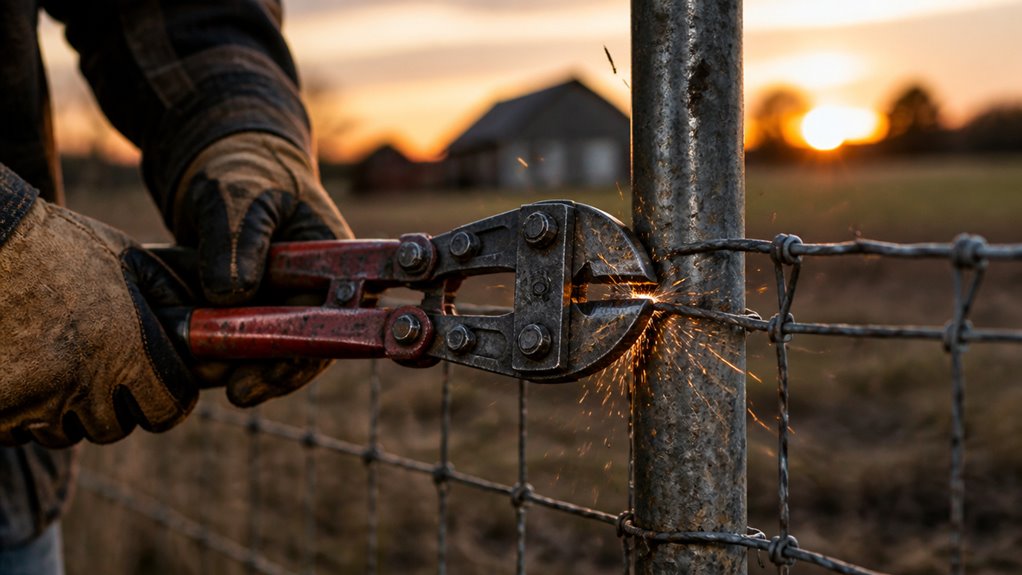
To cut welded wire fence safely and efficiently, first select the right tool based on wire thickness. Use scissors for thin mesh, wire cutters or tin snips for medium, and hacksaws or bolt cutters for thicker wire.
Measure and mark your cut line precisely, aligning with weld points. Secure the mesh on a stable surface, wear gloves and safety glasses, and cut near welds carefully.
Finish by bending and deburring edges to prevent injury. You can explore more detailed tips to guarantee a clean, safe cut.
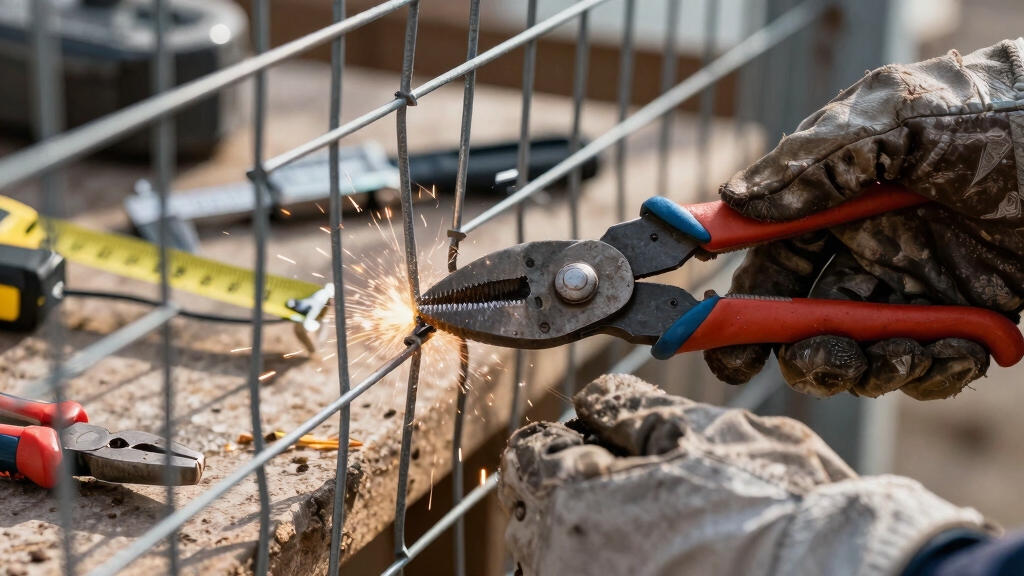
Start by matching your cutting tool to the thickness of your welded wire mesh to guarantee efficiency and safety.
Choose the right cutting tool for your wire mesh thickness to ensure efficient and safe work.
For very thin mesh up to 0.21 mm (35 gauge), use scissors designed for precision cutting.
If your mesh is medium thickness, around 1.2 mm (18 gauge), wire cutters work well.
Tin snips offer faster cutting along longer edges when cutters feel insufficient.
For thicker mesh, up to 5 mm (6 gauge), a hacksaw is appropriate.
Cutting is slow since each strand requires individual sawing.
When dealing with the strongest wire up to 10 mm (0 gauge), bolt cutters are necessary.
They’re physically demanding and slower than expected.
Selecting the right tool prevents damage to the mesh and reduces physical strain during cutting.
Always wear protective gloves and safety glasses to ensure safe handling when cutting welded wire mesh.
After selecting the appropriate tool for your wire mesh thickness, you’ll need to measure and mark the exact cutting line to guarantee precision.
Use a tape measure to determine the exact length or angle of the cut, then mark clearly with a permanent marker or chalk.
Align your marks with the mesh grid whenever possible, as following weld points helps reduce uneven edges and protrusions.
For angled cuts, draw a straight line along the intended path to maintain accuracy.
Marking the line before cutting guarantees you don’t waste material or make uneven cuts, which can compromise the fence’s integrity.
Take your time measuring and double-check before marking. Accuracy here directly impacts the quality and safety of your final cut.
Always ensure your personal protective equipment is properly worn before starting the cutting process to maintain safety.
Before cutting, make sure your workspace is secure and organized to prevent accidents and improve control.
Ensure your workspace is safe and organized to avoid accidents and maintain control before cutting.
Wear protective gear, including gloves and safety glasses, to shield yourself from sharp edges and flying debris.
Clamp the welded wire mesh firmly to a flat, stable surface like a workbench or heavy table to minimize movement during cutting.
If the mesh is light or large, enlist a partner to hold it steady.
Keep bystanders clear of the area to reduce injury risks.
Arrange your tools within easy reach to maintain workflow efficiency.
Clear away clutter and ensure adequate lighting so you can see your marked cutting line clearly.
A safe, stable setup greatly enhances precision and reduces the chance of mishaps throughout the cutting process.
Ensure the workspace is free of flammable materials and moisture to maintain fire safety during cutting.
Choose the appropriate tool based on the thickness and strength of your welded wire mesh to guarantee efficient cutting.
For very thin mesh up to 0.21 mm, use scissors, cutting each strand near the weld.
For medium wire up to 1.2 mm, wire cutters or tin snips work best; tin snips speed up longer cuts.
Use a hacksaw for thicker wire up to 5 mm, sawing each strand carefully.
For the strongest mesh up to 10 mm, bolt cutters provide the necessary force but demand physical effort.
An angle grinder with a metal-cutting disc can also handle heavy-duty mesh when aligned with your marked line.
Always cut close to weld points for cleaner edges and maintain steady pressure for precision.
For larger and tougher cuts, consider using an angle grinder for its greater torque and cutting power.
Finishing cut edges properly is essential to prevent injuries from sharp wire ends.
After cutting, use lineman’s pliers to bend any protruding wires back into the mesh. This reduces the risk of punctures or scratches.
Use lineman’s pliers to bend protruding wires inward, preventing punctures and scratches after cutting.
Inspect the edge carefully for burrs or sharp points that remain even after a clean cut.
Remove these hazards with a metal file, sanding disc, or grinding attachment to smooth the surface thoroughly.
Always handle detached mesh carefully, avoiding direct contact with exposed strands.
Folding wire ends inward and deburring guarantees safer handling and installation.
Taking these steps minimizes injury risks and improves the fence’s durability by preventing snagging and damage during use or transport.
Prioritize edge finishing as a critical final step in your cutting workflow.
For added safety, always wear appropriate protective gloves to prevent cuts and burns while handling sharp or hot wire ends.
Yes, you can cut welded wire mesh without professional tools if the wire is thin enough.
For very thin mesh, sharp scissors or tin snips can do the job effectively.
Medium wire may require sturdy wire cutters, which many DIYers have.
However, thicker or heavy-duty mesh will be tough to cut cleanly without specialized tools like bolt cutters or an angle grinder.
Always prioritize safety and secure the mesh before cutting.
Weather conditions impact your cutting process by affecting tool performance and safety.
Cold temperatures make wire more brittle, increasing break risk.
Heat can soften tools or make handling uncomfortable.
Wet or humid conditions cause slippery surfaces and rust risks, reducing grip and cutting efficiency.
Always make sure your work area is dry, tools are well-maintained, and wear gloves for grip and protection.
Avoid cutting in extreme weather to maintain precision and safety.
Picture a pile of sharp, twisted wire scraps waiting to be discarded.
The best way to recycle them is to first sort and clean the metal, removing debris or coatings.
Then, bundle or bag the scraps securely to prevent injury during transport.
Take them to a local scrap metal recycling center, where they’ll be melted down and repurposed efficiently.
This keeps waste minimal and recovers valuable materials for new uses.
You’ll find brands like Klein Tools and Irwin highly reliable for wire cutters and tin snips, thanks to their durability and cutting precision.
For bolt cutters, Knipex and Crescent offer robust options that handle thick wire mesh well.
If you prefer angle grinders, DeWalt and Makita deliver powerful, consistent performance with quality metal-cutting discs.
Choosing these brands guarantees efficient, safe cutting with tools built to withstand tough wire mesh conditions.
You prevent rust on cut edges by cleaning the metal right after cutting. Then, apply a rust-inhibiting primer or cold galvanizing spray.
Since freshly cut edges expose raw metal, coating them promptly is essential to stop oxidation. You can also use a wire brush to remove burrs before treatment.
If you want extra protection, seal the edges with waterproof paint or a rust-resistant sealant. Regular inspections keep rust at bay.
Cutting welded wire fence is straightforward when you choose the right tool and prepare carefully. Did you know that nearly 70% of DIY fence projects experience delays due to improper cutting methods?
By measuring accurately and securing your workspace, you’ll work efficiently and safely. Use tools like bolt cutters or angle grinders for the best results.
Don’t forget to finish the edges to prevent injuries. This small step guarantees durability and protects you during installation and use.
[…] wear protective gear such as gloves and safety glasses to enhance safety during cutting […]