Phone:
(701)814-6992
Physical address:
6296 Donnelly Plaza
Ratkeville, Bahamas.

Phone:
(701)814-6992
Physical address:
6296 Donnelly Plaza
Ratkeville, Bahamas.

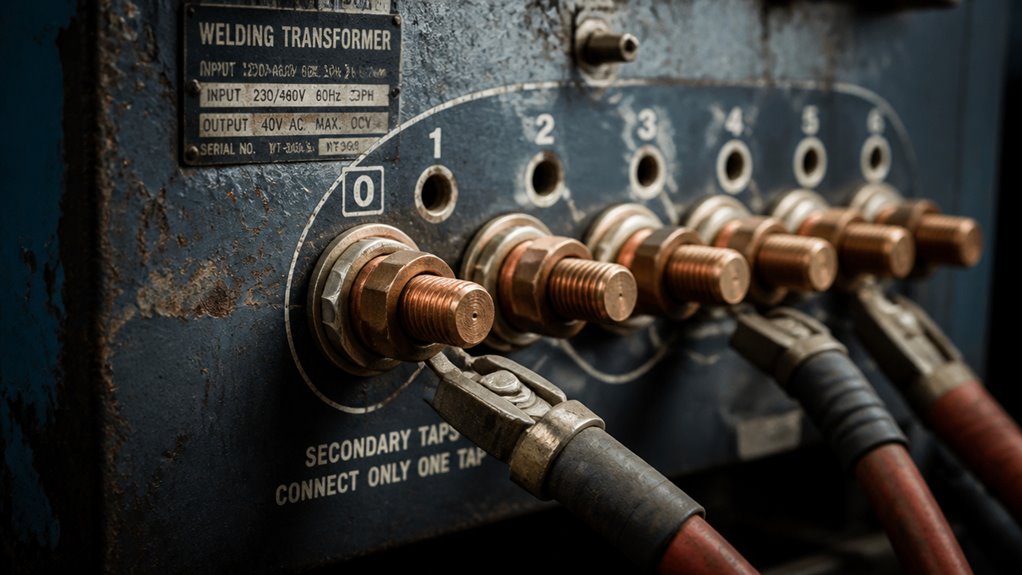
You use taps on a welding transformer to adjust the turns ratio by selecting different connection points on the primary or secondary windings. This controls the secondary voltage and welding current, allowing you to match output to material thickness and process needs.
Primary taps compensate for supply voltage variations. Secondary taps fine-tune arc stability and heat input. Proper tap selection optimizes weld quality and transformer performance.
Understanding these settings can markedly enhance your welding control and results.
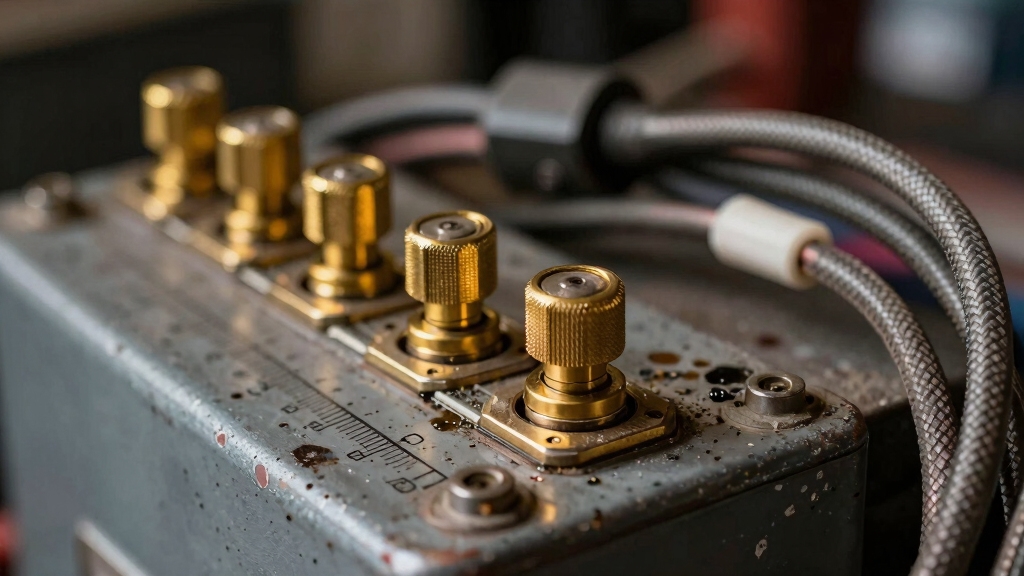
When you adjust the taps on a welding transformer, you’re changing specific connection points on its winding to vary the effective number of turns.
Adjusting welding transformer taps changes winding connections to vary the effective number of turns.
These taps serve as selectable nodes on the primary or secondary winding, enabling you to alter the turns ratio.
By modifying this ratio, you effectively control the transformer’s output characteristics, primarily voltage and current, without mechanical adjustments.
In welding applications, taps provide a means for macro adjustment of weld current to suit different materials and processes.
They allow you to compensate for supply voltage variations or tailor output for specific welding requirements.
Understanding the function and location of these taps helps you optimize transformer performance and guarantees you can maintain consistent welding parameters across varying conditions.
The output can be precisely controlled by changing taps to achieve the appropriate turns ratio for stable arc generation and metal fusion.
When you adjust the tap position on a welding transformer, you’re actually changing the effective turns ratio. This is pretty important because it directly affects the secondary voltage and current output.
So, here’s the deal: when you set it to a higher tap, you’ll get an increase in secondary voltage. But, on the flip side, this also means the maximum current goes down. It’s a bit of a balancing act.
Now, if you go with a lower tap setting, you’ll notice that the voltage decreases. But here’s the upside: this allows for a higher current flow. Getting a handle on these changes can really help you fine-tune your welding parameters for whatever specific application you’re working on. This adjustment is similar in principle to how inverter welding machines use precise current control to optimize welding performance.
Adjusting the tap position on a welding transformer directly modifies the primary-to-secondary turns ratio, thereby changing the secondary voltage output. When you shift taps, you effectively alter the number of primary winding turns in use. This impacts the voltage induced in the secondary winding.
This variation lets you tailor the transformer’s output to better fit your welding task requirements.
| Tap Position | Effect on Primary Turns | Secondary Voltage Output | Welding Current Potential |
|---|---|---|---|
| High | More turns | Higher voltage | Lower current potential |
| Mid-High | Moderate turns | Moderate-high voltage | Moderate current |
| Mid-Low | Fewer turns | Moderate-low voltage | Higher current potential |
| Low | Least turns | Lowest voltage | Highest current potential |
Selecting the right tap position optimizes welding performance and efficiency. Proper tap selection supports maintaining a stable arc by matching voltage and current outputs to the welding process requirements.
Understanding how tap positions affect the primary-to-secondary turns ratio sets the stage for analyzing their impact on voltage and current output.
When you adjust the tap, you change the effective number of turns on the primary winding, directly influencing secondary voltage and current. Here’s how it plays out:
This adjustment is crucial because transformers typically supply alternating current (AC), which affects how the arc interacts with different metals during welding.
When it comes to welding transformers, primary and secondary taps play a crucial role. You know, primary taps are there to help you deal with fluctuations in supply voltage. By adjusting the transformer’s turns ratio, they ensure that you get a steady secondary voltage output, no matter what’s happening with the incoming power. That’s pretty important, right?
On the other hand, secondary taps give you the ability to fine-tune the welding voltage and current directly. This adjustment is key to optimizing arc stability and improving weld quality. So, when you think about it, having a good grasp of how both of these tap types work is essential. It really gives you the control you need for precise welding performance.
Additionally, understanding the duty cycle associated with your welding transformer taps helps in selecting the proper breaker size and avoiding nuisance trips during operation.
Primary taps on a welding transformer control the input voltage applied to the primary winding, directly influencing the transformer’s turns ratio and consequently the secondary output voltage and current.
By adjusting primary taps, you alter the effective number of turns in the primary coil, which changes the voltage ratio between primary and secondary windings. This adjustment is essential for adapting the transformer to different supply voltages and welding requirements.
Here’s why primary taps matter:
Proper primary tap selection directly impacts welding performance and equipment longevity. Additionally, incorporating inverter technology can further enhance precise current control and improve energy efficiency in modern welding systems.
Flexibility in voltage adjustment plays an essential role in fine-tuning welding performance. Secondary taps provide this capability by allowing direct modification of the secondary winding turns.
By changing the effective number of turns on the secondary winding, you directly influence the output voltage and current. This tailors the welding transformer’s performance to specific weld requirements.
This precision helps optimize arc stability and heat input, which are critical for different material thicknesses and welding processes. Unlike primary taps, which mainly compensate for supply voltage variations, secondary taps fine-tune the welding output itself.
You benefit from improved control over arc characteristics and energy delivery, enhancing weld quality and efficiency. Using secondary taps strategically guarantees your transformer adapts seamlessly to varying operating conditions, maximizing versatility and output accuracy. Adjusting voltage after setting wire feed speed is key to controlling arc stability and achieving the desired bead profile.
Adjusting tap settings on a welding transformer directly influences the arc characteristics and overall weld quality by controlling the output voltage and current.
Adjusting welding transformer taps controls voltage and current, directly shaping arc behavior and weld quality.
When you select different tap positions, you effectively change the transformer’s turns ratio, which alters the secondary voltage and consequently the welding current.
This adjustment impacts the arc stability, penetration, and bead profile. Consider these effects:
Additionally, managing inductance in welding alongside tap settings can further enhance arc control and improve metal transfer characteristics.
Understanding how voltage and current ranges vary by tap setting lets you optimize your welding transformer’s performance for specific tasks.
Each tap adjusts the effective turns ratio, directly influencing the secondary voltage and current output.
Lower tap settings reduce secondary voltage, which increases the available welding current, often within a range of 200 to 600 amperes.
Conversely, higher tap settings raise secondary voltage, enhancing open-circuit voltage typically between 40 and 100 volts, improving arc stability.
You can expect typical secondary voltage ranges from approximately 15 to 45 volts, depending on tap selection.
By selecting the appropriate tap, you ensure the transformer delivers the correct kVA to match the welding process and material thickness.
This maintains arc quality and consistent weld performance within design parameters.
Keep in mind that 120V supply machines often require derating on output current, which impacts tap selection and welding capacity.
Because welding jobs vary widely in material thickness and type, you must select the correct tap setting to match the specific current and voltage requirements.
Adjusting taps guarantees the welding transformer delivers peak arc characteristics and weld quality. Consider these scenarios for tap adjustments:
Additionally, balancing both voltage and amperage ensures optimal heat input for high-quality welds.
Selecting the appropriate tap setting requires correctly identifying the available tap positions on your welding transformer. Typically, the transformer has multiple primary taps labeled with voltage ratings or positions. This allows you to adjust the turns ratio to suit input supply variations or welding current needs. Consult the transformer’s nameplate or wiring diagram for exact tap designations.
Use the table below to understand typical tap labeling and corresponding output effects:
| Tap Position | Primary Voltage (V) | Approximate Secondary Voltage (V) |
|---|---|---|
| Tap 1 | 230 | 25 |
| Tap 2 | 240 | 27 |
| Tap 3 | 250 | 29 |
| Tap 4 | 260 | 31 |
Set the tap switch firmly in the desired position to guarantee stable contact and reliable output voltage.
When you adjust transformer taps, failing to make sure the power is disconnected can cause dangerous electrical shocks or equipment damage. Always de-energize the system before changing taps.
Always disconnect power before adjusting transformer taps to prevent electrical shock and equipment damage.
Here are common mistakes to avoid:
Avoid these errors to ensure precise, safe tap adjustments that maintain peak welding performance.
Transformer taps affect your welding machine’s energy efficiency by optimizing voltage and current output to match your welding task.
When you select the correct tap, you reduce unnecessary power loss and improve the arc’s stability, minimizing energy waste.
Using a tap that’s too high or low can increase losses, lowering efficiency.
Yes, you can automate or remotely control taps on welding transformers by integrating motorized tap changers or electronically controlled switching mechanisms.
This allows you to precisely adjust output voltage and current without manual intervention.
Implementing such systems requires careful design to maintain arc stability and safety.
Automation enhances process control, enabling real-time adaptation to changing welding conditions.
However, it demands compatible transformer designs and robust control systems.
Think of tap switches as the delicate gears in a clockwork mechanism. They need precise care to function reliably.
You should regularly inspect tap contacts for wear or corrosion and clean them with appropriate solvents.
Tighten all connections to prevent resistance and overheating. Lubricate moving parts sparingly to avoid dust buildup.
Periodic electrical testing guarantees consistent voltage regulation. Following these steps maintains welding output quality and prolongs transformer lifespan.
You use taps differently in DC and AC welding transformers primarily because DC units often require rectification after the transformer.
In AC transformers, taps adjust voltage directly on the primary or secondary windings to control output current and voltage.
For DC welders, taps mainly optimize the transformer’s output before the rectifier, ensuring stable DC arc characteristics.
Your tap adjustments in DC systems must consider rectifier effects, while AC taps impact the arc more immediately.
You mightn’t realize it, but improper tap settings can silently shorten your welding transformer’s lifespan.
When you choose a tap that causes excessive current or voltage beyond design limits, you stress the windings and insulation. This leads to overheating and accelerated wear.
Consistently operating on the wrong tap increases thermal cycling, degrading durability.
If you ignore welding transformer taps, you might as well weld in the dark. Your voltage and current will be wildly off, ruining every seam.
Taps aren’t just settings; they’re precision tools that control your arc’s stability and quality. Mastering tap adjustments means mastering your welds.
So, don’t underestimate them. Getting your taps right is the difference between a flawless joint and a catastrophic failure. Adjust with care, or risk everything.