Phone:
(701)814-6992
Physical address:
6296 Donnelly Plaza
Ratkeville, Bahamas.

Phone:
(701)814-6992
Physical address:
6296 Donnelly Plaza
Ratkeville, Bahamas.

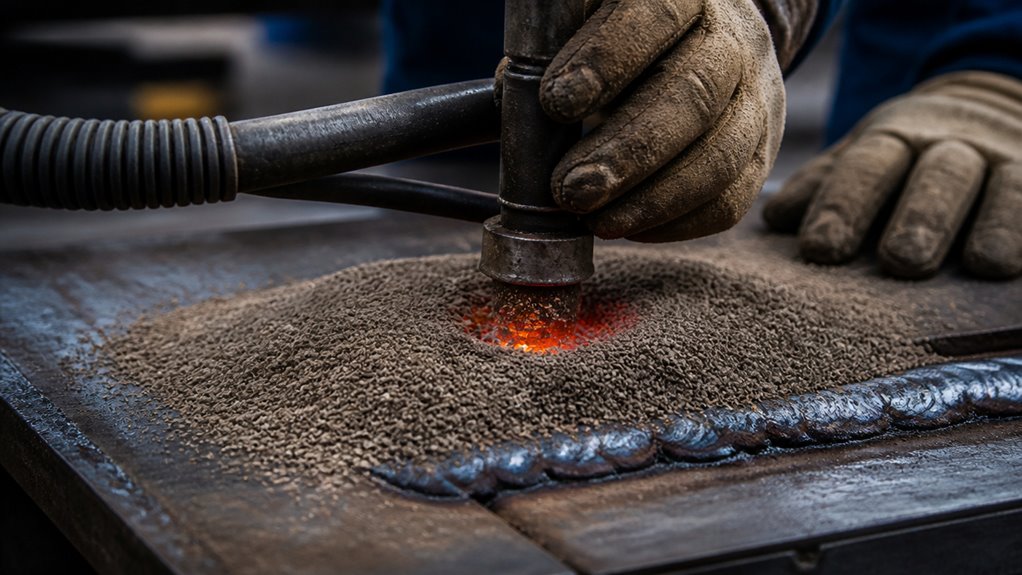
You call it submerged arc welding because the welding arc runs entirely beneath a granular flux blanket that physically covers and shields it from atmospheric exposure.
This flux protects the weld pool by blocking oxygen and nitrogen, stabilizing arc length, and suppressing spatter and fumes.
The arc’s hidden position under the flux creates a controlled, contamination-free environment, distinct from open arc welding.
Understanding this unique flux interaction reveals why the process excels in weld quality and efficiency.
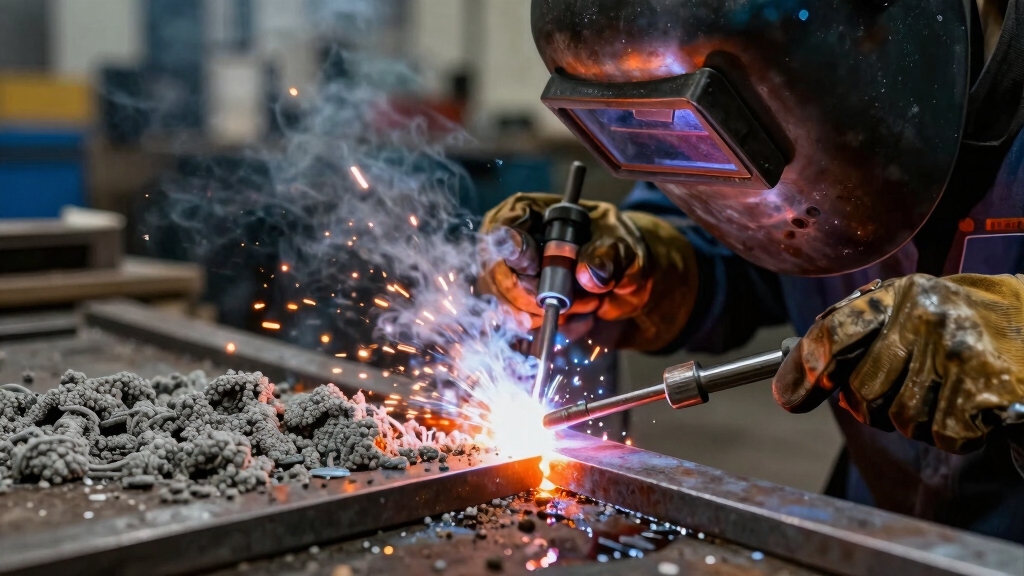
Submerged Arc Welding (SAW) uses a continuous consumable electrode to generate an arc that’s completely covered by a granular flux blanket.
You feed the electrode steadily, creating an arc hidden beneath this flux layer, which blocks atmospheric gases from contaminating the weld pool.
This “submerged” arc operates below the surface, ensuring the molten metal is shielded during fusion.
The flux also melts partially, forming slag that protects the cooling weld.
By keeping the arc submerged, you maintain a stable arc length and reduce spatter, enhancing weld quality.
The process suits flat or near-horizontal welding positions due to the flux’s granular nature.
Understanding this underlying submerged condition clarifies why the technique’s name directly reflects its defining operational characteristic.
Automation or semi-automation in SAW increases deposition rates and repeatability, minimizing human error and improving weld consistency through high deposition efficiency.
You rely on the flux blanket to shield the welding arc effectively from atmospheric gases during SAW. This granular flux covers the weld area, preventing oxygen and nitrogen from interacting with the molten weld pool and arc.
As some flux melts, it forms a slag layer that further isolates the weld from contamination. Meanwhile, the unmelted flux remains as a solid cover, maintaining consistent protection throughout welding.
This barrier reduces spatter and suppresses hazardous fumes and arc radiation, enhancing safety and weld quality. By maintaining an inert environment, the flux blanket stabilizes the arc and assures a clean weld pool.
Its continuous coverage is essential to the process’s reliability and repeatability, making the flux blanket a critical component in submerged arc welding. Proper positioning and consistent coverage of the flux blanket are key to ensuring weld strength and quality.
Although it may seem counterintuitive, the welding arc remains hidden beneath the flux blanket to guarantee peak protection and stability during SAW.
By submerging the arc, the flux physically isolates it from atmospheric gases like oxygen and nitrogen, preventing weld contamination and porosity.
This granular layer also stabilizes the arc’s electrical characteristics by maintaining a consistent arc length and temperature.
You’ll find that the flux blanket suppresses spatter and radiation, enhancing operator safety and weld integrity.
Additionally, the flux’s thermal insulation preserves heat within the weld zone, promoting efficient metal fusion.
The arc’s concealed position under flux isn’t merely a visual trait but a critical functional aspect that secures controlled welding conditions and repeatable, high-quality welds in demanding industrial applications.
When you submerge the arc beneath the flux blanket, you’re actually doing a couple of really important things. First, you’re shielding the weld zone from atmospheric gases, which helps prevent contamination. This is key because it ultimately improves the integrity of the weld.
But that’s not all! This coverage also traps heat within the weld area. So, you’re not just protecting the weld; you’re boosting thermal efficiency, which means you can achieve higher deposition rates.
Once you start to see these benefits, it becomes pretty clear why submerged arc welding stands out. It delivers superior quality and productivity compared to open-arc methods. It’s like having the best of both worlds!
Additionally, the granular flux used in submerged arc welding plays a crucial role in reducing spatter and stabilizing the arc for consistent weld quality.
By submerging the welding arc beneath a granular flux blanket, the process creates an effective barrier that shields the molten weld pool from atmospheric gases like oxygen and nitrogen. This shielding minimizes oxidation and nitriding, guaranteeing a cleaner, stronger weld.
You’ll notice reduced spatter and lower fume emissions, which improve both weld quality and operator safety. The flux also stabilizes the arc, promoting consistent penetration and bead shape.
| Shielding Effect | Weld Quality Impact | Operational Benefit |
|---|---|---|
| Blocks oxygen | Prevents porosity | Reduces rework |
| Blocks nitrogen | Enhances mechanical strength | Lowers spatter |
| Minimizes contamination | Improves bead appearance | Increases uptime |
| Suppresses fumes | Guarantees weld integrity | Enhances operator safety |
| Stabilizes arc | Consistent penetration | Facilitates automation |
Proper breaker sizing, considering factors such as the duty cycle and input current, is essential to ensure stable welding performance and prevent equipment interruptions during submerged arc welding.
Beyond shielding the weld pool from atmospheric contamination, the flux blanket also plays a significant role in retaining heat within the weld zone.
By submerging the arc beneath this granular layer, you effectively trap thermal energy, reducing heat loss to the surrounding environment.
This containment leads to a more stable and concentrated heat input, which enhances penetration and fusion quality.
You’ll notice that the flux’s insulating properties allow for higher deposition rates without compromising weld integrity.
Additionally, the retained heat minimizes cooling rates, reducing residual stresses and distortion.
This thermal efficiency translates directly into improved productivity, as you can weld thicker materials faster while maintaining consistent weld properties.
Fundamentally, the submerged condition optimizes heat management, making SAW both effective and economical for heavy fabrication tasks.
Similar to how high deposition rates improve productivity in GMAW welding, the thermal retention in SAW allows for efficient welding of thick materials.
Although the flux blanket in submerged arc welding offers excellent shielding and heat retention, it also imposes critical limitations on welding positions and accessibility.
The granular flux restricts you primarily to flat or near-horizontal welding, as gravity causes flux displacement in vertical or overhead positions.
Additionally, the flux layer limits access to complex or confined geometries, making it unsuitable for intricate weld joints.
Finally, the need for continuous flux coverage demands precise handling and equipment setup to maintain consistent protection.
These constraints affect the versatility of submerged arc welding despite its efficiency. The importance of shielding gas composition in achieving optimal weld penetration and arc stability highlights key differences between SAW and other arc welding processes.
Understanding the limitations of the flux blanket highlights why the process’s name focuses on the unique condition of the welding arc.
“Submerged” precisely describes how the arc operates beneath a granular flux layer, which physically covers and shields the arc from atmospheric exposure.
This submerged environment prevents contamination and stabilizes the weld pool, distinguishing this method from open arc welding.
The use of a shielding gas to protect the weld pool in other welding processes highlights the unique protective role of flux in submerged arc welding.
| Aspect | Description | Impact |
|---|---|---|
| Arc Position | Beneath flux blanket | Hidden from direct view |
| Shielding | Flux blocks air contact | Prevents oxidation |
| Weld Pool | Under flux bed | Controlled thermal environment |
| Visual | Arc not visible | Unique identifying feature |
| Process Distinction | Compared to open arc welding | Enhanced quality and safety |
This terminology accurately captures the core physical and functional welding environment.
You can’t effectively use submerged arc welding on vertical or overhead welds because the granular flux blanket won’t stay in place.
Since the flux must cover the arc continuously to shield it and maintain weld quality, gravity causes it to fall away in non-flat positions.
This limitation restricts SAW primarily to flat or near-horizontal welding, making it unsuitable for vertical or overhead applications where flux containment is critical.
No, you don’t need shielding gas in submerged arc welding unless you enjoy wasting money on fancy gas bottles for no good reason.
The granular flux blanket does the shielding job perfectly, blocking oxygen, nitrogen, and contamination from the weld pool.
This self-contained coverage makes external shielding gas redundant.
So, you get cleaner welds, less spatter, and better heat retention without fussing over gas flow rates or leaks.
Efficiency at its finest.
You collect surplus flux by carefully removing it once welding cools.
To reuse it effectively, make certain the flux is dry and uncontaminated. Moisture or impurities degrade performance.
Store the recovered flux in sealed containers to prevent exposure to air or humidity.
Before reuse, screen the flux to remove clumps or debris. This maintains consistent granule size for stable arc conditions and peak shielding during subsequent welding operations.
You’ll find that solid and flux-cored wires made of carbon steel, stainless steel, and nickel alloys work best in SAW.
Carbon steel electrodes dominate due to their strength and compatibility with thick plates.
For corrosion resistance or high-temperature applications, stainless steel or nickel-based electrodes suit better.
You should select electrode composition based on base metal and weld requirements, ensuring consistent melting rate and stable arc under the flux blanket for peak performance.
Automation reduces your submerged arc welding costs by increasing consistency and speed, which lowers labor expenses. It minimizes human error, cutting rework and material waste.
You’ll benefit from higher deposition rates and better heat control, improving productivity. Though initial investments are significant, automated systems pay off through enhanced repeatability and reduced downtime.
In heavy fabrication, this precision and efficiency directly translate to overall cost savings and improved throughput.
You might think it’s just a name, but calling it “submerged arc welding” perfectly captures the process. The arc literally hides beneath the flux blanket, shielding it for superior weld quality.
It’s a coincidence that this protective layer not only guards the arc but also boosts efficiency, making your work cleaner and stronger. Understanding this precise interaction helps you appreciate why “submerged” isn’t just terminology. It’s the key to the process’s success.