Phone:
(701)814-6992
Physical address:
6296 Donnelly Plaza
Ratkeville, Bahamas.

Phone:
(701)814-6992
Physical address:
6296 Donnelly Plaza
Ratkeville, Bahamas.

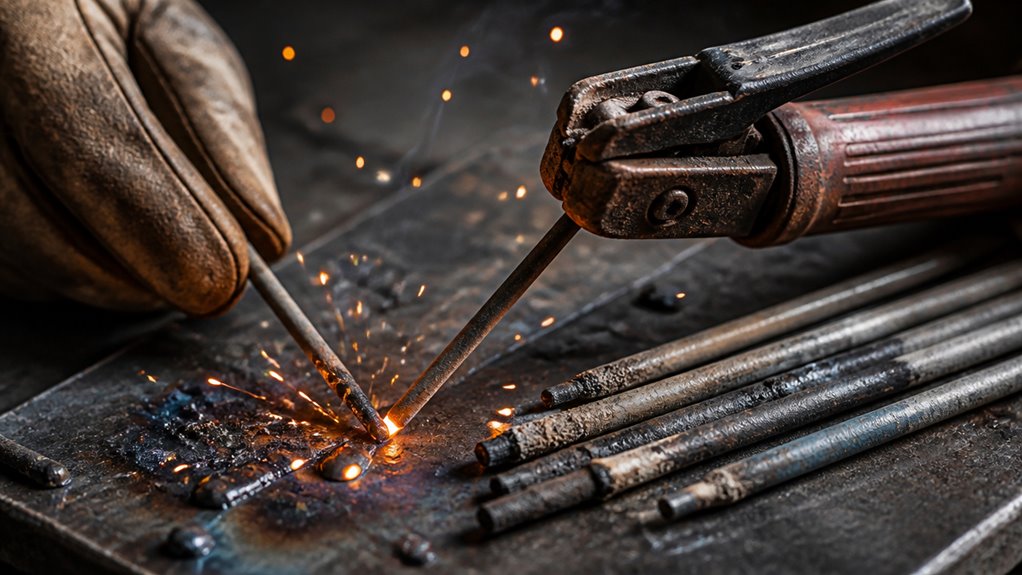
To get strong, clean SMAW welds, you’ll want to start by thoroughly cleaning your metal and work area, removing rust, oil, and moisture.
Choose electrodes that match your metal type and joint. Set amperage based on electrode size and position for stable arc control.
Keep your arc length steady, about the electrode’s diameter. Maintain proper travel angles with controlled rod movement.
Address common defects by adjusting settings and techniques. Keep going to uncover advanced tips for perfect welding results.
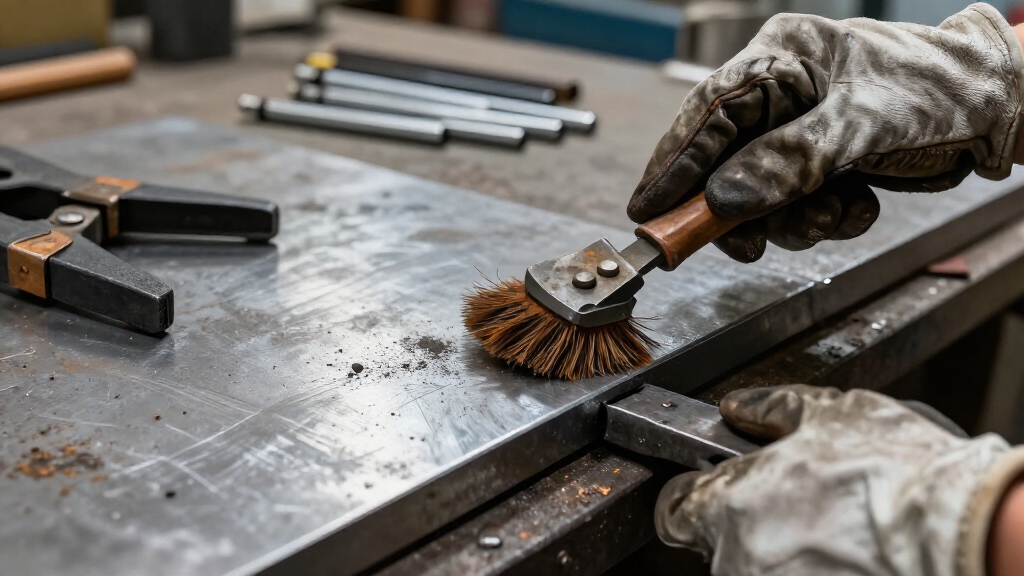
Preparing the surfaces and work area is essential to achieving strong, defect-free SMAW welds. You need to remove rust, dirt, oil, grease, dust, moisture, paint, and scale from the metal to guarantee proper arc stability and penetration.
Clean the clamp area thoroughly to guarantee a solid electrical connection, reducing the risk of poor weld quality. Position your workpiece for stable access and maintain a clear view of the weld puddle, which helps control bead shape and travel speed.
Keep flammable materials and unnecessary tools out of the welding area for safety and workspace efficiency. Finally, make certain all surfaces and the environment remain dry to prevent electrical issues and porosity caused by moisture contamination in the weld. Ensure proper ventilation and use appropriate respiratory protection to reduce exposure to zinc oxide fumes when welding galvanized steel.
When it comes to welding, picking the right electrode is crucial. You want to match it with your metal’s strength and composition to ensure you get a solid weld. For instance, if you’re working with thicker materials, you might lean towards something like E6010, which is great for deep penetration. On the other hand, if you’re dealing with thinner materials, E6013 could be your go-to choice.
Don’t forget to check if your power source can handle the current and polarity that the electrode requires. This little step makes a big difference! By ensuring everything lines up correctly, you’ll boost arc stability and enhance the integrity of your weld, tailored perfectly for your specific joint. Additionally, adjusting the amperage within the electrode’s recommended range and increasing it incrementally can help prevent your welding rods from frequent sticking.
When selecting an SMAW electrode, matching the electrode type to your base metal’s strength and composition is essential for achieving a strong, defect-free weld.
For many mild steel applications, E60 and E70 electrodes offer reliable strength and good weldability. If your joint requires deep penetration, such as tight fit-ups or non-beveled edges, E6010 or E6011 electrodes are ideal due to their aggressive arc characteristics.
For thinner materials or wider root gaps, E6013 provides a softer arc and smoother bead profile. Also, consider your power source: some electrodes need DC polarity, while others work with AC or both.
Choosing the correct electrode type guarantees compatibility with your welding setup and material, ultimately improving weld quality and minimizing defects. Always consult manufacturer specs to confirm electrode suitability.
Additionally, using low-hydrogen electrodes like E7018 on thick structural steel enhances toughness and reduces cracking risk.
Selecting the right electrode for your metal and joint type directly impacts weld strength and quality. You’ll want to match the electrode classification to the base metal’s strength and composition.
For mild steel, E60 or E70 electrodes generally work well. Use E6010 or E6011 electrodes when welding tight fit-up or non-beveled joints, as they provide deeper penetration.
For thinner materials or joints with wider root openings, E6013 is preferable because of its softer arc. Always consider the joint configuration and material thickness when choosing your electrode.
Wrong matches can cause poor penetration or cracking. By selecting electrodes that suit both the metal and joint type, you ensure sound welds with proper fusion and mechanical integrity, avoiding costly defects or rework.
For vertical welding positions, choosing electrodes like E7018 or cellulose-based E6010 with appropriate techniques can significantly improve weld quality and control electrode selection.
In choosing the right SMAW electrode, understanding your power source’s capabilities is essential to achieving peak weld quality.
First, confirm whether your power supply supports AC, DC, or both, as some electrodes require specific polarity or current types.
For example, E6010 rods need DC with electrode positive for deep penetration, while E6011 works with either AC or DC.
Match the electrode classification to your base metal’s strength and composition, ensuring compatibility with your power source.
Set amperage according to the electrode size and manufacturer’s guidelines, generally about 1 amp per 0.001 inch diameter, adjusting for position and weld conditions.
Proper alignment between electrode and power source prevents arc instability, spatter, and poor penetration.
This helps you achieve a stable arc and strong welds.
Additionally, selecting the correct welding current type based on the electrode and base metal thickness is crucial for optimal performance.
Although proper electrode choice is critical, setting the correct amperage and current guarantees a stable arc and quality weld.
Start by matching amperage to electrode diameter, roughly 1 amp per 0.001 inch. For example, a 3/32-inch rod requires about 90 amps.
Adjust current based on welding position; reduce about 15% for overhead work to prevent excessive dripping and instability.
When you notice spatter or poor control, reduce current first before changing other settings.
Always keep amperage within the electrode’s recommended range to avoid undercut or lack of fusion.
Proper current assures consistent melting and penetration, contributing to a smooth, defect-free bead.
Maintaining the proper arc length consistent with the electrode diameter is essential for arc stability and optimal weld quality.
When you control the arc length carefully, you stabilize the weld pool and improve bead quality. Keep the arc length close to the electrode core diameter, typically 1/16 to 3/32 inch.
This distance reduces spatter and maintains a steady arc. Measure from the electrode tip to the work surface, aiming for a consistent gap.
Avoid letting the arc length extend too far; a long arc causes instability and weakens penetration. Conversely, a too-short arc risks sticking the rod.
Maintaining this balance keeps the arc’s heat focused, ensuring proper fusion and bead shape. Consistency is key; fluctuations in arc length lead to uneven welds and defects.
Proper arc control also involves adjusting the electrode angle and travel speed to enhance bead consistency and prevent defects.
When you’re welding, it’s important to hold the electrode almost perpendicular to the joint. A slight tilt of about 5 to 15 degrees in the direction you’re traveling can really help with penetration and achieving the right bead shape.
Now, let’s talk about rod manipulation. You want to keep your movement controlled and limit any side-to-side motion. A good rule of thumb is to move about 2.5 times the diameter of the electrode core. This keeps your arc focused and stable, which is key for quality welds.
As you work, focus on the leading third of the weld pool. Keep that arc concentrated there while you move steadily along. This approach will help you produce clean and consistent SMAW beads every time! When working on remote job sites, welders often receive a per diem allowance to cover lodging, meals, and incidental expenses during extended assignments.
Mastering ideal electrode angles is essential for producing clean, strong SMAW weld beads. You want to maintain a travel angle between 5° and 15° tilted forward in the welding direction. This guarantees peak penetration and bead shape.
For flat and horizontal welds, use a drag angle of 5° to 10%. Vertical-up or overhead positions require a push angle of 5° to 10%. Keep side-to-side motion minimal—about 2.5 times the electrode diameter—to avoid irregular beads.
| Welding Position | Travel Angle | Rod Position Tip |
|---|---|---|
| Flat | 5°–15° drag | Focus arc on leading 1/3 puddle |
| Horizontal | 5°–15° drag | Maintain steady arc length |
| Vertical-up | 5°–10° push | Control bead with slight push |
| Overhead | 5°–10° push | Use consistent forward tilt |
Adjust angles precisely for consistent, defect-free welds. Maintaining a steady arc length approximately equal to the electrode diameter is crucial to prevent spatter or sticking during welding.
Control your electrode with deliberate, steady movements to guarantee consistent penetration and clean bead formation.
Hold the rod nearly perpendicular to the joint, tilting it 5 to 15 degrees in your travel direction. In flat and horizontal positions, use a slight drag angle of 5 to 10 degrees.
Switch to a push angle of 5 to 10 degrees for vertical-up or overhead welding. Limit your side-to-side manipulation to roughly 2.5 times the electrode core diameter to maintain arc focus.
Keep the arc aimed at the leading third of the weld pool as you move, ensuring proper fusion and bead shape. Consistent travel speed paired with precise rod angles prevents defects and promotes a uniform, slag-covered bead ready for cleaning.
Using electrodes like E6011 can improve penetration and performance, especially on rusty or contaminated surfaces.
Maintain a focused arc by carefully managing travel angles and rod manipulation to achieve clean, consistent SMAW beads. Hold the electrode near perpendicular, tilting it 5 to 15 degrees forward in the travel direction.
This keeps the arc concentrated on the leading one-third of the weld pool, promoting uniform penetration and bead shape. Use a slight drag angle of 5 to 10 degrees in flat and horizontal positions; switch to a push angle of 5 to 10 degrees for vertical-up or overhead welding.
Limit side-to-side motion to about 2.5 times the electrode core diameter to maintain arc stability. Consistent control of these variables reduces spatter, prevents arc wandering, and results in smooth, defect-free welds that require minimal cleanup.
When you encounter defects in SMAW welds, identifying their root causes quickly can save time and materials.
Porosity usually stems from contamination or moisture, so make certain thorough surface cleaning and dry electrodes.
Excessive spatter often means your current is too high or your arc length too long. Reduce amperage and shorten the arc to correct this.
Poor penetration suggests improper electrode selection, wrong polarity, or too fast travel speed. Verify electrode type matches the base metal and adjust travel speed accordingly.
Cracking can occur if the electrode doesn’t suit the joint design or material thickness. Match electrode classification carefully.
After welding, always chip slag and brush the bead to inspect quality.
Prompt troubleshooting minimizes rework and maintains weld integrity.
Weather conditions directly impact your SMAW welding quality. Moisture from rain or humidity can cause porosity and arc instability by contaminating the electrode and base metal.
Wind can cool the weld area too quickly, leading to cracking or poor fusion. Cold temperatures may increase brittleness and reduce penetration.
To maintain weld integrity, you should protect your work area from wind and moisture, keep electrodes dry, and adjust amperage for temperature variations.
Think of your welding equipment as a finely tuned instrument. You need to clean the electrode holder and cable connectors regularly to guarantee strong electrical flow.
Inspect cables for cracks or wear; replace damaged parts promptly. Tighten all connections and check the ground clamp for secure contact.
Keep the power source vents clear of dust to avoid overheating. Routine maintenance prevents interruptions and guarantees consistent, high-quality welds every time you strike your arc.
You should cool used welding electrodes completely before disposal to prevent fire hazards.
Collect them in a designated, non-combustible container labeled for metal waste.
Avoid mixing electrodes with general trash or hazardous waste.
If possible, recycle the electrodes through a metal recycling program.
Always wear gloves when handling used electrodes to avoid skin irritation or injury from sharp ends.
Follow local regulations for metal waste disposal to stay compliant and safe.
Automating SMAW welding is like fitting square pegs into round holes: possible but challenging.
You can automate it for production, but its manual nature and slag removal complicate continuous operation.
You’ll need precise control of electrode feeding, positioning, and slag handling.
Automation suits repetitive, consistent joints but requires custom equipment and maintenance.
Evaluate if alternative processes like GMAW or FCAW might better match your production’s speed and consistency needs.
You need a welding helmet with a proper shade lens to protect your eyes from intense light and UV radiation.
Wear flame-resistant gloves and a long-sleeve jacket to shield your skin from sparks and heat.
Use safety boots with steel toes and wear ear protection if noise levels are high.
Respiratory protection is vital if ventilation is poor to avoid inhaling harmful fumes.
Always make certain your gear fits well and is in good condition.
You might think SMAW welding is as simple as striking an arc and dragging the rod, but without prepping surfaces, choosing the right electrode, and controlling your amperage and angles, you’ll quickly find it’s anything but easy.
Luckily, mastering these basics prevents defects that can turn your welds into costly mistakes. So, don’t skip the details unless you enjoy welding that looks like a science experiment gone wrong.