Phone:
(701)814-6992
Physical address:
6296 Donnelly Plaza
Ratkeville, Bahamas.

Phone:
(701)814-6992
Physical address:
6296 Donnelly Plaza
Ratkeville, Bahamas.

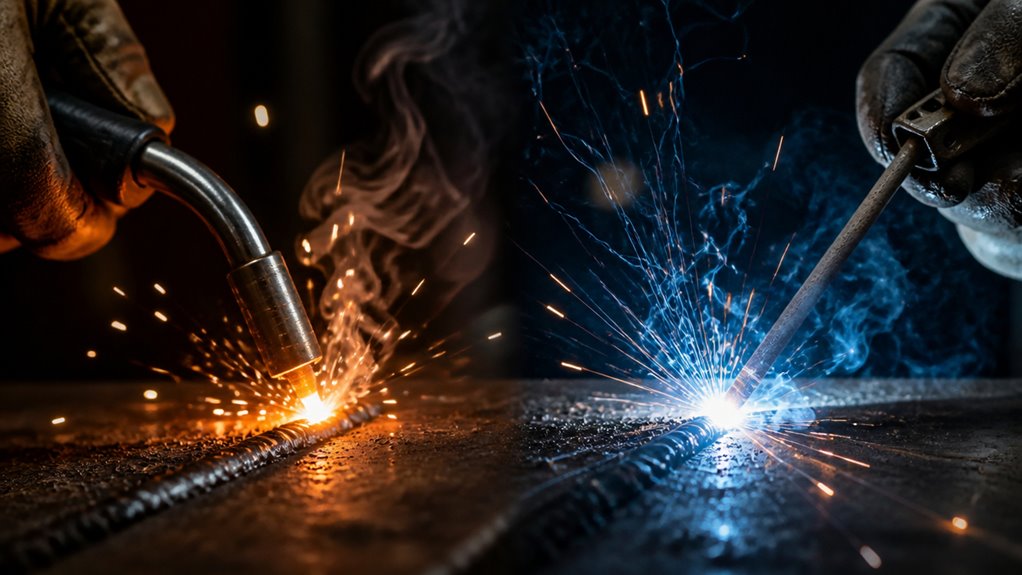
When choosing between flux-core and stick welding, consider your priorities: flux-core offers faster metal deposition with continuous wire feed, boosting productivity in cleaner shop settings.
Stick welding excels outdoors and on contaminated materials, providing deeper penetration and rugged reliability with minimal gear.
Flux-core requires more equipment and post-weld cleanup, while stick’s simplicity aids portability and versatility.
Your choice hinges on balancing speed against durability and environment; understanding these factors will clarify which method suits your project best.
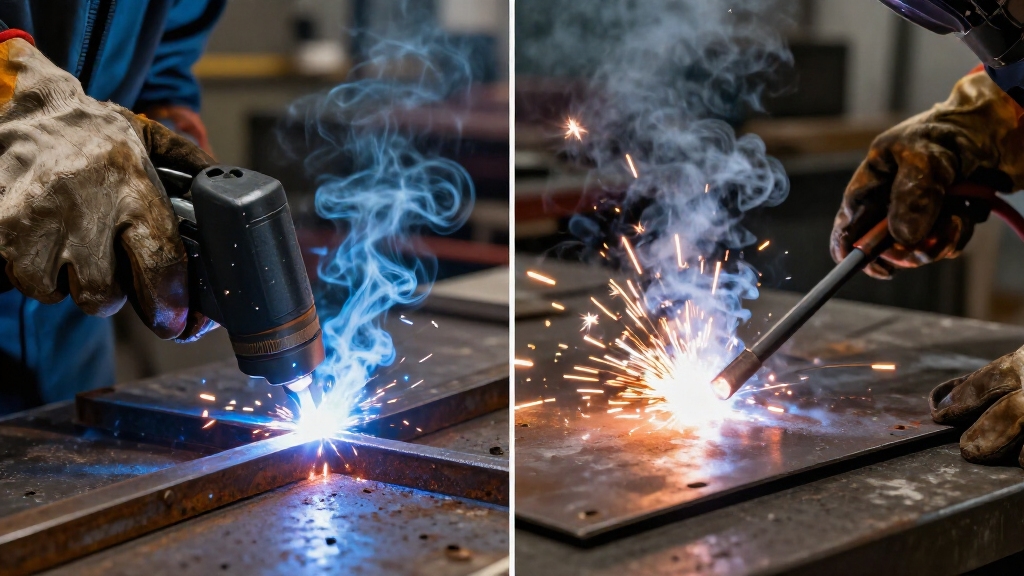
Although both flux-core and stick welding use flux to shield the weld pool, they differ fundamentally in their core processes.
While both use flux for protection, flux-core and stick welding operate through distinctly different methods.
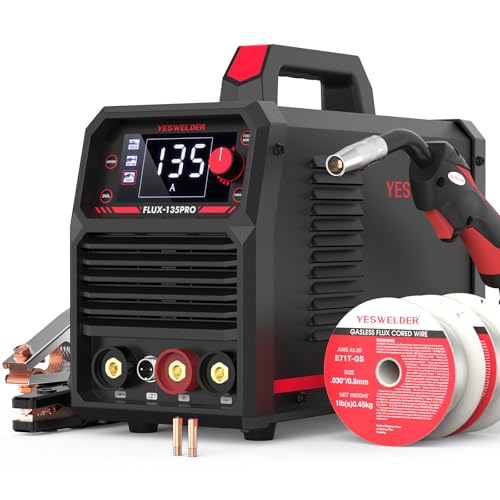
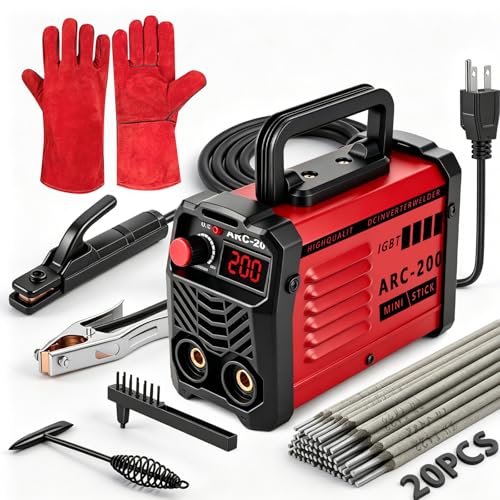
Stick welding employs a consumable electrode coated in flux held in an electrode holder, while flux-core welding uses a continuously fed tubular wire with flux inside. This wire is delivered through a wire feeder and gun.
You’ll notice stick welding, or SMAW, requires frequent electrode changes as rods are consumed, slowing the process. In contrast, flux-core welding, or FCAW, feeds wire continuously, increasing deposition rates markedly.
Stick welding’s simplicity means you only need an electrode holder and power source. Flux-core welding demands a wire feeder setup.
Both produce slag, but flux-core’s continuous feed improves speed and consistency. Stick welding offers rugged portability without additional equipment.
Understanding these distinctions helps you select the best method for your welding tasks. Additionally, flux-core welding’s semi-automatic operation delivers high deposition rates even on contaminated surfaces, making it highly efficient for demanding jobs.
When it comes to choosing between flux-core and stick welding, it really depends on what you’re working with. Flux-core welding shines when you’re dealing with cleaner steels and working in a controlled shop environment. It gives you a nice, smooth finish, which is great for those neat projects.
On the flip side, stick welding is your go-to for tougher conditions. If you’re up against rusty or painted surfaces, or if you’re working outdoors, stick welding really holds its own. It’s less picky about surface prep, thanks to its strong arc stability. Additionally, flux-core welding is often preferred for its self-shielding flux that makes it practical in outdoor and windy conditions.
When selecting between flux-core and stick welding, consider the specific materials and environmental conditions each process handles best.
Stick welding excels on rusty, dirty, or painted steel and thick materials. This makes it ideal for structural and field repairs.
Flux-core welding suits cleaner shop environments and offers faster deposition on steels and cast iron. However, it cannot weld aluminum in its common self-shielded form.
Flux-core welding’s continuous wire feed allows for higher deposition rates, improving productivity on suitable metals.
| Material Type | Stick Welding Suitability | Flux-Core Welding Suitability |
|---|---|---|
| Rusty/Dirty Steel | Excellent | Limited |
| Thick Steel | Excellent | Good |
| Aluminum | Not Suitable | Not Suitable |
This table highlights the distinct compatibility profiles you must evaluate when choosing between these welding methods.
Considering environmental conditions plays a critical role in determining whether flux-core or stick welding is the better choice for your project.
You’ll find stick welding excels in harsh, outdoor environments, handling wind and moisture effectively due to its rugged, self-contained flux coating.
This makes it ideal for field repairs on rusty or painted steel.
Flux-core welding, while also usable outdoors thanks to its self-shielded wire, performs best in controlled shop settings where you can leverage its higher deposition rates for productivity.
However, flux-core struggles somewhat in windy conditions compared to stick welding.
Therefore, you should select stick welding for rugged outdoor jobs and flux-core for faster, cleaner work indoors.
Flux-core welding requires slag removal after welding, which adds to post-weld cleanup compared to stick welding.
Although both flux-core and stick welding can tolerate less-than-perfect surfaces, understanding their differing sensitivities to material conditions is crucial for ideal results.
Stick welding excels on rusty, dirty, or painted steel because its flux-coated electrode effectively shields the arc from contaminants. This allows you to weld with minimal surface prep.
In contrast, flux-core welding, especially self-shielded FCAW, performs best on cleaner metal. Excessive rust or mill scale can degrade weld quality and increase spatter.
For flux-core, you should remove heavy corrosion and ensure a relatively clean surface to maintain arc stability and penetration.
If your work involves rough or outdoor environments with inconsistent surface conditions, stick welding offers more robustness.
Ultimately, your choice depends on the material’s cleanliness and the acceptable level of prep before welding.
To improve weld quality and safety, always thoroughly clean base metal before starting, regardless of the welding method used.
Flux-cored arc welding (FCAW) markedly outpaces stick welding in both speed and metal deposition rates, making it the preferred choice for productivity-focused tasks.
You’ll find FCAW deposits metal continuously via a wire feed. In contrast, stick welding requires frequent rod changes, slowing your progress.
Consider these key points:
When speed and metal deposition volume are critical, FCAW offers clear advantages.
Stick welding, while reliable, simply can’t match FCAW’s efficiency in controlled settings.
Often, stick welding proves the most reliable choice when working outdoors or on the move due to its minimal equipment requirements and strong resistance to environmental factors like wind.
You won’t need a wire feeder or gas bottle, simplifying your setup and enhancing mobility. Stick welding’s flux coating effectively shields the weld pool against contamination, maintaining arc stability despite drafts.
While flux-cored welding also offers self-shielded wire options that improve outdoor usability, it still requires a continuous wire feed system, adding complexity and weight.
Stick welding’s ruggedness and ability to handle dirty or rusty materials further increase its field reliability.
Additionally, controlling heat input during welding is crucial to prevent weak joints and ensure strong fusion in challenging outdoor conditions.
When setting up your welding equipment, you’ll want to weigh the portability and complexity of each method carefully.
Stick welding requires just an electrode holder and power source, making it highly portable and ideal for fieldwork without needing a wire feeder or gas bottle.
Flux-core welding needs a wire feeder and spool, adding setup complexity but increasing continuous operation efficiency.
Consider these factors:
Additionally, gasless flux-cored welding uses a self-shielded wire that eliminates the need for an external shielding gas, making it suitable for outdoor or windy conditions.
Choose based on your need for mobility versus continuous welding productivity.
After considering the setup and portability differences between stick and flux-core welding, it’s important to understand how these factors influence ease of use for beginners.
Flux-core welding simplifies operation by feeding wire continuously, eliminating frequent electrode changes required in stick welding. This steady wire feed helps you maintain a consistent arc length and travel speed, reducing common beginner errors like erratic arc strikes.
Additionally, flux-core’s higher deposition rate means you’ll complete welds faster, which keeps you engaged and builds confidence. The automatic wire feed also lessens hand fatigue, allowing you to focus on technique rather than electrode management.
While stick welding demands precise rod handling and timing, flux-core welding’s semi-automated process offers a more forgiving learning curve. This makes it easier for you to achieve stable, continuous welds early on.
You’ll notice that both flux-core and stick welding produce slag that needs to be cleaned up afterward. However, the characteristics of that slag and the amount of spatter can really differ.
When you’re stick welding, you typically get strong penetration and durable welds. The slag that forms is usually a bit easier to chip away, which is nice when you’re looking to clean up.
On the other hand, with flux-core welding, you might end up with more spatter and a finish that’s not as tidy. FCAW produces more fumes and spatter than stick welding, increasing post-weld cleanup effort.
Although both flux-core and stick welding rely on flux to shield the weld pool, the slag they produce differs noticeably in behavior and cleanup requirements.
When you weld with stick, the slag forms a thick, protective layer that solidifies rapidly.
This requires thorough chipping and brushing to avoid weld defects.
Flux-core slag tends to be thinner but can be more brittle and fragmented.
Consider these slag formation differences:
Understanding these distinctions helps you optimize post-weld cleanup and improve overall weld quality. Flux-cored arc welding (FCAW) typically generates more spatter and slag, which requires additional grinding and chipping compared to stick welding, impacting post-weld labor.
Welders frequently encounter spatter when using both flux-core and stick welding, but the amount and cleanup effort vary markedly between the two.
Flux-core welding tends to produce more spatter due to its higher deposition rate and continuous wire feed, which can scatter molten droplets around the weld zone. This results in a messier workspace and requires more thorough cleaning, typically with wire brushing or grinding.
Stick welding also generates spatter, but generally less, as each electrode produces a more controlled arc and slower deposition. Both processes produce slag that must be chipped off, but flux-core slag often adheres less firmly, sometimes simplifying removal.
Ultimately, flux-core demands more intensive cleanup, impacting workflow, while stick welding offers a cleaner finish but with slower metal deposition. Proper surface preparation before welding can help reduce spatter and improve overall weld quality.
When evaluating weld quality, penetration and strength are critical factors that differentiate stick and flux-core welding. Both methods rely on flux to shield the weld pool, but their penetration characteristics and resulting weld strength vary distinctly.
1. Stick Welding: It provides strong, deep penetration ideal for thick or contaminated materials. This produces durable, structurally sound welds.
Its slag must be removed post-weld, but the resulting joint integrity is excellent.
2. Flux-Core Welding: While it achieves good penetration, especially on thicker stock, it generally produces welds with slightly less depth than stick welding.
The continuous wire feed boosts deposition speed but increases spatter and requires more cleanup.
3. Application Impact: Choose stick welding for rugged, high-strength needs.
Flux-core suits faster production with acceptable strength and moderate cleanup demands.
Because stick welding employs a flux-coated electrode that provides robust arc stability and strong penetration, it excels in harsh environments where consistent performance is critical.
Stick welding’s flux-coated electrode ensures stable arcs and deep penetration, ideal for tough, demanding conditions.
You benefit from its ability to weld through contaminants like rust, paint, and dirt, which often compromise other welding methods.
Its simple equipment setup, with no wire feeders or external gas, makes it highly portable and reliable in field conditions, including wind and moisture.
The slag formed during welding acts as a protective barrier, ensuring the weld solidifies without contamination and enhancing durability.
When you need ruggedness and longevity in structural or heavy-duty repairs, stick welding’s deep fusion and slag protection outperform flux-cored alternatives.
This is especially true on thicker or less-than-ideal surfaces, guaranteeing weld integrity in demanding applications.
Although both flux-core and stick welding offer unique advantages, choosing between them hinges on balancing your need for speed against the versatility required by your specific application.
Flux-core welding excels in productivity due to continuous wire feed, depositing metal 2-4 times faster than stick welding.
Stick welding, however, provides superior adaptability in harsh environments and on contaminated surfaces.
Consider these factors:
Your choice depends on prioritizing rapid production versus rugged, versatile performance.
You can’t use self-shielded flux-core welding for aluminum because the flux inside the wire doesn’t provide the necessary shielding for aluminum’s oxide layer.
Aluminum requires a clean, inert shielding gas like argon, typically used in gas-shielded MIG or TIG welding.
If you want to weld aluminum efficiently, you’ll need a process designed for that metal, as flux-core wires aren’t formulated to handle aluminum’s unique properties.
You’ll want to wear full protective gear for both, but flux-core welding demands extra vigilance against spatter since it produces more.
Stick welding’s slag requires careful removal to avoid burns or contamination, so gloves and chipping hammers are essential.
Because flux-core wire feeds continuously, you must secure loose clothing to prevent catching.
Both need eye protection against UV rays, but flux-core often needs better ventilation due to its heavier smoke output.
You’ll find consumables for stick welding generally cost less per unit than flux-core wire spools. However, stick rods are used up more quickly, increasing overall expense over time.
Flux-core wire feeds continuously, reducing downtime and waste. This can lower labor costs despite higher material prices.
Ultimately, stick welding’s consumables are cheaper upfront. However, flux-core’s efficiency may save money in high-production settings where speed and less frequent replacement matter.
Yes, you’ll notice differences in electrical power requirements between flux-core and stick welding.
Flux-core welding typically needs a constant voltage power source to maintain a steady wire feed and arc.
Stick welding uses a constant current power source to stabilize the arc with the consumable electrode.
Flux-core often operates at higher amperage for faster deposition.
Stick welding runs at lower amperage but requires more voltage control to keep arc stability.
Oh, sure, if you want to punch holes in your delicate metal sheets, stick welding’s your best bet.
But if you actually want better results on thin metal, flux-cored welding edges ahead. Its continuous wire feed and controlled heat input reduce burn-through and warping.
You’ll appreciate flux-core’s smoother, faster welds on thin materials, minimizing unwanted damage while maintaining strong penetration.
Choosing between flux-core and stick welding is like picking the right tool for a complex puzzle.
Flux-core offers speed and ease, ideal for beginners and outdoor jobs, while stick welding delivers rugged durability and superior weld quality in challenging conditions.
By weighing your project’s demands, such as material type, environment, and mobility, you’ll weld the perfect balance of efficiency and strength.
Ultimately, your choice sharpens your craft, ensuring every joint stands firm under pressure.
Last update on 2026-11-07 / Affiliate links / Images from Amazon Product Advertising API
