Phone:
(701)814-6992
Physical address:
6296 Donnelly Plaza
Ratkeville, Bahamas.

Phone:
(701)814-6992
Physical address:
6296 Donnelly Plaza
Ratkeville, Bahamas.

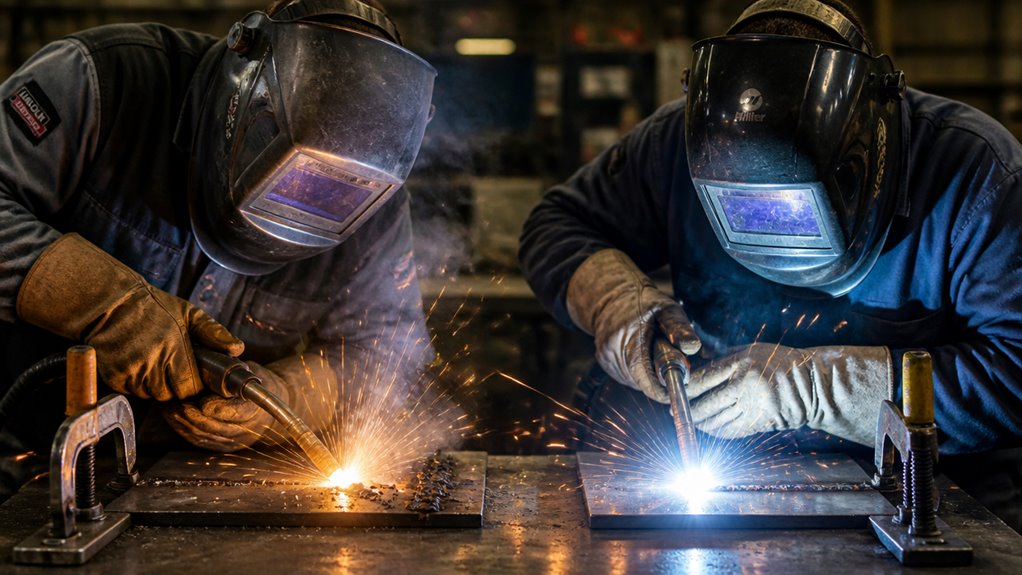
You’ll choose FCAW if you need strong, fast welds outdoors or on dirty materials. Its flux-generated shielding gas provides deep penetration.
GMAW suits you better for cleaner, slag-free welds indoors with thinner metals. It relies on external gas for precision but has less wind tolerance.
FCAW demands more cleanup with slag and fumes, while GMAW offers better aesthetics and less post-weld work. Understanding these core differences helps you optimize your welding approach for environment, quality, and productivity.
| Feature | FCAW | GMAW |
|---|---|---|
| Electrode | Flux-cored tubular wire | Solid wire |
| Shielding Method | Flux-generated shielding gas; self-shielded or gas-shielded | External shielding gas |
| Outdoor Performance | Excellent, especially in windy conditions | Limited due to wind-sensitive gas shielding |
| Penetration | Deeper | Generally shallower |
| Deposition Rate | Higher | Lower |
| Weld Appearance | Rougher, with more spatter and slag | Cleaner and smoother |
| Slag | Yes; requires removal | None |
| Post-Weld Cleanup | Higher | Minimal |
| Fume Generation | Higher | Lower |
| Dirty/Rusty Materials | Performs well with minimal preparation | Better suited to clean materials |
| Thin Materials | Less ideal | Excellent |
| Thick Materials | Excellent | Better for moderate thickness |
| Material Compatibility | Best suited to ferrous and structural metals | Well suited to aluminum, stainless steel, nickel alloys, and thinner metals |
| Operator Skill | Generally requires more experience | Generally easier to learn |
| Gas Requirement | Self-shielded FCAW can operate without external gas | Requires shielding gas |
| Portability | Excellent for job sites | Lower, especially with gas cylinders |
| Robotic Automation | Suitable | Excellent, particularly for clean, precise welds |
| Maintenance | More nozzle cleaning and slag buildup | Less slag-related maintenance; requires gas-flow checks |
| Main Advantage | High productivity, deep penetration, and strong outdoor performance | Clean, precise welds with minimal cleanup |
| Main Drawback | More fumes, slag, spatter, and cleanup | Vulnerable to wind and dependent on stable gas shielding |
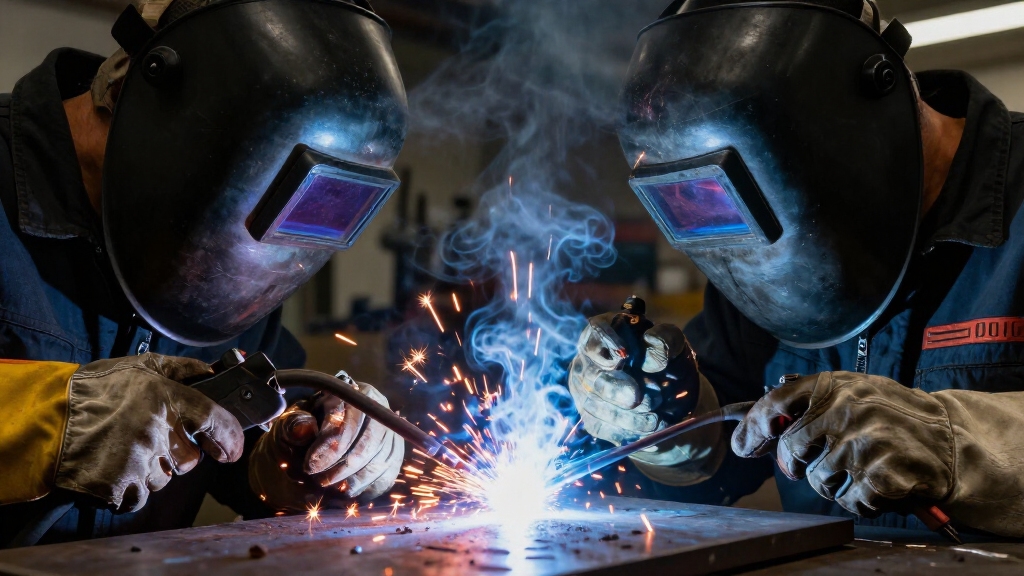
While both FCAW and GMAW are arc welding processes, they differ fundamentally in their electrode design and shielding methods.
FCAW employs a flux-cored tubular wire electrode, which generates shielding gas internally through the flux during welding. This allows you to use either self-shielded or externally gas-shielded versions.
In contrast, GMAW relies on a solid wire electrode and requires an external shielding gas supplied from a cylinder to protect the weld pool. This external gas creates a stable protective atmosphere but is sensitive to environmental factors like wind.
The core technical distinction lies in FCAW’s flux-based internal shielding versus GMAW’s dependency on external gas. Understanding this difference guides your choice based on job conditions, mobility needs, and shielding reliability during welding operations.
Additionally, FCAW’s self-shielding ability makes it especially practical for outdoor and windy conditions where maintaining external gas coverage is challenging.
Because FCAW uses a flux-cored wire that produces slag, you’ll need to spend more time on post-weld cleanup compared to GMAW, which leaves no slag behind.
This difference impacts both the appearance and efficiency of your welds. FCAW tends to generate more spatter, requiring extra grinding or chipping.
GMAW produces cleaner weld beads with minimal spatter. If weld aesthetics and minimal cleanup matter, GMAW is often preferable.
Key considerations include:
FCAW slag must be removed to guarantee weld integrity and appearance.
GMAW’s lack of slag reduces post-weld labor.
FCAW welds may show rougher surfaces due to spatter and slag.
GMAW provides smoother, more visually appealing welds suitable for cosmetic applications.
Understanding these distinctions helps you tailor your process to project demands.
Additionally, selecting the appropriate process based on material thickness and environment can optimize both weld quality and productivity.
When you take a look at FCAW and GMAW, you’ll see that FCAW really stands out with its higher deposition rates. This means you can build up welds more quickly, which is a big plus when you’re on a tight schedule.
Plus, FCAW usually provides deeper penetration. This feature is especially important when you’re working with thicker materials or tackling structural projects. Knowing these distinctions can really help you boost productivity and ensure the weld integrity meets your project’s needs.
Additionally, FCAW’s ability to perform well on contaminated or rusty surfaces makes it ideal for challenging environments and outdoor work with minimal surface preparation.
Although both FCAW and GMAW serve valuable roles in welding, FCAW delivers markedly higher deposition rates. This makes it ideal for projects where productivity is critical.
This advantage stems from FCAW’s flux-cored tubular wire, which deposits filler metal faster than GMAW’s solid wire. When you prioritize rapid material buildup, FCAW outperforms GMAW, especially on thicker sections.
FCAW’s higher deposition rate reduces welding time on heavy-duty jobs. The flux core generates slag, requiring post-weld cleanup, unlike GMAW’s slag-free welds.
GMAW offers cleaner welds but at slower deposition rates suited for thinner materials. FCAW’s self-shielding option minimizes gas use, enhancing portability and efficiency outdoors.
Choosing between the two hinges on balancing your need for speed against cleanup and weld appearance. Additionally, FCAW’s ability to deliver deeper penetration makes it particularly effective for thicker or rusted materials where GMAW may struggle.
Since penetration depth directly affects weld strength and durability, understanding how FCAW and GMAW compare is crucial for selecting the right process.
FCAW typically achieves deeper penetration due to its flux-cored wire, which generates a more concentrated arc and enhanced heat input. This makes FCAW ideal for thicker materials and applications requiring robust root fusion.
In contrast, GMAW’s solid wire and reliance on external shielding gas produce shallower penetration, suitable for thinner sections where precise control and minimal distortion are necessary.
While FCAW penetration supports higher productivity in heavy-duty tasks, GMAW offers better control in clean, moderate-thickness applications.
You should weigh penetration needs, material thickness, and environmental conditions to optimize weld quality and efficiency when choosing between FCAW and GMAW.
Using pure CO2 shielding with FCAW can maximize penetration, especially for thick sections, though it may increase spatter and require more post-weld cleanup.
Because shielding integrity is critical to weld quality, you must carefully consider the welding environment before choosing between FCAW and GMAW.
GMAW relies on an external shielding gas, making it vulnerable to wind and drafts. It excels in controlled indoor settings.
FCAW, especially self-shielded types, forms protective shielding from flux inside the wire. This offers greater reliability outdoors.
Key considerations include:
Matching the process to your environment optimizes weld consistency and reduces defects caused by shielding gas loss. Additionally, humidity effects can increase weld porosity by up to 30%, impacting the integrity of GMAW welds in less controlled settings.
Understanding how FCAW and GMAW perform in different environments leads naturally toward evaluating their suitability for various materials and applications.
Exploring FCAW and GMAW performance guides selecting the best process for specific materials and applications.
You’ll find FCAW excels with ferrous metals and structural steel, making it ideal for heavy fabrication, construction, and shipbuilding. Its deeper penetration and higher deposition rates suit thick, dirty, or rusty materials well.
On the other hand, GMAW works best with aluminum, stainless steel, nickel alloys, and thinner materials, favoring applications like automotive manufacturing and general fabrication. You’ll also prefer GMAW when a clean, slag-free finish is essential.
Ultimately, your choice hinges on material type, thickness, and the nature of the work environment. This aligns FCAW with rugged, high-productivity tasks and GMAW with precision and cleaner aesthetics. For outdoor or windy conditions, FCAW’s use of self-shielded flux-cored wire makes it particularly advantageous due to its internal gas generation and resistance to atmospheric contamination.
While choosing between FCAW and GMAW, you need to weigh practical tradeoffs such as cost implications, fume generation, and operational ease.
FCAW consumables tend to be pricier, but self-shielded options reduce gas costs.
GMAW generally emits fewer fumes, minimizing health risks and cleanup time.
Operationally, GMAW is simpler to use indoors with stable shielding gas.
FCAW excels outdoors or in windy conditions due to flux shielding.
Consider these points:
FCAW offers higher productivity but requires slag removal, increasing post-weld labor.
GMAW provides cleaner welds with minimal spatter and no slag.
FCAW’s fumes are typically higher, necessitating better ventilation.
GMAW demands consistent gas flow, which can complicate outdoor use.
Your choice hinges on balancing cost, environment, and workflow efficiency.
Additionally, selecting the correct shielding gas is critical to minimize spatter and ensure arc stability in both processes.
You’ll find GMAW generally requires less operator skill due to its simpler setup and cleaner welds with minimal slag, making it easier to manage.
FCAW demands more experience because you must control slag removal and manage higher spatter levels.
Its self-shielding variant needs careful technique in windy conditions.
So, if you’re less experienced or prefer straightforward cleanup, GMAW suits you better.
FCAW suits skilled operators handling tougher environments.
You might think FCAW’s slag would complicate automation, but both FCAW and GMAW work effectively for robotic welding.
GMAW’s clean, low-spatter welds simplify post-weld processing, making it ideal for precise, high-speed automation.
However, FCAW offers higher deposition rates and deeper penetration, useful for heavy-duty robotic tasks.
Your choice depends on material thickness, environment, and production speed targets, but both processes integrate well with modern robotic systems.
You’ll need extra ventilation with FCAW because it generates more fumes and slag. These can irritate your respiratory system and skin.
With GMAW, focus on maintaining proper shielding gas flow. Disruptions can cause harmful UV exposure and spatter.
Both require standard PPE: welding helmets, gloves, and protective clothing. However, FCAW demands diligent slag removal to avoid burns.
You should also monitor for potential gas leaks in GMAW setups to prevent asphyxiation risks.
When welding galvanized steel, you’re negotiating a minefield of zinc fumes and coating challenges.
FCAW handles thicker galvanized steel better due to its deeper penetration. However, it generates more fumes and slag, requiring thorough cleanup.
GMAW offers cleaner welds with less spatter and easier post-weld work on thinner galvanized sheets. Yet, it demands careful gas shielding to prevent porosity.
Your choice hinges on thickness, ventilation, and cleanup tolerance.
Yes, you’ll notice distinct maintenance needs between FCAW and GMAW.
FCAW’s flux-cored wire tends to cause more nozzle clogging and slag buildup, requiring frequent cleaning.
GMAW’s solid wire and external shielding gas reduce spatter and slag, so you’ll spend less time on cleanup and nozzle maintenance.
However, GMAW demands consistent gas flow checks and regulator upkeep.
Your maintenance routine will vary based on these equipment sensitivities and consumable behaviors.
When choosing between FCAW and GMAW, consider your priorities: FCAW offers deeper penetration, higher productivity, and better outdoor performance.
GMAW delivers cleaner welds, easier cleanup, and superior appearance indoors.
Balance cost against fumes, weigh ease of use against material compatibility, and factor in your specific application needs.
By analyzing these tradeoffs carefully, you’ll select the welding method that optimizes efficiency, quality, and practicality for your project’s success.