Phone:
(701)814-6992
Physical address:
6296 Donnelly Plaza
Ratkeville, Bahamas.

Phone:
(701)814-6992
Physical address:
6296 Donnelly Plaza
Ratkeville, Bahamas.

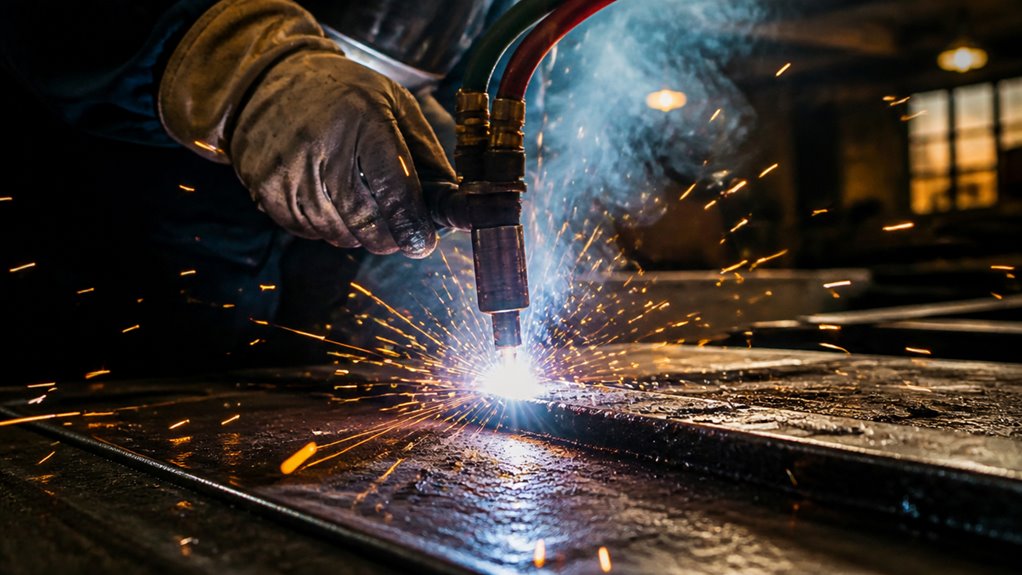
Dual shield welding combines flux-cored wire with an external shielding gas to give you deep penetration and stable arcs for thick steel.
You’ll benefit from higher deposition rates, cleaner weld beads, and reduced spatter compared to self-shielded options.
The flux inside the wire forms protective slag, while the gas prevents contamination.
Precise control of wire feed, gas flow, and technique guarantees defect-free, corrosion-resistant joints.
Keep exploring to understand its materials, methods, and ideal applications.
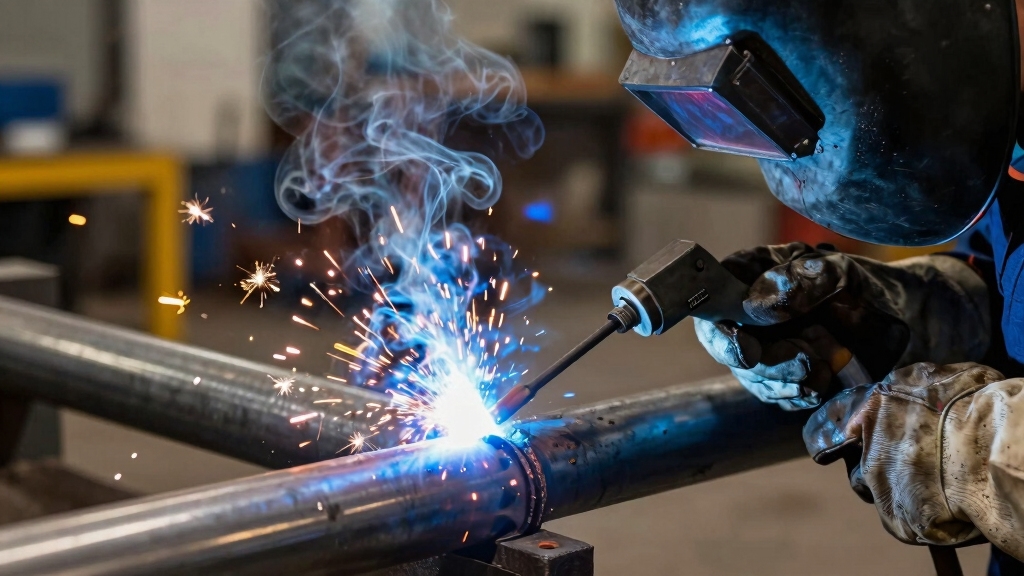
To get a firm grasp on dual shield welding, you need to understand how it merges flux-cored wire with an external shielding gas to optimize arc stability and weld quality.
Dual shield welding combines flux-cored wire with shielding gas for superior arc stability and weld quality.
You feed a hollow flux-cored wire through the welding gun while simultaneously releasing a shielding gas, commonly CO2 or a CO2/argon blend, that prevents atmospheric contamination.
As the direct current electrode positive (DCEP) polarity powers the arc, it melts both the wire and base metal. The flux inside the wire generates a protective slag covering the weld pool.
This dual shielding results in deep penetration, stable arc characteristics, and reduced spatter.
You control welding parameters such as wire feed speed and gas flow to ensure consistent deposition and mechanical integrity.
This makes the process highly effective for thick, dirty, or rusty steel applications.
The use of an external shielding gas in dual-shield welding significantly improves arc stability and reduces slag compared to self-shielded variants.
When it comes to dual shield welding, you’ll want to pay close attention to the shielding gases you use. A common choice is a 75/25 argon-CO2 mix, but pure CO2 can also do the job well. These gases help protect the weld pool from contamination, which is super important for a clean weld.
Now, let’s talk about the flux-cored wire. Choosing the right one, like a .045″ Boehler E71T-1, can really make a difference. It’s all about getting that peak penetration and mechanical strength you’re aiming for.
When you combine the right shielding gas with the right wire, you’re setting yourself up for success. Together, they work to ensure a stable arc and help minimize any defects in your welds. So, make sure to choose wisely! Using a gas-shielded flux core wire in dual shield welding improves arc stability and results in cleaner welds with less spatter.
A critical component in dual shield welding is the choice of shielding gas, which directly influences arc stability, weld quality, and penetration depth. You typically use either pure CO2 or a 75/25 argon/CO2 mix (C25).
Pure CO2 offers deeper penetration but increases spatter. C25 stabilizes the arc and reduces spatter for cleaner welds. Gas flow rates must be controlled precisely to avoid porosity and assure consistent coverage.
Properly balancing the reactive gases like carbon dioxide is essential to maintain optimal arc stability and weld characteristics.
| Gas Type | Composition |
|---|---|
| Pure CO2 | 100% Carbon Dioxide |
| C25 | 75% Argon / 25% CO2 |
| C10 | 90% Argon / 10% CO2 |
| Argon | 100% Argon |
| Argon/Oxygen Mix | Argon with 1-5% Oxygen |
Each gas affects weld characteristics differently. Select based on material and application.
Selecting the appropriate flux-cored wire is essential for optimizing dual shield welding performance. You’ll primarily encounter wires like the .045″ (1.1mm) Boehler E71T-1, engineered for thick steel and contaminated surfaces.
These wires feature a hollow flux core, which resists crushing and guarantees consistent feed rates. The flux composition governs slag formation, arc stability, and weld metal chemistry, directly affecting penetration and mechanical properties.
You’ll also consider wire classification based on tensile strength and usability in all positions. Matching wire characteristics with the shielding gas—typically 75/25 argon/CO2 or pure CO2—is critical to minimizing spatter and porosity.
Additionally, the flux core eliminates the need for external shielding gas in some conditions, providing versatility for outdoor welding and improved weld quality.
Because dual shield welding combines both flux-cored wire and external shielding gas, it delivers superior weld strength and cleanliness compared to other arc welding methods. You benefit from deep penetration and high deposition rates, ensuring robust mechanical properties and less spatter.
This process offers better puddle control, producing cleaner weld beads, which reduces post-weld cleanup. It’s especially effective on thicker, dirty metals where consistent quality is critical.
| Feature | Benefit | Impact on Weld Quality |
|---|---|---|
| Flux-cored wire | Slag formation | Protects molten pool, reduces porosity |
| External shielding gas | Prevents contamination | Enhances arc stability, cleaner welds |
| Deep penetration | Strong joint integrity | Improves mechanical strength |
| Reduced spatter | Less post-weld cleaning | Saves time, improves appearance |
Dual shield welding is often chosen for applications requiring high deposition rates and fast welding speeds, making it ideal for industrial and heavy fabrication work.
Mastering effective dual shield welding techniques requires understanding how wire feed, gun angle, and travel speed interact to produce strong, defect-free welds.
You’ll want to maintain a consistent wire feed rate that matches the amperage setting, ensuring stable arc characteristics and proper metal deposition.
Adjust your gun angle according to the weld position: typically 10 to 15 degrees push angle for flat or horizontal, and a slight drag angle for vertical uphill welding to promote penetration.
Travel speed directly influences bead shape and penetration depth; too fast causes lack of fusion, too slow leads to excessive reinforcement.
You must also control contact tip to work distance carefully to avoid spatter and maintain arc stability.
Finally, employing the drag technique for flat welds and triangle manipulation for vertical positions optimizes slag coverage and weld integrity.
Using a multi process welder can simplify switching between dual shield and other welding processes, enhancing versatility and efficiency on varied projects.
While dual shield welding delivers strong, efficient welds, you need to address common issues like slag inclusions, porosity, and lack of fusion to guarantee peak results.
First, maintain optimal shielding gas flow. Too low invites contamination, while too high causes turbulence and porosity.
Control your contact tip to work distance (CTWD) precisely. Excessive CTWD reduces wire feed stability, increasing spatter and fusion defects.
Use the correct polarity, typically DCEP, and apply consistent travel speed to ensure proper heat input and penetration.
Clean your base metal thoroughly to minimize slag entrapment and porosity.
Finally, employ appropriate welding techniques. Use drag for flat welds and triangle manipulation for vertical to promote slag removal and uniform fusion.
These controls minimize defects and maximize weld integrity in dual shield applications.
Additionally, remember that dual shield welding combines flux core wire with external shielding gas, leveraging both self-shielding flux core and gas protection to enhance weld quality.
Although dual shield welding demands careful control and technique, its advantages make it a preferred choice across several heavy-duty industries.
You’ll find it indispensable when working with thick steel and critical welds, thanks to its deep penetration and high deposition rates.
Industries rely on dual shield welding for structurally demanding projects that require strong, defect-free joints.
Key applications and industries include:
Its combination of flux-cored arc welding and gas shielding provides enhanced multi-pass welding capabilities essential for thick plate joints.
You can expect to invest roughly $2,500 to $5,000 for a reliable dual shield welding setup. This includes the welding power source, wire feeder, welding gun, and a gas cylinder.
Higher-end models with advanced controls or automated feeders can push costs beyond $7,000. Keep in mind, consumables like flux-cored wire and shielding gas add ongoing expenses.
Balancing initial cost with productivity gains is essential for your welding operations.
You can expect to learn dual shield welding proficiently within 3 to 6 months of consistent hands-on practice, assuming you have prior welding experience.
Mastering the process requires understanding wire feed settings, gas flow control, and slag removal techniques.
Developing steady manipulation for various positions, especially vertical and overhead, takes focused training.
Your proficiency improves markedly through real-world applications and troubleshooting common defects like porosity and slag inclusions.
Yes, you can automate dual shield welding for robotic systems like a conductor directing a precise orchestra.
Its consistent wire feed, gas flow, and stable arc suit robotic control perfectly.
Automation enhances productivity and weld quality on thick steel components, especially in structural and heavy equipment fabrication.
You’ll need precise programming to manage parameters like wire speed, gas mix, and torch angle to prevent defects and optimize penetration and deposition rates.
You need to guarantee proper ventilation to handle both flux fumes and shielding gas exposure unique to dual shield welding.
Wearing a respirator is vital since flux-cored wire produces more smoke.
Control gas flow precisely to prevent oxygen contamination and avoid gas leaks.
Use insulated gloves and protective clothing to shield against intense arc radiation and hot slag.
Finally, maintain a stable workspace to minimize slag inclusions and porosity risks impacting weld quality.
Picture a sudden gust scattering shielding gas like leaves in the wind.
Outdoor dual shield welding performance suffers because wind disrupts the protective gas flow, inviting oxygen and nitrogen contamination.
You’ll face increased porosity, slag inclusions, and weaker welds.
To maintain arc stability and weld integrity, you must control gas flow meticulously, use windshields, or opt for indoor environments.
Weather conditions directly dictate your weld quality and consistency outdoors.
You might think mastering dual shield welding is complex, but it’s actually a precise balance of materials, technique, and control.
These are the same factors that guarantee strong, clean welds. When you apply the right shielding gases and maintain proper parameters, you avoid common defects while achieving superior results.
By understanding its process and components, you can confidently use dual shield welding to meet the demanding standards of various industries.