Phone:
(701)814-6992
Physical address:
6296 Donnelly Plaza
Ratkeville, Bahamas.

Phone:
(701)814-6992
Physical address:
6296 Donnelly Plaza
Ratkeville, Bahamas.

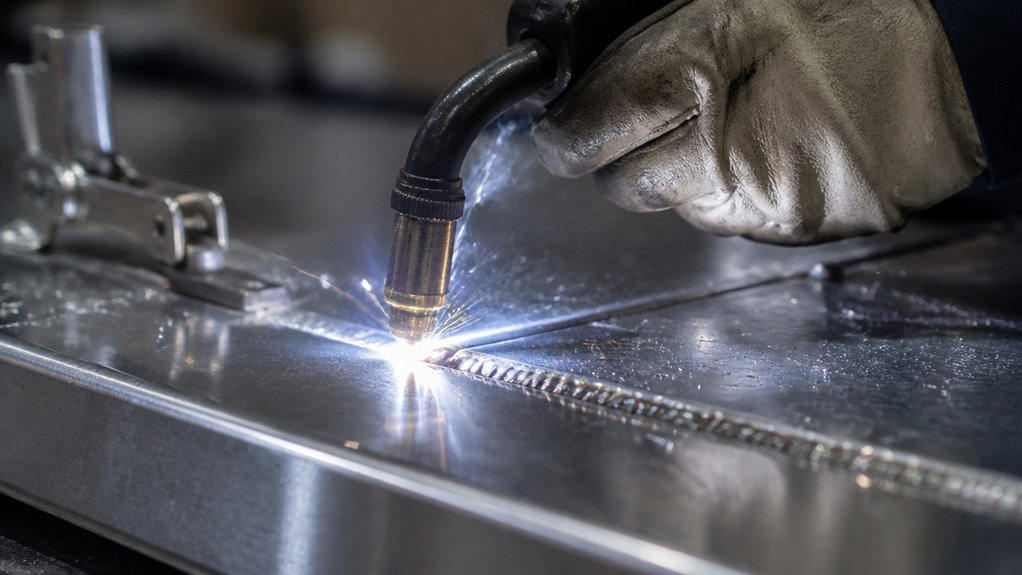
To weld aluminum with a spool gun, use 100% argon shielding gas at 20–35 cfh for clean coverage and prevent porosity.
Load aluminum wire with proper downward feed, adjust idler wheel tension to avoid burnback, and keep wire stickout between ½” and ¾”.
Maintain a 10–20° gun angle using a push technique.
Fine-tune voltage and wire speed for stable arc and penetration.
Master these basics, and you’ll improve weld quality and troubleshoot issues more effectively.
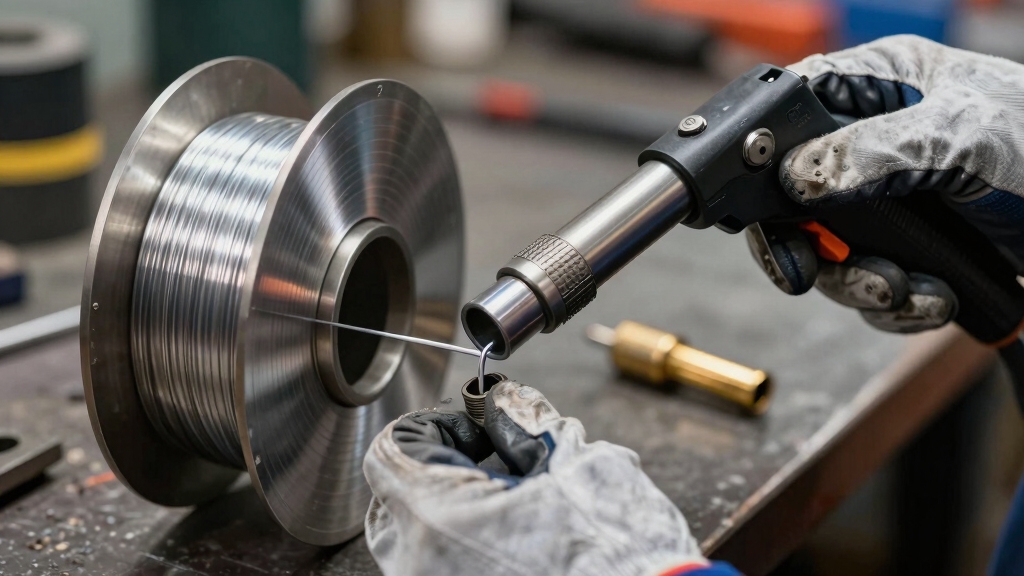
Begin by integrating the spool gun with your MIG welding machine. Ensure you connect it through the control jack to enable trigger functionality.
Start by connecting the spool gun to your MIG welder via the control jack for trigger operation.
Next, load the aluminum wire onto the spool, taking care that it feeds downward through the gun’s internal mechanism. Adjust the idler wheel tension to secure the wire without crushing it. This enables consistent feeding when the trigger is engaged.
Verify the internal feed components, including clamp, idler wheel, and feed roller, are clean and properly aligned. This will help avoid wire slippage or feeding issues.
Utilize the spool gun’s onboard wire feed control to fine-tune feed speed directly. This eliminates the need to access the main welder for adjustments.
Finally, double-check all electrical connections and ensure the spool gun trigger operates smoothly before proceeding.
Using a spool gun with aluminum-specific liners and drive rolls helps prevent bird-nesting and feeding inconsistencies during welding.
Why is using pure 100% argon gas essential for aluminum welding? Argon provides an inert atmosphere that prevents oxidation and contamination, guaranteeing a clean, strong weld.
Unlike steel, aluminum requires this pure shielding to avoid weld defects caused by reactive gases.
When choosing argon gas and flow rate, consider:
Use 100% argon exclusively; argon/CO2 mixes cause porosity and contamination.
Set flow rate between 20 to 35 cfh to maintain stable shielding without turbulence.
Monitor for black soot around the weld as an indicator of insufficient gas coverage.
Utilize existing gas regulators compatible with argon to control precise flow rates.
Proper argon selection and flow rate maintain weld integrity, minimize oxidation, and guarantee consistent arc stability when welding aluminum with a spool gun.
Additionally, maintaining recommended gas flow rates of 20–50 CFM ensures effective shielding and prevents porosity during the welding process.
After ensuring you have the correct pure argon gas setup and flow rate, the next step involves properly loading the aluminum wire into the spool gun and adjusting the feed mechanism.
Begin by securing the spool of aluminum wire onto the gun’s spindle, ensuring it spins freely without obstruction.
Start by mounting the aluminum wire spool securely, allowing it to rotate smoothly without any hindrance.
Feed the wire downward through the gun’s internal channel, passing it between the clamp, idler wheel, and feed roller.
Adjust the idler wheel tension to pinch the wire firmly but without deforming it, allowing consistent, controlled feeding when the trigger is engaged.
Confirm the wire feeds smoothly by manually advancing it before welding.
Proper tension prevents wire slippage and burnback, ensuring stable arc formation and consistent bead quality throughout the welding process.
Using a spool gun with pulsed MIG capability can further reduce spatter and enhance feeding consistency during aluminum welding.
Maintain a consistent gun angle between 10 to 20 degrees to guarantee peak shielding gas coverage and prevent atmospheric contamination during aluminum welding. This angle ensures the argon gas adequately shields the weld pool, minimizing oxidation and porosity.
Alongside angle, wire stickout is critical; keep it between 1/2 to 3/4 inch for optimal arc stability and penetration without risking burnback or contact tip fouling.
Key points to remember:
Precise angle and stickout control yield clean, defect-free aluminum welds. Using zirconiated tungsten electrodes can further enhance arc stability and reduce contamination when welding aluminum.
Controlling the gun angle and wire stickout sets the foundation for clean aluminum welds. However, how you move the gun along the joint equally impacts bead quality.
Using the push angle technique means you advance the gun in the direction of travel with a consistent 10-15 degree work angle. This maintains optimal gas shielding, reduces soot, and produces smoother, defect-free beads.
Avoid pulling or dragging the gun, as this compromises shielding and bead appearance.
For aluminum welding on thicker sections, incorporating helium into argon can increase heat input and penetration for improved weld quality.
| Parameter | Recommendation |
|---|---|
| Gun angle | 10-15 degrees push |
| Motion direction | Forward push |
| Stickout length | 1/2″ to 3/4″ |
| Shielding gas | 100% argon, 20-35 cfh |
Following these guarantees uniform bead contour and improved penetration.
While setting initial parameters gives you a starting point, you’ll need to fine-tune voltage and wire speed to optimize your aluminum welds. Adjusting these settings directly affects bead shape, penetration, and heat input.
Start by reducing voltage slightly from chart recommendations if you notice burn-through or excessive spatter. Then, calibrate wire speed to match voltage; too high causes burn-back and too low leads to poor fusion.
Monitor bead appearance and adjust incrementally for smooth, consistent welds.
Lower voltage by 0.5–1 volt if the bead is too fluid or causes burn-through.
Increase wire speed to improve penetration but avoid excessive spatter.
Balance settings to minimize black soot and guarantee a stable arc.
Use the spool gun’s onboard feed control for precise wire speed adjustments.
Systematic tweaking guarantees superior aluminum weld quality.
For optimal results, remember that using 100% pure argon as a shielding gas provides the best arc stability and contamination prevention during aluminum welding.
Identifying and addressing common issues in aluminum welding guarantees consistent, high-quality results. If you encounter porosity, excessive spatter, or burn-through, systematically check your setup and parameters.
Adjust wire feed speed, voltage, and gas flow carefully. Maintain correct stickout and keep your gun angle consistent to assure shielding gas coverage. Proper cleaning of aluminum before welding is essential to avoid defects caused by contaminants and oxide layers, which can lead to porosity and weak joints.
| Issue | Cause | Solution |
|---|---|---|
| Porosity | Insufficient gas shielding | Increase argon flow to 35 cfh |
| Burn-through | Excessive heat or slow travel | Reduce voltage; increase speed |
| Wire burnback | Excessive stickout | Adjust stickout to 1/2–3/4 inch |
| Contact tip fouling | Poor wire feed tension | Adjust idler wheel tension |
You can use a spool gun primarily for aluminum welding due to its design for softer wire feeding.
While technically possible to weld other metals, spool guns aren’t optimized for steel or stainless steel. Standard MIG feeders perform better with heavier wire spools.
Using a spool gun on non-aluminum metals may cause feeding issues and inconsistent arc stability. For best results, match your gun type to the specific metal and wire characteristics you’re welding.
Like tuning a fine instrument, you should clean or replace the contact tip regularly to maintain peak welding performance.
Inspect it before each session; if you notice wire burnback, spatter buildup, or inconsistent wire feeding, clean it immediately.
Replace the tip after several cleanings or if damage or wear persists.
Consistent maintenance prevents arc instability and ensures smooth wire feeding, vital for precise, high-quality welds every time you pull the trigger.
You should wear a welding helmet with a proper shade, usually #10-#12, to protect your eyes from intense UV and IR radiation during aluminum welding.
Use flame-resistant gloves and a long-sleeve welding jacket to shield your skin from sparks and heat.
Respiratory protection is vital since aluminum welding fumes can be hazardous; use a respirator or ensure adequate ventilation.
Don’t forget ear protection to prevent noise-related damage and safety boots for foot protection.
Welding aluminum with a spool gun outdoors in windy conditions is like trying to hold water in a sieve.
It’s challenging.
Wind disrupts argon gas shielding, leading to contamination, heavy soot, and poor weld quality.
You need windbreaks or enclosures to maintain stable gas coverage.
Without them, the protective argon layer becomes inconsistent, causing weld defects.
Always monitor gas flow and gun angle carefully to mitigate wind effects and achieve consistent, high-quality welds.
To prevent oxidation, store aluminum wire in a clean, dry environment with low humidity.
Keep the wire sealed in its original packaging or an airtight container with desiccant packs to absorb moisture.
Avoid exposure to air and contaminants by handling wire with clean gloves.
Regularly inspect the wire for oxidation or discoloration before use, as oxidized wire can cause poor arc stability and weld defects.
Proper storage guarantees consistent wire feed and weld quality.
So, now you know how to weld aluminum with a spool gun. Who wouldn’t want to master the art of feeding wire like a pro, tweaking voltage like a mad scientist, and battling porosity like a gladiator?
Just remember, pure argon and the perfect push angle aren’t optional; they’re your new best friends. Keep adjusting, keep grinding, and soon, you’ll weld aluminum so clean even your toughest critics will want to borrow your spool gun.