Phone:
(701)814-6992
Physical address:
6296 Donnelly Plaza
Ratkeville, Bahamas.

Phone:
(701)814-6992
Physical address:
6296 Donnelly Plaza
Ratkeville, Bahamas.

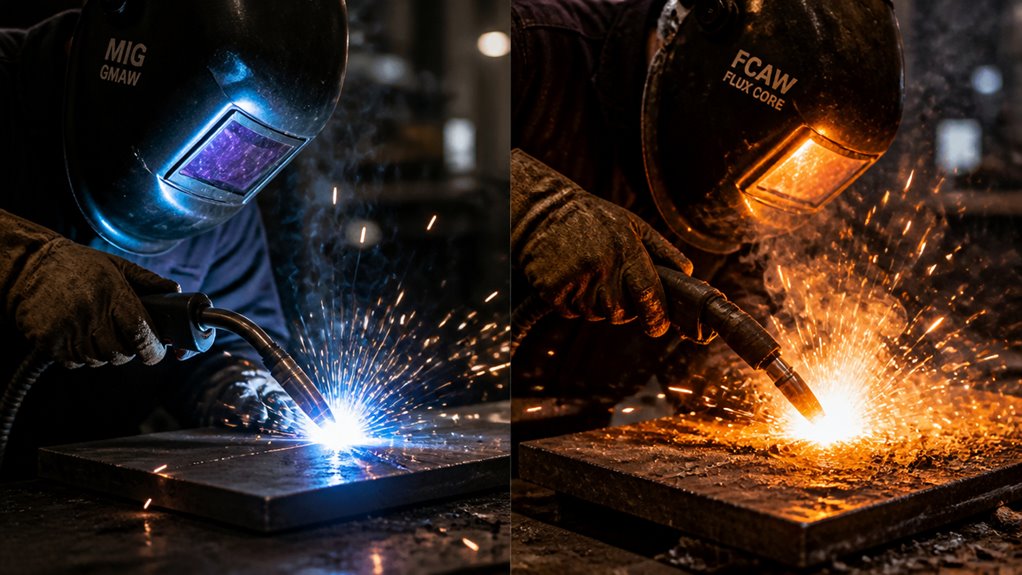
You’ll find MIG welding ideal for clean, indoor jobs on thinner, well-prepped metals. Its solid wire and consistent external gas shielding produce precise, low-spatter welds.
FCAW, on the other hand, uses flux-cored wire that shields internally. This provides deeper penetration and better performance on thick, rusty, or outdoor materials.
With higher deposition rates but more cleanup, understanding these fundamental differences helps you optimize process choice and efficiency based on your environment and material needs.
| Feature | MIG Welding | FCAW Welding |
|---|---|---|
| Full Name | Metal Inert Gas Welding | Flux-Cored Arc Welding |
| Wire Type | Solid wire electrode | Flux-cored wire |
| Shielding Method | External shielding gas required | Flux-generated shielding (with or without gas) |
| Best Environment | Indoor, controlled conditions | Outdoor and indoor environments |
| Wind Resistance | Poor | Excellent (self-shielded FCAW) |
| Weld Appearance | Cleaner and smoother | Rougher with more spatter |
| Spatter Level | Low | Higher |
| Cleanup Required | Minimal | More extensive |
| Fume Production | Lower | Higher |
| Penetration Depth | Moderate | Deeper penetration |
| Thin Metal Performance | Excellent | Good |
| Thick Metal Performance | Good | Excellent |
| Rusty/Dirty Metal | Requires clean surfaces | Handles contaminated surfaces better |
| Deposition Rate | Moderate | Higher |
| Welding Speed | Fast | Faster on heavy materials |
| Portability | Less portable due to gas cylinder | More portable, especially self-shielded FCAW |
| Equipment Complexity | More gas-related equipment | Simpler with self-shielded wire |
| Initial Equipment Cost | Moderate | Lower for self-shielded setups |
| Operating Cost | Lower wire cost, gas required | Higher wire cost, no gas needed for FCAW-S |
| Best Applications | Automotive work, fabrication, thin steel | Structural steel, construction, heavy fabrication |
| Main Advantage | Clean welds with minimal finishing | High productivity and deep penetration |
| Main Drawback | Sensitive to wind and surface contamination | More fumes, slag, and cleanup |
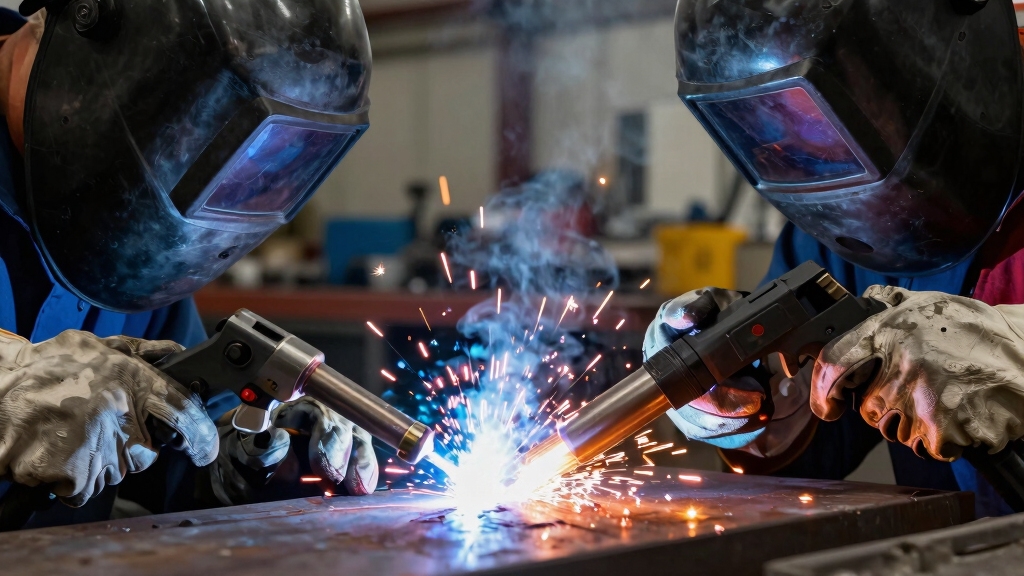
Although both MIG and FCAW are continuous wire-fed arc welding processes, they fundamentally differ in wire composition and shielding methods.
MIG uses a solid wire electrode and depends on an external shielding gas cylinder to protect the weld pool.
In contrast, FCAW employs a flux-cored wire filled with fluxing agents that provide shielding internally or combined with external gas in FCAW-G.
FCAW uses a flux-cored wire that shields the weld internally or with added external gas.
This flux stabilizes the arc and can add alloying elements, enhancing penetration and weld strength.
MIG’s external gas shielding is vulnerable to wind interference, making FCAW’s self-shielding more suitable for outdoor conditions.
Additionally, MIG’s process generally results in cleaner welds with less spatter.
FCAW tends to produce more fumes and requires more post-weld cleanup, particularly in self-shielded modes.
The flux core welding process offers consistent welds with minimal spatter and high deposition rates, even on contaminated surfaces.
When you’re trying to pick between MIG and FCAW, it’s important to think about where you’ll be working and how thick the materials are. MIG is fantastic for indoor projects, especially when you’re dealing with thinner, cleaner metals.
On the other hand, FCAW really shines when you’re outside or working with thicker, rusted surfaces.
Another thing to consider is portability. FCAW uses self-shielded wires, which means you won’t need as much equipment. This makes it a lot easier to move around.
Additionally, FCAW produces more slag and spatter, which requires extra cleanup compared to MIG.
Since environmental conditions heavily influence weld quality, choosing between MIG and FCAW depends largely on whether you’re working indoors or outdoors.
Indoors, MIG welding excels due to its reliance on external shielding gas, providing cleaner welds with minimal spatter and less post-weld cleanup.
Controlled environments protect the shielding gas from contamination, ensuring metallurgically higher-quality welds and superior aesthetics.
Conversely, outdoors, wind disrupts MIG’s gas shield, causing defects and porosity.
Here, FCAW, especially self-shielded FCAW-S, offers greater reliability because its flux core generates shielding internally, eliminating gas interference issues.
FCAW also tolerates dirt and rust better, making it ideal for fieldwork.
When portability and protection from environmental factors are priorities, FCAW is your go-to.
Ultimately, your choice hinges on balancing weld quality demands with environmental challenges specific to your project location.
Additionally, understanding the metal transfer modes used in these processes helps optimize welding parameters for each environment.
Environmental factors often dictate your welding process choice, but the thickness of the material you’re working with plays an equally significant role.
MIG welding excels with thinner materials, typically under 3/16 inch, where its cleaner welds and lower heat input reduce distortion.
FCAW is better suited for thicker steel, delivering deeper penetration and higher deposition rates.
Consider these points when deciding:
Selecting the appropriate shielding gas mixtures can further optimize weld quality and efficiency in both MIG and FCAW applications.
Although both MIG and FCAW welding offer continuous wire-fed processes, their portability and equipment requirements differ markedly. This influences their suitability for various project environments.
MIG welding demands an external shielding gas cylinder, regulator, and hoses. This adds weight and setup complexity, limiting mobility, especially in outdoor or remote locations.
In contrast, self-shielded FCAW eliminates the need for external gas, substantially enhancing portability and simplifying fieldwork logistics. However, FCAW equipment requires precise polarity settings and may involve more spatter cleanup.
For indoor, controlled environments where mobility is less critical, MIG’s cleaner welds and lower post-weld cleanup outweigh its equipment burden. Meanwhile, FCAW’s self-shielded variant excels outdoors and on thicker, less-prepared materials. It prioritizes portability and fast deployment despite increased cleanup demands. Self-shielded FCAW is particularly advantageous in windy conditions where external gas shielding would be impractical.
When it comes to MIG welding, you’re using an external shielding gas to protect the weld pool. This gas is great, but it can be easily disrupted by wind, especially if you’re working outdoors. That can be a bit tricky, right?
Now, let’s talk about FCAW. This method generates its own shielding internally through the flux in the wire. Because of this, it’s much more resistant to wind interference. So, if you’re in a breezy environment, FCAW might just be the way to go.
Understanding these differences can really help you choose the right welding method for your specific environment and project needs. It’s all about finding what works best for you! Additionally, combining flux-cored wire with external shielding gas in Dual Shield Welding offers improved arc stability and weld quality, particularly in challenging conditions.
In considering shielding methods, MIG welding relies on an external gas cylinder to protect the weld pool from atmospheric contamination. This ensures a stable arc and clean weld.
FCAW, however, uses a flux-cored wire containing chemical agents that generate shielding gas internally when heated. This fundamental difference impacts your welding environment and results.
Choosing between external gas and flux depends on your work conditions, required weld quality, and equipment logistics. For FCAW with external shielding gas, using pure CO2 maximizes penetration, making it ideal for thick materials requiring strong fusion.
Because shielding gas is exposed directly to the environment, wind can easily disrupt its protective coverage in MIG welding. This leads to weld contamination and defects. When the gas disperses, atmospheric gases like oxygen and nitrogen intrude, causing porosity and weak welds.
You must control wind conditions carefully or use windbreaks to maintain weld quality. In contrast, self-shielded FCAW generates its own protective gas from the flux core, making it inherently resistant to wind interference. This self-shielding allows FCAW to perform reliably outdoors without external gas cylinders or elaborate wind protection.
Even gas-shielded FCAW (FCAW-G) fares better than MIG under moderate wind due to combined flux and gas protection. Understanding these differences helps you select the best process for outdoor welding environments where wind conditions vary. Additionally, MIG welding requires continuous wire feed and shielding gas to ensure consistent welds, which makes it more vulnerable to environmental factors like wind.
Weld quality and cleanup play a critical role in choosing between MIG and FCAW processes, especially when appearance and post-weld finishing are factors.
You’ll find MIG generally produces cleaner welds with markedly less spatter, minimizing your post-weld cleanup time. FCAW, particularly self-shielded types, tends to generate more fumes and spatter, demanding more finishing effort.
Consider these points:
Understanding these distinctions helps you balance weld quality with your project’s cleanup requirements. Additionally, the presence of slag inclusions in FCAW requires thorough post-weld cleaning to ensure structural integrity.
While weld quality and cleanup influence your process choice, penetration depth and base metal conditions directly affect weld strength and durability.
FCAW generally achieves deeper penetration than MIG, making it more suitable for thicker steel sections where weld integrity under load is critical.
The flux core in FCAW also improves performance on dirty, rusty, or painted surfaces, enhancing arc stability and reducing contamination risk.
Conversely, MIG excels on clean, properly prepared metals in controlled environments, offering sufficient penetration for thinner materials and producing a more precise weld profile.
When selecting between MIG and FCAW, consider base metal condition and thickness. Choose FCAW for robust penetration on challenging or heavy materials, and MIG for cleaner, thinner substrates requiring less post-weld finishing and controlled fabrication conditions.
Additionally, FCAW eliminates the need for external shielding gas, making it more practical for outdoor or windy environments where MIG welding may struggle.
Maximizing deposition rates directly impacts productivity. FCAW excels in this area compared to MIG. FCAW’s flux-cored wire design enables markedly higher deposition rates, allowing for faster joint filling and reduced overall welding time. This efficiency makes FCAW ideal for heavy fabrication where speed is critical.
FCAW’s higher deposition rates boost productivity, enabling faster welding and efficiency in heavy fabrication projects.
Key factors contributing to FCAW’s productivity advantage include:
When prioritizing fast, robust welds, FCAW offers a clear edge over MIG in deposition and productivity.
When considering portability and equipment requirements, FCAW and MIG differ markedly in setup complexity and mobility.
MIG welding demands an external shielding gas cylinder, regulator, and hose, complicating your setup and limiting your mobility, especially outdoors.
In contrast, FCAW’s self-shielded variant eliminates the need for gas cylinders, enhancing portability and simplifying fieldwork logistics.
However, if you choose gas-shielded FCAW, the equipment parallels MIG in complexity.
FCAW’s reliance on flux core wire requires careful machine polarity and parameter adjustments, while MIG setups emphasize consistent gas flow management.
Ultimately, self-shielded FCAW suits remote or windy conditions where carrying gas is impractical.
MIG excels in controlled environments where stable shielding gas delivery and cleaner welds are priorities.
Your choice hinges on balancing mobility and equipment demands against environmental conditions.
Both MIG and FCAW welding involve distinct cost factors that can markedly impact your project’s budget. You’ll want to weigh equipment, consumables, and cleanup costs carefully.
In selecting between MIG and FCAW for your welding environment, evaluate factors like location, material condition, and project requirements.
If you’re working outdoors or in windy conditions, FCAW-S’s self-shielding flux core provides superior arc stability without gas interference.
For cleaner, indoor fabrication on pristine metals, MIG’s external gas shielding guarantees better weld appearance and less post-weld cleanup.
When welding thicker or rusted steel, FCAW offers deeper penetration and higher deposition rates, enhancing productivity.
However, MIG suits thinner materials and applications demanding minimal finishing.
Consider portability too; FCAW-S eliminates gas cylinders, easing field mobility.
Ultimately, your choice hinges on balancing environmental constraints, weld quality standards, and operational efficiency to match the specific demands of your welding project.
Yes, you can automate both MIG and FCAW welding for robotic systems.
You’ll find MIG’s consistent, cleaner welds ideal for precise, high-speed automation, especially indoors.
FCAW, with its higher deposition rates, suits robotic setups needing thicker welds or outdoor conditions, particularly using gas-shielded FCAW for better weld quality.
However, you’ll need to optimize parameters and equipment for each process to maintain weld integrity and productivity in automated workflows.
You’ll find that larger wire diameters increase deposition rates and penetration, improving productivity on thicker materials but requiring higher amperage.
Smaller diameters offer better control, precision, and smoother arcs, ideal for thin metals or detailed work.
In both MIG and FCAW, selecting wire diameter balances weld quality and speed.
Too large can cause excessive spatter and heat input, while too small limits penetration and deposition, impacting overall performance.
You’ll find FCAW produces more fumes and spatter than MIG, especially with self-shielded flux-core wire. This increases potential respiratory hazards.
MIG’s shielding gas typically results in cleaner welding with fewer airborne contaminants.
To protect yourself, always use proper ventilation and respiratory protection. Be extra cautious with FCAW in confined spaces or outdoors where fumes can accumulate.
Regular monitoring of fume levels is essential to maintain safe working conditions.
You’d think welding machines require endless upkeep, but specific maintenance differs.
MIG machines demand careful gas line and regulator checks to guarantee consistent shielding. Regular cleaning of the contact tip is essential to prevent wire feed issues.
FCAW units require frequent nozzle and tip cleaning due to flux residue buildup, especially self-shielded types. This helps avoid clogging and poor arc stability.
Both need wire drive rolls inspected, but FCAW demands more attention to flux-related residue.
You’ll find FCAW generates more fumes and spatter than MIG, increasing airborne particulates and cleanup waste.
MIG uses external shielding gas, often inert, which has minimal environmental impact but requires gas production and transport.
FCAW’s self-shielded wire reduces gas reliance but produces more slag and fumes.
Consequently, MIG generally has a cleaner environmental footprint, while FCAW’s higher emissions demand better ventilation and waste management to minimize environmental harm.
When choosing between MIG and FCAW welding, consider that FCAW offers up to 30% higher deposition rates, boosting productivity markedly.
You’ll appreciate MIG’s cleaner finish and simpler shielding in controlled environments. FCAW excels outdoors and on thicker metals.
Balancing equipment portability, cost, and weld quality depends on your project’s specific needs.
Understanding these technical distinctions guarantees you select the most efficient, cost-effective welding method tailored precisely to your environment and application.