Phone:
(701)814-6992
Physical address:
6296 Donnelly Plaza
Ratkeville, Bahamas.

Phone:
(701)814-6992
Physical address:
6296 Donnelly Plaza
Ratkeville, Bahamas.

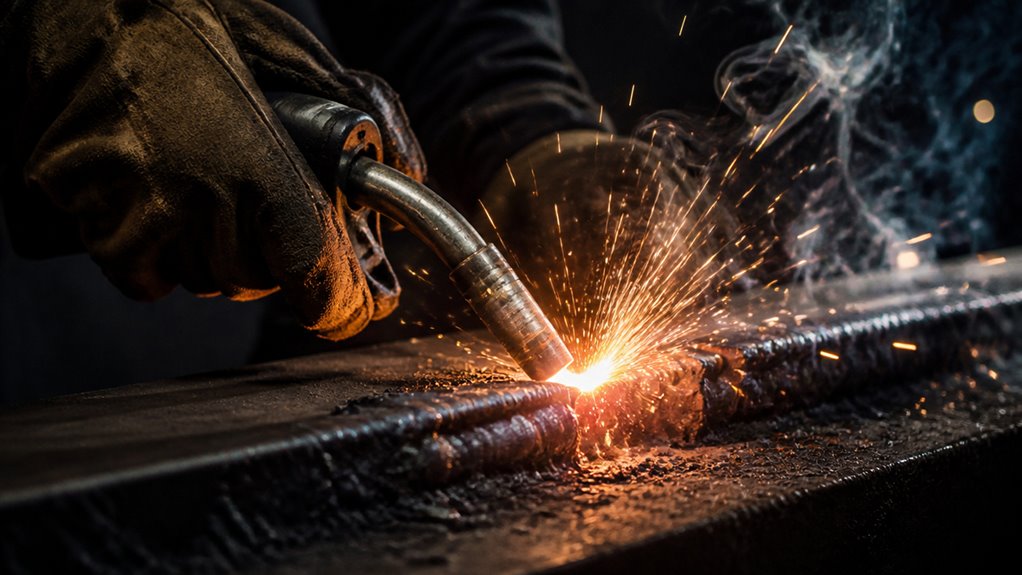
To optimize flux core wire welding, set polarity to DC electrode negative (DCEN) and use knurled drive rolls sized precisely for your wire diameter. This guarantees steady feed without deforming the wire.
Maintain light wire tension and keep stickout between 5/8 to 3/4 inch for arc stability. Thoroughly clean metal surfaces and ground clamps to prevent erratic arcs.
Use a drag technique at a 5–15° angle with balanced heat and travel speed for consistent beads. Understanding these factors lays the groundwork for mastering advanced flux core techniques.
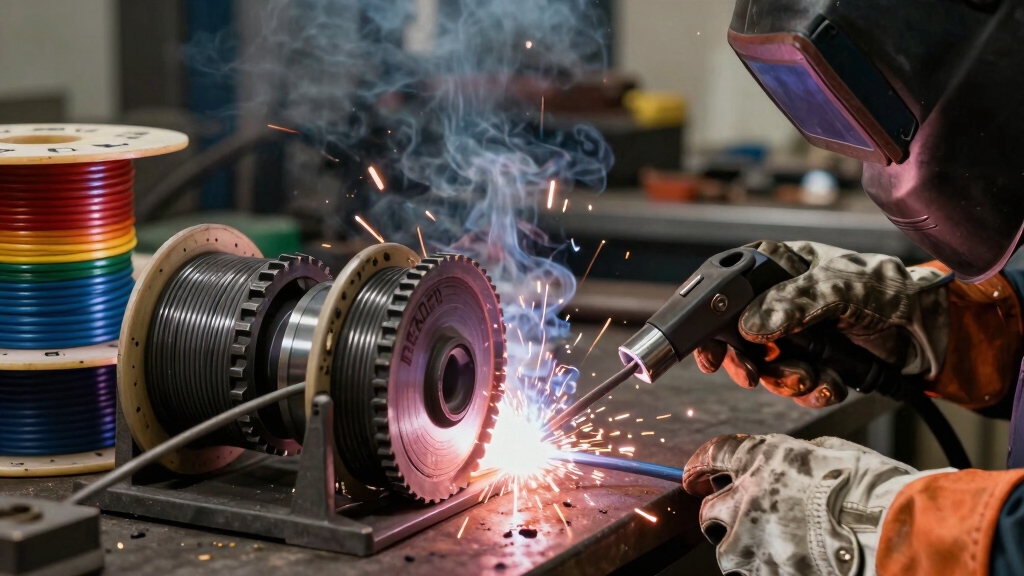
When setting up your machine for flux core welding, ensure the polarity is set to DC electrode negative (DCEN), also known as straight polarity. This configuration optimizes arc stability and penetration for flux core wire.
Always verify polarity after switching from MIG to flux core to avoid arc instability or poor weld quality. Next, select knurled drive rolls specifically designed for flux core wire. These rolls provide a secure grip without deforming the softer, hollow wire.
Standard smooth or V-groove rolls can crush the wire, causing feed issues. Set the wire tension lightly to enable smooth feeding without slipping or wire deformation. Proper polarity and drive roll selection directly influence weld consistency, bead appearance, and overall machine performance during flux core welding.
For optimal results, choose the appropriate flux core wire type based on your welding environment and material thickness.
Choose roller sizes that precisely match your flux core wire diameter to guarantee consistent feeding and prevent wire deformation. Using improperly sized rollers can crush or flatten the hollow flux core wire, leading to erratic wire feed and arc instability.
Opt for knurled drive rolls designed for flux core wire; their grip improves feeding without damaging the wire’s softer surface. When setting wire tension, adjust it just enough to prevent slipping but avoid overtightening, which deforms the wire and causes feed issues.
Too much tension stresses the wire, risking feed jams and inconsistent arc characteristics, while too little tension leads to slippage and irregular bead formation. Regularly verify roller alignment and tension settings after changing wire diameters to maintain consistent, trouble-free wire delivery during welding. Additionally, maintaining proper wire feed speed is essential to ensure stable amperage and penetration throughout the welding process.
Dialing in the correct wire speed is critical for maintaining a stable arc and consistent bead quality in flux core welding. If the wire speed is too low, the arc will be erratic and the bead irregular. If too high, you risk excessive spatter and burnback.
Start with manufacturer recommendations based on your wire diameter and adjust incrementally. Monitor the arc’s behavior and bead appearance closely as you tweak settings.
Key factors to consider include:
Matching wire speed to wire diameter and type.
Ensuring drive roll tension prevents slipping without deforming wire.
Watching for smooth, even wire feed without surges.
Avoiding burnback by not overfeeding the wire.
Testing beads on scrap to dial in ideal speed before critical welding.
Precise wire speed control directly impacts feed consistency and weld integrity. Proper wire diameter also optimizes feed rates and reduces welding defects for better overall performance.
Although flux core welding is somewhat forgiving, you must prepare metal surfaces and ground clamps meticulously to assure a stable arc and strong electrical connection.
Begin by thoroughly cleaning the base metal, removing mill scale, rust, paint, and dirt. Contaminants increase resistance and reduce arc stability.
Use a wire brush or grinder to expose clean, bare metal where the weld and ground clamp will contact. Attach the ground clamp directly to this prepared surface to minimize electrical resistance and guarantee consistent current flow.
Inspect the ground cable and clamp for damage or looseness that might compromise conductivity. This preparation is critical, especially on scrap or practice materials.
Poor grounding or dirty surfaces can cause erratic arc behavior, inconsistent bead appearance, and reduced penetration. Proper surface and clamp prep lays a foundation for reliable, high-quality flux core welds.
Regular maintenance of equipment and ensuring proper arc stability also contribute significantly to reducing spatter and achieving consistent weld quality.
Mastering the drag technique is essential for achieving consistent penetration and minimizing spatter in flux core welding.
Unlike the push method used in MIG welding, dragging the gun pulls the slag behind the weld pool. This promotes better fusion and bead profile.
Maintain a travel angle of about 5 to 15 degrees, which maximizes arc stability and penetration without excessive spatter.
Keep these points in mind:
Hold the gun at a 5–15° travel angle relative to the workpiece.
Use a work angle near 90° for flat-position butt welds.
Drag the gun steadily to allow slag to flow behind the bead.
Avoid travel angles beyond 20°, which destabilize the arc.
Control travel speed to maintain a consistent puddle and bead shape.
This guarantees clean, controlled welds with peak mechanical properties.
For optimal results, ensure you use self-shielded flux-cored wire designed specifically for gasless MIG welding.
Consistently maintaining the correct stickout, typically around 3/4 inch, is critical for achieving arc stability in flux core welding.
This length provides ideal resistance, ensuring a stable arc and consistent metal transfer. If you let the stickout extend beyond this range, the arc becomes unstable, leading to erratic puddle behavior and increased spatter.
Conversely, too short a stickout risks wire sticking or insufficient arc length, compromising weld quality. Aim to keep your stickout within approximately 5/8 to 3/4 inch, as many sources recommend, adjusting slightly based on your specific wire and machine setup.
Maintaining proper stickout also helps control the deposition rate, which is crucial for efficient welding and minimizing defects.
To get the best results, you really need to set your heat just right. This means matching it to the wire diameter and the thickness of the material. You want to achieve peak penetration without risking any burn-through.
Now, let’s talk about travel speed. Keeping a steady pace is key here. It helps ensure that the puddle remains consistent, which is crucial for avoiding irregular bead shapes and too much spatter.
And hey, don’t forget to adjust your technique based on how the bead looks as you go. Keeping an eye on the bead appearance will help you maintain a good balance between heat input and travel speed. It’s all about finding that sweet spot!
Additionally, maintaining the proper wire feed speed is essential to control deposition rate and bead consistency for strong, clean welds.
Control heat settings and travel speed carefully to guarantee uniform bead appearance and penetration during flux core welding. Adjusting these parameters directly influences bead consistency, puddle size, and penetration depth.
Too much heat can cause excessive penetration and burn-through, while too little results in weak fusion and poor bead shape. Matching travel speed with wire feed and heat output is critical to avoid undercut or overlap.
Keep these points in mind:
Start with manufacturer-recommended amperage and wire feed settings. Test beads on scrap to fine-tune heat and speed.
Increase travel speed to reduce heat input and prevent burn-through. Decrease travel speed for thicker material or deeper penetration.
Maintain consistent wire feed tension to guarantee stable arc and bead formation.
Precise control here leads to cleaner, stronger welds with predictable bead profiles.
Using flux-cored wire with self-shielding capabilities can simplify shielding and improve weld quality in challenging environments.
Maintaining steady travel speed plays a critical role in achieving uniform bead appearance and ideal penetration during flux core welding.
You must control your travel speed to match the wire feed rate and heat input, ensuring the molten puddle remains stable and properly sized.
Moving too fast causes narrow, weak beads with poor fusion, while traveling too slow leads to excessive buildup and burn-through.
Consistent speed also helps regulate heat distribution, preventing warping or undercutting.
To maintain steady travel, focus on smooth, deliberate motion aligned with the joint geometry and gun angle, typically 5 to 15 degrees drag technique.
Practice on scrap improves muscle memory and feedback perception, allowing you to adjust speed intuitively.
Ultimately, steady travel is essential to produce consistent, defect-free flux core weld beads.
Because flux core welding requires a drag torch technique to manage slag coverage and penetration, maintaining steady travel speed becomes even more critical.
Although flux core welding offers versatility and ease, several common mistakes can compromise weld quality and equipment performance.
You need to avoid these pitfalls to maintain consistent, strong welds and protect your gear.
Using incorrect polarity is a mistake; always confirm DC electrode negative (DCEN) for flux core welding.
Applying excessive wire tension can deform the softer flux core wire and cause feed issues.
Neglecting proper gun angle is another error; dragging the gun at 5 to 15 degrees is essential for slag control and penetration.
Allowing excessive stickout beyond 3/4 inch destabilizes the arc and reduces control.
Welding on dirty or painted surfaces degrades ground connection and causes erratic arc behavior.
Proper selection of shielding gas also plays a crucial role in preventing porosity and ensuring weld quality.
When practicing vertical-down flux core welding, you’ll typically start at the top of the joint and move downward using a steady weave motion. This controlled side-to-side weave helps manage heat input, preventing excessive penetration and burn-through common in vertical-down welding.
Maintain a consistent travel speed and weave width to guarantee uniform bead shape and proper slag coverage. Your gun angle should remain slightly tilted, roughly 10 to 15 degrees, promoting stable arc characteristics and peak puddle control.
Avoid abrupt movements, as they can cause irregular bead profiles and porosity. Focus on balancing wire feed speed and stickout to stabilize the arc throughout the weave. Regular practice on clean scrap helps refine your technique, improving bead consistency and penetration without sacrificing weld integrity.
You need essential safety gear when flux core welding: a welding helmet with a proper shade lens to protect your eyes from intense UV and infrared rays.
Flame-resistant gloves shield your hands from heat and spatter, and long-sleeved flame-retardant clothing covers exposed skin.
Don’t forget safety glasses underneath for extra eye protection, and a respirator if you’re working in confined spaces to avoid inhaling harmful fumes.
Always wear sturdy boots to protect your feet.
Weather conditions can be the invisible opponent in your flux core welding battle.
Wind acts like a thief, blowing away the shielding gas and causing erratic arcs and excessive spatter.
Moisture invites contamination, leading to porous welds and weak joints.
Cold temperatures stiffen wire feed and reduce puddle fluidity.
Heat can speed up cooling, affecting penetration.
You’ll need windbreaks, dry surfaces, and adjusted settings to keep your weld consistent outdoors.
You can weld on rusty or painted metal, but it’s not ideal.
Rust, paint, and dirt interfere with arc stability and reduce weld quality. You’ll likely face poor penetration, slag inclusion, and inconsistent bead appearance.
To guarantee reliable grounding and peak arc performance, clean the metal surface down to bare metal where you attach the ground clamp.
Proper surface prep improves weld integrity and makes your bead easier to control and evaluate.
You’ll want to chip, grind, and wire brush to clean flux core weld slag effectively.
Start by using a chipping hammer to break away large slag chunks. Then switch to an angle grinder with a flap disc for smoother slag removal.
Finish with a wire brush to clear residual debris and expose the clean weld bead. This sequence guarantees precise slag removal without damaging the weld integrity or surrounding metal.
You should wait until the flux core weld has fully cooled to room temperature before grinding. This usually takes about 15 to 30 minutes depending on weld size and material thickness.
Grinding too soon risks slag and metal distortion or damage. Make sure the weld is solid and cool to maintain structural integrity.
Use proper grinding speed and technique to remove slag without gouging the base metal or compromising the weld bead.
Mastering flux core wire welding hinges on precise control. Did you know improper wire speed causes up to 40% of common weld defects?
By selecting the right polarity, roller size, and maintaining peak tension, you’ll guarantee smooth wire feed and arc stability.
Combine this with proper surface prep, gun angle, and heat control, and you’ll consistently produce strong, clean beads.
Avoiding typical mistakes and practicing techniques like vertical-down weaving will elevate your weld quality markedly.