Phone:
(701)814-6992
Physical address:
6296 Donnelly Plaza
Ratkeville, Bahamas.

Phone:
(701)814-6992
Physical address:
6296 Donnelly Plaza
Ratkeville, Bahamas.

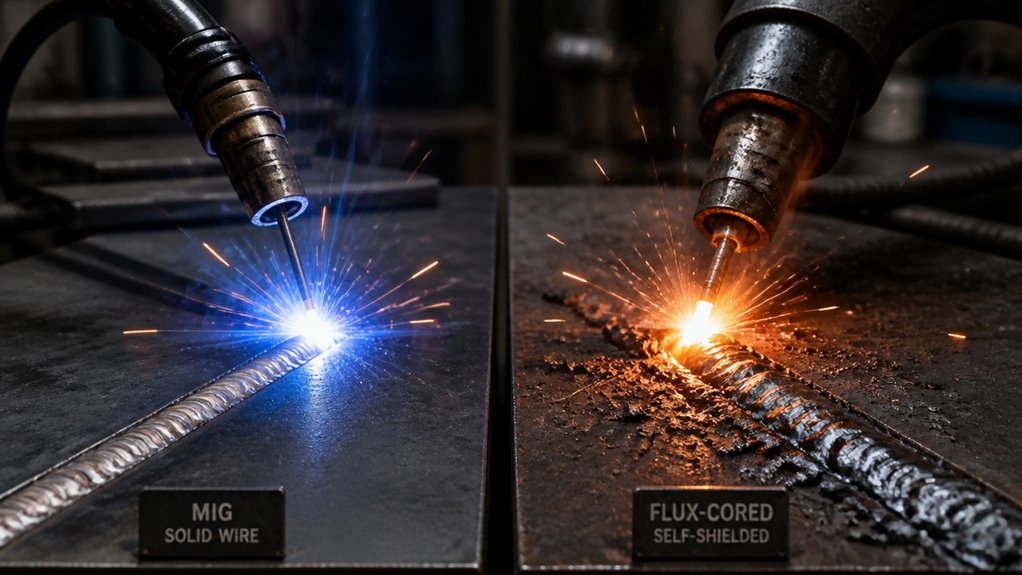
You’ll find that MIG welding uses a solid wire with external inert gas shielding. It is ideal for clean, thin metals indoors, delivering precise, slag-free welds with minimal cleanup.
Flux welding (FCAW) uses a flux-filled tubular wire generating internal gas and slag. This makes it better outdoors or on thicker, contaminated metals, but it requires more cleanup due to slag and spatter.
The choice hinges on your environment, metal type, and finish needs, with deeper insights on setup and quality differences ahead.
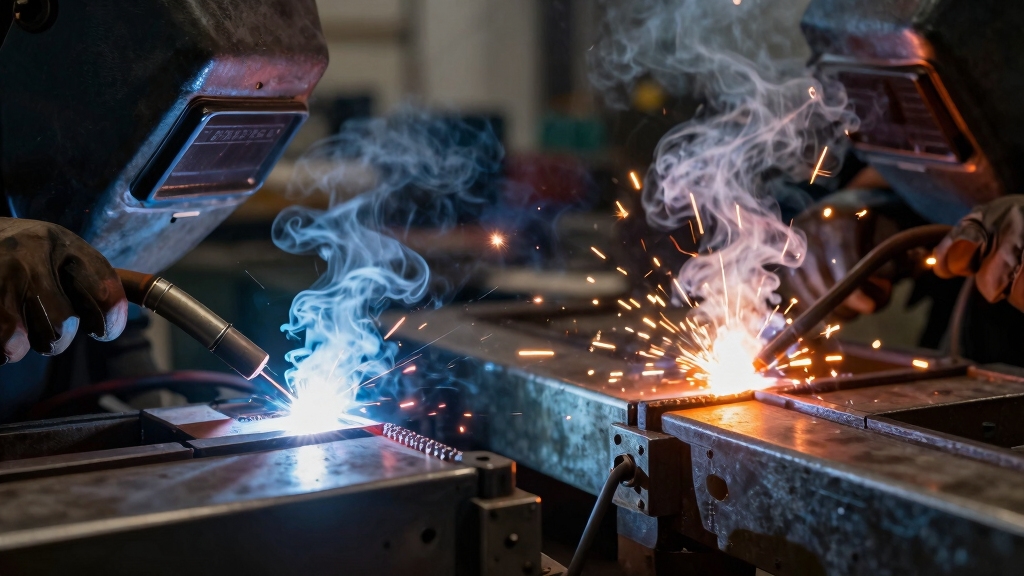
When comparing shielding methods in MIG and flux-core welding, you’ll find that MIG relies on an external inert gas delivered through the welding gun to protect the molten weld pool.
This gas, typically argon or a mixture with CO2, forms a controlled atmosphere that prevents contamination from oxygen, hydrogen, and moisture.
In contrast, flux-core welding uses a tubular wire filled with flux, which decomposes under heat to produce shielding gas internally.
This self-generated gas shields the weld, making flux-core less sensitive to wind and ideal for outdoor conditions.
While MIG requires additional equipment like a gas cylinder and regulator, flux-core can operate without external gas in self-shielded mode.
Your choice affects weld cleanliness, spatter, and environmental susceptibility, which are critical to process optimization.
Additionally, FCAW’s flux creates a protective slag that aids bead formation but necessitates post-weld cleaning to remove residues.
When you’re deciding between MIG and flux-core welding, it’s essential to think about what metals you’ll be working with and the environment you’ll be in. MIG is fantastic for clean, thinner metals, especially when you’re indoors and have a stable shielding gas available. It really shines in those controlled conditions.
On the other hand, if you’re dealing with thicker materials or need to work outside where wind might be a factor, flux-core welding is the way to go. It’s designed to handle those tougher situations. So, by understanding these aspects, you can pick the right welding process for your specific needs and the types of materials you’re using.
Flux-core welding eliminates the need for external shielding gas, making it especially practical for outdoor and windy conditions where gas coverage can be difficult to maintain.
Regarding metal compatibility, choosing between MIG and flux-core welding hinges on the specific material and application demands you face.
MIG welding excels with clean, thin metals such as mild steel, stainless steel, and aluminum. Its use of solid wire and inert gas shielding prevents contamination and guarantees precise, clean welds.
Flux-core welding, however, suits thicker, heavier gauge steels and field repairs where shielding gas might be compromised. Its flux-filled wire generates protective gases during welding, allowing you to weld effectively despite wind or surface rust.
Note that flux-core is generally unsuitable for aluminum or other non-ferrous metals due to contamination risks and slag formation.
Ultimately, your metal choice and environmental considerations dictate the best welding process for strength, appearance, and efficiency.
In addition, flux-core welding’s ability to perform well on contaminated surfaces makes it ideal for outdoor and construction site applications where surface preparation is limited.
In selecting the ideal welding process, you must consider the environmental conditions and material characteristics that impact performance.
MIG welding excels indoors on clean, thinner metals like steel and aluminum.
Stable shielding gas guarantees precise, slag-free welds with minimal spatter.
Its controlled environment suits applications requiring cosmetic, visible welds.
Conversely, flux-core welding thrives outdoors and on thicker metals due to its self-shielding flux.
This flux resists wind disruption and generates higher heat for deep penetration.
However, flux-core produces slag needing cleanup and is generally unsuitable for aluminum.
You should favor MIG for fabrication or automotive work in controlled settings.
Meanwhile, flux-core fits construction, heavy equipment repair, or fieldwork where environmental factors compromise MIG’s gas shielding.
In these cases, weld strength on robust materials is critical.
For optimal results with MIG, selecting the appropriate transfer mode based on material thickness and welding position is essential.
Although both MIG and flux-core welding feed wire continuously, they require distinct polarity settings and equipment configurations to optimize performance.
MIG welding typically uses DC positive polarity, which directs current to the electrode, improving arc stability and weld bead appearance. You’ll need a shielding gas supply with a cylinder, regulator, and hose to protect the weld pool.
Flux-core welding, especially self-shielded types, generally operates on DC negative polarity to accommodate the flux within the wire, which generates its own shielding gas. This eliminates the need for external gas equipment.
When switching between processes, you must adjust drive rolls and machine parameters to handle differences in wire diameter, flux content, and polarity. Proper setup guarantees consistent wire feed and peak weld quality for each method.
Additionally, maintaining proper wire feed speed is crucial to ensure consistent amperage and penetration regardless of the welding process used.
When you’re welding with MIG, you’ll notice that there’s usually little to no slag to deal with. Plus, you get less spatter overall, which means your post-weld cleaning time is cut down quite a bit.
Pretty convenient, right?
Now, on the flip side, when you go for flux-core welding, things can get a bit messier. You’ll end up with slag that needs to be chipped away, and there’s often more spatter involved.
This definitely ramps up your cleanup effort.
So, knowing these differences is super helpful.
It can really help you plan out the finishing steps in your workflow! Additionally, flux-cored wires emit more fumes and require respiratory protection during welding to ensure safety.
Welders often encounter significant differences in slag presence and removal between MIG and flux-core welding.
MIG welding produces virtually no slag due to its use of a solid wire electrode combined with an external shielding gas. This results in a cleaner weld bead that requires minimal post-weld cleanup, allowing you to focus on finishing and inspection quickly.
In contrast, flux-core welding generates slag as a byproduct of the flux core burning during the weld. This slag adheres to the weld bead, necessitating manual removal through chipping or wire brushing to guarantee proper weld integrity and appearance.
Efficient slag removal is critical in flux-core welding to prevent defects like slag inclusions, which can compromise weld strength and durability. Understanding this distinction helps you optimize workflow and quality control in different welding scenarios.
The flux inside the wire generates a protective slag covering over the weld pool that is essential for shielding but must be carefully managed for optimal results.
Beyond slag management, spatter levels represent another key factor affecting weld cleanup between MIG and flux-core welding.
When comparing these processes, you’ll notice distinct differences in spatter production that influence post-weld handling:
Understanding these spatter tendencies helps you select the appropriate process based on your cleanup capacity and final weld quality requirements. Using pure CO2 as a shielding gas in flux-core welding increases spatter due to its forceful arc characteristics, which can impact cleanup time.
Typically, post-weld cleaning demands vary markedly between MIG and flux-core welding due to their inherent process characteristics.
When you use MIG welding, the external shielding gas prevents slag formation, resulting in welds that require minimal cleanup.
You’ll find little to no slag or spatter, so your finishing efforts mostly involve removing minor surface imperfections.
In contrast, flux-core welding generates slag from the flux within the wire, which solidifies on the weld bead.
You must chip or grind this slag away to ensure proper weld integrity and appearance.
Additionally, flux-core welding produces more spatter and smoke, increasing cleanup time and effort.
Consequently, if you prioritize reduced post-weld cleaning, MIG welding offers a distinct advantage, especially in applications demanding clean, precise finishes.
This is largely because MIG welding uses inert shielding gas to protect the weld pool from contamination, which helps minimize slag and spatter.
When you compare the weld quality and performance of MIG and flux-core welding, you’ll notice distinct differences driven by their shielding methods and electrode types.
MIG uses a solid wire with external gas shielding, producing cleaner, more precise welds with minimal spatter and no slag.
Flux-core welding employs a flux-filled tubular wire, generating shielding gas internally. This enhances performance in windy or outdoor conditions but leaves slag requiring cleanup.
Consider these key points:
This analysis clarifies performance trade-offs between these processes. Optimizing voltage and wire speed in MIG welding is critical to minimizing spatter and achieving the best weld quality.
Since your project’s environment and material specifications directly affect welding performance, choosing between MIG and flux-core welding requires careful evaluation of these factors.
Opt for MIG when working indoors on thinner, cleaner metals where you can maintain consistent external shielding gas. This ensures minimal spatter and a slag-free finish.
MIG welding excels in producing cosmetically superior welds with easier cleanup.
Conversely, select flux-core welding for outdoor or drafty conditions where wind would disrupt MIG’s gas shielding.
Flux-core tolerates thicker metals better, delivers higher heat input, and self-shields without external gas. However, it leaves slag requiring post-weld cleanup.
Also, consider flux-core’s incompatibility with aluminum and non-ferrous metals.
Your choice hinges on prioritizing weld appearance and cleanliness versus field adaptability and penetration requirements for robust, practical welds.
You can’t simply swap MIG and flux-core wires in the same welder without adjustments. Each wire requires different polarity and drive roll settings.
MIG uses DC positive, while self-shielded flux-core uses DC negative. Also, MIG needs external shielding gas, whereas flux-core generates shielding internally.
Using the wrong wire without proper setup risks poor weld quality and equipment damage. Always adjust voltage, polarity, and feeding mechanisms to match the wire type.
About 40% of welding-related injuries involve exposure to fumes.
When you weld flux-core, you must prioritize ventilation more than with MIG. This is because flux-core produces more smoke and slag.
You’ll also want to wear a respirator rated for particulate matter.
MIG welding needs a steady shielding gas flow, so avoid drafts that could disrupt protection.
Both require eye protection and gloves, but flux-core demands extra care with slag removal to prevent burns.
You’ll find MIG welding generally allows faster welding speeds due to its stable arc and consistent shielding gas flow.
This promotes smoother metal deposition.
Flux-core welding tends to be slower because the flux inside the wire creates more slag and spatter.
This requires careful bead control and post-weld cleanup.
However, flux-core can maintain welding speed better outdoors where wind disrupts MIG’s gas shield.
This balances efficiency in challenging environments.
Flux-core welding tends to be more cost-effective for beginners since it eliminates the need for external shielding gas, reducing initial setup expenses.
However, you’ll face additional cleanup costs due to slag removal.
MIG welding requires more upfront investment in gas equipment but offers cleaner welds with less post-weld work.
Your choice depends on budget constraints and whether you prioritize simplicity or cleaner results in your learning phase.
Think of flux-core welding like a roaring bonfire. It’s great for thick logs but overwhelming for delicate kindling.
You can use flux-core on thin sheet metal, but you risk burning through, warping, or creating excessive slag that demands cleanup.
Its higher heat output and slag formation make it less precise for thin materials. For thin sheets, you’d do better with a gentler, more controlled process like MIG welding to guarantee clean, strong welds.
So, you want the perfect weld without the drama?
MIG gives you a clean, controlled arc, while flux-core throws a party with smoke and spatter. Your cleanup’s the hangover.
Choose MIG for precision, flux-core for rugged conditions. In the end, it’s like picking between a tailored suit and work boots: both get the job done, but only one keeps you looking sharp.
Your project’s success depends on which personality fits your welding style.