Phone:
(701)814-6992
Physical address:
6296 Donnelly Plaza
Ratkeville, Bahamas.

Phone:
(701)814-6992
Physical address:
6296 Donnelly Plaza
Ratkeville, Bahamas.

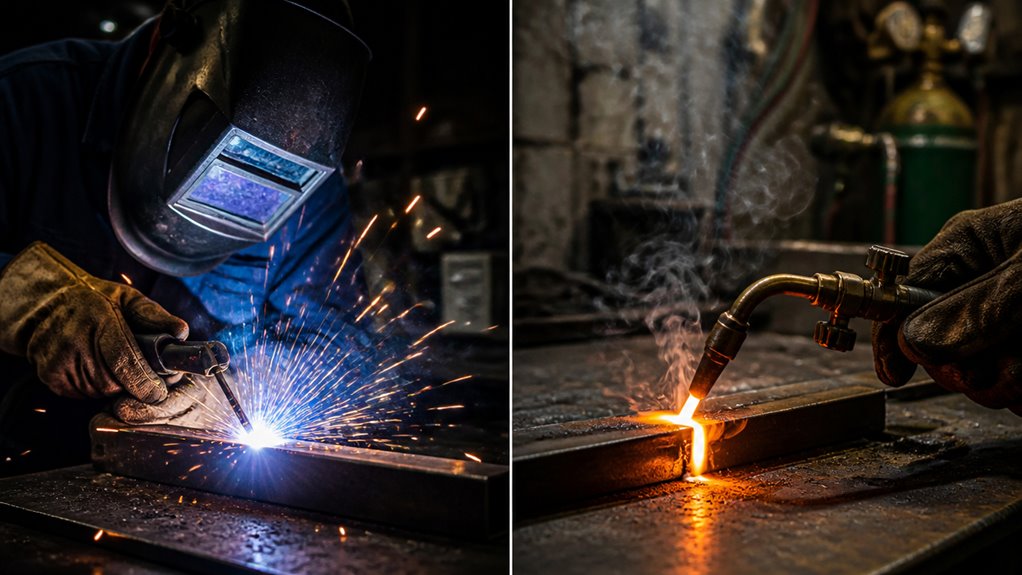
You’ll find arc welding generates higher temperatures with concentrated heat. This delivers deeper penetration and faster speeds, ideal for thick steel and heavy-duty jobs.
Gas welding uses a lower-temperature flame, offering precise control and portability. This makes it better suited for thin metals and field repairs.
Arc welding demands electrical power and complex gear, while gas welding relies on simpler, portable equipment.
Understanding these core differences helps you select the most efficient method for your specific materials and environment. Explore further to grasp all key factors.
| Feature | Arc Welding | Gas Welding |
|---|---|---|
| Heat Source | Electric arc | Fuel gas and oxygen flame |
| Heat Intensity | Higher, concentrated heat | Lower, more gradual heat |
| Typical Temperature | Often exceeds 6,000°F | Around 6,300°F |
| Penetration | Deeper | Shallower |
| Welding Speed | Faster | Slower |
| Deposition Rate | Higher | Lower |
| Best Material Thickness | Medium to thick (>3 mm) | Thin (<3 mm) |
| Best Metals | Steel, stainless steel, aluminum | Low-carbon steel, non-ferrous alloys |
| Thin Metal Performance | Good, but greater burn-through risk | Excellent |
| Heat-Affected Zone | Smaller | Larger |
| Distortion Risk | Lower | Higher |
| Equipment | Power source, holder, electrodes, cables | Gas cylinders, torch, hoses, regulators |
| Portability | Lower | Excellent |
| Electrical Power | Required | Not required |
| Setup | Relatively quick | Simple but requires gas setup |
| Outdoor/Remote Work | Limited by power availability | Excellent |
| Weld Strength | High; suitable for structural loads | Good for suitable thin/low-stress applications |
| Best Applications | Heavy fabrication, structural work, high-volume production | Field repairs, maintenance, thin-metal work |
| Main Advantage | Fast, deep penetration and strong joints | Portable, simple, and precise heat control |
| Main Drawback | Requires electricity and more equipment | Slower with greater heat distortion |
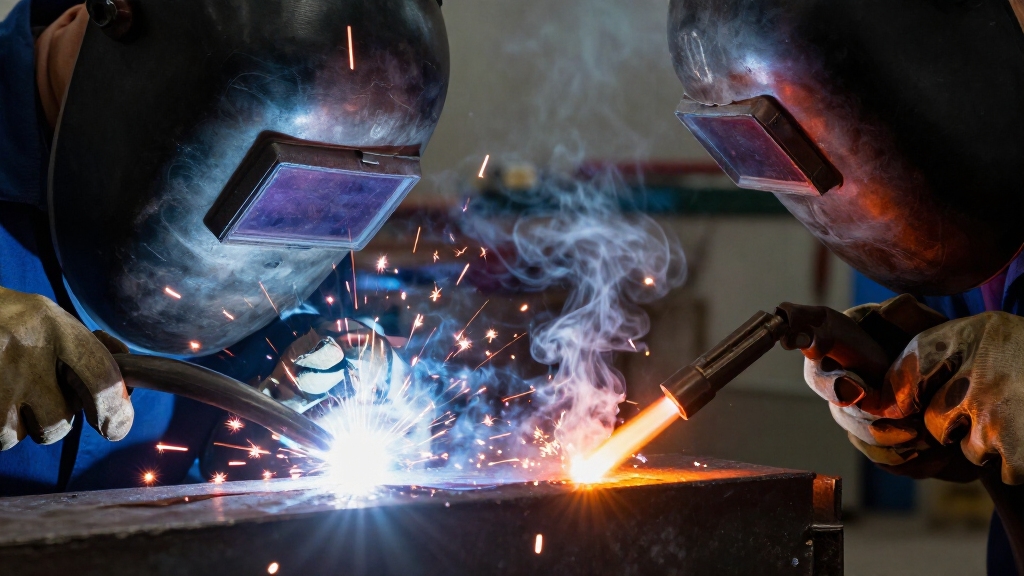
Although both arc and gas welding generate heat to melt metals, they do so through fundamentally different mechanisms.
In arc welding, you use electrical current to create an intense electric arc between the electrode and the base metal. This arc produces extremely high temperatures, often exceeding 6,000°F, which rapidly melts the metal and filler.
In contrast, gas welding relies on a controlled combustion flame from a fuel gas like acetylene mixed with oxygen. This flame generates lower temperatures, typically around 6,300°F but with less concentrated heat than an arc.
Because of this, arc welding achieves deeper penetration and faster melting suitable for thicker metals. Gas welding’s heat output limits it to thinner or softer materials.
Understanding these heat sources helps you select the right process for your welding needs. Proper flame adjustment in gas welding is crucial to achieve optimal weld quality and metal compatibility.
When it comes to welding techniques, you’ll notice that arc welding is noticeably faster. Why? Well, it has a higher heat input and maintains a continuous arc, which really speeds up the melting process and filler deposition.
On the flip side, gas welding takes a bit more time. It requires longer heating periods and careful flame control, which can slow things down and affect overall efficiency.
Arc welding is generally easier to learn and requires less intensive training, contributing to its higher speed and throughput in many applications.
When comparing welding speed between arc and gas welding, arc welding clearly outpaces gas welding due to its ability to sustain a continuous and intense electric arc.
This electric arc heats the base metal rapidly, enabling faster melting and filler deposition. In contrast, gas welding relies on a flame that heats the workpiece more gradually, resulting in slower joint formation.
You’ll notice arc welding minimizes cycle time, increasing production efficiency, especially on thicker materials. Gas welding demands longer heating periods and careful flame adjustment, which reduces overall speed.
Additionally, arc welding’s higher heat intensity supports deeper penetration faster, while gas welding’s slower heat transfer limits welding pace.
Therefore, when speed and productivity are critical, arc welding typically offers significant advantages over gas welding.
Among arc welding methods, Submerged Arc Welding (SAW) provides exceptionally high deposition rates, making it ideal for very thick plates and high-production environments.
The faster welding speed of arc welding stems directly from its higher heat input compared to gas welding. This increased heat input allows arc welding to melt metals more rapidly and maintain a stable weld pool.
You’ll notice three key impacts of this difference:
In contrast, gas welding’s lower temperature flame requires longer heating times. This slows progress and increases the risk of distortion.
Understanding these heat input impacts helps you choose the right process for speed and productivity demands in your welding projects. The electric arc used in arc welding generates temperatures ranging from 3,500 to 15,500 °C, which is significantly higher than the flame temperature in gas welding.
Typically, arc welding offers greater efficiency and faster setup compared to gas welding, largely due to its continuous electric arc and intense heat output.
Arc welding sustains a stable weld pool quickly, enabling faster filler deposition and shorter cycle times. Gas welding demands more time to heat the workpiece and adjust flame settings, reducing overall speed and productivity.
| Aspect | Arc Welding | Gas Welding |
|---|---|---|
| Setup Time | Short, requires power source | Longer, involves gas mixing |
| Welding Speed | High, continuous arc | Slower, flame heating delay |
| Productivity | Better for high-volume work | Suitable for small repairs |
Choosing arc welding boosts your throughput, especially in production environments. For optimal results, ensure you control heat input to prevent weak joints and ensure strong fusion during welding.
Equip yourself with the correct tools to guarantee effective arc or gas welding. Each method demands distinct equipment tailored to its heat source and operational needs.
For arc welding, you’ll need:
Gas welding requires:
Understanding these essential components assures you maintain operational safety and weld quality.
Each setup directly influences heating efficiency, control, and suitability for various applications.
Additionally, gas welding offers enhanced portability and cost advantages due to its reliance solely on compressed gas cylinders without the need for electricity.
Metal compatibility and thickness range play critical roles when choosing between arc and gas welding.
Arc welding excels with thicker metals like steel, stainless steel, and aluminum. It provides deeper penetration and faster melting.
Gas welding suits thinner, softer metals, such as low-carbon steel and non-ferrous alloys. Here, precision and control on delicate materials matter more.
Use the table below to guide your choice:
| Welding Method | Best Metals | Thickness Range |
|---|---|---|
| Arc Welding | Steel, Stainless Steel, Aluminum | Medium to Thick (>3mm) |
| Gas Welding | Low-carbon Steel, Non-ferrous | Thin (<3mm) |
| Both | Mild Steel | Thin to Medium (1–6mm) |
Choose arc welding for structural and heavy-duty tasks. Opt for gas welding on thin, low-stress parts. Proper heat input control is essential in both methods to reduce cracking and ensure weld quality.
When you compare arc and gas welding, you’ll notice key differences in weld quality and distortion patterns.
Arc welding delivers deeper penetration and stronger joints due to its higher heat intensity. This results in more consistent and smoother weld beads.
Arc welding provides deeper penetration and stronger joints, producing consistent, smooth weld beads with high heat intensity.
Gas welding, on the other hand, heats the workpiece longer. This creates a larger heat-affected zone and typically more distortion.
Here’s what to expect:
Understanding these distinctions helps you choose the right method for quality welds with minimal deformation. Additionally, the superior arc stability of DC welding contributes to better control in vertical and overhead positions, further reducing distortion risks.
Choose arc welding for heavy-duty jobs that demand high strength, deep penetration, and efficient heat input.
Arc welding’s high temperatures and continuous electric arc enable faster melting and superior fusion, critical for thick metals and structural components.
It excels in steel, stainless steel, and aluminum applications where joint integrity under stress is paramount.
Its efficiency reduces cycle times, boosting productivity in production environments.
The process creates a heat-affected zone (HAZ) that must be carefully managed to maintain optimal metallurgical properties.
| Aspect | Arc Welding Advantage |
|---|---|
| Heat Source | Electric arc with higher temperature |
| Penetration Depth | Deep, consistent for thick sections |
| Speed | Faster weld cycles |
| Materials | Steel, stainless, aluminum |
| Weld Strength | High, suitable for structural loads |
Use arc welding when your project demands reliability, speed, and strength in heavy-duty fabrication.
Gas welding equipment is super lightweight and easy to transport, which makes it perfect for field repairs. You can just grab it and go!
Plus, the setup is pretty straightforward, so you can get started quickly.
One of the best things about gas welding is the precise control you have over the flame. This is crucial, especially when you’re dealing with thin metals.
It really helps you maintain accuracy in your maintenance tasks. So, whether you’re on-site or just need a quick fix, gas welding is a fantastic option!
Its versatility as the “Swiss Army knife of welding” means it can handle both delicate repairs and heavier fabrication jobs with ease.
Many repair tasks demand equipment that’s both effective and easy to transport, making gas welding an ideal choice.
You benefit from its lightweight setup, which enhances mobility and reduces fatigue during extended use.
Unlike arc welding systems, gas welding requires no heavy electrical power sources, relying instead on compact gas cylinders and a torch.
This simplicity streamlines onsite repairs, especially in remote areas.
The lightweight equipment offers three key advantages:
These factors make gas welding highly practical for maintenance tasks demanding light, portable tools without sacrificing precision.
Gas welding often offers quicker setup times and more intuitive control compared to arc welding. This makes it especially suitable for repair work in varied environments.
With gas welding, you only need a torch and gas cylinders, eliminating the need for complex electrical equipment and power sources. This simplicity accelerates the preparation process, allowing you to begin welding faster.
Additionally, the flame’s heat output can be finely adjusted manually, granting precise control over temperature and weld pool size. This aspect is particularly advantageous when working on-site or in confined spaces where portability and adaptability are critical.
While arc welding demands stable electrical power and more intricate equipment setup, gas welding’s straightforward configuration enhances mobility and responsiveness. This makes it the preferred choice for maintenance and field repairs.
Typically, repairs on thin metals demand a welding process that offers fine temperature control and minimal distortion. Gas welding excels here because it provides a lower, more controllable heat source than arc welding. This reduces the risk of burn-through and warping.
When you choose gas welding for thin metals, consider these advantages:
This combination makes gas welding ideal for maintenance or fieldwork where thin metal components require careful joining. While arc welding suits thicker or structural metals, gas welding’s controlled flame and portability give you a practical edge for thin-metal repairs.
Although both arc and gas welding serve important roles in metal joining, each method offers distinct advantages and drawbacks that affect their suitability for specific applications.
Arc welding delivers higher temperatures and faster speeds, enabling deeper penetration and stronger joints. This makes it ideal for thick materials and high-volume production.
However, it demands electrical power and more complex equipment, limiting portability.
Gas welding excels in portability and manual control, making it useful for thin metals, repairs, and maintenance.
However, it operates at lower temperatures, leading to slower welding and greater heat distortion.
While arc welding offers superior efficiency and weld consistency, gas welding’s simplicity and flame precision make it valuable where electrical supply is unavailable.
Understanding these pros and cons helps you evaluate which method aligns best with your technical requirements and operational constraints.
Selecting the right welding method depends on the specific demands of your project, including material type, thickness, and operational environment.
You’ll want to analyze these factors carefully to guarantee peak weld quality and efficiency.
Consider:
You need to handle arc welding with care around electrical hazards, intense UV radiation, and hot spatter. Wear insulated gloves, a welding helmet with a proper shade, and fire-resistant clothing.
Gas welding demands vigilance against gas leaks, flame exposure, and asphyxiation risks. This requires proper ventilation and secure gas cylinder handling.
Both require eye protection, but arc welding’s electrical risks make grounding and insulation critical. Gas welding focuses more on flame and gas safety protocols.
You can combine arc and gas welding in a single project, using arc welding for thicker, high-strength joints and gas welding for thinner or delicate areas.
You’ll benefit from arc welding’s speed and penetration alongside gas welding’s precision and portability.
However, you must carefully plan heat input, joint design, and material compatibility to avoid distortion and guarantee consistent weld quality throughout the project.
This approach optimizes both processes’ strengths effectively.
You’ll find arc welding consumes more electricity, contributing indirectly to carbon emissions depending on your power source.
Gas welding releases combustion gases like CO and NOx directly, impacting air quality.
Arc welding produces less direct emissions but may generate metal fumes and ozone, posing health risks.
Gas welding’s open flame emits CO2 and unburned hydrocarbons, adding to greenhouse gases.
Choosing between them depends on your environmental priorities and site conditions.
Imagine steady hands guiding molten metal with precision.
Your skill level directly impacts arc welding’s consistency; mastering current control guarantees smooth, strong welds.
In gas welding, your ability to manage flame size and temperature affects heat distribution and bead quality.
Less experience can cause undercuts or excessive distortion in both processes.
Honing your technique minimizes defects, enhances joint strength, and optimizes efficiency across welding types.
You should regularly inspect and clean your arc welding electrode holders, cables, and power source connections to prevent electrical resistance and overheating.
For gas welding, focus on checking torch tips for clogging and leaks in hoses and regulators to guarantee proper gas flow and safety.
Both require timely replacement of worn consumables and leak tests.
However, gas welding demands careful handling of gas cylinders and valves, while arc welding needs diligent electrical component maintenance.
Now that you’ve seen how arc and gas welding differ in heat generation, speed, and equipment, the choice isn’t as straightforward as it seems.
Will you prioritize heavy-duty strength or portability? Are weld quality and distortion your biggest concerns?
Before you decide, consider how each method aligns with your project’s specific metals and thicknesses.
The best welding method is just beyond this decision. Are you ready to make the call?