Phone:
(701)814-6992
Physical address:
6296 Donnelly Plaza
Ratkeville, Bahamas.

Phone:
(701)814-6992
Physical address:
6296 Donnelly Plaza
Ratkeville, Bahamas.

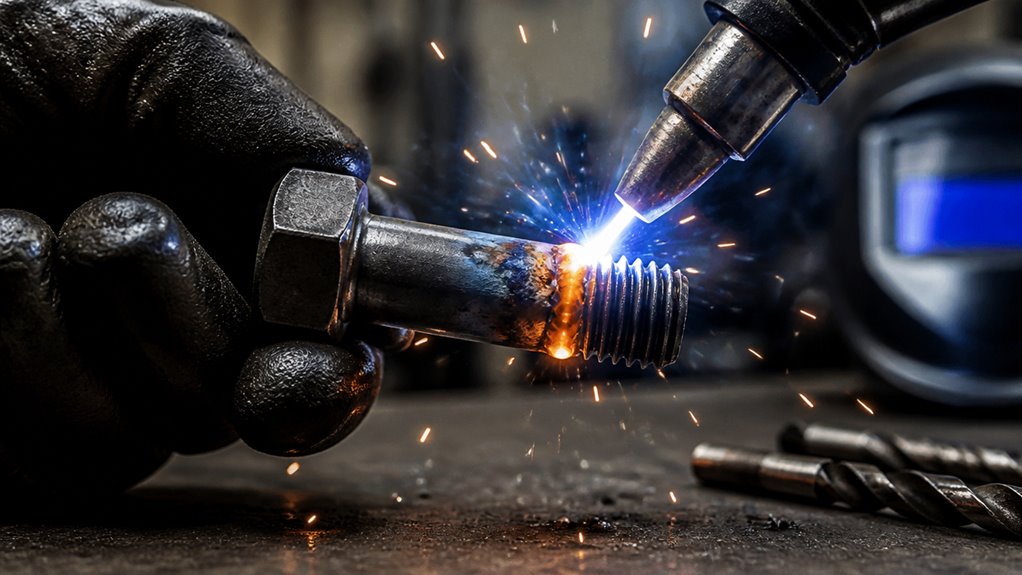
You shouldn’t weld Grade 8 bolts because the welding heat disrupts their quench-and-temper microstructure, destroying the certified strength and causing unpredictable metallurgical damage.
This heat-affected zone weakens the bolt by creating brittle or softened areas, leading to potential sudden failures under load.
Welding turns these engineered fasteners into unreliable components, unsuitable for safety-critical or load-bearing applications.
If you’ve encountered welded Grade 8 bolts, understanding the risks, alternatives, and proper handling is essential before proceeding.
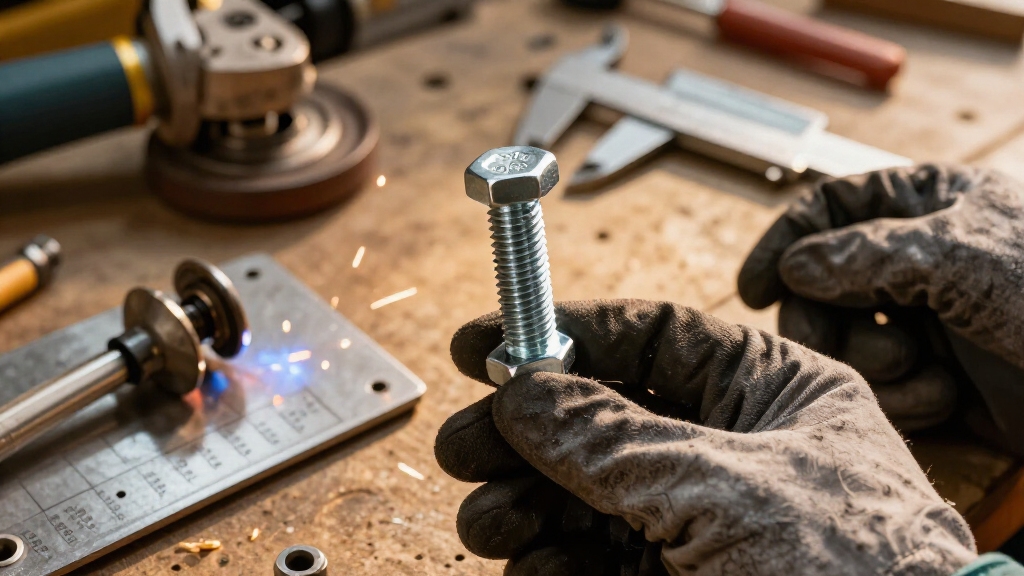
Understanding what Grade 8 bolts are is essential when selecting fasteners for high-strength applications. You’re dealing with SAE J429 Grade 8 bolts, designed to meet stringent mechanical standards: approximately 120 ksi proof stress, 130 ksi yield strength, and 150 ksi tensile strength for bolts up to 1-1/2 inches.
These bolts are manufactured from medium-carbon alloy steel, then quenched and tempered to achieve their high strength. This heat treatment, rather than just the base metal chemistry, defines their mechanical properties.
When you specify Grade 8 bolts, you rely on their certified performance, critical in load-bearing or safety-critical assemblies. Keep in mind that Grade 8 hardware is identified as SAE J429 fasteners, not as weldable structural stock, underscoring their specialized role in engineered connections.
You really shouldn’t weld Grade 8 bolts. Why? Well, the heat from welding can mess with their critical quench-and-temper treatment. This is super important for maintaining their strength.
When that treatment is compromised, it creates brittle zones in the bolt. These zones are more likely to crack when they’re under stress. Proper heat control and slow cooling are essential to minimize the risk of thermal stress and maintain bolt integrity.
Because Grade 8 bolts rely on quench-and-temper heat treatment to achieve their high strength, applying welding heat disrupts their hardened microstructure, causing irreversible damage.
When you weld a Grade 8 bolt, you:
This damage means the bolt no longer meets its original mechanical specifications.
The localized heating and rapid cooling cycles from welding alter the carefully controlled metallurgical condition.
This transforms a certified high-strength fastener into an unreliable component.
You should never expect a welded Grade 8 bolt to retain its specified proof stress or tensile strength, as the quench-and-temper process is effectively nullified by welding heat input.
Controlled preheating and post-weld heat treatment, essential in high-hardness steels, are generally impractical for Grade 8 bolts due to their small size and geometry, further increasing the risk of residual stresses.
Although Grade 8 bolts offer exceptional strength through their quench-and-temper treatment, welding subjects them to intense localized heat that alters their microstructure. This markedly increases the risk of brittleness.
When you weld a Grade 8 bolt, the heat-affected zone undergoes rapid thermal cycles that can transform the microstructure into hard, brittle phases prone to cracking. This brittleness compromises toughness, making the bolt susceptible to sudden failure under load.
Additionally, residual stresses from welding exacerbate crack initiation and propagation. You can’t rely on the original ductility or impact resistance after welding, as the altered microstructure loses its ability to absorb stress without fracturing.
For critical applications, this increased brittleness undermines reliability, making welding an unsuitable process for Grade 8 bolts.
Proper preheating techniques and controlled cooling are essential in welding hardened steels to reduce the formation of brittle martensite and minimize cracking risk.
When welding Grade 8 bolts, the intense heat disrupts the quench-and-temper treatment that provides their high tensile strength. This causes a significant loss in mechanical performance. You can’t expect the bolt to retain its original 150 ksi tensile strength because welding alters its microstructure unpredictably.
This leads to zones that are either softened or brittle, both undermining reliability.
Consider these critical impacts:
In short, welding transforms a certified Grade 8 fastener into an uncertified, compromised component. If strength and toughness matter, avoid welding Grade 8 bolts altogether. Controlled cooling and post-weld heat treatment are essential in welding high-strength steels to mitigate cracking and residual stresses, but these procedures are often impractical for Grade 8 bolts.
Welding a Grade 8 bolt can really mess with its performance. You see, when you apply that intense heat, it disrupts the bolt’s carefully engineered microstructure. This happens because the heat alters the quench-and-temper treatment that was originally done to the bolt.
Now, this thermal damage isn’t just a minor issue. It creates zones in the bolt that can either become brittle or softened. That’s a big deal because it compromises key mechanical properties like strength and toughness.
In the end, the bolt’s original performance characteristics take a hit, making it pretty unreliable when it’s under load. So, if you’re thinking about welding a Grade 8 bolt, it’s definitely something to reconsider! Additionally, the use of a welding transformer ensures a stable arc and controlled heat input, which is critical to avoid excessive thermal damage during welding.
Exposing Grade 8 bolts to welding heat markedly alters their microstructure, undermining the carefully engineered quench-and-temper condition that provides their high strength.
When you weld these bolts, the intense heat input disrupts the hardened matrix, causing localized changes that degrade mechanical properties.
Specifically, you’ll encounter:
These heat damage effects render the bolt unreliable for critical applications.
The original Grade 8 certification no longer applies after welding-induced thermal degradation.
Preheating and controlled cooling techniques are essential to minimize these thermal stresses and reduce the risk of cracking in heat-sensitive metals like Grade 8 bolts, as seen in thermal stress reduction methods.
Although Grade 8 bolts offer impressive strength due to their quench-and-temper microstructure, welding introduces thermal cycles that fundamentally alter this engineered condition.
When you weld, the localized heat disrupts the tempered martensitic structure, causing phase transformations in the heat-affected zone (HAZ).
This leads to softening or the formation of brittle microconstituents, like untempered martensite, increasing susceptibility to cracking.
You’ll find that residual stresses from rapid cooling exacerbate brittleness and reduce toughness.
Consequently, the bolt’s original mechanical properties deteriorate unpredictably, undermining load-bearing capacity and fatigue resistance.
Put simply, welding compromises the engineered microstructure, making Grade 8 bolts unsuitable for applications demanding certified performance and reliability.
Additionally, the presence of hardened, brittle phases within the HAZ acts as stress concentrators, which can initiate cracks and further compromise structural integrity.
Welding Grade 8 bolts introduces significant safety risks that compromise the integrity of critical joints.
When you weld these bolts, the controlled quench-and-temper microstructure that delivers high strength is disrupted. This causes unpredictable mechanical properties, leading to brittleness, cracking, and sudden failure under load.
Specifically, you face three key safety risks:
Because of these risks, you should never rely on welded Grade 8 bolts in critical load-bearing joints.
Instead, opt for weldable fasteners designed to maintain structural reliability.
Maintaining correct amperage settings and proper welding parameters is crucial to avoid further compromising the metal’s integrity during any welding process.
When you encounter field repairs or noncritical fixtures, you might see Grade 8 bolts subjected to welding despite the risks. This usually happens when immediate fixes are necessary, and replacing the bolt or using appropriate weldable fasteners isn’t feasible.
In such cases, welding might be applied to prevent bolt rotation or secure a component temporarily. However, once welded, the bolt’s original mechanical properties become unreliable. You must treat the fastener as a custom, altered part.
For load-bearing or safety-critical joints, welding Grade 8 bolts is inadvisable due to unpredictable strength loss and brittleness. Even in noncritical applications, any welded assembly requires thorough re-evaluation.
Manufacturers don’t endorse welding Grade 8 bolts. When you see it in practice, it’s often a compromise driven by urgency rather than sound engineering. Welding introduces heat-induced brittleness that significantly compromises the bolt’s integrity under stress.
Because Grade 8 bolts lose their mechanical integrity when exposed to welding heat, you should select fasteners specifically designed for welding applications instead. These alternatives maintain strength and reliability without risking brittle failure.
Consider these options:
Selecting the appropriate welding process and amperage is also critical to avoid compromising fastener integrity, especially when working with heat-sensitive materials and joints, as outlined in amperage and voltage guidelines.
Prevent Grade 8 bolts from losing their critical mechanical properties by securing them with methods that avoid direct welding.
Protect Grade 8 bolts by using securing methods that eliminate the need for direct welding.
You can rely on mechanical locking techniques such as lock nuts, lock washers, or thread-locking adhesives to prevent bolt rotation without compromising heat treatment.
If positional restraint is needed, consider using a tab washer or a castellated nut with a cotter pin.
For applications requiring attachment to a structure, you might use welded containment blocks or clamps that hold the bolt in place without heat exposure.
Alternatively, specify weldable fasteners like low-carbon steel studs when welding is necessary, reserving Grade 8 bolts for high-strength, non-welded joints.
If you find that a Grade 8 bolt has already been welded, you must immediately reconsider its mechanical reliability and intended performance.
Welding disrupts the quench-and-temper microstructure, compromising strength and toughness. You can no longer assume the bolt meets Grade 8 specifications.
To address this, follow these steps:
In safety-critical or structural applications, rely on components engineered for welding rather than attempting to salvage a welded Grade 8 bolt.
When you need a fastener that maintains high strength and toughness, don’t weld Grade 8 bolts. The welding process compromises their critical heat-treated microstructure and mechanical properties.
Welding disrupts the quench-and-temper condition, leading to brittle or softened zones that reduce reliability. If welding is necessary, opt for weldable studs or low-carbon weld fasteners designed to retain integrity under heat.
Treat any welded Grade 8 bolt as a custom component with uncertain performance; it no longer meets original SAE J429 Grade 8 specifications. For structural or safety-critical connections, avoid welding Grade 8 hardware entirely.
The safest engineering practice is selecting fasteners intended for welding rather than modifying heat-treated bolts. Simply put, Grade 8 and welding don’t mix if you require assured mechanical performance.
Yes, welding discoloration can indicate bolt damage.
When you see color changes near a weld, it often signals that the heat-affected zone has altered the bolt’s microstructure.
This can lead to loss of hardness, brittleness, or reduced toughness.
You shouldn’t ignore discoloration because it’s a visual cue that the bolt’s mechanical properties may be compromised.
This poses a risk of failure under load or stress if the bolt was originally heat-treated.
Bolt size affects weld susceptibility like a sponge soaking up water. The larger the bolt, the more heat it absorbs and conducts.
When you weld a bigger bolt, the heat-affected zone expands. This increases risks of microstructural changes like brittleness or cracking.
Smaller bolts cool faster but may still lose strength locally. The bigger the bolt, the greater the challenge in controlling heat input to avoid compromising mechanical properties during welding.
You won’t find any welding methods that are truly safe for Grade 8 bolts because their heat treatment gets compromised by welding heat.
Techniques like TIG or laser welding might minimize heat input but still risk altering the bolt’s microstructure, causing brittleness or cracking.
If you must weld near a Grade 8 bolt, keep heat as low and localized as possible.
However, you should never rely on the bolt retaining its original strength afterward.
You can’t reliably restore a welded Grade 8 bolt’s original properties through heat treatment.
Welding disrupts the controlled quench-and-temper microstructure, causing unpredictable hardness and brittleness.
Even if you attempt re-heat treatment, precise control is difficult because of the bolt’s altered metallurgical state and residual stresses.
This means you can’t guarantee the bolt will regain its certified strength or toughness.
You know what they say: “An ounce of prevention is worth a pound of cure.”
To detect weld-induced bolt defects, you should use non-destructive testing methods like ultrasonic testing (UT) to spot internal cracks.
Magnetic particle inspection (MPI) is effective for surface and near-surface flaws, while dye penetrant testing (DPT) is useful for surface cracks.
Radiographic testing (RT) can also reveal internal discontinuities.
Combining these techniques guarantees you catch brittle zones, cracks, or distortions caused by welding heat.
You might think welding Grade 8 bolts is a quick fix, but it’s like turning a precision engine into a ticking time bomb.
Welding drastically weakens their strength, risking catastrophic failure in critical joints.
Don’t gamble your safety or your project’s integrity. Instead, use proper fastening methods or high-strength alternatives.
If you find a welded Grade 8 bolt, replace it immediately. No shortcuts.
Precision and safety always demand respect with these high-performance fasteners.