Phone:
(701)814-6992
Physical address:
6296 Donnelly Plaza
Ratkeville, Bahamas.

Phone:
(701)814-6992
Physical address:
6296 Donnelly Plaza
Ratkeville, Bahamas.

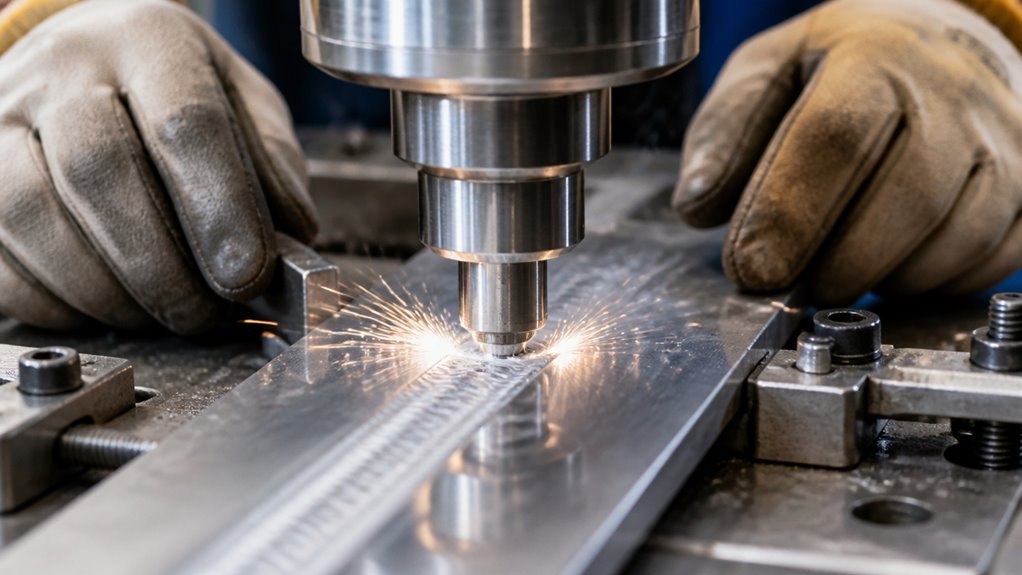
Friction stir welding (FSW) joins materials below their melting point using a rotating, non-consumable tool that generates frictional heat and plasticizes the workpieces.
You plunge the tool into the joint and traverse the seam, mechanically stirring softened material to form a solid-state bond with no filler or shielding gas.
This avoids fusion defects and preserves base metal properties, producing strong, defect-free welds with low residual stress.
Exploring this process further reveals its components, applications, and advantages.
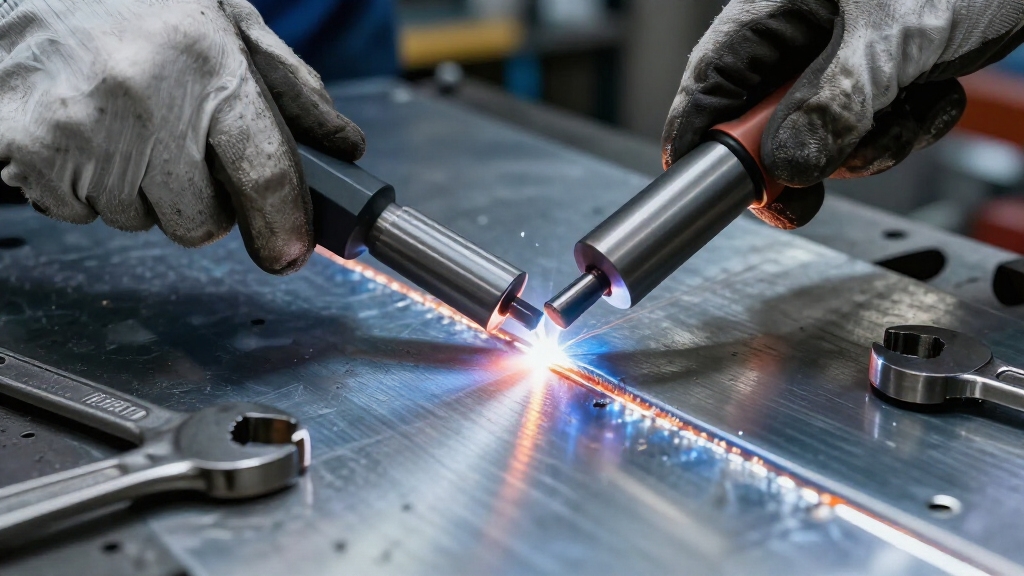
Friction Stir Welding (FSW) works by plunging a rotating, non-consumable tool directly into the joint between two metal pieces and then moving it steadily along the seam.
As the tool’s shoulder contacts the surface, frictional heat softens the metal without melting it, reaching a plasticized state below the melting point.
The profiled pin stirs and mechanically mixes this softened material from the leading edge to the trailing edge, while the shoulder applies pressure to forge a continuous, solid-state bond.
This stirring action breaks up oxides and refines the microstructure, creating a defect-free weld zone.
You control tool rotation speed, travel speed, and plunge depth to optimize heat input and material flow, ensuring a high-strength joint with minimal distortion and superior mechanical properties.
The process preserves the original microstructure and mechanical properties by avoiding melting, which minimizes the heat-affected zone and prevents defects.
Distinguishing itself from traditional welding methods, this process joins metals without melting them. It relies on frictional heat and mechanical stirring to create a solid-state bond. You won’t deal with molten pools or filler materials here; instead, the metal softens through plastic deformation below its melting point.
Joining metals without melting, using frictional heat and stirring for a solid-state bond.
This fundamental difference gives you several advantages:
Reduced thermal distortion and residual stresses due to lower peak temperatures.
Elimination of solidification defects like porosity and hot cracking common in fusion welding.
Ability to join difficult alloys and dissimilar metals that conventional methods struggle with.
Friction stir welding produces fine-grained, defect-free welds with less distortion, enhancing joint quality especially in thin sheets.
The friction stir welding tool has two main components that play critical roles: the tool shoulder and the profiled pin.
The shoulder is responsible for generating frictional heat and applying forging pressure. It’s fascinating how this part works to create the right conditions for welding.
On the other hand, the pin stirs the material and plastically deforms it along the joint line. This action is key to ensuring a strong bond between the materials being welded.
When you understand how these components work together, you can really optimize both the quality of the weld and the overall efficiency of the process.
Understanding the tool shoulder’s role is essential to mastering friction stir welding. The shoulder directly contacts the workpiece surface, generating most of the frictional heat needed to plasticize the material. It also applies the forging pressure that consolidates the stirred zone behind the tool, ensuring a defect-free weld.
You rely on the shoulder to:
The shoulder’s diameter and surface finish affect heat generation and material flow dynamics, making it a critical design parameter. Proper shoulder engagement balances heat input and mechanical pressure, enabling consistent, high-quality welds. Effective process control, including parameters such as heat input and pressure, is crucial to maintain weld quality and joint integrity.
While the tool shoulder generates most of the heat and forges the plasticized material, the profiled pin plays a vital role in stirring and mixing the workpieces beneath the surface.
The pin’s geometry, often threaded, fluted, or tapered, controls material flow, ensuring thorough plastic deformation and mechanical mixing. Its length determines the weld depth, matching the joint thickness precisely to prevent defects.
A well-designed pin promotes efficient heat generation through friction and minimizes tool wear. You’ll find that pin profile variations markedly affect weld quality, influencing grain refinement and joint strength.
Effective weld quality also depends on maintaining consistent arc length and stable conditions during the welding process.
Which metals respond best to friction stir welding?
You’ll find that FSW excels with metals that soften plastically without melting, enabling solid-state bonding.
Aluminum alloys dominate this list due to their low melting points and high thermal conductivity, which facilitate the process.
You can also weld other non-ferrous metals effectively, especially those difficult to fusion weld. Key materials compatible with FSW include:
Keep in mind, FSW demands rigid clamping to prevent joint separation and specialized equipment for very thick or hard metals.
The process’s reliance on plastic deformation rather than melting means you avoid challenges related to solidification defects common in fusion welding.
Laser welding offers precision control that can complement FSW in applications requiring high-performance welds.
Friction stir welding is a game-changer when it comes to reducing common defects. You know, things like porosity and hot cracking? They’re almost non-existent because this process skips the melting phase entirely. It’s pretty neat!
Plus, since it’s a solid-state process, you don’t have to worry as much about distortion and shrinkage. The lower peak temperatures during welding really help with that.
Additionally, friction stir welding offers precise control over heat input, which contributes to its ability to maintain material properties and produce high-quality joints.
Experience markedly fewer welding defects and minimized distortion when using friction stir welding (FSW) thanks to its solid-state process.
Because FSW doesn’t melt the base materials, you avoid common fusion-related defects like porosity and hot cracking.
The localized heat and mechanical stirring produce a consistent microstructure, reducing residual stresses that cause warping.
When you choose FSW, you benefit from:
Reduced thermal gradients that limit shrinkage and distortion in complex assemblies.
Absence of filler metals and flux, which eliminates contamination and associated flaws.
Controlled plastic deformation that guarantees uniform material flow and void-free joints.
This precision in thermal and mechanical control allows you to maintain dimensional accuracy and structural integrity in your welded components.
FSW is ideal for high-quality manufacturing.
Unlike processes such as submerged arc welding, FSW does not require a flux blanket or continuous wire feed, simplifying the welding setup and reducing environmental concerns.
Release superior joint performance with friction stir welding (FSW), which enhances mechanical properties through controlled heat input and intense plastic deformation. You benefit from refined grain structures and minimized residual stresses, resulting in increased tensile strength and fatigue resistance. The precise thermal cycle avoids melting, preserving base metal characteristics and preventing common fusion welding defects. Unlike fusion welding, FSW does not create a heat-affected zone that alters metallurgical properties, maintaining the integrity of the base materials.
| Property | FSW Effect | Benefit |
|---|---|---|
| Tensile Strength | Increased by grain refinement | Stronger joints under load |
| Fatigue Resistance | Enhanced via low residual stress | Longer service life |
| Hardness | Uniform distribution | Improved wear resistance |
Although friction stir welding offers many advantages, it also comes with specific limitations that you need to take into account before selecting it for your application. The process is constrained by factors such as material thickness, tooling requirements, and joint accessibility.
Friction stir welding excels but requires careful consideration of thickness, tooling, and joint accessibility limitations.
Thickness limitations: Extremely thick materials demand specialized tools and higher forces. This may increase complexity and cost.
Tooling wear: Hard or abrasive materials accelerate tool wear. This necessitates frequent maintenance or replacement to maintain weld quality.
Joint design constraints: The tool must access the joint line directly. Complex geometries or inaccessible welds may be impractical or impossible to process.
Understanding these limitations helps guarantee you choose friction stir welding only when its advantages outweigh these operational challenges. Additionally, precise control of parameters like current, pressure, and timing is essential in other welding methods to ensure consistent weld quality.
Friction stir welding is really making waves in the aerospace industry. It’s often used to join lightweight, high-strength aluminum components, and you know how crucial it’s to have defect-free joints in that field. Every little detail matters when it comes to safety and performance.
Moving on to automotive manufacturing, this technique shines when creating durable, low-distortion structural assemblies. It’s especially popular for electric vehicle frames, where strength and precision are key.
And let’s not forget about the shipbuilding and rail industries. They rely on friction stir welding to produce long, consistent welds in aluminum structures. It’s all about high repeatability and strength, and FSW delivers on that front!
The precise control over heat input and minimal distortion seen in friction stir welding is similar to the benefits provided by plasma welding technology.
When you look into aerospace component manufacturing, friction stir welding (FSW) stands out for its ability to create lightweight, high-strength joints critical for aircraft performance and safety.
By joining aluminum alloys and other aerospace-grade materials without melting, FSW minimizes distortion and eliminates defects like porosity and hot cracking.
This guarantees consistent structural integrity in components subjected to demanding stress conditions.
You’ll find FSW particularly advantageous for wing skins and fuselage panels, where joint strength and fatigue resistance are paramount.
It is also ideal for fuel tanks and cryogenic vessels requiring leak-tight welds with minimal distortion.
Additionally, FSW is effective for engine components made from difficult-to-weld alloys demanding precise microstructural control.
FSW’s solid-state nature and low heat input enable you to attain superior mechanical properties while maintaining tight dimensional tolerances essential in aerospace manufacturing.
Building on friction stir welding’s success in aerospace for producing lightweight, high-strength joints, the automotive industry also leverages this technology to enhance structural integrity and reduce vehicle weight.
You’ll find FSW extensively applied in joining aluminum alloys in chassis components, battery enclosures for electric vehicles, and crash management structures. Its solid-state nature avoids melting-related defects, ensuring high joint strength and fatigue resistance critical for safety and performance.
By producing welds with minimal distortion and fine microstructures, FSW supports precise dimensional control necessary for automotive assembly. Additionally, the process enables joining dissimilar aluminum grades, optimizing material distribution for weight savings without compromising structural demands.
When you adopt friction stir welding, you also cut energy consumption and eliminate filler materials, aligning with automotive industry goals for sustainability and manufacturing efficiency.
Several shipbuilding and rail manufacturing operations rely on friction stir welding to create long, continuous joints in aluminum structures that demand high strength and corrosion resistance.
You’ll find FSW particularly valuable when working on large panels or extrusions that require consistent mechanical properties along extensive weld lines.
This solid-state process reduces distortion and eliminates defects common in fusion welding, ensuring structural integrity.
When applying FSW in these industries, you should focus on:
Integrating automation into friction stir welding (FSW) markedly enhances process efficiency by ensuring consistent tool positioning, travel speed, and pressure application.
You gain improved repeatability and reduced human error, which leads to higher throughput and lower scrap rates.
Automation also enables precise control over welding parameters, optimizing heat input and material flow for uniform weld quality.
Additionally, robotic systems can handle complex geometries and long seam welds more reliably than manual methods, reducing cycle times and operator fatigue.
| Automation Aspect | Efficiency Benefit |
|---|---|
| Tool Positioning | Precise, repeatable placement |
| Travel Speed Control | Maintains ideal welding rate |
| Pressure Regulation | Consistent forging force |
| Process Monitoring | Real-time parameter adjustments |
| Robotic Handling | Handles complex, long welds |
Friction stir welding creates strong, high-quality joints by mechanically mixing materials below their melting point. This process preserves the base metals’ microstructure and eliminates solidification defects.
You’ll find that this solid-state process avoids common welding issues like porosity and hot cracking by not melting the workpieces. Instead, the rotating tool heats and plasticizes the material, enabling intensive mechanical stirring and forging under pressure.
This results in joints with superior mechanical properties due to:
As industries demand stronger, lighter, and more complex components, friction stir welding technology will advance rapidly to meet these needs.
Improvements in tool materials, automation, and process monitoring will enhance weld quality and expand applications.
Integration with AI and real-time sensors will optimize parameters dynamically.
Hybrid processes combining FSW with additive manufacturing are emerging to create complex geometries and multi-material joints.
| Trend | Benefit | Impact |
|---|---|---|
| Advanced Tooling | Increased durability | Enables harder materials |
| AI-driven Control | Optimized welding parameters | Reduced defects, higher yield |
| Sensor Integration | Real-time quality monitoring | Immediate correction capability |
| Hybrid Welding | Complex, multi-material joints | Expands design possibilities |
| Automation | Consistent, high-throughput | Industrial scalability |
Tool wear directly affects friction stir welding quality by altering the tool’s geometry. This reduces stirring efficiency and heat generation.
You’ll see inconsistent plastic deformation, leading to defects like voids or weak joints. Excessive wear can increase tool forces, risking workpiece damage or misalignment.
To maintain weld integrity, you need to monitor wear closely and replace tools before performance degrades. This ensures consistent heat input, material flow, and strong, defect-free welds.
You need to wear heat-resistant gloves and protective eyewear to guard against sparks and hot material during friction stir welding.
Assure proper ventilation to avoid inhaling fumes from heated alloys.
Securely clamp workpieces to prevent movement under tool pressure.
Maintain a safe distance from the rotating tool to avoid injury.
Regularly inspect tooling for wear to prevent unexpected failures that could cause accidents or weld defects.
Yes, you can use friction stir welding to repair damaged parts, especially those made from aluminum alloys and other non-ferrous metals.
The process effectively restores structural integrity by mechanically mixing and bonding material without melting, minimizing distortion and defects.
However, make sure the damaged area is accessible and securely clamped during welding.
For severe damage or very thick materials, specialized tooling and precise control are necessary to achieve a reliable repair.
Your joint design critically influences friction stir welding outcomes by affecting heat generation, material flow, and tool access.
Proper joint geometry guarantees uniform contact and pressure, minimizing defects like voids or incomplete bonding.
Designs with tight tolerances and suitable fit-up help maintain consistent plasticization and stirring.
You must consider joint thickness, groove shape, and clamping rigidity, as these factors determine weld strength, microstructure quality, and distortion control during the process.
Typical cycle times for industrial friction stir welding vary widely but often range from 10 seconds to several minutes per weld, depending on material thickness, joint complexity, and machine capability.
You’ll find thin aluminum sheets welded faster, sometimes under 20 seconds.
Thicker or harder materials require slower tool travel speeds, extending cycle times.
Optimizing parameters like tool rotation speed and traverse rate helps you balance quality and productivity efficiently.
Imagine friction stir welding as a master sculptor, precisely molding metal without melting it, like kneading clay to create seamless art.
With over 90% joint efficiency compared to traditional welding, FSW offers unmatched strength and reliability.
By understanding its unique process and tool components, you’ll see why industries from aerospace to automotive rely on FSW for durable, high-quality welds.
Embracing this technology means welding with precision and innovation at every turn.