Phone:
(701)814-6992
Physical address:
6296 Donnelly Plaza
Ratkeville, Bahamas.

Phone:
(701)814-6992
Physical address:
6296 Donnelly Plaza
Ratkeville, Bahamas.

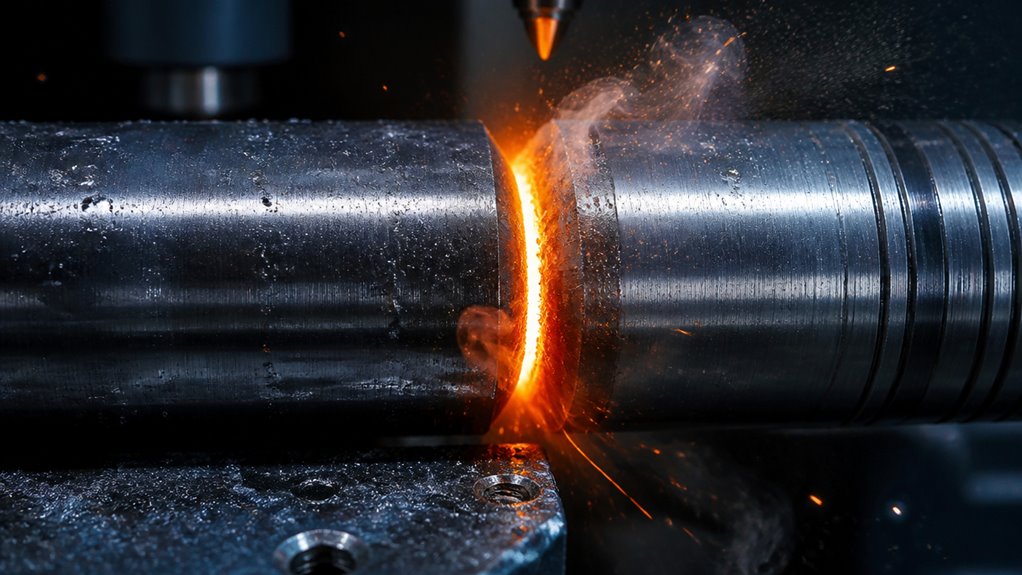
You join metals by generating heat through mechanical friction without melting them. This is achieved by precisely controlling speed, pressure, and duration.
This process plasticizes the interface, allowing materials to fuse on a molecular level without filler metals, flux, or gas. It preserves the original microstructure, creating strong joints with minimal heat-affected zones and no fusion-related defects.
Friction welding adapts to various metals and applications. It offers significant advantages in the aerospace and automotive industries.
Exploring its types and control parameters reveals its full potential.
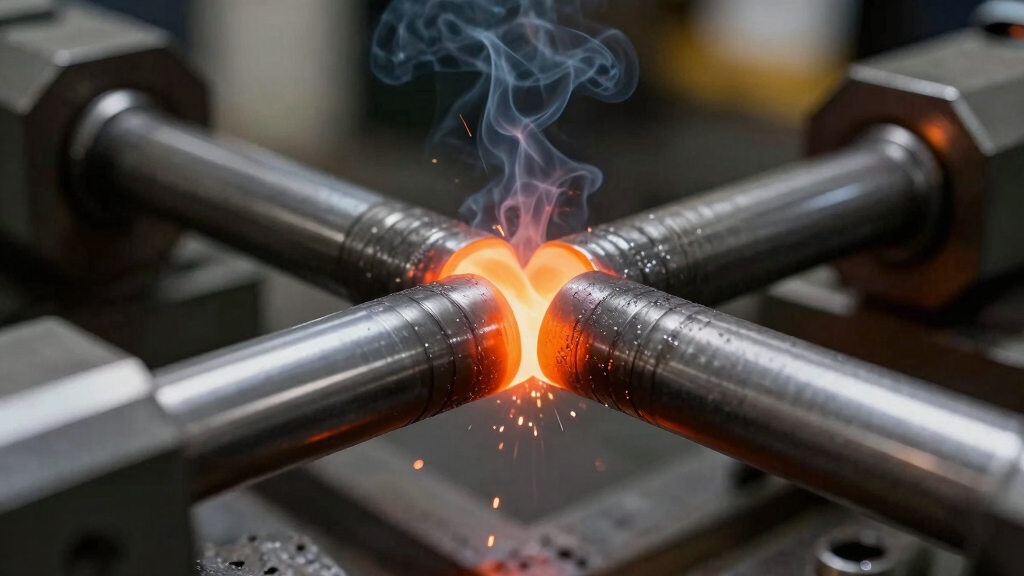
Friction welding is a solid-state joining process that creates bonds between materials without melting them.
You generate heat by applying mechanical friction between two workpieces in relative motion, which softens the materials to a plastic state.
You then apply a lateral upset force that plastically displaces and fuses the materials at their interface.
This process requires no filler metal, flux, or shielding gas, differentiating it from fusion welding methods.
The key lies in controlling friction speed, pressure, and duration to achieve sufficient heat and plastic deformation without reaching molten conditions.
By doing so, you guarantee a molecular-level bond forms while maintaining the base metals’ integrity.
Understanding this mechanism sets the foundation for analyzing specific friction welding techniques and their applications.
The process parallels forge welding but uses controlled relative motion to generate consistent heat and pressure.
Because this welding process joins metals without melting them, you preserve the original microstructure and mechanical properties of the base materials.
This retention is critical for maintaining strength and durability in welded components. Friction welding achieves strong joints by plastically deforming the interface under controlled heat and pressure.
This results in a solid-state bond that avoids typical fusion defects.
Here’s why friction welding keeps metal strong:
Through this precise control, the process delivers consistently robust, high-performance joints.
However, successful friction welding requires precise control of parameters to avoid defects and maintain weld quality.
Maintaining the strength and integrity of welded joints depends greatly on the specific friction welding method employed.
The strength and durability of welded joints hinge on choosing the right friction welding technique.
You’ll encounter several types, each optimized for different applications.
Rotary friction welding spins one workpiece against another, creating heat through relative rotation.
Linear friction welding generates heat via oscillating, sinusoidal motion between parts.
Friction stir welding (FSW) uses a rotating, non-consumable tool to plastically deform and join materials along a seam.
Inertia friction welding leverages a flywheel’s kinetic energy to produce frictional heat, offering precise control over energy input.
Finally, direct-drive friction welding maintains constant rotational speed, allowing continuous heat generation and upset force application.
Understanding these variations enables you to select the ideal process based on component geometry, material compatibility, and production requirements without compromising joint quality.
Unlike electron beam welding, friction welding does not require a vacuum environment to maintain weld quality.
Control of heat and pressure directly determines the quality and consistency of the welded joint. You must precisely regulate frictional heat through rotational speed and applied pressure to initiate plastic deformation without melting.
Insufficient heat or pressure leads to weak bonding; excess risks material degradation. After friction, increased forging pressure consolidates the joint, ensuring atomic diffusion and eliminating voids.
Key factors you control include:
Friction welding benefits from precise heat control, similar to other thermal processes like GTAW and plasma arc welding, to minimize thermal distortion and ensure weld quality.
Friction welding technology joins a wide range of metals and thermoplastics by exploiting their plasticized states without melting.
You can efficiently weld dissimilar metals like steel to aluminum or titanium alloys, which conventional fusion methods struggle with due to differing melting points and thermal expansion.
Industries like aerospace depend on friction welding for high-strength, fatigue-resistant structural joints.
Automotive manufacturers use it to produce durable engine components and chassis parts with minimal distortion.
You’ll also find this process in repair and fabrication sectors, where it enables joining previously unweldable combinations.
Thermoplastics benefit from friction welding in applications demanding strong, contamination-free bonds.
By selecting appropriate parameters, you guarantee consistent quality across diverse materials and demanding industrial environments.
This makes friction welding a versatile, reliable joining solution.
Unlike fusion welding, friction welding typically does not produce a heat-affected zone, preserving the base materials’ original properties.
Yes, you can use friction welding on non-metal materials, particularly thermoplastics.
The process works by generating heat through mechanical friction, softening the materials to a plastic state without melting.
This allows you to join thermoplastics effectively, benefiting from precise control of temperature and pressure.
However, the technique’s success depends on the material’s thermal and mechanical properties.
You need to carefully adjust parameters to guarantee a strong, defect-free bond.
You’ll find friction welding often reduces overall costs compared to traditional welding.
It eliminates the need for filler materials, shielding gases, and extensive post-weld treatments, cutting consumable expenses.
Though initial equipment investment is higher, automation and repeatability lower labor and rework costs.
Plus, the reduced heat-affected zone minimizes distortion and rejects, saving money on repairs and scrap.
Over time, friction welding’s efficiency and quality control make it more cost-effective.
You’ll find friction welding has a lower environmental impact compared to traditional welding.
It consumes less energy since it operates below melting temperatures and doesn’t require filler metals, flux, or shielding gases.
This reduces waste and hazardous emissions.
Also, its precise heat generation minimizes distortion and scrap rates.
By extruding contaminants and producing strong joints without melting, you reduce pollutants and material consumption.
This supports a cleaner, more sustainable manufacturing process.
You generally don’t need post-weld heat treatment after friction welding because the process avoids melting. This preserves base metal properties and minimizes residual stresses.
However, if your application demands specific mechanical properties or microstructural changes, you might consider it. The decision depends on material type and service requirements.
Typically, friction welding’s plastic deformation and controlled temperature reduce the necessity for additional heat treatment to achieve peak joint performance.
A typical friction welding cycle usually takes just a few seconds to a couple of minutes, depending on factors like material type, part size, and process parameters.
You’ll find rotary friction welding cycles often last between 5 and 30 seconds, while linear friction welding can take slightly longer.
Precise control of rotational speed, friction pressure, and forging time guarantees consistent heat generation and plastic deformation.
This optimization enhances cycle time without compromising joint quality.
Now that you understand friction welding, you see how it’s like the silent architect behind strong metal joints.
No sparks, no filler, just pure force and heat joining atoms seamlessly.
Like a skilled conductor controlling every note, you control pressure and temperature to create bonds that rival traditional welding.
Whether in aerospace or automotive, friction welding’s precision guarantees durability and efficiency.
It makes it an essential technique you can rely on for advanced metal fabrication.
[…] friction welding, cold welding preserves the original microstructure by avoiding melting, resulting in strong, clean […]