Phone:
(701)814-6992
Physical address:
6296 Donnelly Plaza
Ratkeville, Bahamas.

Phone:
(701)814-6992
Physical address:
6296 Donnelly Plaza
Ratkeville, Bahamas.

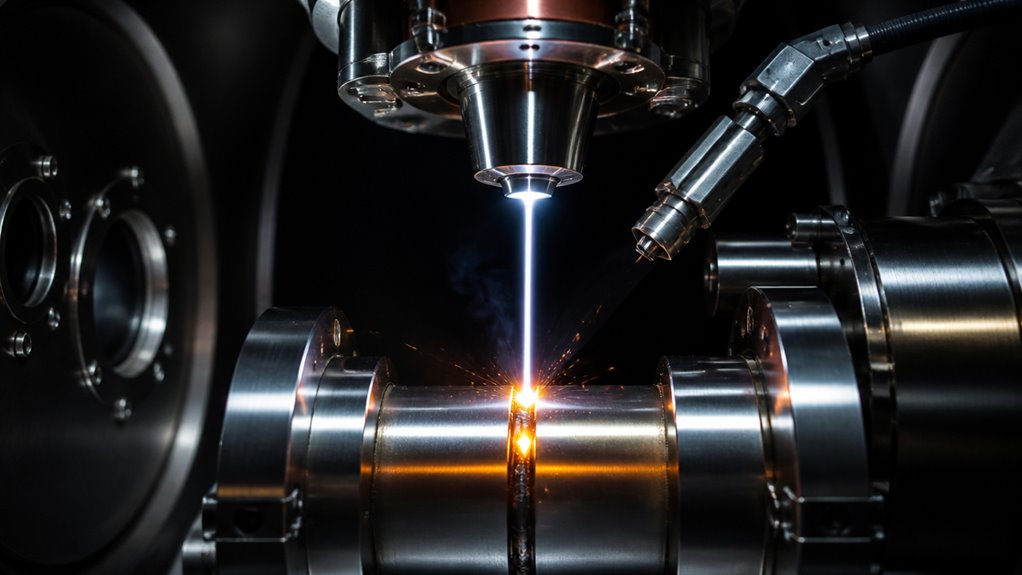
Electron Beam Welding uses a focused beam of high-velocity electrons to precisely melt and join metals by converting kinetic energy into intense heat.
You operate this process in a vacuum to maintain beam focus, prevent oxidation, and guarantee deep penetration with minimal distortion.
Specialized equipment like an electron gun, magnetic lenses, and a vacuum chamber control the weld quality.
If you want to understand how this method achieves its precision and where it excels, exploring its principles and applications reveals much more.
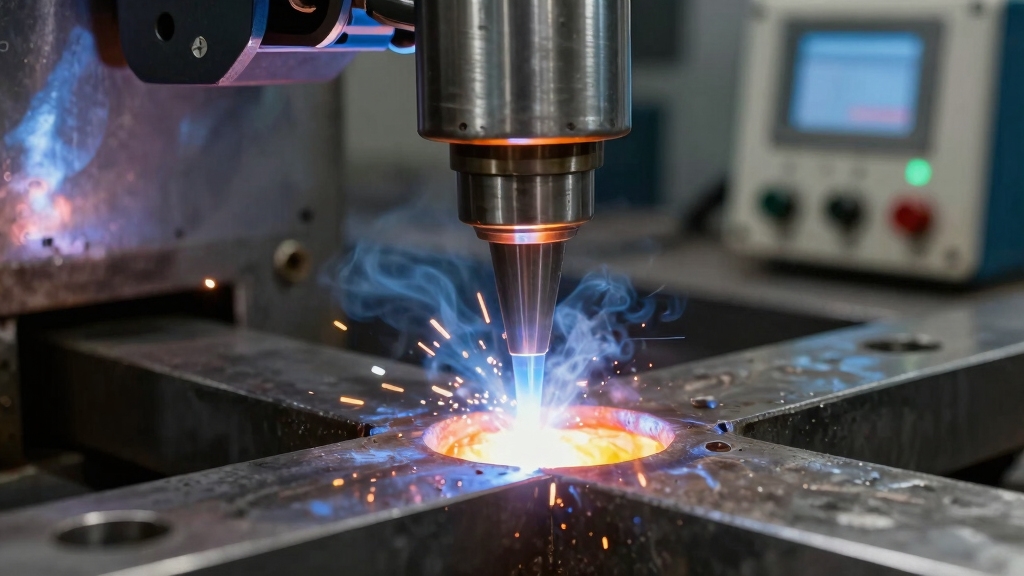
Electron beam welding (EBW) joins materials by directing a focused beam of high-velocity electrons onto the joint. This converts their kinetic energy into intense localized heat that melts the workpieces.
This process creates a narrow molten pool that rapidly solidifies to form a precise weld with minimal heat-affected zones. The electron beam’s energy density far exceeds conventional welding, enabling deep penetration with minimal distortion.
To achieve this, you rely on an electron gun to generate and accelerate electrons. These electrons are then focused into a fine spot using magnetic lenses.
The molten metal flows together seamlessly, producing strong fusion. This technique excels when welding high-melting-point metals or when tight dimensional control and weld quality are critical.
It ensures reliable, repeatable joints in demanding applications. Unlike thermite welding, EBW requires external power and precise equipment to generate and control the electron beam, making it less portable but more suitable for intricate and controlled welds with minimal heat-affected zones.
Why does maintaining a vacuum environment matter so much in this welding process? You need a vacuum to prevent electron scattering caused by air molecules.
When electrons collide with gas molecules, their trajectory deviates, reducing beam focus and energy density. This degradation compromises weld precision and penetration depth.
The vacuum also eliminates oxidation and contamination, which can weaken the weld joint. Additionally, the vacuum guarantees stable electron acceleration by minimizing electrical discharge risks.
Without a vacuum, controlling beam parameters like current density and spot size becomes unreliable, undermining the process’s core advantages: high energy concentration and minimal heat-affected zones.
Consequently, sustaining a high vacuum is essential for maintaining beam coherence, process repeatability, and weld integrity in electron beam welding.
Moreover, effective vacuum conditions help prevent beam scattering and maintain the high energy density necessary for deep, precise welds.
To achieve the precise and high-energy focus required for electron beam welding, you need specialized equipment designed to generate, accelerate, and control a concentrated electron beam.
Specialized equipment is essential to generate and control the focused, high-energy electron beam for welding.
Central to this is the electron gun, which emits and accelerates electrons using a high-voltage power supply, often operating at tens of kilovolts.
You’ll also rely on electromagnetic lenses or coils to focus the beam into a fine spot, ensuring concentrated energy delivery.
The entire process occurs inside a vacuum chamber to prevent electron scattering and contamination.
Additionally, a manipulator system positions the workpiece accurately, while control electronics regulate beam parameters and monitor the welding process.
Together, these components create the stable, high-intensity beam necessary for deep, precise welds with minimal distortion.
Like electric arc welding, electron beam welding requires precise control of power supply parameters to maintain beam stability and weld quality.
You can actually weld a pretty impressive variety of metals with electron beam welding! It works really well with refractory alloys and those tough high-melting-point materials.
Plus, one of the coolest things about this process is its ability to join dissimilar metals. That’s thanks to its precise energy control and the vacuum environment it operates in.
Now, it’s super important to understand how compatible different materials are. This knowledge can really help you optimize weld quality and reduce the chances of defects.
Additionally, the precise heat distribution in electron beam welding helps preserve base material integrity and overall weld strength.
Metals suitable for electron beam welding (EBW) include a wide range of materials, particularly those with high melting points and complex compositions.
You can reliably weld refractory metals like tungsten, molybdenum, and tantalum, which are often challenging with other methods due to their high melting temperatures.
EBW also excels with titanium and its alloys, benefiting from the vacuum environment that prevents oxidation.
You’ll find it effective for high-strength steels, nickel-based superalloys, and aluminum alloys, especially when precise, deep penetration welds are required.
The process’s focused energy and minimal heat-affected zone help maintain the base metal’s mechanical properties.
However, you must consider the metal’s thermal conductivity and electron beam absorption characteristics to optimize weld quality and avoid defects like porosity or warping.
Maintaining exceptional shielding and purge conditions is critical to prevent contamination and preserve weld integrity when welding reactive metals like titanium.
Although welding dissimilar materials poses unique challenges, electron beam welding (EBW) offers a controlled and precise method to join metals with differing physical and chemical properties.
You can leverage EBW’s high energy density and vacuum environment to mitigate oxidation and contamination, which are critical when fusing reactive or refractory metals.
The process enables careful heat input control, reducing issues like cracking or brittle intermetallic formation.
When joining dissimilar materials with EBW, consider:
Additionally, maintaining a controlled current during welding is essential for producing clean, strong, and professional-quality welds.
Because electron beam welding (EBW) concentrates a high-velocity stream of electrons into an extremely fine spot, it generates intense kinetic energy that converts into localized heat upon impact.
This focused energy rapidly melts the material in a narrow, deep keyhole, allowing you to achieve deep penetration with minimal heat-affected zones.
By controlling electron beam parameters such as current, focus, and travel speed, you precisely manage the weld pool size and shape.
The vacuum environment prevents beam scattering, maintaining beam coherence and stability, which directly enhances weld accuracy.
This combination of concentrated energy input and controlled conditions enables you to create extremely precise welds with a fusion zone that’s narrow and deep.
It minimizes distortion while ensuring strong metallurgical bonding throughout the joint’s thickness.
Like ultrasonic welding, EBW relies on precise control of energy delivery to optimize weld quality and minimize defects, showcasing the importance of controlled process parameters in advanced welding techniques.
You know, one of the standout features of electron beam welding is its incredible precision and accuracy.
This means you can create clean, exact joints with very little distortion. Isn’t that impressive?
Plus, it’s got this amazing ability to achieve deep penetration in just a single pass.
This not only cuts down on processing time but also boosts the strength of the joints.
By recognizing these advantages, you can really optimize your welding outcomes, especially when dealing with complex applications.
It’s definitely worth considering!
Similar to plasma welding, electron beam welding offers precise control over heat input to maintain superior weld quality.
When you require exceptionally precise welds, electron beam welding delivers unmatched accuracy by concentrating energy into a finely focused beam. This focused energy guarantees minimal thermal distortion and allows you to control weld dimensions with high repeatability.
The vacuum environment further stabilizes the beam, preventing scattering and contamination, which enhances weld quality.
Key factors contributing to this precision include:
These elements combine to give you superior weld accuracy, making electron beam welding ideal for applications demanding tight tolerances and minimal post-weld processing. Additionally, proper heat control is essential to avoid altering metal microstructure, which can compromise weld strength and reliability.
Although deep penetration is a hallmark of several welding processes, electron beam welding stands out by delivering exceptionally deep, narrow welds with minimal heat input to surrounding materials.
You benefit from reduced thermal distortion and a smaller heat-affected zone, preserving material properties adjacent to the weld. This capability lets you weld thick sections in a single pass, improving efficiency and strength.
| Benefit | Description |
|---|---|
| Deep Weld Penetration | Enables single-pass welding of thick materials. |
| Minimal Heat Input | Reduces distortion and preserves base metal. |
| Narrow Fusion Zone | Enhances precision and joint integrity. |
| High Energy Density | Concentrates heat for rapid, effective melting. |
This combination makes EBW ideal for critical applications demanding strength and dimensional stability. The ability to perform precise heat input control ensures enhanced weld quality and minimizes defects in sensitive materials.
Numerous industries rely on electron beam welding (EBW) for its unparalleled precision and deep penetration capabilities.
When you need high-quality, strong joints with minimal distortion, EBW excels in specialized sectors. Here are three common applications you should consider:
The industries relying on electron beam welding (EBW) highlight its unique advantages over conventional welding methods.
Unlike arc or laser welding, EBW delivers markedly higher energy density, enabling deeper penetration with minimal heat-affected zones.
EBW achieves deeper welds with higher energy density and minimal heat-affected zones compared to arc or laser welding.
You’ll notice EBW excels in reducing thermal distortion, thanks to its precise, focused beam and vacuum environment that prevents oxidation.
While arc welding often requires shielding gases and filler materials, EBW typically forms strong joints without them, improving joint purity.
Compared to laser welding, EBW provides superior penetration in thicker materials but demands vacuum conditions, which may limit its flexibility.
If you prioritize weld quality, precision, and minimal post-processing, EBW outperforms many traditional techniques, especially for high-performance applications involving refractory or dissimilar metals.
To achieve high-quality electron beam welds, you need to carefully control key process parameters and maintain ideal equipment conditions. Precision in beam focus, vacuum integrity, and power settings directly impacts weld penetration and fusion quality.
You focus and control the electron beam using electromagnetic lenses and magnetic fields that precisely narrow the beam to a fine spot.
The electron gun generates and accelerates electrons, while high-voltage power supplies maintain beam energy.
Operating the process in a vacuum keeps the beam stable and prevents scattering.
Control electronics continuously adjust beam parameters and positioning, ensuring accurate targeting and consistent weld quality throughout the operation.
You need to wear protective eyewear to shield against intense electron radiation and X-rays generated during welding.
Make certain the vacuum chamber is properly sealed to prevent exposure to high voltages and beam emissions.
Use interlocks and shielding to avoid accidental beam exposure.
Maintain grounding to prevent electrical hazards.
Also, follow strict ventilation protocols to control any fumes.
Regularly inspect equipment for insulation integrity and enforce training on emergency shutdown procedures.
You can automate electron beam welding for mass production, achieving up to 95% system efficiency.
Automation suits EBW because the process requires precise control of vacuum, beam focus, and positioning. These tasks are ideal for robotics and CNC systems.
This guarantees consistent, high-quality welds with minimal human intervention.
Plus, automation handles complex joint geometries and repetitive cycles efficiently. This makes EBW a reliable choice for industries demanding precision and throughput, like aerospace and automotive manufacturing.
Joint fit-up critically affects electron beam welding quality because small gaps guarantee consistent beam penetration and uniform fusion.
If you maintain tight tolerances, you’ll reduce defects like porosity or incomplete fusion.
While deeper welds can tolerate larger gaps or filler wire, poor fit-up can cause irregular heat distribution, leading to distortion or weak joints.
Precise alignment is essential to maximize weld strength and minimize post-weld corrections in EBW processes.
You’ll encounter porosity as a common defect, affecting up to 5% of EBW joints. This defect is caused by trapped gases in the weld pool.
Cracking can appear due to rapid cooling and high residual stresses.
Misalignment or improper joint fit-up leads to incomplete fusion or voids.
Surface contamination risks introducing inclusions.
Controlling vacuum levels and beam parameters precisely helps you minimize these challenges. This ensures high-quality, defect-free welds.
So, you want perfect welds with laser-like precision but hate sunlight and fresh air?
Electron beam welding’s vacuum chamber is your new best friend because who doesn’t love working in a space void?
With its deep penetration and minimal distortion, it’s basically the welding superhero you didn’t ask for but definitely need.
Just remember, if you’re not into complex equipment and strict conditions, maybe stick to your grandma’s old torch.
Otherwise, welcome to the future of welding!