Phone:
(701)814-6992
Physical address:
6296 Donnelly Plaza
Ratkeville, Bahamas.

Phone:
(701)814-6992
Physical address:
6296 Donnelly Plaza
Ratkeville, Bahamas.

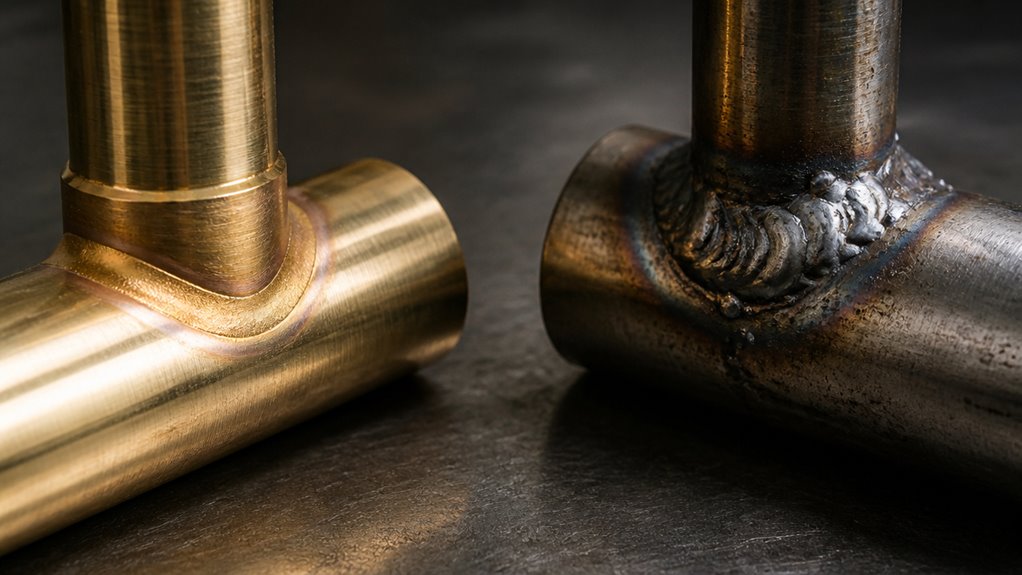
When you braze, you melt only a filler metal, preserving the base metals’ structure and minimizing thermal distortion.
Welding, however, melts the base metals themselves, creating stronger fusion joints ideal for load-bearing and thick steel parts.
Brazing suits delicate or dissimilar metals with precise fit, while welding demands higher temperatures, energy, and complex setups but offers superior strength.
If you need clarity on which suits your project’s thermal and mechanical demands, there’s more detail ahead to explore.
| Feature | Brazing | Welding |
|---|---|---|
| Primary Process | Melts filler metal only | Melts and fuses base metals |
| Joint Strength | Strong but generally lower | Typically stronger |
| Best Strength Use | Moderate-load applications | High-stress and load-bearing structures |
| Operating Temperature | About 600°C–1200°C | Much higher, often several thousand °F |
| Base Metal Melting | No | Yes |
| Thermal Distortion | Low | Higher |
| Heat Input | Lower | Higher |
| Energy Consumption | Generally lower | Generally higher |
| Equipment | Gas torches or induction heaters | Arc, TIG, MIG, plasma, and related systems |
| Equipment Complexity | Simpler | More sophisticated |
| Dissimilar Metals | Excellent | More challenging |
| Similar/Thick Metals | Suitable for certain assemblies | Excellent for thick structural components |
| Joint Types | Close-fitting, lap, thin-section joints | Structural and heavier joints |
| Material Properties | Preserves base-metal structure | Can alter properties through heat |
| Leak-Tight Joints | Well suited | Can provide strong sealed joints |
| Precision Assemblies | Excellent | Less suitable when distortion must be minimized |
| Heavy-Duty Applications | Limited compared with welding | Excellent |
| Typical Applications | Plumbing, HVAC, electronics, heat exchangers, delicate assemblies | Steel fabrication, structural work, load-bearing components |
| Main Advantage | Low distortion and material versatility | Maximum strength and durability |
| Main Drawback | Lower strength under heavy loads | Higher heat, energy use, and distortion risk |
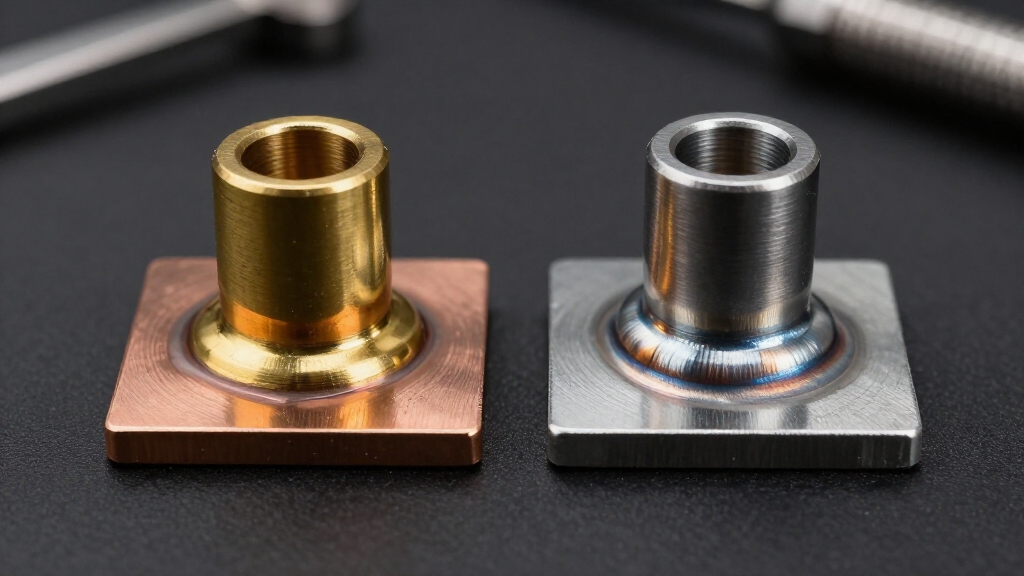
Although brazing and welding both join metals, they differ fundamentally in their processes and outcomes.
When you braze, you melt a filler metal that flows into the joint without melting the base metals, preserving their original structure.
Brazing melts only the filler metal, leaving the base metals intact and structurally unchanged.
Welding, on the other hand, melts the base metals themselves, fusing them into a single piece.
This distinction impacts strength, with welded joints typically stronger and more suitable for high-stress applications.
Brazing excels at joining dissimilar metals and delicate assemblies due to its lower heat input, which minimizes distortion and preserves base metal properties.
Welding requires more complex equipment and higher temperatures, often producing joints that exceed base metal strength.
Your choice depends on whether you prioritize strength, material compatibility, or minimal thermal impact during the joining process.
Brazing relies on capillary action to draw molten filler metal into tight joints without melting the base metals.
When comparing brazing and welding, temperature plays a critical role in defining their processes and outcomes.
Brazing typically occurs between 600°C and 1200°C, remaining below the melting point of the base metals, which stay solid throughout.
This lower temperature reduces energy consumption and limits thermal distortion.
Welding, by contrast, operates at much higher temperatures, often exceeding several thousand degrees Fahrenheit and sometimes reaching around 10,000°F, to melt and fuse the base metals.
This intense heat enables metallurgical fusion but increases risks of warping and altered material properties.
Understanding these temperature differences helps you select the appropriate joining method based on energy efficiency, thermal impact, and material compatibility.
This ensures peak performance and structural integrity in your application.
Because brazing operates below the melting point of the base metals, it minimizes thermal stress and distortion compared to welding.
Temperature differences between brazing and welding directly influence the strength of their joints.
Temperature variations in brazing and welding significantly impact the resulting joint strength and durability.
Welding melts the base metals, creating a fusion joint that typically exceeds the strength of the original materials.
Brazing, by contrast, melts only the filler metal, forming a metallurgical bond without altering the base metals’ integrity. This results in a joint that’s strong but generally less robust than a weld.
When comparing joint strength, consider these points:
Welding joints often surpass base metal strength, making them suitable for high-stress applications.
Brazed joints provide durable bonds but are weaker under heavy loads.
Welding heat can induce residual stresses, which may affect long-term performance.
Brazing’s lower temperature minimizes distortion, preserving base metal properties.
Proper joint design can optimize brazed joint strength within its intended use.
Understanding these factors helps you select the best method for your strength requirements.
Additionally, the ultimate strength of a weld also depends on matching filler metals, joint design, and welder skill to ensure defect-free, high-strength joints.
Because brazing and welding employ different thermal and metallurgical mechanisms, they suit distinct materials and joint configurations.
Brazing excels in joining dissimilar metals such as copper, brass, nickel, and precious metals without melting the base metals. This makes it ideal for delicate or mixed-metal assemblies.
It works best with close-fitting, lap, or thin-section joints where precise control is essential.
Conversely, welding requires melting base metals and favors similar metals and heavier, larger structural joints.
Welding’s higher temperatures facilitate strong, integral bonds, especially in steel fabrication. When selecting a method, you must consider material compatibility and joint design.
Brazing offers versatility in mixed-metal and fine assemblies, while welding provides superior strength and durability for homogenous metal structures and thick materials.
Proper surface preparation, including thorough cleaning and mechanical abrasion, is critical for achieving reliable brazed or welded joints.
Although both brazing and welding join metals effectively, brazing markedly reduces distortion due to its lower heat input and localized heating approach.
When you braze, the base metals don’t melt, which minimizes thermal expansion and contraction. This control limits warping and residual stresses common in welding, where melting the base metal causes significant thermal cycling.
Consider how brazing reduces distortion by:
Operating at temperatures typically between 600°C and 1200°C, much lower than welding.
Applying heat only near the joint, preserving surrounding material properties.
Preventing melting of base metals, maintaining dimensional stability.
Using filler metals that flow without altering the base metal structure.
Reducing residual stress accumulation, minimizing post-process deformation.
In contrast, fusion welding produces a heat-affected zone that can alter material properties and contribute to distortion.
Minimizing distortion through brazing also means you can work with simpler equipment and lower energy consumption compared to welding.
Choosing brazing reduces distortion while allowing the use of simpler, more energy-efficient equipment than welding.
Brazing typically uses gas torches or induction heaters, which require less power since they heat only the filler metal and joint area without melting the base metals.
This contrasts with welding, where you need high-energy sources like arc welders, TIG, MIG, or plasma systems that generate temperatures often exceeding several thousand degrees Fahrenheit to melt base metals fully.
These welding processes demand more sophisticated machinery, shielding gases, and cooling systems to manage heat input and avoid material degradation.
Consequently, welding consumes markedly more electricity or fuel, increases operational costs, and requires complex setups.
If you prioritize energy efficiency and equipment simplicity, brazing offers a distinct advantage over welding in most joining scenarios.
Submerged arc welding, for example, enhances weld quality and efficiency by using a granular flux blanket that shields the arc and weld pool from atmospheric contamination.
Brazing is a fantastic option when you need to join dissimilar metals. It really shines because it can handle different thermal expansion rates without messing up the integrity of the joint. Pretty neat, right?
Plus, if you’re working with precision and delicate assemblies, brazing is ideal. It uses minimal heat input, which means there’s less chance of distortion and it helps preserve the material properties. Understanding these strengths can really guide you in choosing brazing for applications where you need to keep a close eye on both metallurgical and mechanical effects. Additionally, brazing avoids the formation of brittle Fe-Al intermetallic compounds, which commonly weaken direct aluminum-to-steel welds.
When you need to join dissimilar metals, brazing offers a distinct advantage over welding due to its ability to create strong, metallurgical bonds without melting the base materials.
This feature prevents issues like cracking or brittleness that often occur in welded joints between incompatible metals. Brazing also minimizes thermal distortion, preserving the integrity of each metal’s properties.
You’ll find brazing particularly effective for joining copper to steel or brass to stainless steel, combining metals with vastly different melting points, creating leak-tight joints in plumbing or HVAC systems, assembling electrical components requiring reliable conductivity, and fabricating mixed-metal heat exchangers or radiators.
Additionally, brazing avoids the formation of brittle intermetallics, which are common challenges in welding dissimilar metals like copper and steel.
In applications requiring precision and delicate assembly, brazing stands out due to its controlled heat input and ability to join components without compromising their structural integrity.
Because brazing melts only the filler metal, you avoid warping or altering base metals, critical when working with thin, sensitive parts.
You can join dissimilar metals and maintain tight tolerances, which welding’s higher temperatures and melting of base metals often disrupt.
Brazing’s lower heat reduces residual stress and distortion, preserving material properties essential for precision instruments, electronics, and fine mechanical assemblies.
When you need consistent, clean joints without thermal damage, brazing offers a reliable solution.
Its suitability for lap joints and close-fitting components makes it ideal when structural strength is secondary to dimensional accuracy and delicate handling.
Additionally, using galvanized or vinyl-coated welded wire materials in assemblies can enhance corrosion resistance without compromising delicate components.
Although brazing offers advantages in certain applications, welding remains the superior choice whenever maximum structural strength is critical.
When you need joints that often exceed the base metal’s strength, welding delivers unmatched durability and resilience.
It’s ideal for load-bearing structures, thick steel components, and high-stress environments where failure risks must be minimized.
Welding fuses base metals at high temperatures, creating a homogeneous joint capable of withstanding extreme mechanical and thermal loads.
Welding joins metals through intense heat, forming a unified bond that endures severe mechanical and thermal stress.
Consider welding when you require:
In these scenarios, welding guarantees safety and longevity beyond brazing’s capabilities. Proper preheat techniques and heat control are essential to reduce cracking risk and ensure weld integrity.
You can expect brazed joints to last decades under normal conditions if the assembly avoids extreme stress or temperature.
Welded joints typically outlast brazed ones in heavy-duty or high-stress environments, often matching or exceeding the base metal’s lifespan.
Proper design, material compatibility, and maintenance play essential roles in longevity.
You can perform welding underwater using specialized techniques like wet welding or hyperbaric welding, designed to handle extreme environments and pressure.
Brazing underwater is impractical due to its reliance on controlled heat and flux, which water disrupts.
For extreme environments, welding adapts better, offering stronger, more reliable joints under stress and temperature extremes.
Brazing suits less demanding conditions but struggles with moisture and pressure challenges.
Safety specifics shift markedly between brazing and welding.
When welding, you’ll wear welded-resistant wearables, including welding helmets, gloves, and aprons, to withstand extreme heat and bright arcs.
Brazing’s lower temperatures let you skip heavy shields but still demand eye protection and ventilation to avoid fumes.
Welding needs strict fire prevention protocols due to molten metal spatter.
Brazing requires careful handling of flux fumes and gas cylinders.
Both demand disciplined, diligent safety diligence.
You’ll find brazing generally has a lower environmental impact than welding because it uses less energy due to its lower temperatures.
Brazing emits fewer fumes and gases, reducing air pollution.
Welding’s higher heat demands more power and often releases more hazardous emissions.
However, welding’s strong joints may reduce material waste long-term.
Ultimately, brazing suits applications prioritizing energy efficiency and lower emissions.
Welding demands higher resource use but stronger results.
Yes, you’ll find differences in inspection and testing for brazed versus welded joints.
Welded joints often require nondestructive testing like ultrasonic or radiographic inspection to detect internal flaws, given their critical structural role.
Brazed joints, with less critical strength demands, usually undergo visual and leak testing.
You’ll focus on joint cleanliness and filler distribution in brazing, while welding inspection prioritizes fusion quality, porosity, and crack detection.
Choosing between brazing and welding is like selecting the right tool from a precision toolkit. Each has its distinct role.
Brazing offers lower temperatures and less distortion, ideal for delicate or dissimilar materials. Welding delivers superior joint strength, perfect for structural demands.
By understanding their temperature ranges, material compatibility, and equipment needs, you can make an informed decision. This guarantees peak performance and reliability in your specific application.