Phone:
(701)814-6992
Physical address:
6296 Donnelly Plaza
Ratkeville, Bahamas.

Phone:
(701)814-6992
Physical address:
6296 Donnelly Plaza
Ratkeville, Bahamas.

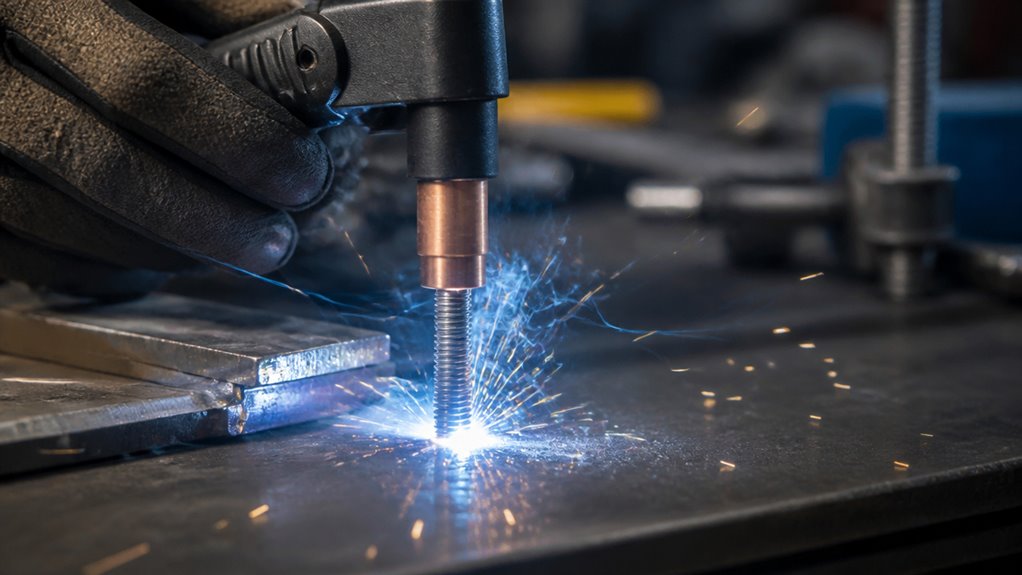
A stud welder lets you join metal studs directly to base metals in a single, precise step without filler material. It uses controlled heat via an electrical arc or capacitor discharge to create a strong metallurgical bond while minimizing distortion and backside weld marks.
You can weld various metals like steel and aluminum cleanly and quickly, ideal for applications requiring fast, permanent fastening. Mastering its operation and safety measures guarantees best results. Exploring further reveals detailed methods and uses.
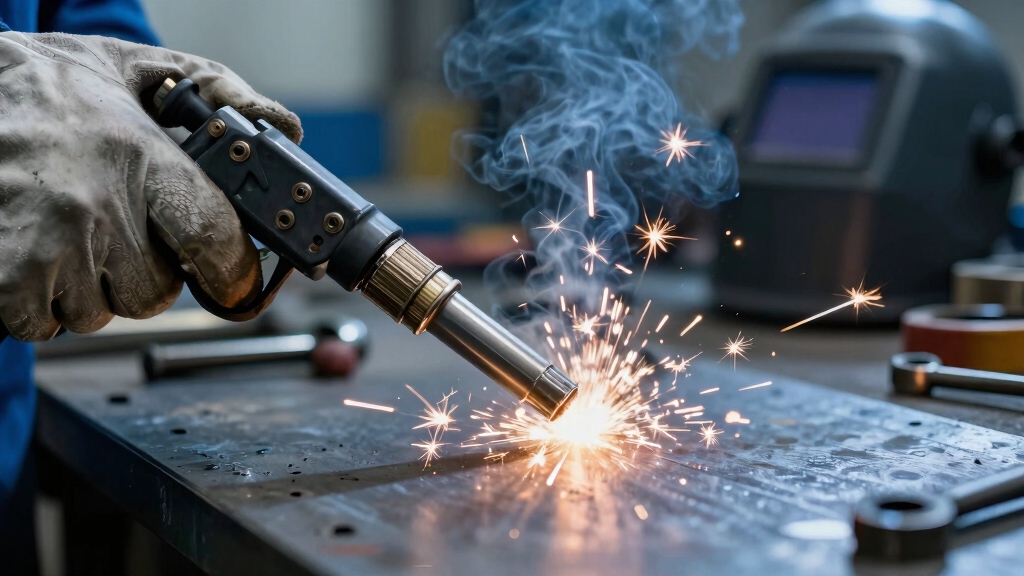
A stud welder is a specialized welding machine designed to join a metal stud or fastener directly to a base metal in a single step.
A stud welder quickly fuses a metal stud to a base metal in one efficient step.
You use it to create a permanent bond between the stud and the workpiece without needing filler material. The process relies on weld studs available in threaded, unthreaded, or tapped forms, tailored to the specific application.
When you operate a stud welder, you achieve a strong attachment quickly, leaving no visible weld bead on the reverse side of the metal.
This precision makes stud welding ideal for fast, clean fastening where traditional welding could be impractical or damaging.
You’ll find stud welders essential in industries requiring rapid, durable metal fastening with minimal surface disruption.
Stud welding often utilizes resistance welding principles to achieve efficient, strong bonds without filler materials.
Stud welders generate an electrical arc that rapidly melts the contact surfaces of both the stud and the base metal.
You initiate the process by positioning the stud against the prepared metal surface, then activating the stud welder to create the arc.
The intense heat softens the adjacent metals almost instantly.
Simultaneously, you apply controlled pressure, driving the stud into the molten pool formed at the interface.
This pressure guarantees intimate fusion and a strong metallurgical bond upon solidification.
The process avoids filler material, relying solely on the melted base metals to form the joint.
Depending on the system, energy delivery can be continuous or via a rapid capacitor discharge.
The result is a clean, permanent attachment with minimal heat-affected zones and no backside weld bead, making stud welding efficient and precise.
Unlike some welding methods, stud welding produces low electrical resistance joints that ensure efficient current flow and durable connections.
You’ll come across two main types of stud welding methods: drawn arc and capacitor discharge.
So, what’s the difference? Well, drawn arc welding uses a sustained electrical arc to heat and bond the stud.
On the other hand, capacitor discharge relies on a quick release of energy for faster fusion.
Now, let’s talk about the stud welders themselves. They can be either automatic or semi-automatic systems.
This variation definitely impacts how you manage feed and firing control.
It’s something to consider based on your specific needs!
Control of heat input is critical in stud welding to ensure proper weld pool formation and strong metallurgical bonds.
Utilizing an electrical arc to generate intense heat, drawn arc welding fuses the stud and base metal by melting their contact surfaces. This process creates a strong, permanent bond through controlled melting and pressure application.
When you use drawn arc welding, you’ll typically follow these steps:
Drawn arc welding suits thicker studs and metals, producing deep fusion without filler material. It requires clean surfaces and precise timing for consistent, defect-free welds. This method excels in construction and heavy manufacturing applications. Proper preparation and the use of protective gear are essential to ensure safety and quality in welding operations.
Capacitor discharge welding rapidly releases stored electrical energy to generate a brief, intense arc that melts the surfaces of both the stud and base metal.
You rely on a capacitor bank to discharge a high current pulse lasting only a few milliseconds, which creates a controlled molten pool at the joint interface.
This rapid energy release minimizes heat input, reducing distortion and preventing damage to thin or heat-sensitive materials.
You position a specially designed stud in the gun, press it against the workpiece, and trigger the discharge.
Because the weld time is so short, the process produces minimal spatter and a clean, flush weld, ideal for thin metals or delicate assemblies.
Capacitor discharge welding demands precise timing and consistent energy storage to guarantee a reliable, strong bond without filler material.
Proper surface preparation and full curing are critical to ensure thermal stability in high-heat applications.
While both automatic and semi-automatic stud welding systems serve the same fundamental purpose of joining studs to base metals, they differ markedly in operation and control.
You’ll find these distinctions essential when selecting equipment for your application:
Understanding these differences helps you optimize efficiency and weld quality. Additionally, the use of semiautomatic wire feeding enhances precision and productivity by automating consumable feed while retaining manual torch control.
Many industries rely on stud welders because they deliver fast, strong, and permanent attachments without the need for filler materials.
You’ll appreciate that stud welding drastically reduces cycle times, as it creates reliable joints almost instantly.
The process is straightforward and highly automated, minimizing operator error and increasing repeatability.
Since no filler rod is required, you eliminate material handling complexity and reduce contamination risks.
Stud welding also produces clean joints with minimal surface disruption, preserving the integrity of the base metal and enhancing aesthetics.
When executed correctly, the welded joint offers excellent mechanical strength, comparable or superior to traditional welding methods.
Additionally, the use of automated welding systems in stud welding contributes to consistent, high-quality results with minimal post-weld cleanup.
Stud welding excels at fastening a wide range of metals, including steel, stainless steel, aluminum, brass, and copper. This versatility meets various industrial needs.
Stud welding securely fastens diverse metals, offering versatile solutions across many industries.
Understanding specific applications helps you leverage this technology effectively.
Stud welding, like electron beam welding, benefits from precise control over heat input to minimize distortion and ensure strong, clean joints in diverse materials and settings, a key advantage of precise energy delivery.
Before operating a stud welder, you must thoroughly prepare the metal surface by cleaning it to remove paint, rust, oil, or contaminants that could compromise weld quality.
Use abrasive tools or solvents to expose bare metal, ensuring optimal electrical contact and fusion during welding. Always connect the ground clamp securely to the workpiece to complete the electric circuit.
Position the stud correctly in the gun chuck, then firmly press the gun tip against the surface before triggering the weld cycle.
Wear appropriate personal protective equipment, including gloves, eye protection, and respiratory gear, to prevent injury from sparks, UV radiation, and fumes.
Maintain proper ventilation to reduce hazardous exposure. Follow manufacturer guidelines meticulously to avoid equipment damage or weak welds, ensuring consistent, safe, and high-quality stud welds.
Regularly inspect and replace worn or damaged personal protective equipment to maintain safety during welding operations.
A professional stud welder typically costs between $1,000 and $5,000, depending on power, type, and features.
Portable, lower-power models fall on the cheaper side, while automated or high-capacity units with advanced controls and accessories push prices higher.
You’ll also want to factor in consumables like studs and maintenance costs.
Investing in quality guarantees durability and consistent welds, especially in demanding industrial or automotive applications.
Stud welding in rainy conditions is like trying to light a candle in the wind. It’s risky and generally not recommended.
Moisture can cause electrical shorts, inconsistent arcs, and poor weld quality. You’d need to make certain all equipment is dry, use weatherproof covers, and take extra safety precautions.
Ideally, perform stud welding in a dry environment or use temporary shelters to protect both the workpiece and welding gear from rain.
You need to regularly inspect and clean the gun chuck, tip, and cables to prevent debris buildup and guarantee proper electrical contact.
Check connections for tightness and wear, replacing damaged parts promptly. Maintain the power supply by verifying capacitor charge levels and cooling systems.
Calibrate controls periodically for consistent output.
Also, clean or replace filters and guarantee grounding clamps are corrosion-free.
Proper lubrication of moving parts keeps your stud welder reliable and efficient.
You typically need specific welding certifications to operate a stud welder safely and effectively, such as those from the American Welding Society (AWS).
Certification guarantees you understand proper techniques, safety protocols, and equipment handling.
Requirements vary by region and industry, so check local regulations.
Training often covers stud welding processes like drawn arc or capacitor discharge.
Without certification, you risk poor weld quality and safety hazards on the job.
A stud weld lasts as long as a fortress under stress, providing a permanent, strong bond.
Its durability depends on factors like material type, welding technique, and load conditions.
Properly executed drawn arc or capacitor discharge stud welds maintain structural integrity under repeated stress.
They often match or exceed base metal strength.
With correct preparation and welding parameters, the weld withstands fatigue, vibration, and environmental challenges reliably over time.
Now that you understand how stud welders operate and their key benefits, consider this: many believe stud welding is only for heavy industrial use, but its precision and speed make it ideal for intricate applications too.
By mastering proper safety and preparation, you’ll harness a reliable, efficient joining method that minimizes material distortion and maximizes strength.
So, when you need a fast, strong bond, stud welding is a technically sound choice worth exploring further.