Phone:
(701)814-6992
Physical address:
6296 Donnelly Plaza
Ratkeville, Bahamas.

Phone:
(701)814-6992
Physical address:
6296 Donnelly Plaza
Ratkeville, Bahamas.

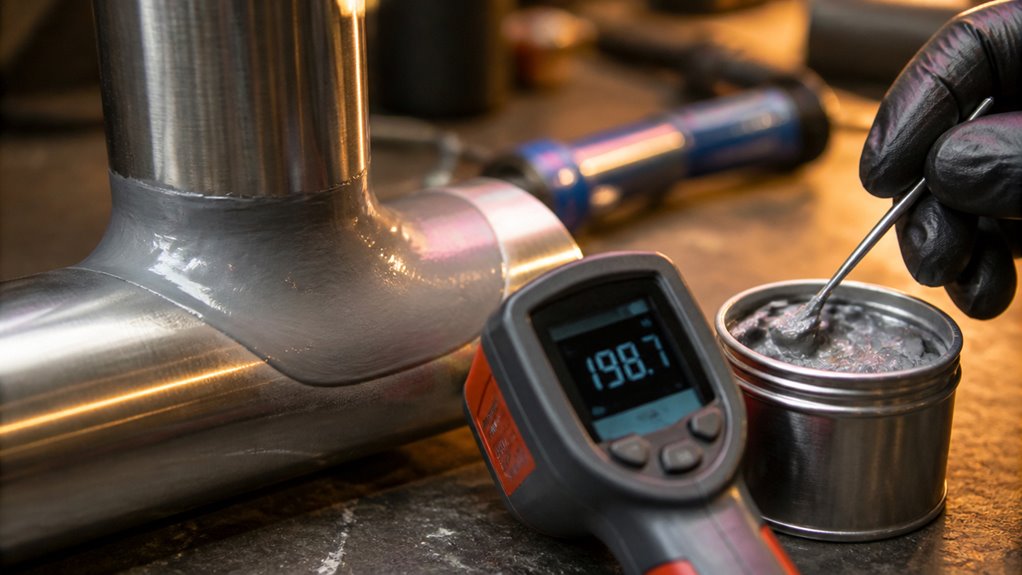
You can trust J-B Weld for heat-resistant repairs, with the Original formula handling continuous temperatures up to 550°F and short bursts near 600°F.
For hotter environments, the HighHeat formula supports steady exposure around 450°F and spikes up to 500°F.
ExtremeHeat endures continuous heat near 1000°F and extreme spikes up to 2400°F. Proper surface prep and full curing are critical to achieve maximum thermal stability.
Exploring these factors reveals how to optimize J-B Weld for your high-heat applications.
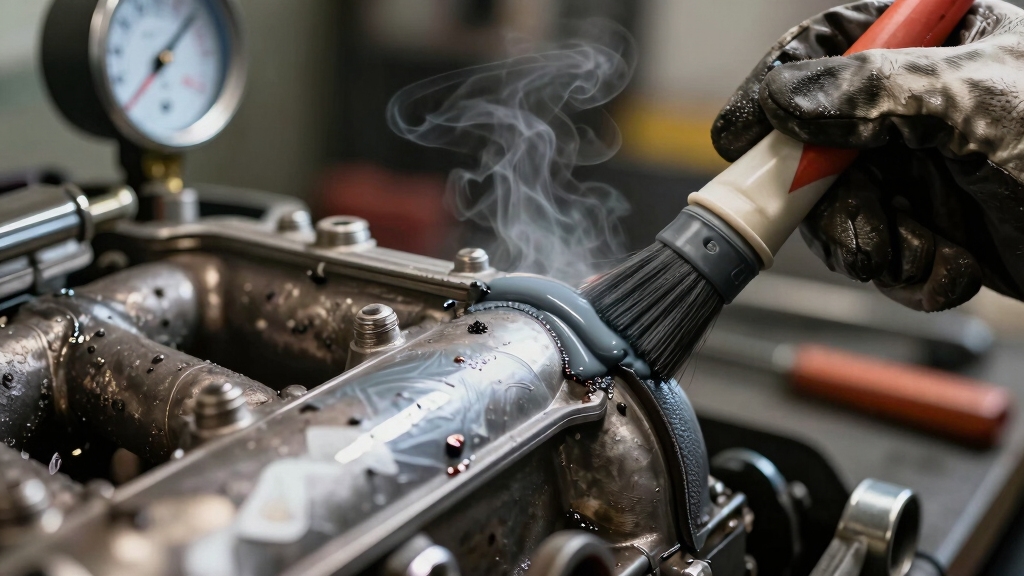
While J-B Weld offers several formulations, each product line has distinct temperature limits you need to take into account carefully.
Original J-B Weld typically withstands up to 550°F (288°C) under continuous exposure and can tolerate short bursts near 600°F (316°C).
Original J-B Weld endures continuous heat up to 550°F and brief spikes near 600°F.
However, pushing beyond these limits risks compromising bond strength and durability.
HighHeat formulation manages continuous exposure around 450°F (232°C) and intermittent exposure up to 500°F (260°C).
This makes it suitable for automotive and industrial applications requiring moderate heat resistance.
ExtremeHeat is engineered for very high temperatures, handling environments up to approximately 1000°F (537°C) or higher, depending on specific product claims.
You must verify manufacturer specifications before applying any J-B Weld product in high-heat contexts to guarantee peak performance and avoid premature failure.
Temperature fluctuations and heat can trigger premature partial curing; minimizing exposure helps maintain mechanical integrity.
Because you need reliable heat resistance for many repair tasks, understanding Original J-B Weld’s thermal limits is essential.
Original J-B Weld withstands temperatures up to about 550°F (288°C) under continuous exposure. Intermittent peaks are tolerable around 600°F (316°C) for short durations close to 10 minutes.
Exceeding these thresholds risks degrading bond integrity and reducing long-term durability. Full curing, typically 15 to 24 hours, is critical to achieve these heat resistance levels.
Surface preparation also plays a key role in adhesion strength, directly influencing thermal performance.
While Original J-B Weld handles moderate heat well, it’s not formulated for constant high-temperature applications like exhaust systems or furnaces.
You should strictly adhere to manufacturer guidelines on mixing, curing, and temperature exposure to maintain ideal bond strength and heat resistance.
For best results, apply the product on clean, dry surfaces and allow a full 24-hour cure to maximize heat resistance and bond strength.
Original J-B Weld performs well under moderate heat but isn’t designed for sustained exposure to higher temperatures common in automotive or industrial settings.
When you need a solution for continuous heat around 450°F or intermittent spikes up to 500°F, J-B Weld HighHeat offers a more suitable formulation.
It achieves tensile strengths near 4000 PSI, guaranteeing structural integrity under thermal stress.
To maximize performance, you must prepare surfaces meticulously and allow a full 24-hour cure at room temperature, or accelerate curing with heat after initial set.
Keep in mind that exceeding these temperature limits compromises the bond’s durability.
Choosing HighHeat over the original epoxy guarantees better resistance to thermal cycling and mechanical strain in hot environments like engine components or industrial machinery, aligning your repair with technical demands.
For enhanced durability, consider applying a post-weld heat treatment approach to relieve stresses and improve thermal resistance.
When you require a repair material that withstands extreme heat beyond typical automotive or industrial ranges, J-B Weld ExtremeHeat excels due to its specialized formulation.
This water-based epoxy contains no solvents or VOCs, enhancing thermal stability and reducing combustion risk. Its chemical matrix is engineered for strong adhesion to ferrous metals like iron and steel.
It maintains integrity at continuous temperatures up to approximately 1000°F (537°C) and intermittent spikes reaching 2400°F (1300°C).
The formulation optimizes cross-link density and thermal resistance, preventing degradation under rapid thermal cycling common in exhaust systems and furnaces.
This guarantees durable bonding and mechanical strength under extreme thermal stress. Its compatibility with metal substrates, combined with precise curing parameters, allows it to sustain functionality where standard epoxies would fail.
However, for optimal longevity, proper surface preparation and curing are essential to ensure maximum adhesion and heat resistance.
When working with J-B Weld, it’s super important to let it fully cure to reach its rated heat resistance. If you don’t give it enough time to cure, you might find that the bond isn’t as strong and it can’t handle high temperatures as well.
Now, while you might be tempted to speed things up by applying heat, hold on! You really need to let it set properly at first before doing that. It makes a big difference.
And don’t forget about surface preparation! How well you prepare the surfaces can really impact how well the adhesive sticks. This, in turn, affects how the epoxy performs when things heat up. So, take your time and do it right!
For best results, make sure to clean and roughen surface thoroughly before application to enhance adhesion and durability.
Making certain a full cure is critical to achieving the maximum heat resistance that J-B Weld products can offer.
Without adequate curing time, the epoxy’s molecular structure remains incomplete, reducing its thermal stability and mechanical strength.
To guarantee peak performance, you should:
Proper curing converts the liquid resin into a solid thermoset, providing essential chemical resistance and dimensional stability for heat durability.
Following proper curing protocols markedly impacts J-B Weld’s heat resistance, but temperature also plays a key role in the curing process itself.
Heat accelerates the chemical reaction between resin and hardener, reducing cure time markedly. For example, J-B Weld HighHeat typically cures in 24 hours at room temperature. Yet exposure to 250°F can achieve a full cure in about one hour.
This accelerated curing enhances polymer cross-linking density, which is critical for achieving peak tensile strength and thermal stability. However, premature heat application before initial set can compromise bond integrity.
Thus, you must allow the epoxy to set adequately before applying heat. Understanding this thermal cure dependency guarantees you maximize J-B Weld’s heat resistance, especially in applications involving intermittent or continuous high-temperature exposure.
Applying the epoxy in thin layers under 1/8 inch helps ensure uniform curing and avoids extended drying times when using heat to accelerate the process.
Proper surface preparation directly influences the adhesive bond strength and, consequently, the heat resistance of J-B Weld.
You need a clean, roughened surface free of oils, rust, or contaminants to guarantee optimal adhesion. Without this, curing won’t produce a strong, heat-resistant bond.
Cure time also plays a crucial role.
Incomplete curing reduces thermal tolerance and mechanical strength.
To maximize heat resistance, follow these steps:
Skipping these steps compromises the bond’s integrity under high temperatures, leading to premature failure.
Additionally, achieving the proper cross-link density during curing is essential for maintaining chemical resistance and mechanical strength at elevated temperatures.
Although J-B Weld offers different formulations tailored for high-temperature applications, the compatibility of materials you plan to bond critically influences heat resistance and overall performance.
J-B Weld’s heat resistance depends heavily on the compatibility of the materials being bonded.
You’ll find that J-B Weld bonds effectively with metals such as steel, iron, aluminum, and cast iron, which maintain structural integrity under elevated temperatures.
Ceramics and glass also exhibit good adhesion, supporting heat resistance in these applications.
Wood and concrete can be repaired but may degrade at sustained high temperatures, limiting their usefulness in extreme heat.
Flexible plastics generally resist bonding and can compromise thermal durability.
For high-heat environments like exhausts or furnaces, metal substrates paired with HighHeat or ExtremeHeat formulas guarantee optimum performance.
Always confirm the material’s thermal stability and surface condition to maximize the epoxy’s heat resistance and longevity.
Proper surface preparation and curing conditions significantly improve resistance to failure under pressure, enhancing the overall thermal endurance of the bond.
When working with J-B Weld in high-temperature environments, you must guarantee the surfaces are meticulously cleaned and free of contaminants to achieve peak adhesion and heat resistance. Proper surface prep guarantees the epoxy forms a strong molecular bond capable of withstanding thermal expansion and contraction.
To maximize performance:
Following these steps confirms the bond maintains integrity under heat stress, reducing failure risk in critical repairs.
You shouldn’t rely on J-B Weld to withstand direct flame or open fire exposure unless you use their ExtremeHeat formula, which tolerates very high temperatures up to about 2400°F.
Original and HighHeat versions resist heat but aren’t designed for continuous flame contact.
To guarantee performance, you need proper surface prep, correct mixing, and full curing.
For direct flame repairs, choose ExtremeHeat and follow manufacturer guidelines carefully to avoid bond failure.
Humidity can slow J-B Weld’s curing process by interfering with the epoxy’s chemical reaction. This can potentially reduce its heat resistance if full cure isn’t achieved.
High moisture levels may weaken adhesion and lower thermal stability, especially during initial set. To guarantee optimal heat resistance, cure J-B Weld in a controlled, low-humidity environment.
Allow full curing time as recommended, since incomplete curing compromises the epoxy’s ability to withstand elevated temperatures.
You shouldn’t use J-B Weld on food-contact surfaces exposed to heat unless the product specifically states food safety compliance.
J-B Weld formulas are generally not certified as food-safe, and curing chemicals or residual solvents could contaminate food.
Even if heat-resistant, the epoxy’s composition may leach harmful substances.
For heated food-contact repairs, choose FDA-approved, heat-resistant adhesives designed explicitly for such applications to guarantee safety and compliance.
You shouldn’t treat heating cured J-B Weld like handling a nuclear reactor, but you must still be cautious.
Always make certain it’s fully cured, typically 15-24 hours, to reach max heat tolerance.
Avoid exposing it to temperatures beyond the product’s rated limit to prevent bond failure or toxic fumes.
Use proper ventilation when heating and wear gloves to prevent skin contact.
Follow manufacturer guidelines strictly for mixing, curing, and temperature exposure to maintain safety and performance.
Yes, you can paint or coat J-B Weld repairs after heat exposure, but you need to make sure the epoxy is fully cured and cooled first.
Heat can alter the surface texture and adhesion properties, so lightly sanding the area before applying paint or coating improves bonding.
Use heat-resistant paints or coatings compatible with the expected temperature range to maintain durability.
Always test a small patch to confirm adhesion and finish quality after heat exposure.
If you think J-B Weld can’t handle extreme temperatures, think again. It’s practically a superhero in the heat-resistance world.
From the Original formula to ExtremeHeat, these epoxies withstand conditions that would make ordinary adhesives melt away like butter.
Just remember, curing time and material compatibility are your secret weapons to unseal peak performance.
So, when you need a bond that laughs in the face of fire, J-B Weld is your go-to, no contest.