Phone:
(701)814-6992
Physical address:
6296 Donnelly Plaza
Ratkeville, Bahamas.

Phone:
(701)814-6992
Physical address:
6296 Donnelly Plaza
Ratkeville, Bahamas.


You use downhill pipe welding mainly to speed up long pipeline runs while minimizing heat input. This reduces distortion and burn-through, which is critical for thin-wall pipes.
This method employs a straight-line, top-to-bottom root pass with cellulosic electrodes that produce a fast-freezing weld pool. This enables faster travel and higher throughput.
It also relies on factory-machined pipe ends and internal clamps for consistent root gaps. Understanding its benefits and limitations will clarify why it’s favored for high-output pipeline projects.
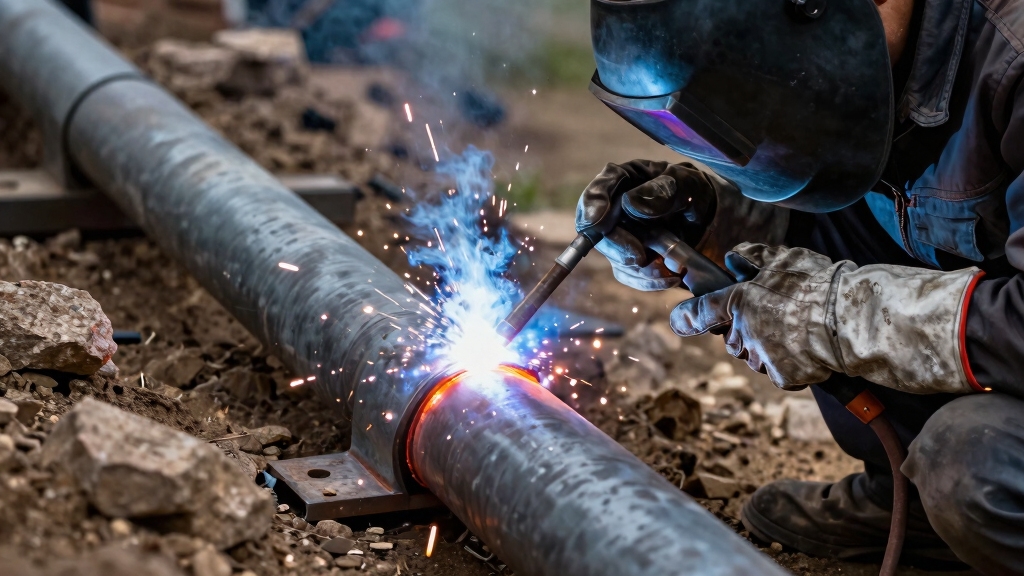
In pipeline construction, downhill pipe welding refers to the technique where you weld in a downward direction along the joint, starting from the top and moving toward the bottom.
Downhill pipe welding involves joining pipes by welding downward from the top to the bottom of the joint.
This method prioritizes speed by enabling faster travel rates during welding, particularly on long pipeline runs.
You use a straight-line motion for the root pass, often with cellulosic electrodes like E6010 or E6011, which promotes a fast-freezing weld pool.
The technique benefits from factory-machined pipe ends and internal clamps to maintain uniform root gaps and alignment, facilitating rapid joint closure.
By welding downhill, you reduce heat input, minimizing distortion and burn-through risks on thinner materials.
This approach suits field conditions requiring efficient, repetitive welding cycles, especially for thin-wall carbon steel pipes in cross-country pipeline applications.
The use of cellulose-based flux in electrodes like E6010 enhances arc force and cleaning action, which is crucial for deep penetration and controlling the weld pool during downhill pipe welding.
When working with thin-wall pipe construction, downhill welding offers distinct advantages by guaranteeing heat input to prevent burn-through and distortion.
By welding downhill, you apply less heat to the joint compared to uphill welding, reducing the risk of warping delicate 12 mm or thinner pipe walls.
The technique’s faster travel speed also limits thermal exposure, minimizing residual stress and metallurgical changes.
You can maintain a stable, fast-freezing weld pool using cellulosic electrodes like E6010, which suits root-pass work on thin materials.
Additionally, downhill welding’s straightforward, straight-line motion helps you achieve consistent penetration without excessive fusion or undercut.
This controlled heat input, combined with rapid deposition, guarantees structural integrity while preserving the pipe’s dimensional accuracy.
This makes downhill welding ideal for thin-wall pipeline applications where minimizing damage is critical.
However, careful management of travel speed and heat input is essential to prevent common defects such as lack of fusion and porosity.
Maximizing pipeline welding speed hinges on downhill welding’s ability to sustain high travel rates without compromising joint quality.
You rely on downhill welding to accelerate the root and fill passes, especially on long pipeline sections where production speed is critical.
This technique balances rapid progression with controlled heat input, minimizing distortion and burn-through risks on thinner pipe walls.
Key factors making downhill welding essential for pipeline speed include:
High travel speeds increase weld output per shift.
Factory-machined pipe ends enable uniform root gaps.
Internal clamps allow quick pipe alignment without tack welds.
Two-welder operations on opposite sides speed joint completion.
Compliance with pipeline welding codes like API 1104 guarantees quality.
Maintaining consistent travel speed and proper torch angle during downhill welding is crucial to prevent weld defects and ensure mechanical integrity.
Downhill welding achieves faster speeds than uphill methods primarily because it allows for a continuous, straight-line motion that reduces the time spent manipulating the electrode. You can maintain a steady travel speed without frequent stops or directional changes, which boosts productivity.
Additionally, downhill welding generates less heat input, enabling faster cooling and quicker progression along the joint. This lower heat input also helps to minimize distortion, which is critical for maintaining pipe integrity.
| Factor | Downhill Welding | Uphill Welding |
|---|---|---|
| Travel Motion | Straight-line, continuous | Intermittent, controlled pauses |
| Heat Input | Lower, reducing distortion | Higher, requiring slower pace |
| Electrode Manipulation | Minimal adjustments | Frequent angle and speed changes |
| Cooling Rate | Faster | Slower |
| Skill Demand | Moderate | Higher |
This technical efficiency makes downhill welding ideal for rapid pipeline construction. Proper control of heat input and cooling rates is essential to maintain weld integrity during this process.
So, why opt for cellulosic electrodes when doing downhill root passes? Well, one big reason is that they create a fast-freezing weld pool. This is super helpful because it aligns perfectly with the high travel speeds needed for efficient pipeline welding.
When the weld pool solidifies quickly, it really helps prevent defects from popping up. Plus, it allows for a stable arc throughout the process, which is always a bonus.
Another advantage is their deep penetration capability. This ensures solid fusion, which is crucial for maintaining the integrity of the root pass in thin-wall pipes.
Additionally, cellulosic electrodes benefit from a high dig setting that maintains arc force and penetration during the fast travel speeds common in downhill welding.
Frequently, welders choose cellulosic electrodes such as E6010 or E6011 for root passes in downhill pipe welding. These electrodes create a fast-freezing weld pool that supports high travel speeds.
This fast-freezing characteristic is essential to prevent excessive weld pool sagging and maintain joint integrity when welding downhill. You’ll find this beneficial because it:
Enables rapid solidification, reducing weld pool fluidity.
Minimizes risk of undercut and overlap defects.
Supports consistent penetration at increased travel speeds.
Allows easier control of the weld pool geometry.
Reduces chances of weld pool collapse on vertical joints.
Additionally, the fast-freezing slag produced by these electrodes helps stabilize the weld puddle and reduces slag inclusion, making downhill welding more reliable.
Because cellulosic electrodes like E6010 and E6011 produce a deep, narrow penetration profile, they guarantee strong fusion at the root pass even when welding downhill at high speeds.
You’ll find these electrodes create a concentrated arc force that drives the weld pool deeply into the joint despite rapid travel.
This deep penetration is critical for ensuring full root fusion, preventing lack of fusion defects common in downhill welding due to faster travel speeds.
Additionally, their cellulose coating generates a reducing atmosphere that stabilizes the arc and improves slag detachability, which helps maintain weld integrity.
The intense arc heat produced by these electrodes results from the electric arc bridging the gap between the electrode tip and the workpiece, generating sufficient thermal energy to melt the base metal and electrode.
You’ll really see the benefits of downhill pipe welding on those long-distance pipeline projects where efficiency is key. It’s a game changer, especially when you’re working with thin-wall pipes. By minimizing heat input, it helps reduce the risk of distortion, which is always a plus.
Plus, one of the best parts about downhill welding is how quickly you can complete joints. This speed not only boosts productivity but also helps you wrap up the entire construction process faster. So, if you’re looking to streamline your project, downhill pipe welding is definitely worth considering! However, controlling the proper amperage settings is crucial to avoid burn-through and ensure quality welds on thinner materials.
In long-distance pipeline projects, downhill pipe welding markedly boosts efficiency by enabling faster travel speeds during root and fill passes.
This method is particularly effective on extensive sections where rapid joint completion directly impacts overall project timelines.
You’ll see the greatest benefits in applications requiring consistent, high-output welding with minimal heat build-up.
Key pipeline projects that benefit most include:
Downhill welding often utilizes Flux-Cored Arc Welding for its higher deposition rates and suitability in outdoor conditions.
Long-distance pipeline efficiency often depends on selecting welding methods tailored to the pipe’s physical characteristics.
When working with thin-wall pipe, typically 12 mm or less, you’ll find downhill welding highly advantageous. This technique minimizes heat input, reducing burn-through risk and distortion, which are critical concerns for thinner materials.
The fast-freezing weld pool created by downhill welding suits cellulosic electrodes like E6010. This allows you to maintain joint integrity without excessive penetration.
Projects involving long cross-country pipelines or extensive oil and gas transport lines benefit most from downhill pipe welding due to its speed and heat control.
However, you should avoid downhill methods on thicker pipes where penetration and fusion control are paramount.
Proper edge preparation and alignment are essential to ensure weld integrity and minimize distortion in these applications, as emphasized in weld preparation principles.
Accelerate pipeline construction by using downhill pipe welding to achieve rapid joint completion, especially on projects demanding high throughput. This technique excels in long-distance pipeline projects where speed directly affects schedule and cost efficiency.
You’ll find downhill welding ideal when working with factory-machined pipe ends, allowing consistent root gaps and quick internal clamp alignment. Its suitability for thin-wall pipe and high travel speeds enables faster weld cycles while maintaining quality.
Projects that benefit most include:
Because downhill welding emphasizes speed and efficiency, managing heat input becomes critical to maintaining weld quality.
Downhill welding demands precise heat input control to ensure fast, efficient, and high-quality welds.
If you apply too much heat, you risk excessive penetration, burn-through, or distortion, especially on thin-wall pipe.
Conversely, insufficient heat input can cause lack of fusion and weak joints.
You must balance travel speed and amperage to control heat input precisely, ensuring the weld pool freezes quickly to prevent slag entrapment and porosity.
Using cellulosic electrodes like E6010 or E6011 facilitates this fast-freezing weld pool, but the heat input still requires tight control.
By optimizing heat input, you maintain the integrity of the root pass and overall joint without sacrificing speed.
Consequently, heat input directly impacts mechanical properties, defect rates, and dimensional stability in downhill pipe welding.
Although downhill welding excels in speed and efficiency for thin-wall pipeline construction, it faces significant limitations when applied to thicker or refinery piping.
Thicker materials require better penetration control, which downhill welding struggles to provide.
Refinery piping demands stringent code compliance and inspection standards, often favoring uphill welding for its superior fusion and defect resistance.
Additionally, downhill welding’s high travel speed risks lack of fusion on heavier sections.
Key constraints include:
Thus, you’ll typically avoid downhill welding on refinery or thick-wall piping.
You need to wear proper PPE, including flame-resistant clothing, gloves, and a welding helmet with the correct shade lens.
Make sure good ventilation to avoid fume buildup, especially when using cellulosic electrodes.
Maintain a stable work position to control the fast travel speed safely.
Keep flammable materials away and be cautious of sparks falling downhill.
Always inspect equipment before use and follow site-specific safety protocols to prevent burns, eye injury, and respiratory hazards.
Weather impacts downhill welding by influencing weld quality and operator control.
Wind can cause shielding gas turbulence, increasing porosity risk.
Cold temperatures slow weld cooling but can harden the weld, affecting toughness.
Rain or moisture risks contamination and arc instability.
You’ll need to shield the weld area, maintain dry conditions, and adjust parameters for temperature shifts.
Proper weather management guarantees consistent penetration and minimizes defects during field downhill welding.
Don’t worry if downhill welding seems tricky at first; start with hands-on training using thin-wall pipe samples to visualize heat control and travel speed.
You’ll focus on mastering steady, straight-line electrode motions and fast-freezing weld pools, often with E6010 or E6011 rods.
Simulations and supervised field practice are essential to build speed without sacrificing fusion quality.
Understanding pipeline codes like API 1104 also guarantees you weld to industry standards confidently.
Yes, you can automate downhill welding effectively, especially in controlled pipeline settings.
Mechanized systems maintain consistent high travel speeds and steady heat input, improving productivity on thin-wall pipes.
Automation reduces operator fatigue and increases repeatability, which is critical for long pipeline runs.
However, precise control is essential to avoid lack of fusion or burn-through.
You’ll need well-calibrated equipment and monitoring to balance speed with weld quality.
Think of weld inspections for downhill pipe joints as a detective’s careful eye. You’re scanning for defects like lack of fusion or burn-through.
You’ll adapt by focusing on ultrasonic and radiographic tests, emphasizing root pass quality since high travel speeds can mask imperfections. Visual inspections target surface flaws, while nondestructive exams verify internal integrity.
You must adjust criteria to account for the rapid cooling and thinner materials typical in downhill welding.
When welding pipe downhill, you’re prioritizing speed without sacrificing quality. Time is money on pipeline projects.
This method suits thin-wall pipes where controlled heat input prevents burn-through. It’s ideal for fast, efficient root passes using cellulosic electrodes.
However, remember that haste makes waste on thicker or refinery pipes, where downhill welding risks weld integrity.
Use downhill welding strategically, balancing speed with the technical demands of your specific pipeline task.