Phone:
(701)814-6992
Physical address:
6296 Donnelly Plaza
Ratkeville, Bahamas.

Phone:
(701)814-6992
Physical address:
6296 Donnelly Plaza
Ratkeville, Bahamas.

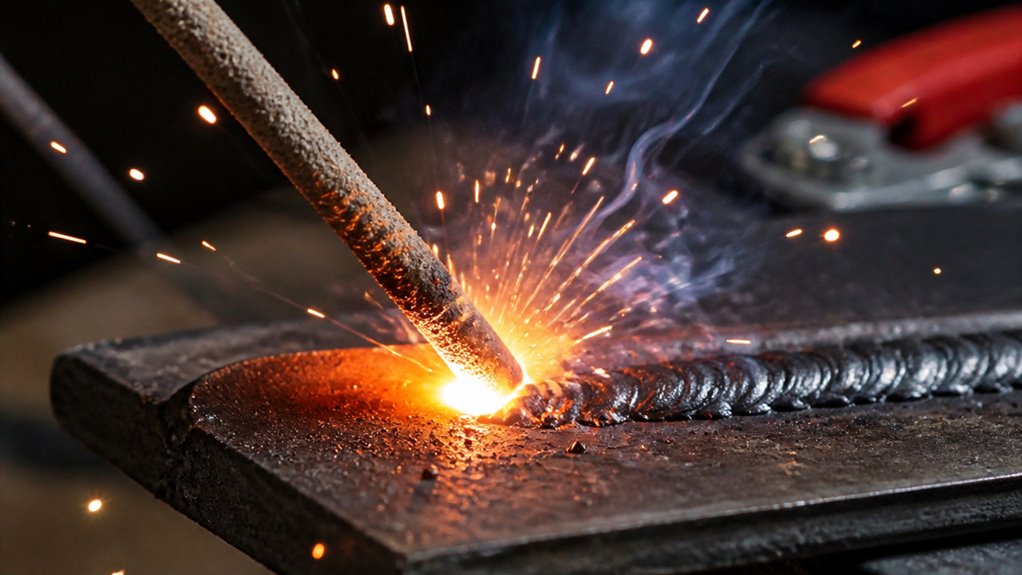
You produce heat in shielded metal arc welding by creating an electric arc between the electrode tip and the workpiece.
This arc ionizes gas, forming plasma that reaches temperatures up to 10,000°F, melting both the electrode and base metal.
The welding current controls arc intensity and Joule heating within the electrode, raising its temperature and melting rate.
Voltage sets arc length and stability, influencing heat concentration.
Understanding these elements shapes weld quality and penetration. Explore how materials, flux, and joint design further affect heat management.
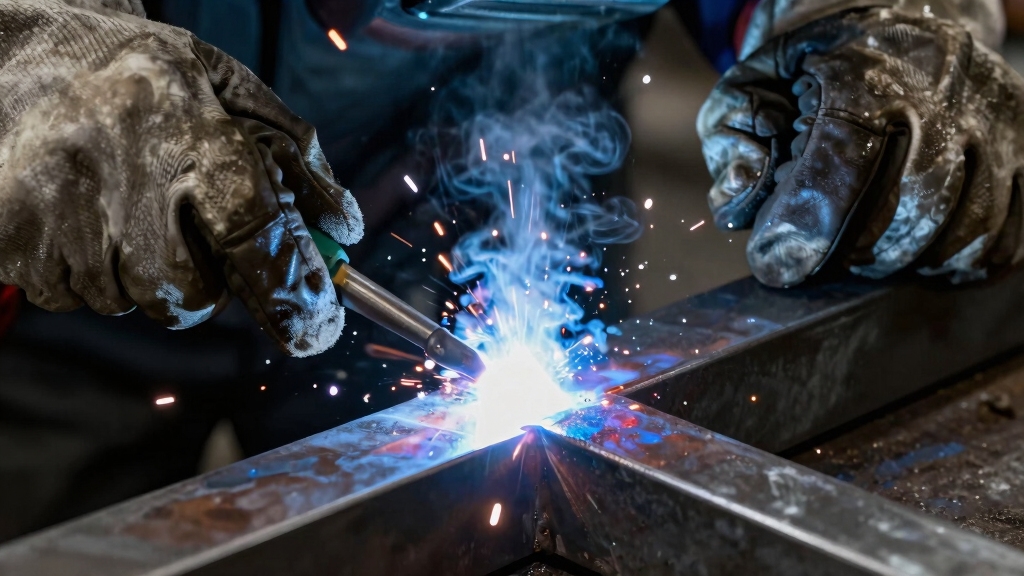
When you initiate shielded metal arc welding, the electric arc forms the primary heat source by bridging the gap between the electrode tip and the workpiece.
The welding current jumps this gap, ionizing the surrounding gas and creating plasma, a highly conductive state that enables current flow and generates intense thermal energy.
This arc temperature typically ranges between 6,000°F and 10,000°F, sufficient to melt both the base metal and the electrode.
The heat generated by the arc is concentrated, allowing it to form a molten weld pool where fusion occurs.
Understanding this mechanism is vital, as the arc’s stability and temperature directly influence weld quality, penetration depth, and the metallurgical bonding essential in shielded metal arc welding.
The use of a flux-coated consumable electrode also provides shielding by producing gases and slag that protect the molten weld pool from contamination.
While the electric arc supplies most of the heat in shielded metal arc welding, the electrode itself also generates significant thermal energy through electrical resistance.
As welding current passes through the electrode, it encounters resistance, producing Joule heating that raises the electrode’s temperature before melting begins.
This resistive heating depends on current magnitude, voltage, and arc duration, directly influencing electrode consumption and weld quality.
Proper management of electrode coating composition is essential to optimize arc stability and heat distribution during welding.
| Parameter | Effect on Electrode Heat | Emotional Impact |
|---|---|---|
| Welding Current | Increases Joule heating | Heightens control anxiety |
| Voltage | Modulates heat intensity | Balances precision |
| Arc Duration | Sustains heat buildup | Challenges endurance |
| Electrode Material | Alters resistance | Inspires material confidence |
Sure! Here’s a more conversational version of the text:
So, when we talk about electrode melting, it’s really a mix of factors at play. You’ve got Joule heating happening right in the electrode, plus heat being conducted from the arc. It’s like a team effort!
Now, the composition of the electrode is super important here. It really impacts how well heat travels along its length and, in turn, affects the melting rates. If you understand these heat transfer mechanisms, you can really get a handle on how to control electrode performance when you’re welding. It’s all about knowing how things work together!
Additionally, during Shielded Metal Arc Welding, the process called dig dynamically boosts amperage when the arc length shortens, providing extra heat and penetration exactly when the electrode nears the weld puddle.
Because electrical current passes through the electrode during shielded metal arc welding, Joule heating markedly raises its temperature before and during melting. As current encounters the electrode’s electrical resistance, it generates heat internally, increasing the electrode’s temperature along its length.
This resistive heating supplements the arc’s thermal energy, accelerating the melting of the electrode tip and influencing droplet formation. You’ll find that higher welding currents intensify Joule heating, directly affecting how quickly the electrode melts and transfers metal to the weld pool.
The electrode’s material composition and cross-sectional area also determine the degree of resistive heating, impacting heat distribution and melting behavior. Understanding Joule heating allows you to optimize welding parameters to control melting rates and improve weld quality. Additionally, the steady, unidirectional flow of direct current (DC) enhances arc stability, which can influence the consistency of Joule heating during the welding process.
As the intense arc heat radiates from the welding zone, it conducts through the molten droplet into the solid electrode wire.
This raises its temperature along the length. You’ll find that this conduction markedly influences the melting rate of the electrode tip.
Heat flows from the arc plasma through the liquid metal into the cooler solid wire. The temperature gradient established along the electrode depends on welding current, arc length, and thermal conductivity of the electrode material.
This heat transfer combines with Joule heating to determine the energy available for melting the consumable electrode.
Controlling arc heat conduction is vital because it affects droplet transfer frequency and weld pool stability.
This, in turn, directly impacts weld quality and deposition efficiency in shielded metal arc welding.
Higher amperage and elevated voltage accelerate electrode wear and increase spatter and uneven wear.
Understanding how electrode composition affects heat transfer is key to controlling the melting behavior during shielded metal arc welding. The electrode’s alloy content and coating materials determine thermal conductivity, electrical resistance, and heat absorption.
These factors influence how quickly heat moves through the electrode, affecting melting rate and droplet formation. You must consider:
Additionally, the flux coating generates shielding gases and slag that stabilize the arc and protect the molten weld pool during melting.
When you strike the arc in shielded metal arc welding, the flux coating on the electrode quickly vaporizes under the intense heat. This generates shielding gases that envelop the molten weld pool.
These gases, primarily carbon dioxide, oxygen, and inert elements, form a protective atmosphere that prevents oxidation and contamination from atmospheric nitrogen and hydrogen.
As the flux decomposes, endothermic and exothermic reactions occur, influencing localized heat distribution. The generation of shielding gases stabilizes the arc by maintaining plasma composition and electrical conductivity.
Additionally, flux constituents affect slag formation, which insulates the weld, controlling cooling rates and thermal gradients. By managing gas evolution and slag coverage, the flux coating directly impacts arc stability, heat transfer patterns, and ultimately weld integrity and penetration characteristics during the welding process.
This process also provides the deep penetration and cleaning action necessary for durable, high-strength welds on thick or contaminated metals.
Control over welding current and voltage plays a crucial role in determining heat input during shielded metal arc welding. Adjusting these parameters influences arc intensity and heat distribution, directly affecting weld penetration and quality.
Higher current increases arc temperature and Joule heating, accelerating electrode melting and base metal fusion. Voltage affects arc length and stability, altering heat concentration and weld bead shape.
Consider these key effects:
Increasing current raises heat input, enhancing penetration but risking excessive dilution. Higher voltage lengthens the arc, spreading heat over a broader area.
Low voltage produces a shorter, more concentrated arc with deeper penetration. Stable current and voltage ensure consistent arc characteristics and heat delivery.
Welding positions demand tailored current-voltage settings to optimize heat input and weld integrity. The use of a magnetic shunt in welding transformers helps fine-tune current for precise heat control during welding.
Although joint design and base metal thickness might seem like straightforward factors, they critically dictate how heat flows during shielded metal arc welding.
Joint design and base metal thickness play a crucial role in controlling heat flow during shielded metal arc welding.
You’ll find that joint geometry, such as groove angle, root opening, and land thickness, directly affects heat absorption and distribution. This influences weld penetration and fusion quality.
A narrow groove angle concentrates heat, enhancing penetration but risking burn-through if not controlled. Conversely, wider angles disperse heat, requiring higher input.
Base metal thickness also governs heat flow. Thicker materials demand more heat to achieve full fusion due to greater thermal mass and conductivity. Without adequate heat, you risk incomplete fusion or weak joints.
Understanding these parameters lets you optimize welding conditions. This ensures efficient heat transfer and consistent weld integrity across varying joint designs and material thicknesses.
Proper edge preparation, alignment, and heat control are critical to ensure weld integrity and minimize distortion.
Electrode materials markedly impact heat generation and arc stability in shielded metal arc welding. They govern electrical resistance, melting characteristics, and heat conduction.
You’ll find that the electrode’s core composition and flux coating chemistry directly influence how much heat is produced and how consistently the arc behaves. Understanding these effects helps you optimize welding parameters for better fusion and minimal defects.
Key influences include:
Additionally, using an auto darkening welding helmet enhances safety by protecting the welder’s eyes from intense arc radiation during operation.
Managing base metal temperature before welding markedly influences heat input and distribution during shielded metal arc welding.
Controlling base metal temperature significantly impacts heat input and distribution in shielded metal arc welding.
When you preheat the workpiece, you reduce the thermal gradient between the arc and the base metal. This controls heat flow and minimizes rapid cooling.
As a result, you achieve more uniform heat distribution, reducing the risk of cracking or distortion.
Preheating also lowers the electrical resistance of the base metal, allowing current to pass more efficiently and stabilizing the arc.
By controlling the initial temperature, you effectively manage the weld pool formation and fusion characteristics.
Additionally, preheating mitigates the heat sink effect in thick or high-conductivity materials. This ensures sufficient heat remains to achieve full penetration and proper metallurgical bonding.
Ambient temperature affects welding arc heat by influencing the cooling rate of both the electrode and workpiece.
When it’s colder, you’ll experience faster heat dissipation, requiring you to increase welding current or slow your travel speed to maintain proper fusion.
Conversely, higher ambient temperatures reduce heat loss, potentially causing excessive weld pool fluidity.
You need to adjust parameters carefully to guarantee stable arc characteristics and consistent heat input despite temperature variations.
Imagine standing near a blazing furnace: you’ve got to shield yourself carefully.
In SMAW, you wear flame-resistant gloves, a welding helmet with a darkened visor, and protective clothing to guard against radiant heat and molten splatter.
You also use proper ventilation to avoid heat buildup and stay hydrated.
These precautions minimize burns, eye damage, and heat stress, ensuring that you stay safe while managing the intense thermal energy generated during welding.
You’ll find that increasing welding speed reduces heat input per unit length. This can minimize distortion but may cause insufficient fusion or poor bead shape.
Slower welding speed increases heat input, enhancing penetration and fusion. However, it risks excessive weld pool fluidity, distortion, or burn-through.
Yes, humidity can impact the stability of the welding arc heat.
Moisture in the air increases the risk of arc interruptions and inconsistent ionization, which disrupts plasma formation.
This instability causes fluctuations in arc temperature and heat input, leading to uneven weld penetration and poor fusion.
You should control humidity levels to maintain consistent shielding gas behavior and stable arc conditions.
This ensures reliable heat transfer and peak weld quality.
You make certain electrode storage maintains dryness, prevents contamination, and controls temperature to keep heat generation consistent.
Proper storage avoids moisture absorption, which could cause arc instability, spatter, and uneven heating.
By storing electrodes in a controlled environment, you preserve the flux coating’s integrity, stabilize arc characteristics, and maintain predictable electrical resistance.
Consequently, you achieve reliable Joule heating, consistent melting rates, and uniform heat distribution during welding operations.
You generate heat in shielded metal arc welding primarily through the electric arc’s intense energy. This acts like a concentrated lightning bolt between the electrode and base metal.
This arc’s heat, influenced by electrical resistance, current, voltage, and electrode properties, melts both the metal and flux. Understanding these factors lets you control heat flow precisely.
This ensures strong welds while preventing damage, like a skilled conductor directing an orchestra of thermal energy for peak performance.