Phone:
(701)814-6992
Physical address:
6296 Donnelly Plaza
Ratkeville, Bahamas.

Phone:
(701)814-6992
Physical address:
6296 Donnelly Plaza
Ratkeville, Bahamas.

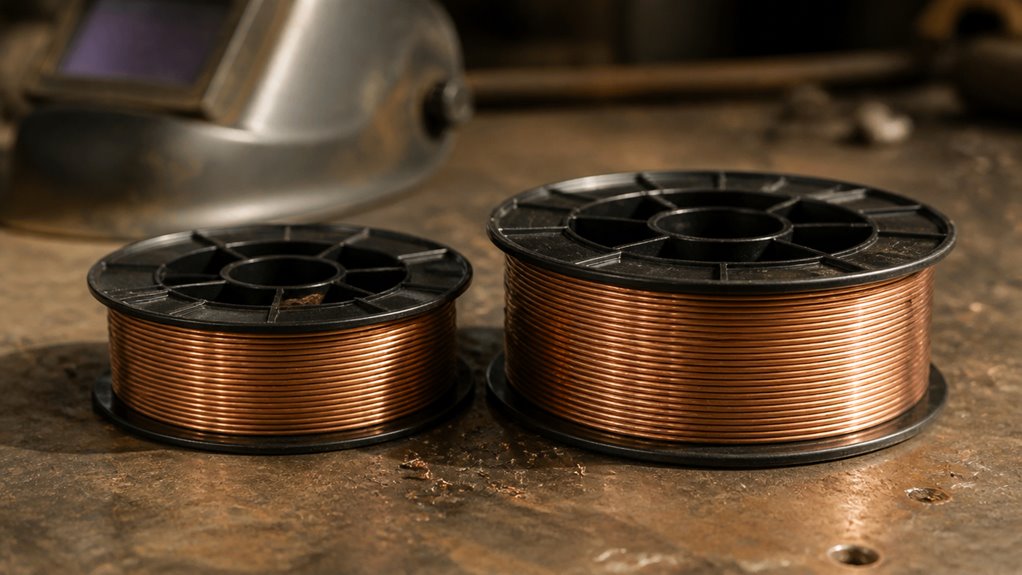
When choosing between 0.030 and 0.035 flux core wire, match the wire diameter to your material thickness and welding needs.
Use 0.030 for thinner metals (22 to 14 gauge) to get better control, lower heat input, and reduced burn-through risk.
Opt for 0.035 on thicker steel (18 gauge to 3/16″+) to benefit from higher deposition rates, deeper penetration, and stronger fusion.
However, expect more spatter and cleanup.
Adjust voltage and feed speed accordingly to optimize weld quality and efficiency.
Understanding these details improves both precision and productivity.
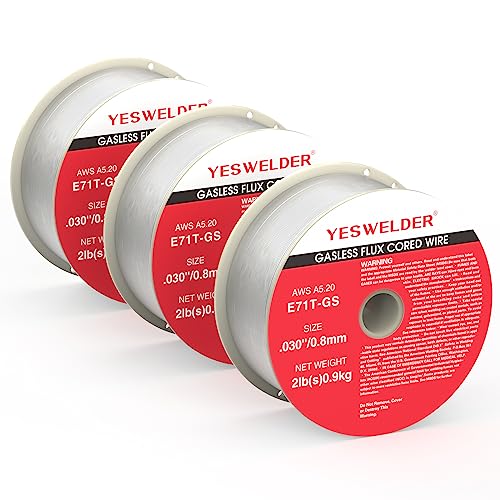
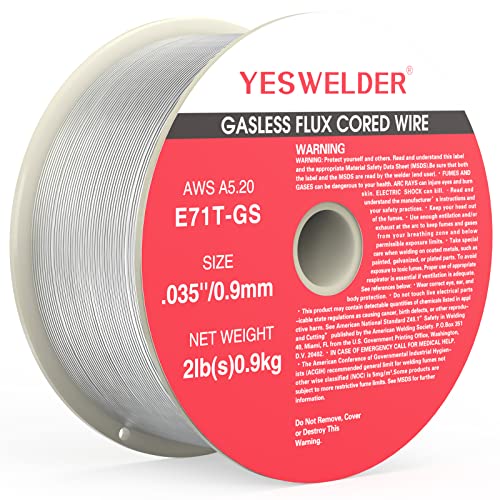
| Feature | 0.030 Flux Core Wire | 0.035 Flux Core Wire |
|---|---|---|
| Wire Diameter | 0.030 inch | 0.035 inch |
| Main Purpose | Thin metal welding and precision work | Thicker metal welding and heavy-duty repairs |
| Typical Material Thickness | 22 to 14 gauge | 18 gauge to 3/16 inch or thicker with multiple passes |
| Best Applications | Sheet metal, automotive panels, light fabrication | Structural welding, farm repairs, heavy fabrication |
| Heat Input | Lower | Higher |
| Voltage Range | Approximately 17 to 20 volts | Approximately 18 to 24 volts |
| Wire-Feed Speed | Approximately 170 to 215 IPM | Approximately 170 to 350 IPM |
| Amperage Requirements | Generally lower | Generally higher |
| Penetration Depth | Shallower, more controlled | Deeper penetration |
| Deposition Rate | Lower | Higher |
| Weld Bead Profile | Narrower, more controlled bead | Wider bead with deeper fusion |
| Burn-Through Risk | Lower on thin materials | Higher on thin materials if settings are unsuitable |
| Weld Quality | Better control on thin steel | Strong fusion on thicker steel when properly set |
| Spatter Production | Generally lower | Moderate to high |
| Smoke Output | Lower | Higher |
| Slag and Cleanup | Less cleanup required | More slag removal and cleanup |
| Heat Control | Better for delicate work | Better suited to applications requiring greater heat |
| Distortion Risk | Helps minimize warping on thin metal | Requires careful heat management on thinner sections |
| Machine Compatibility | Suitable for smaller welding machines within their rated capacity | Better suited to machines capable of higher output |
| Feed Tension | Requires careful adjustment because thinner wire can deform | Tolerates higher tension, but excessive tension can cause feeding problems |
| Drive Rolls | Smaller V-groove or U-groove rolls may be suitable | Knurled or V-groove rolls designed for the wire diameter may be required |
| Multiple-Pass Welding | Less suited to heavy, thick-stock applications | Suitable for building up welds on thicker material |
| Main Advantage | Precision, lower heat input, and easier cleanup | Higher deposition rates, deeper penetration, and stronger fusion on thick material |
| Main Limitation | Limited effectiveness on thick stock | More spatter and greater burn-through risk on thin metal |
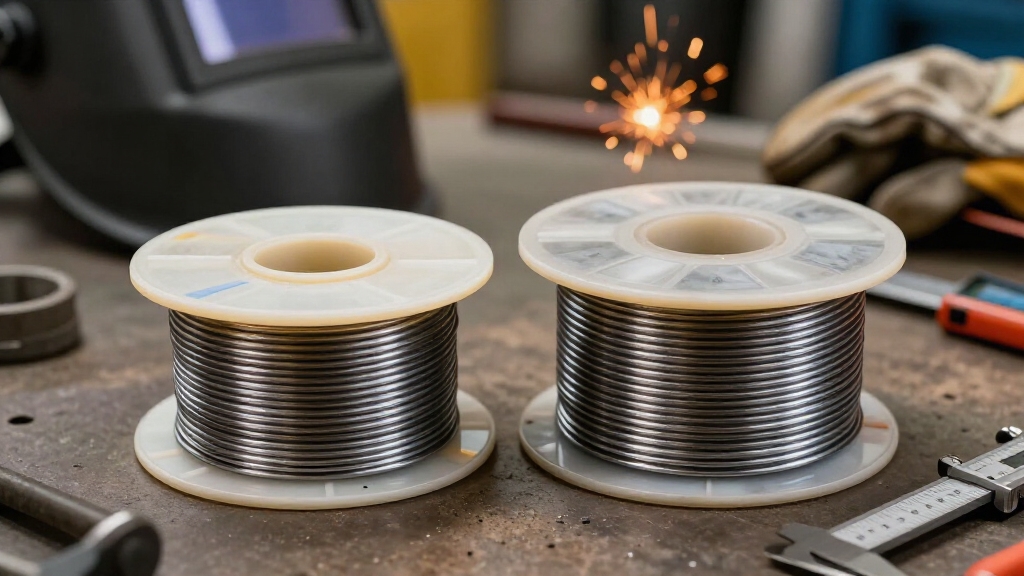
When choosing between 0.030 and 0.035 flux core wire, you must consider the thickness of your material and the welding machine’s capabilities.
Selecting between 0.030 and 0.035 flux core wire depends on material thickness and welder capacity.
The 0.035 wire has a larger diameter and cross-sectional area, enabling higher deposition rates and supporting more aggressive voltage and wire-feed speed settings.
This wire suits machines with higher output capacity and applications requiring stronger fusion.
Conversely, 0.030 wire runs at lower voltage and amperage ranges, offering better control over heat input.
This minimizes burn-through risk on thinner metals.
Its lower spatter and smoke levels also reduce cleanup.
You should match your wire choice to your equipment’s power range and the weld’s thermal demands.
This ensures optimal penetration and weld profile without exceeding machine limits or compromising weld quality.
Additionally, selecting the correct roller size for your wire diameter helps guarantee consistent feeding and prevents deformation during welding.
Selecting the appropriate flux core wire diameter hinges largely on the thickness of the material you’re welding. The 0.030-inch wire suits thinner steel, typically from 22 gauge to 14 gauge, providing controlled heat input and minimizing burn-through.
The 0.035-inch wire handles thicker steel, roughly 18 gauge up to 3/16 inch or more with multiple passes. It delivers deeper penetration and higher deposition rates.
| Wire Diameter | Typical Thickness Range | Application Focus |
|---|---|---|
| 0.030 inch | 0.030″ (22 ga)–0.074″ (14 ga) | Thin sheet metal, auto body |
| 0.035 inch | 0.047″ (18 ga)–0.188″ (3/16″) | Structural, heavier plate |
| 0.035 inch | >0.188″ (3/16″) multiple passes | Heavy fabrication, repair |
| 0.030 inch | <0.030″ | Very thin, delicate work |
| 0.035 inch | 0.100″–0.188″ | Medium-thick single pass |
Choosing the correct wire diameter is crucial to match the metal thickness and amperage for proper penetration and deposition, ensuring optimal weld quality and efficiency through arc stability.
Matching wire diameter to material thickness sets the stage for optimizing voltage and wire-feed settings in flux core welding. When choosing between 0.030 and 0.035 wire, you should adjust your parameters to match their characteristics for consistent arc stability and deposition rates.
Selecting the right wire diameter is crucial for stable arc and consistent weld quality in flux core welding.
Consider these key settings differences:
0.030 wire typically runs at 17–20 volts, with wire-feed speeds between 170–215 IPM.
0.035 wire operates at 18–24 volts, with broader wire-feed speeds from 170 up to 350 IPM.
Higher voltage and feed rates with 0.035 wire increase heat input for thicker material.
Lower amperage settings suit 0.030 wire, reducing burn-through risk on thin steel.
Proper calibration guarantees steady wire melting and peak weld bead formation.
Adjust settings precisely for your application’s material thickness and machine capability.
Using controlled heat input is essential to prevent hydrogen-induced cracking and weld defects when working with varying wire sizes.
When you look at 0.030 and 0.035 flux core wire, you’ll see some interesting differences.
Generally, the 0.035 wire gives you deeper penetration. Why? Well, it’s larger in diameter and has a higher heat input. This means it can really create a fuller, stronger bead, which is great for working with thicker materials.
On the flip side, if you go with 0.030, you’ll find that it offers better heat control. This is especially handy when you’re dealing with thin steel because it helps to minimize burn-through while still ensuring you get good fusion.
Additionally, the choice of wire diameter affects the deposition rate and penetration, influencing weld quality and efficiency.
Although both 0.030 and 0.035 flux core wires are effective for welding mild steel, you’ll notice significant differences in penetration depth that impact weld quality.
The 0.035 wire’s larger diameter allows for higher heat input and deeper fusion, ideal for thicker sections. Conversely, 0.030 wire provides more controlled penetration, reducing burn-through risk on thinner material.
Consider these key factors:
0.035 wire supports higher voltage (18–24V) and amperage, increasing penetration.
0.030 wire runs at lower voltage (17–20V), limiting heat and penetration.
Deeper penetration from 0.035 enhances fusion in heavy-duty repairs.
0.030 wire’s shallower penetration suits thin gauge steel and precision work.
Multiple passes with 0.035 improve weld strength on thicker stock.
Choosing wire size directly influences your weld’s penetration and overall integrity.
Self-shielded flux-cored wire generates its own shielding gases and slag, making it ideal for gasless MIG welding applications where external gas is not used.
Understanding the weld profile differences between 0.030 and 0.035 flux core wire is essential for optimizing your weld quality and penetration.
The 0.030 wire produces a narrower, more controlled bead profile suitable for thin materials, reducing burn-through risk and maintaining consistent fusion.
In contrast, 0.035 wire delivers a wider bead with deeper penetration, ideal for thicker materials requiring stronger joint integrity.
The increased flux content in 0.035 wire enhances slag coverage but also leads to more spatter and post-weld cleanup.
You’ll notice that 0.035 wire supports higher amperage and voltage, promoting robust fusion and reinforcement, while 0.030 wire excels in precise, cleaner welds on lighter gauge steel.
Selecting the proper wire diameter directly influences your weld’s mechanical properties and final appearance.
Additionally, the tubular flux-filled wire design of flux core wires generates shielding gas internally, eliminating the need for external gas and improving weld practicality in various conditions.
Controlling heat input plays a critical role in determining penetration depth and overall weld quality between 0.030 and 0.035 flux core wires.
When you choose 0.030 wire, you’re working with lower amperage and voltage, which limits heat, reducing burn-through risk on thin metals.
Conversely, 0.035 wire demands higher heat input, allowing deeper fusion on heavier sections but increases spatter and smoke.
Consider these heat control effects when selecting wire:
0.030 wire offers precise heat control for thinner gauges.
0.035 wire supports aggressive heat for thicker material.
Higher heat with 0.035 improves penetration but raises cleanup needs.
Lower heat with 0.030 enhances weld profile consistency on thin steel.
Heat input directly affects deposition rate and weld strength.
Optimizing heat intake guarantees you balance penetration and weld integrity effectively.
Additionally, choosing between gas-shielded and self-shielded flux core wires can influence weld quality and spatter levels due to differences in shielding gas requirements.
When you choose between 0.030 and 0.035 flux core wire, managing spatter and cleanup becomes a key consideration. The 0.030 wire produces less spatter and smoke, reducing post-weld cleanup time. In contrast, the 0.035 wire contains more flux, leading to increased spatter and more extensive slag removal. Your choice impacts both weld quality and efficiency. Additionally, adjusting the wire feed speed can help control spatter levels and improve bead consistency.
| Wire Diameter | Spatter Level | Cleanup Effort |
|---|---|---|
| 0.030 | Low | Minimal |
| 0.035 | Moderate to High | Moderate to Extensive |
| Material | Thin Sheets | Thicker Plates |
| Flux Content | Lower | Higher |
| Smoke Output | Lower | Higher |
Understanding these factors helps you optimize workflow and maintain weld integrity.
When it comes to using flux core wire, 0.030 is fantastic for working with thin materials, like sheet metal and light fabrication. It really shines because it has a controlled heat input, which helps minimize the risk of burn-through. This makes it a great choice for those delicate projects where precision matters.
On the flip side, if you’re dealing with thicker metals, you’ll want to reach for the 0.035 wire. It’s designed for deeper penetration and creates a stronger fusion, making it ideal for structural work and heavy-duty repairs. So, when you’re selecting your wire, just remember that matching the wire size to the thickness of your material is key to achieving optimal weld quality and efficiency. Happy welding!
Additionally, choosing the right flux core wire size helps optimize deposition rates for faster and more productive welding on different material thicknesses.
Several factors make 0.030 flux core wire the preferred choice for thin material applications, especially in the range of 22 gauge to 14 gauge steel.
You’ll benefit from its controlled heat input, reducing the risk of burn-through and warping. The smaller diameter supports precise weld profiles and lower spatter levels, making cleanup easier.
When working with thin sheet metal or automotive panels, 0.030 wire offers superior control and appearance.
Key advantages include:
Lower amperage and voltage settings for delicate work, reduced spatter and smoke production, better compatibility with small welding machines, enhanced weld bead control on thin gauges, and minimized distortion and heat-affected zone.
This makes 0.030 flux core ideal for light fabrication and thin metal repairs where precision is critical.
For optimal results, ensure thorough surface preparation before welding to improve strength and durability.
Moving from thin to thick materials requires adjusting your wire choice to handle increased metal mass and heat demands.
For thicker steel, 0.035 flux core wire delivers deeper penetration and higher deposition rates, essential for structural and heavy-duty repairs. It supports higher voltage and wire-feed settings, enabling multiple passes and stronger fusion.
Conversely, 0.030 wire lacks the capacity for such heat input and deposition, limiting its effectiveness on thick stock.
| Wire Diameter | Material Thickness | Best Use Case |
|---|---|---|
| 0.030 | 22 to 14 gauge | Light fabrication, sheet metal |
| 0.035 | 18 gauge to 3/16 inch+ | Farm repair, structural welding |
| 0.035 | Multiple passes on thicker | Heavy plate, high-strength joints |
You’ll find that wire feed tension directly impacts both 0.030 and 0.035 wire performance by controlling consistent wire delivery.
Too much tension can deform the softer 0.030 wire, causing feeding issues.
The 0.035 wire, being thicker, tolerates higher tension but risks feed stoppages if excessive.
Properly adjusted tension guarantees steady arc stability and consistent deposition.
You should fine-tune tension specifically for wire diameter to optimize weld quality and minimize burnback or birdnesting.
You can use 0.030 and 0.035 wires interchangeably on the same machine, but you must adjust settings accordingly.
Voltage, wire-feed speed, and feed tension all need tweaking to match each wire’s diameter and deposition rate.
Neglecting this leads to inconsistent arc stability and poor weld quality.
Make sure your drive rolls fit the wire size to avoid feeding issues.
Precision in setup guarantees peak performance regardless of wire swap.
You should store flux core wire in a dry, temperature-controlled environment to prevent moisture absorption, which degrades weld quality.
Keep spools sealed in airtight containers or original packaging with desiccants.
Avoid exposure to humidity, dust, and corrosive atmospheres, as these promote rust and flux contamination.
Proper storage maintains consistent wire feeding, stable arc performance, and reduces spatter.
This ensures peak weld integrity and minimizes downtime during your welding operations.
Your wire spool size directly affects welding duration by determining how long you can weld before changing spools.
Larger spools hold more wire, letting you weld longer without interruption. Since 0.035 wire has a larger diameter, it feeds faster at similar amperage, so a bigger spool benefits you more by reducing downtime.
With 0.030 wire’s smaller diameter and slower feed, spool size still matters but impacts duration less dramatically.
You’ll find that 0.035 wire typically requires knurled or V-groove drive rolls designed for its larger diameter.
In contrast, 0.030 wire works well with smaller V-groove or U-groove rolls.
Using the wrong roll can cause feeding issues like birdnesting or wire deformation.
When you choose between 0.030 and 0.035 flux core wire, picture your weld like a tailored fit. Thinner wire slices through lighter materials with finesse, while thicker wire drives deep with power.
Adjust your voltage and feed settings like tuning an instrument for precision. Remember, cleaner welds mean less post-weld cleanup.
By matching wire size to your project’s demands, you’ll achieve strong, consistent welds that stand the test of time with minimal hassle.
Last update on 2026-10-21 / Affiliate links / Images from Amazon Product Advertising API
