Phone:
(701)814-6992
Physical address:
6296 Donnelly Plaza
Ratkeville, Bahamas.

Phone:
(701)814-6992
Physical address:
6296 Donnelly Plaza
Ratkeville, Bahamas.

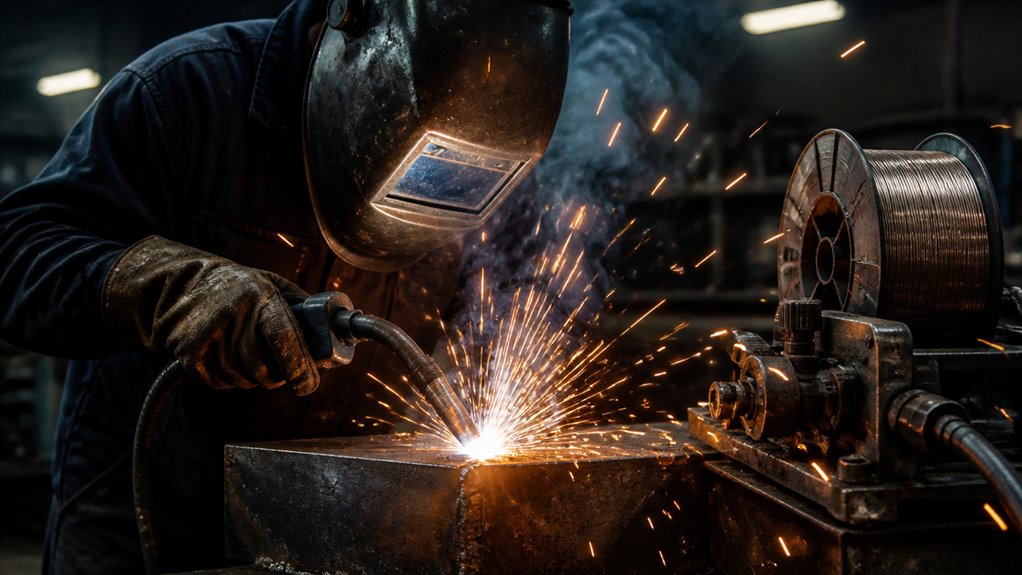
Flux core wire is a tubular welding electrode with a metal outer sheath and a hollow center filled with flux and alloying materials.
You feed it continuously through a compatible welding gun as an electric arc melts the wire and your base metal.
The heated flux helps shield the weld pool. Some wire types also require external shielding gas.
You’ll find out how its types, setup, and applications affect welding performance in the sections ahead.
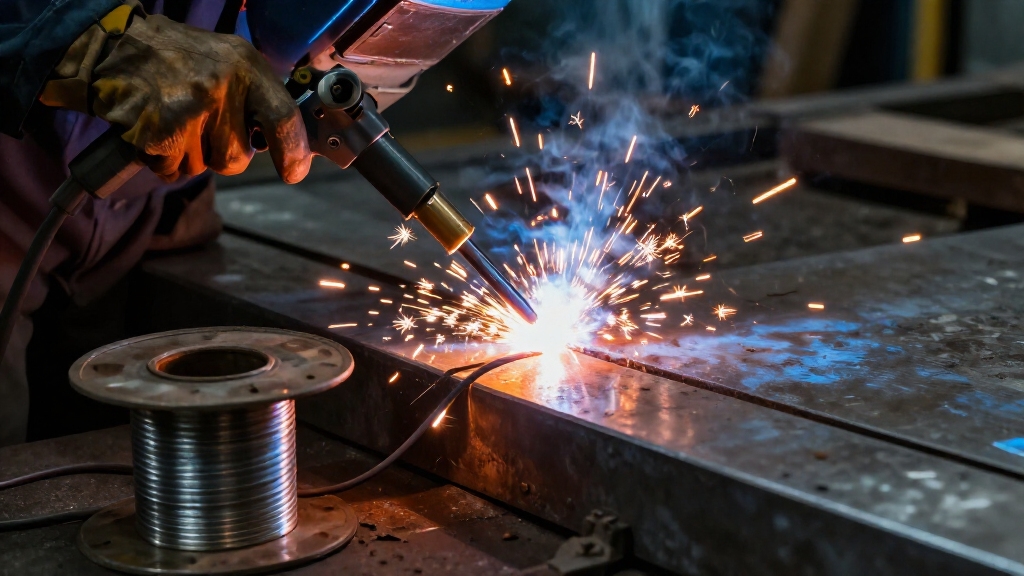
Flux core wire is a tubular welding electrode with a metal outer sheath and a hollow center filled with flux and alloying materials.
Flux core wire has a metal sheath surrounding a hollow center filled with flux and alloying materials.
You’ll find it supplied on a spool for continuous feeding through a compatible welding gun. Unlike solid MIG wire, its center contains materials that support the welding process rather than solid metal.
This construction defines the electrode and distinguishes it from other wire types. The process that uses this electrode is called flux-cored arc welding or FCAW.
When selecting wire, you’ll need to match its type and specifications to your machine, base metal, and application.
Flux core wire is available in formulations for different welding conditions and materials. Its tubular design makes it a distinct consumable for FCAW, not simply solid wire with a different label. Some types are self-shielded, generating protective gases from the flux without requiring an external gas supply.
During flux-cored arc welding, a machine feeds the wire through a gun. An electric arc melts the electrode and base metal to form a weld bead.
As you guide the gun along the joint, the wire continuously replaces the electrode material consumed by the arc. Heat also melts the adjoining base metal, joining the materials as the molten pool solidifies.
Inside the tubular wire, flux decomposes under heat and generates shielding gases that help protect the weld pool from atmospheric contamination. The flux also forms slag, which settles over the bead as it cools.
You’ll need to remove this slag after welding to inspect the finished joint.
For many self-shielded applications, the flux-generated gases provide protection without an external gas supply. This simplifies your equipment setup.
A constant-voltage power source helps maintain a stable arc as the wire feeds continuously.
You can choose between two main types of flux core wire: self-shielded and gas-shielded. Both use a tubular electrode, but they protect the weld pool differently. Your choice determines whether you need an external shielding gas supply.
| Type | Shielding method | Typical setup |
|---|---|---|
| Self-shielded | Flux generates shielding gases | No gas cylinder |
| Gas-shielded | Flux and external gas | Gas cylinder and regulator |
| Shared feature | Tubular, flux-filled wire | Continuously fed |
| Key distinction | Internal or combined shielding | Match wire to machine |
With self-shielded wire, you rely on gases released by the flux. You don’t connect an external gas cylinder for most work.
Gas-shielded wire combines flux with supplied shielding gas. This often produces cleaner welds in controlled shop conditions.
Self-shielded wire is especially useful outdoors because its shielding is less affected by windy conditions.
Check the wire’s specifications and your equipment requirements before welding. The two types aren’t interchangeable in every setup.
Once you’ve chosen self-shielded or gas-shielded wire, match it to the metal and job.
Flux core wire suits mild steel particularly well, especially when you’re joining thicker sections or filling large joints. You can also select specialized wires for stainless steel and cast iron.
Check the wire’s classification and compatibility with the base metal before welding.
For outdoor repairs, construction, and field work, self-shielded wire lets you weld without external shielding gas. Its shielding resists wind disruption.
In fabrication shops and industrial production, gas-shielded wire can support cleaner welds and high deposition rates.
Flux-cored welding also handles some rust, dirt, and mill scale better than many processes, but cleaner metal improves weld quality.
Don’t choose it for aluminum; flux core wire isn’t a practical option for that metal.
Flux core’s higher deposition rate can help speed up work on thicker steel.
Before striking an arc, match the welder’s settings and components to your flux core wire and workpiece. Check the wire label for polarity, voltage, and feed-speed guidance. Consult your machine manual for adjustments.
| Setup item | What you should check | Action |
|---|---|---|
| Wire type | Self- or gas-shielded | Match wire to process |
| Polarity | Wire manufacturer’s specification | Set leads accordingly |
| Drive roll | Wire diameter and type | Install compatible roll |
| Tension | Smooth, steady feeding | Tighten without crushing |
| Settings | Wire chart and thickness | Set voltage and feed speed |
Load the spool so wire feeds from the bottom or top as the machine specifies. Thread it through the liner and gun, then trim the tip. For gas-shielded wire, connect the specified cylinder and set flow.
Clamp the work lead to clean metal. Wear a welding helmet, gloves, and protective clothing. Clear flammables. Test-feed the wire, then make a short bead on scrap matching your workpiece. Adjust settings if the arc stubs or burns back. For gasless welding, use self-shielded flux-cored wire to protect the weld pool without external shielding gas.
Sure! Here’s a more conversational version of the text:
When you use self-shielded flux core wire, one big advantage is that you don’t have to mess with a gas cylinder. This really simplifies your setup and makes it easier to move around.
Plus, the high deposition rate of this wire means you can fill joints quickly and efficiently—who doesn’t want to save time on that?
Another great perk is that you can weld outdoors without much worry. The flux-generated shielding is way less affected by wind compared to external shielding gas, so you can keep working even when the breeze picks up.
For thicker materials, flux core wire can provide deeper penetration than MIG wire.
Because self-shielded flux core wire generates shielding gases as it melts, you can weld without an external gas cylinder. The wire’s flux also forms slag, which covers the cooling weld and helps protect it from contamination.
Without a cylinder, regulator, and gas hose, you can simplify your equipment setup and move your welding machine more easily between work areas. This makes self-shielded wire practical for repairs, portable jobs, and outdoor welding, where wind can disperse shielding gas from a conventional setup.
You’ll still need to match the wire type to your machine and application; some flux-cored wires require external gas. For self-shielded work, follow the manufacturer’s settings and maintain suitable ventilation, since flux decomposition produces fumes. Adjusting voltage and wire speed can help improve arc stability and reduce spatter.
Remove the slag after the weld cools.
Flux core wire can deposit metal quickly, making it efficient for filling joints and welding thicker materials. As the wire feeds continuously, you can maintain a steady arc and add weld metal without repeatedly stopping to replace an electrode.
This high deposition rate helps you complete large welds faster than with many lower-output processes, improving productivity in fabrication and repair work. You’ll get the most benefit when you match the wire’s diameter and feed speed to the material thickness, joint design, and welding position.
A suitable setup lets you build a bead efficiently while maintaining proper fusion and penetration. For thick sections, multiple passes may still be necessary to meet strength requirements. FCAW’s deeper penetration makes it well suited to thick materials and structural projects.
Remove slag between passes and inspect the finished weld for defects; fast deposition doesn’t replace sound technique or quality control.
When wind would disperse shielding gas, self-shielded flux core wire can keep outdoor welding practical. Its flux generates shielding gases at the arc, so you don’t need a gas cylinder for most self-shielded applications.
This simplifies transport and setup when you’re repairing equipment, fencing, or structural steel away from a workshop.
Wind can still affect weld quality by disturbing the arc or carrying away shielding products. Choose a sheltered work area whenever possible.
Match the wire type and polarity to your machine’s specifications. Set voltage and wire-feed speed for the material thickness.
Flux core wire can tolerate some rust, dirt, and mill scale, but cleaning the joint improves consistency. After welding, remove the protective slag and inspect the bead for defects before you rely on the joint.
Its continuous wire feed can also help you deposit weld metal faster than with stick welding.
Although flux core welding is versatile, it has drawbacks you should consider: it produces slag that must be chipped away, can create more spatter than some wire processes, and may require external shielding gas for certain applications.
These factors can add cleanup time and affect weld appearance. You’ll also need to match the wire type, drive roll, and machine settings to your application; incorrect setup can cause feeding problems or poor weld quality.
Key considerations include:
Plan for cleanup and verify your equipment settings before welding to achieve consistent results. Self-shielded flux-core wire can also tolerate windy conditions that may disrupt MIG shielding gas.
Store your flux core wire in its original sealed packaging until you’re ready to use it. Keep opened spools in an airtight container or moisture-resistant bag, ideally with desiccant.
Place them in a clean, dry area. Avoid damp floors, temperature swings, and condensation.
Follow the manufacturer’s temperature and humidity limits; some wires require controlled storage or rebaking.
Don’t use wire with visible rust, corrosion, or moisture-related feeding problems.
Yes, flux core wire can go bad over time, especially if moisture reaches its flux.
Imagine striking an arc only to hear popping and see porous, inconsistent beads?
Damp or contaminated wire may cause those problems, excess spatter, and poor weld quality.
Check the manufacturer’s shelf-life guidance, packaging, and storage conditions.
Discard wire that’s rusty, damaged, or moisture-exposed.
Keep usable spools sealed and dry.
Don’t assume age alone makes properly stored wire unusable.
Wear a properly rated welding helmet with the correct shade lens, plus safety glasses underneath to protect against sparks and debris.
Cover your skin with flame-resistant clothing, leather welding gloves, and sturdy leather boots; avoid synthetic fabrics that can melt.
Use hearing protection when noise levels warrant it.
Maintain adequate ventilation, and wear a respirator if fume controls can’t keep exposure within safe limits.
Keep nearby people protected with welding screens.
Choose flux core wire diameter based on your welder’s specifications, material thickness, and welding position.
What thickness are you joining? For thin sheet, use smaller wire, typically 0.030 inch. For general fabrication, 0.035 inch offers versatility.
Thicker plate and high-deposition work may need 0.045 inch or larger, if your machine supports it.
Check the wire manufacturer’s chart for recommended amperage and voltage, and match your drive rolls and contact tip to the diameter.
You can spot flux-core weld defects by inspecting the bead’s surface and checking its profile.
Look for cracks, pores, pinholes, excessive spatter, undercut grooves, overlap, or uneven width and height.
Slag trapped along or within the bead can signal poor technique or inadequate cleaning.
Clean the weld, then use a bright light and magnification; check both sides when accessible.
For critical joints, use suitable nondestructive testing, such as dye penetrant or radiography.
Flux core wire gives you a practical path to strong welds, especially outdoors or on thicker steel.
Choose the right wire, match your machine settings to the metal, and prepare each joint carefully.
Remember that flux-cored welding can create spatter, slag, and fumes, so use proper protection and ventilation.
When you balance wire, workpiece, and technique, you’ll make cleaner, more consistent welds and build confidence with every pass.