Phone:
(701)814-6992
Physical address:
6296 Donnelly Plaza
Ratkeville, Bahamas.

Phone:
(701)814-6992
Physical address:
6296 Donnelly Plaza
Ratkeville, Bahamas.

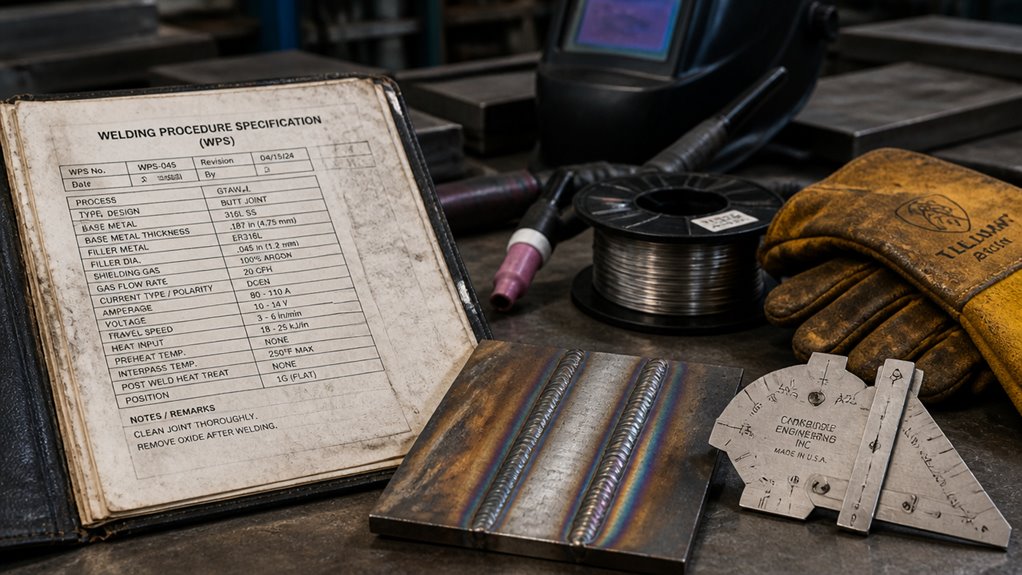
WPS stands for Welding Procedure Specification, a detailed written guide you use to make certain your welding meets required standards consistently.
It outlines exact parameters like welding process, base metal type, filler material, joint design, and electrical settings to minimize defects and maintain quality.
This “recipe” supports repeatability and compliance with codes by controlling critical variables systematically.
Understanding its key components and qualification process helps you produce reliable, high-quality welds every time.
More insights reveal how WPS drives compliance and production efficiency.
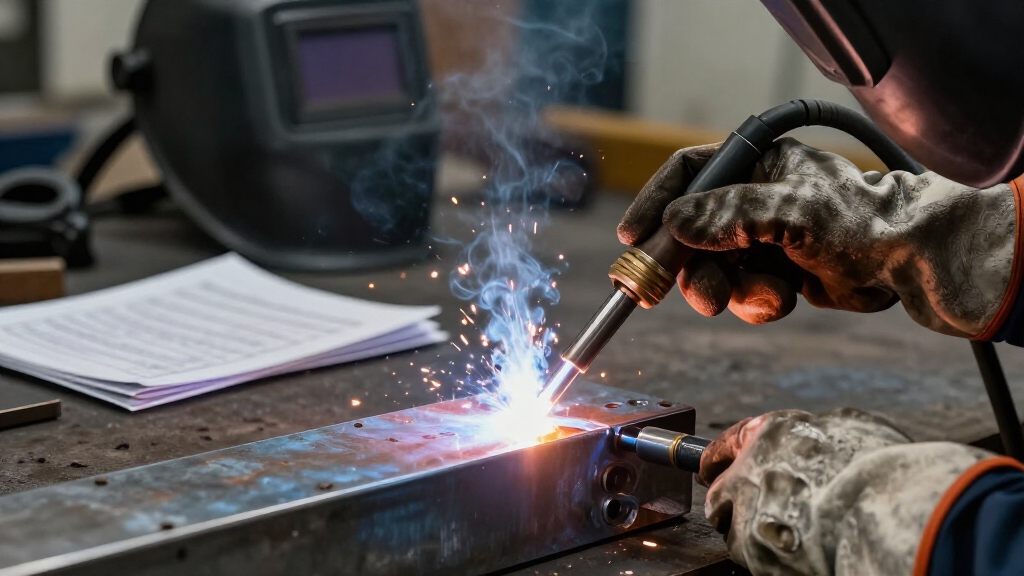
A Welding Procedure Specification (WPS) is a detailed, written document that instructs you on how to perform a specific welding operation to meet established standards.
A Welding Procedure Specification (WPS) provides clear, detailed instructions to ensure welding meets required standards.
It serves as a formal guide detailing the welding process, base metal type, filler material, joint design, and welding position.
You’ll find precise parameters such as preheat temperature, current, voltage, polarity, and shielding gas outlined clearly.
By following a WPS, you apply approved variables consistently, ensuring the weld conforms to code and quality requirements.
The document functions as your welding “recipe,” reducing variability between welds and supporting repeatability.
It’s essential that you adhere strictly to the WPS on the shop floor, as it forms the basis for producing compliant, high-quality welds aligned with industry standards.
A WPS is developed based on validated Procedure Qualification Records to guarantee weld quality and performance.
Because weld quality depends on strict control of variables, you need a Welding Procedure Specification (WPS) to assure consistent results. The WPS defines approved welding parameters, reducing variability and assuring that every weld meets quality and code standards.
When you follow a WPS, you control critical factors systematically, minimizing defects and improving repeatability.
| Variable | Purpose | Impact on Quality |
|---|---|---|
| Welding Current | Controls heat input | Prevents burn-through |
| Filler Metal | Matches base material | Ensures weld strength |
| Shielding Gas | Protects molten weld | Avoids contamination |
A WPS is closely linked to the Welding Procedure Qualification Record, which provides documented proof that the welding process consistently produces sound welds meeting required standards.
When you prepare or review a Welding Procedure Specification (WPS), you’ll find it includes detailed parameters that govern the welding process to guarantee consistent quality.
Key components include the welding process type, base metal classification, and thickness range.
You’ll specify filler metal type, classification, and diameter to assure compatibility.
Joint design and welding position are clearly defined to guide execution.
Electrical parameters such as current, voltage, polarity, and shielding gas type and flow rate are outlined precisely.
Preheat and interpass temperature limits control thermal conditions.
Also included are welding technique details, such as travel speed and number of passes.
These components collectively establish the controlled variables, reducing variation and assuring compliance with applicable codes and quality standards.
Understanding these elements helps you maintain repeatable, high-quality welds.
A WPS is developed based on a validated Procedure Qualification Record to ensure the welding parameters produce sound and reliable welds.
Understanding the detailed parameters in a Welding Procedure Specification (WPS) sets the stage for its qualification and validation.
To qualify a WPS, you perform a Procedure Qualification Record (PQR) test. A weld is made under specified conditions.
You then subject the weld to mechanical and non-destructive tests, such as tensile, bend, and hardness tests. This verifies it meets code and quality standards.
Validation confirms that the WPS produces consistent, sound welds within defined variables.
You must document all results meticulously to demonstrate compliance.
Only after successful testing and approval can you use the WPS in production.
This process guarantees that the welding procedure is reliable, repeatable, and aligned with applicable codes. It safeguards weld integrity and performance.
AWS certification programs often require adherence to qualified WPS to ensure weld integrity and safety across industries.
Ensuring compliance and streamlining production rely heavily on adhering to a Welding Procedure Specification (WPS).
When you follow a WPS, you align welding operations with established codes and quality standards, minimizing nonconformities.
The WPS precisely defines welding variables: process, base metal, filler, joint design, and parameters.
This allows you to produce consistent, repeatable welds.
This consistency is critical for meeting mechanical and inspection requirements, reducing rework and inspection failures.
Certified welders use the WPS to maintain quality standards and ensure safety throughout the welding process.
When it comes to creating a WPS, you can’t leave it to chance. You’re usually relying on a welding engineer or a qualified welding procedure specialist.
They tailor the document to your project’s specific needs, ensuring all parameters meet relevant codes and standards. You’ll want this expert to methodically define essential variables, from materials to welding techniques.
This way, your welds come out consistent, strong, and compliant every time.
You should review and update a WPS whenever there’s a change in welding variables, codes, or project requirements.
Regular reviews typically occur annually or with each new welding contract.
If you modify welding processes, base metals, filler materials, or environmental conditions, update the WPS accordingly.
This guarantees your procedures remain compliant, accurate, and effective, maintaining weld quality and consistency throughout production and inspections.
No, you can’t use a single WPS for different welding processes because each process has unique parameters like current, voltage, and technique.
You need a specific WPS tailored to processes such as SMAW or GMAW to guarantee proper control of variables and compliance with codes.
Using one WPS for multiple processes risks inconsistent weld quality and non-compliance. Always prepare distinct WPS documents for each welding method you apply.
You need formal welding training covering the specific process in the WPS, including theory and hands-on practice.
Certification courses teach how to interpret welding symbols, parameters, and variables outlined in the WPS.
You’ll also learn safety protocols, equipment setup, and quality control measures.
Ongoing skill assessments confirm you follow the procedure precisely, maintaining consistency and code compliance.
Without proper training, you risk weld defects and failing inspections.
A WPS impacts welding inspection procedures by defining precise welding variables and acceptance criteria you must verify.
It guides you on what parameters to check, such as weld dimensions, technique, and materials.
By following the WPS, you guarantee inspections confirm compliance with code and quality standards.
This reduces ambiguity during inspection and helps you identify deviations quickly, assuring weld integrity and repeatability across production batches.
Understanding what WPS stands for in welding is vital for maintaining consistent quality.
Did you know that over 85% of weld failures stem from not following a proper Welding Procedure Specification?
By adhering to a WPS, you guarantee repeatable processes, compliance with industry standards, and reduced defects.
This precise documentation guides every weld, helping you achieve reliable results and smoother production.
Don’t underestimate the power of a well-qualified WPS in your welding operations.
[…] plays a crucial role in validating that welding processes conform to the Welding Procedure Specification to ensure quality and […]