Phone:
(701)814-6992
Physical address:
6296 Donnelly Plaza
Ratkeville, Bahamas.

Phone:
(701)814-6992
Physical address:
6296 Donnelly Plaza
Ratkeville, Bahamas.

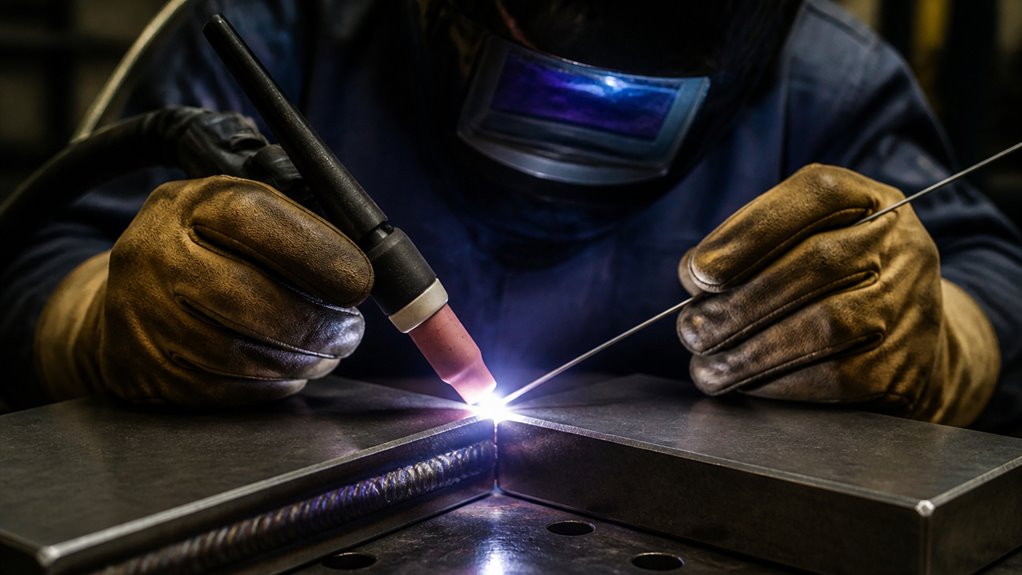
A Welding Procedure Specification (WPS) is your detailed blueprint that standardizes welding methods to ensure uniform, strong, and defect-free welds.
It defines essential parameters like welding process, base and filler metals, electrical settings, shielding gas, and joint prep, guaranteeing consistent quality and compliance with codes like ASME and AWS.
The WPS is validated through a Procedure Qualification Record (PQR) to confirm reliability.
Understanding how a WPS controls quality and safety will enhance your welding outcomes.

When you look at a Welding Procedure Specification (WPS), you’re seeing a detailed, written blueprint that guides welders through standardized welding methods.
It precisely documents the welding process to assure consistent, high-quality results conforming to industry standards.
You’ll find exact instructions on joint design, base and filler materials, electrical parameters, and shielding gas details, all tailored to control and repeatability.
The WPS serves as a mandated reference to maintain uniformity across welds, reducing variability and risk of failure.
By following a WPS, you guarantee compliance with codes such as ASME and AWS, safeguarding structural integrity and safety.
This formal document is essential for systematic welding execution and quality assurance in fabrication operations.
A WPS is developed using validated data from a Procedure Qualification Record to ensure the welding process meets all required mechanical and quality standards.
A WPS lays out exactly which welding method you should use—whether it’s SMAW, GMAW, or TIG. This clarity helps ensure that the right technique is applied for the job.
Plus, it goes a step further by specifying the base metals you’ll be working with and the compatible filler materials.
It even details the exact compositions and classifications of those materials. With this level of detail, you’re not just guessing; you’re making sure that your welds meet all the required standards. This way, you can be confident that they’ll perform reliably under the conditions they’re meant for.
Additionally, the WPS often includes recommendations on shielding gas selection to optimize weld quality and minimize defects.
Welding methods in a WPS lay out exactly which processes and materials you’ll use to achieve a consistent, high-quality weld.
The WPS specifies the welding process, such as SMAW, GMAW, TIG, or MIG, to guarantee you select the correct technique suited for the application.
It also defines critical parameters like electrical settings, including voltage, amperage, and polarity, to control heat input and weld penetration.
Additionally, the WPS details joint preparation and configuration to maintain uniformity.
Shielding gas types and flow rates are identified for processes requiring gas protection.
By adhering strictly to these specified methods, you control variables impacting weld integrity, repeatability, and compliance with relevant codes.
This precision guarantees the welding operation meets required mechanical properties and quality standards without deviation.
A Welding Procedure Qualification Record serves as official documentation confirming that the welding methods and parameters specified in the WPS produce sound, compliant welds.
Specify the exact base and filler materials to guarantee compatibility and structural integrity in your welds. Your WPS must clearly identify the base metals, including their grade, classification, and chemical composition.
This precision secures proper fusion and reduces risks of defects or failures. Similarly, you need to specify the filler material type, such as electrode or wire classification, matching or complementing the base metal properties.
Including essential details like alloy content, mechanical properties, and form prevents inconsistencies during welding. By controlling these variables within your WPS, you safeguard metallurgical compatibility and predictable weld performance.
Accurate documentation of base and filler materials also supports compliance with applicable codes and standards, reinforcing quality assurance and repeatability across all welding operations. Proper selection of welding consumables ensures weld quality, strength, durability, and reduces defects and rework.
A WPS, or Welding Procedure Specification, lays out some really important details about the welding process. For example, it specifies the methods used, like SMAW, GMAW, or TIG, depending on the specific application you’re working on.
But that’s not all! It also gets into the nitty-gritty of electrical settings. You’ll find information about voltage, amperage, and polarity, all of which are crucial for ensuring the weld quality is up to par.
And let’s not forget about the materials involved. A WPS clearly outlines the base metals and filler types to make sure everything is compatible and consistent. This way, you can have confidence in the welding results!
Additionally, controlling the heat input specified in the WPS is vital to manage weld pool formation and prevent defects such as distortion or excessive heat-affected zones.
Understanding the key parameters within a Welding Procedure Specification (WPS) is essential for controlling the welding process and ensuring repeatability.
One critical parameter is the welding process method, which defines the specific technique you’ll use, such as Shielded Metal Arc Welding (SMAW), Gas Metal Arc Welding (GMAW), Tungsten Inert Gas (TIG), or Metal Inert Gas (MIG).
Each method has distinct operational requirements and impacts weld quality and efficiency. Your WPS must clearly state the selected process to guide the welder in applying the correct technique, ensuring consistency.
Additionally, AWS standards play a crucial role in defining the parameters and qualifications required within a WPS to maintain weld integrity and safety.
Control the welding process effectively by carefully defining the electrical and material settings within the WPS. You need to specify key electrical parameters such as voltage, amperage, polarity, and travel speed. These directly influence weld penetration, bead shape, and heat input.
For material settings, identify the base metals and filler materials, including their grades and classifications. This ensures compatibility and integrity of the weld. Detailing these variables guarantees repeatability and compliance with applicable codes.
Additionally, if using shielding gas, include type and flow rate to protect the weld pool from contamination. By precisely documenting these electrical and material parameters, you create a reliable framework. This allows welders to achieve consistent, high-quality welds that meet industry standards and project requirements.
Selecting the appropriate power supply mode, such as constant current or constant voltage, based on the welding process and automation level, further refines control over the arc and weld quality.
Because a WPS provides detailed, standardized instructions for every welding parameter, it guarantees that each welder follows the same method regardless of location or operator.
You’ll find exact specifications on welding process, base and filler materials, joint design, electrical settings, and shielding gas.
By controlling these variables, the WPS limits deviations that could compromise weld integrity.
When you adhere to the WPS, you repeat the welding procedure under consistent conditions, producing uniform welds that meet specified mechanical and chemical properties.
This methodical approach reduces variability and assures compliance with industry codes like ASME and AWS.
Ultimately, the WPS functions as a technical blueprint that enforces repeatability, controls quality, and minimizes the risk of weld defects across production runs.
Additionally, following a qualified WPS is essential for achieving full joint penetration and ensuring the strength and integrity of critical welds.
While the WPS outlines the specific welding parameters and procedures you must follow, the Procedure Qualification Record (PQR) provides the empirical evidence that those instructions produce a sound weld.
The WPS defines welding steps, while the PQR proves those steps yield a strong, reliable weld.
You use the PQR to verify that the welding conditions detailed in the WPS, such as base material, filler material, electrical settings, and joint configuration, result in acceptable mechanical and metallurgical properties.
The PQR documents test results from actual welds, confirming compliance with applicable codes and standards. By comparing these test outcomes to the WPS parameters, you make certain the procedure is valid and repeatable.
Together, the WPS guides production welding, and the PQR validates it, forming a vital quality control cycle that guarantees weld integrity and adherence to industry requirements.
When you explore into welding procedures, you’ll encounter several types of Welding Procedure Specifications (WPS) tailored to different stages and applications.
The most common are Preliminary WPS, developed during initial testing, and Prequalified WPS, which meet industry standards without additional qualification.
Standard or Production WPS are fully qualified documents used for routine welding operations.
Additionally, the NCPWB numbering system classifies WPS based on base metal P-numbers and welding processes, using formats like X-Y-Z for single metals and X1:X2-Y-Z for dissimilar metals.
Each type defines critical variables: welding method, materials, joint design, and parameters to guarantee consistent, repeatable weld quality.
Understanding these WPS types helps you select the right specification for your project’s requirements and ensure compliance and uniformity across welding tasks.
Certified welders often use WPS to align their work with industry certification requirements and maintain high standards.
Adhering strictly to a Welding Procedure Specification (WPS) guarantees you maintain both safety and regulatory compliance throughout the welding process.
The WPS delineates critical parameters such as electrical settings, shielding gas flow, and joint design, ensuring welds meet industry codes like ASME and AWS.
By following these detailed instructions, you minimize the risk of weld defects that could compromise structural integrity or cause hazardous failures.
Compliance with the WPS also satisfies mandatory safety standards, protecting both personnel and equipment.
Ignoring the WPS increases the chance of non-conformance, triggering costly inspections, rework, or legal penalties.
Consequently, your consistent adherence to the WPS is essential for executing welds that are structurally sound, code-compliant, and safe within regulated manufacturing or construction environments.
The tail information on weld symbols often references the WPS to streamline communication and ensure precise adherence to welding procedures.
Following a Welding Procedure Specification (WPS) doesn’t just guarantee safety and compliance; it directly enhances quality control throughout welding operations.
By providing detailed, standardized instructions, including welding methods, material specifications, joint designs, and electrical settings, a WPS guarantees uniformity and repeatability in every weld.
When you adhere to a WPS, you minimize variability, reducing defects and rework. The WPS serves as a technical blueprint, guiding welders to meet stringent industry codes like ASME and AWS.
In addition, paired with a Procedure Qualification Record (PQR), it validates that the welding process consistently produces sound, high-quality joints.
This methodical approach allows you to monitor and control critical variables, assuring each weld maintains structural integrity and meets performance standards.
Ultimately, the WPS is your primary tool for maintaining consistent, verifiable quality in welding operations.
You should review or update a WPS whenever there’s a change in welding variables, materials, or processes.
Additionally, periodic reviews are essential, typically annually or as dictated by your industry standards like ASME or AWS.
If inspections, audits, or non-conformances reveal issues, update the WPS immediately to maintain compliance and quality.
Staying proactive guarantees weld consistency, safety, and adherence to codes throughout your welding operations.
Imagine you’re welding a new alloy not covered by standard specs. Yes, you can customize a WPS for unique projects.
You’ll modify parameters like base material, filler metal, and electrical settings to suit the specific metals and joint design. This secures your weld meets code compliance and quality standards.
Customizing a WPS methodically controls the process, guaranteeing repeatability and safety even in unusual welding scenarios.
You’re responsible for creating a WPS if you’re a qualified welding engineer or a certified welding procedure specialist. You must make certain it meets all applicable industry codes and standards.
Once drafted, a certified welding inspector or a qualified authority reviews and approves the WPS. This approval confirms the procedure’s validity and compliance, allowing you to execute welds consistently and safely under controlled conditions.
To hit the nail on the head, you need specialized training to follow a WPS correctly. This includes understanding welding processes, interpreting technical specifications, and mastering equipment operation per the WPS.
You’ll also undergo hands-on practice and safety protocols aligned with industry standards like AWS or ASME. Certification guarantees you can execute welds consistently, meeting all parameters in the WPS for quality and compliance.
You document a WPS as a detailed written record, including all welding parameters, materials, procedures, and compliance standards.
Typically, you use standardized forms or digital templates aligned with industry codes like ASME or AWS.
For future reference, you store it securely in a centralized database or physical filing system, ensuring easy retrieval and version control.
This methodical documentation supports repeatability, quality control, audits, and regulatory compliance throughout welding operations.
Think of a Welding Procedure Specification (WPS) as your blueprint in the forge, guiding each spark and bead with precision.
By following a WPS, you make certain every weld aligns perfectly, like gears in a finely tuned machine.
It’s not just about consistency; it’s your safeguard against errors, a shield for safety, and a cornerstone for quality control.
In welding, the WPS is your trusted compass, steering you toward reliable, compliant results every time.