Phone:
(701)814-6992
Physical address:
6296 Donnelly Plaza
Ratkeville, Bahamas.

Phone:
(701)814-6992
Physical address:
6296 Donnelly Plaza
Ratkeville, Bahamas.

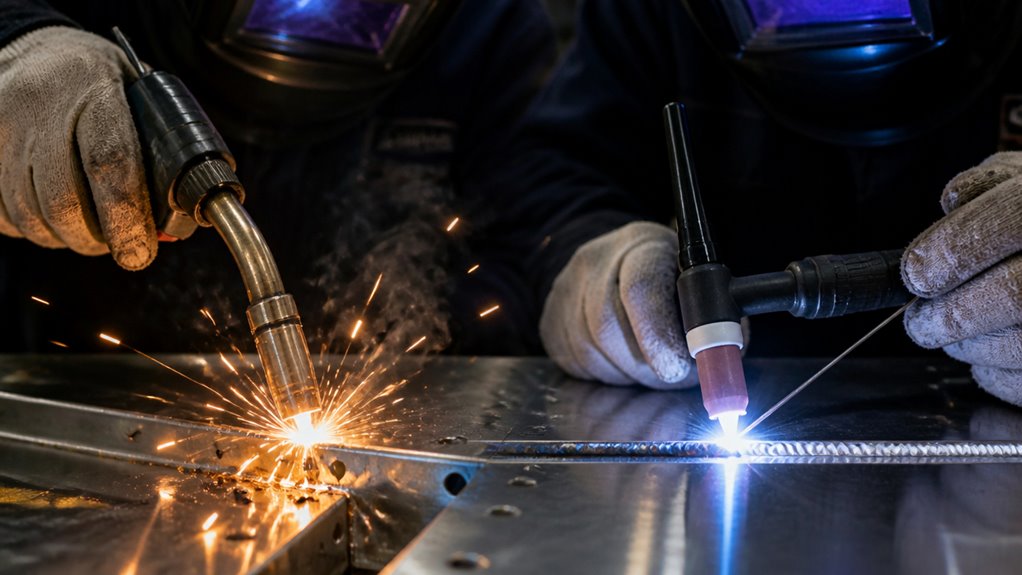
You’ll choose MIG welding for thicker aluminum to gain faster operation and higher deposition rates. This makes it efficient, though it creates more spatter and requires cleanup.
For thinner aluminum, TIG welding offers precise heat control, reducing warping and burn-through. It also provides cleaner, aesthetically superior welds.
TIG demands more skill and slower speeds but guarantees quality on critical applications.
Depending on your project’s priorities, speed versus precision, the right process varies. Explore equipment, settings, and skill differences to make an informed choice.
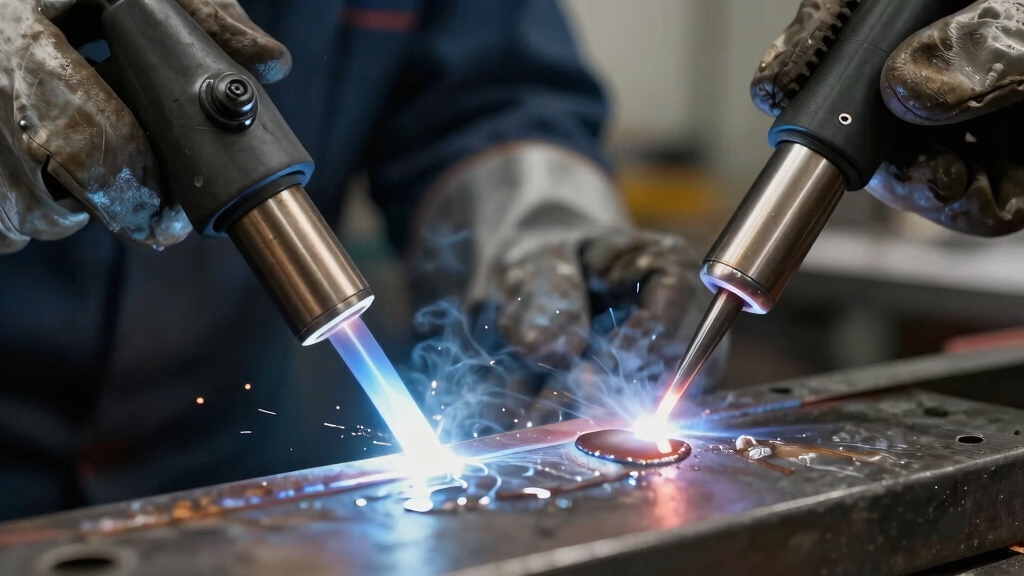
Although both MIG and TIG welding are effective for aluminum, they differ fundamentally in electrode type, current requirements, and wire feed methods.
With MIG, you use a continuously fed consumable wire electrode that acts as both filler and electrode.
In contrast, TIG employs a non-consumable tungsten electrode, requiring you to manually add filler separately.
MIG welding aluminum operates with direct current (DC), facilitating a spray transfer arc that melts wire and base metal simultaneously.
TIG necessitates alternating current (AC) to disrupt the aluminum oxide layer, enabling a controlled, non-spray arc.
Both require 100% argon shielding gas for effective protection.
Understanding these mechanical distinctions helps you select the most suitable process for your welding objectives.
This emphasizes MIG’s automated feed and speed versus TIG’s precision and manual control.
Additionally, MIG welding aluminum demands specialized equipment such as a spool gun to handle the softer aluminum wire and ensure smooth feeding.
When you’re dealing with thin aluminum, say 3 mm or less, TIG welding is the way to go. It really shines here because it gives you precise heat control, which means you can avoid that pesky burn-through. No one wants to ruin a good piece of aluminum!
On the flip side, if you’re working with thicker sections, like 4 mm and above, MIG welding comes into play. It’s great for these applications because it offers higher deposition rates and deeper penetration. This makes it super efficient, especially for larger structural projects. For MIG welding aluminum, using pure argon shielding gas is essential to ensure a stable arc and prevent oxidation.
Welding thin aluminum demands careful process selection to prevent burn-through and guarantee joint integrity.
For aluminum thinner than 3 mm, TIG welding offers superior control overheat input, reducing the risk of warping and perforation.
TIG’s non-consumable tungsten electrode and manual filler addition allow precise adjustments, ensuring minimal distortion and a clean, high-quality weld.
Conversely, MIG welding, while faster, often generates excessive heat and spatter, increasing the likelihood of burn-through in thin sections.
If you prioritize speed over finesse and can manage the risks, MIG might suit slightly thicker thin materials near 3 mm.
However, for critical, fatigue-sensitive, or aesthetic applications on thin aluminum, TIG remains the best choice due to its better heat management and weld integrity.
Maintaining a short arc length during TIG welding is essential for concentrating heat and preventing contamination, which is especially important when working with thin aluminum.
Handle thick aluminum with a method that balances heat input and deposition efficiency to guarantee strong, durable joints.
For aluminum plates 4mm or thicker, MIG welding stands out due to its higher heat input and faster deposition rates, enabling deep penetration essential for structural integrity.
MIG’s continuous wire feed and spray transfer arc deliver efficient filler addition, reducing welding time markedly compared to TIG.
However, if surface finish and minimal distortion are critical, TIG remains an option but may require multiple passes and longer welding times.
Select MIG when production speed and joint strength on thick sections matter most.
TIG suits cases demanding precision but is less practical for large, thick aluminum applications due to its slower deposition and sensitivity to heat management.
Using a spool gun with 100% argon is essential for smooth feeding and optimal weld quality in MIG aluminum welding.
How does the choice between MIG and TIG welding impact the quality and appearance of aluminum welds?
When you use TIG welding, you get cleaner, more precise welds with minimal spatter and distortion. This method offers superior control over heat input, essential for thin sections and fatigue-critical joints.
The result is smooth, aesthetically pleasing weld beads ideal for visible applications.
Conversely, MIG welding produces faster welds with deeper penetration but generates significant spatter, which compromises surface finish and requires more post-weld cleanup. MIG welds tend to have a rougher appearance, especially on thinner aluminum, due to less precise arc control.
If weld quality and visual appeal are your priorities, TIG welding generally delivers superior results. MIG suits less critical, thicker aluminum work where speed outweighs finish.
Proper cleaning and preparation prior to TIG welding are crucial to avoid defects such as porosity and oxide inclusions, ensuring the highest weld quality and appearance.
Boosting your production rates hinges on choosing the right welding process for aluminum. MIG welding outperforms TIG in speed and deposition, delivering about 15 inches per minute versus TIG’s 6 inches per minute on 1/8″ aluminum. This translates to markedly higher throughput and lower cycle times.
MIG’s continuous wire feed and spray transfer arc enable deposition rates up to 2.0 kg/h, ideal for large-scale fabrication. TIG, while slower, emphasizes precision over speed.
Selecting the appropriate wire diameter to match the metal thickness and amperage is essential for maintaining arc stability and optimal deposition during MIG welding.
| Parameter | MIG Welding | TIG Welding |
|---|---|---|
| Welding Speed | ~15 in/min | ~6 in/min |
| Deposition Rate | 1.5–2.0 kg/h | 0.5–0.7 kg/h |
| Ideal for | High production | Precision joints |
| Spatter Level | Higher | Minimal |
Choose MIG for faster, higher-volume aluminum welding.
Mastering the equipment setup and fine-tuning the settings are critical for successful aluminum welding with both MIG and TIG processes.
For MIG welding, use a 100% argon shielding gas with DCEP polarity. Maintain a 3/4-inch stickout to prevent gun tip burnback.
Set the voltage between 18–26 V and current within 120–250 A, adjusting for material thickness.
Employ the push technique to enhance gas coverage and minimize contamination.
Choose ER4043 wire for thin sections and ER5356 for structural strength.
TIG welding demands AC current to break aluminum oxide, a non-consumable tungsten electrode, and manual filler addition.
Shielding gas remains 100% argon. Precise heat control and consistent arc length are essential.
Both setups require meticulous calibration to balance penetration, bead shape, and weld integrity.
An AC-capable TIG welder is necessary to handle oxide cleaning and achieve a stable arc during aluminum TIG welding.
Understanding the equipment and settings lays the groundwork for evaluating the skill and cost factors involved in MIG and TIG aluminum welding. You’ll find MIG welding more approachable if you’re new to aluminum, thanks to its automated wire feed and simpler arc control.
TIG welding, however, demands greater manual dexterity and heat management. It requires extensive training to master. Equipment-wise, TIG systems are costlier, ranging from $1,000 to $5,000, while MIG setups typically cost $500 to $2,000. This reflects their complexity and versatility differences.
MIG offers faster training due to automation and straightforward operation. TIG demands higher skill for precise filler addition and arc control. TIG equipment investment is higher but supports broader metal applications. MIG suits budget-conscious users prioritizing speed and ease of use.
Choosing depends on your skill level, budget, and application needs. Using the right tools and preparation can significantly improve efficiency and safety in welding projects.
Yes, you can combine MIG and TIG welding in a single aluminum project to leverage each method’s strengths.
Use TIG for thin, precision joints to guarantee clean, fatigue-resistant welds. Switch to MIG for thicker sections requiring faster deposition and deeper penetration.
Just maintain consistent parameters and joint preparation to avoid compatibility issues. This hybrid approach optimizes efficiency and weld quality across varied aluminum thicknesses and application demands.
For MIG welding aluminum, you’ll typically use ER4043 or ER5356 wire. ER4043 offers better fluidity for thinner sections, while ER5356 delivers higher strength for structural parts.
For TIG welding, the same filler rods—ER4043 and ER5356—are preferred. Choose ER4043 for improved weld flow and corrosion resistance, and ER5356 for enhanced mechanical properties.
Selecting the right filler metal depends on your aluminum alloy, desired strength, and application requirements.
You need to clean aluminum thoroughly for both MIG and TIG welding.
However, TIG demands more meticulous preparation. For TIG, you must remove the aluminum oxide layer using a stainless steel wire brush dedicated solely to aluminum. This ensures a pristine surface for AC arc action.
MIG also requires oxide removal, but it’s less sensitive to minor contamination due to higher heat input and continuous wire feed.
Both require 100% argon shielding to prevent oxidation during welding.
Think of MIG welding aluminum like handling fireworks. Spatter flies unpredictably, so you’ve got to wear full protective gear, including a flame-resistant jacket and a face shield with a high shade lens.
TIG welding demands you treat the tungsten electrode carefully to avoid contamination. Use dry, insulated gloves and ensure proper ventilation to handle ozone and nitrogen oxides.
Both require argon shielding gas precautions and eye protection against intense UV radiation.
You must control environmental factors like wind and humidity because they disrupt argon shielding gas coverage, causing oxidation and porosity in aluminum welds.
MIG’s spray transfer is more sensitive to drafts, increasing spatter and defects. TIG’s precise arc suffers from inconsistent shielding, leading to contamination.
Temperature variations affect heat input control, making TIG’s manual adjustments essential. Always weld in sheltered, dry conditions to maintain weld integrity and quality.
When choosing between MIG and TIG welding aluminum, remember: each process shines in its own right.
MIG offers speed and ease for thicker materials, while TIG provides unmatched precision and aesthetics for thinner aluminum.
Your decision hinges on balancing production demands with quality expectations.
Like a craftsman selecting the perfect tool, you’ll match your welding method to the task, ensuring peak results without compromise.
So, which welding style will you wield?