Phone:
(701)814-6992
Physical address:
6296 Donnelly Plaza
Ratkeville, Bahamas.

Phone:
(701)814-6992
Physical address:
6296 Donnelly Plaza
Ratkeville, Bahamas.

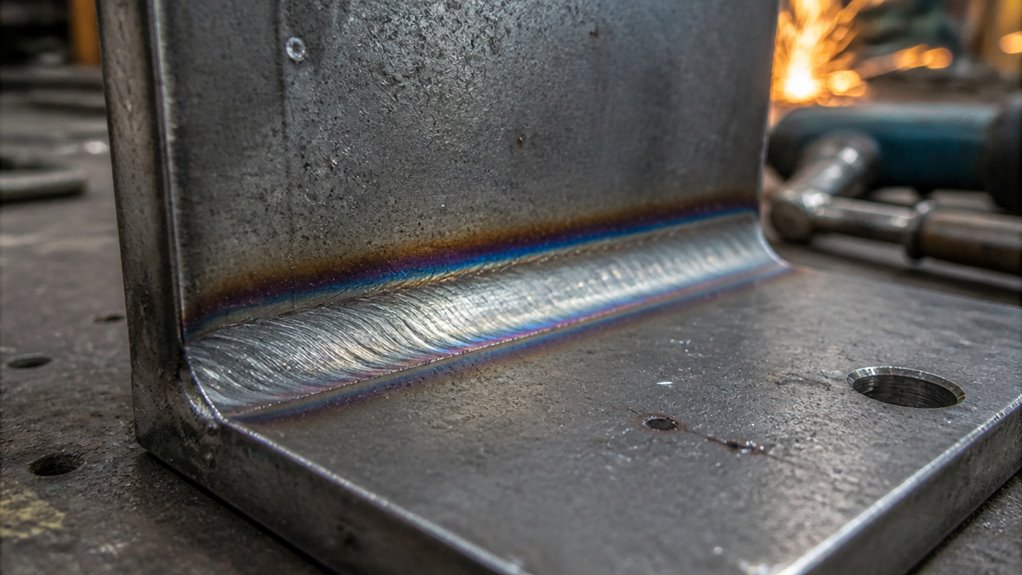
You use fillet welds to join two surfaces at right angles, creating a triangular cross-section common in lap, T-, and corner joints.
Their size is defined by leg length, which affects strength via throat thickness. This is the shortest distance from root to face that bears load.
Fillet welds offer fast, cost-effective joining with minimal prep, but they don’t match the strength or penetration of groove welds.
Understanding their components and limitations can improve your welding strategy markedly.
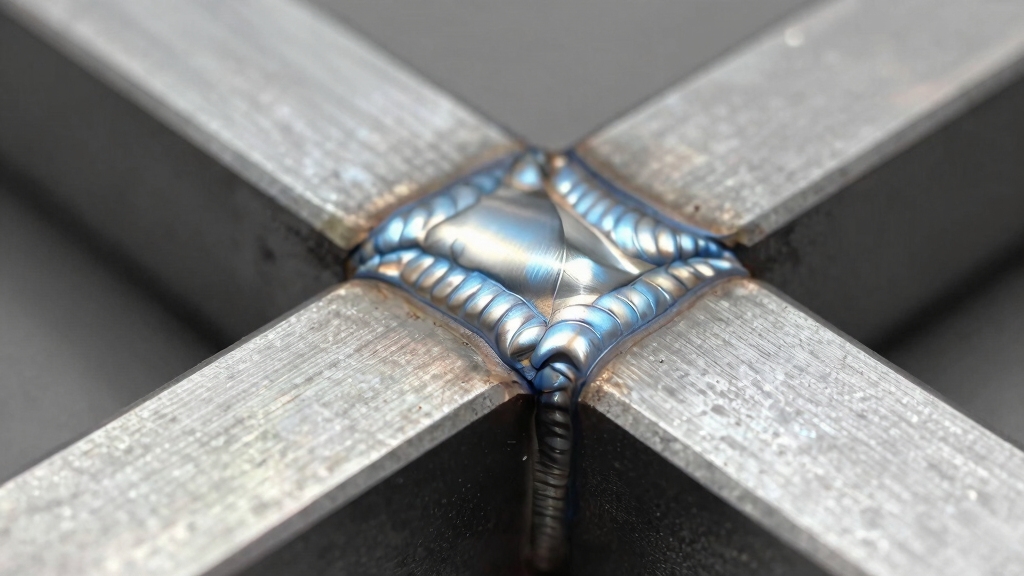
Although fillet welds may appear simple, understanding their geometric characteristics is essential for accurate design and application.
You’ll find that fillet welds join two surfaces at approximately right angles, forming a triangular cross-section.
They connect metal pieces in lap, T-, or corner joints.
When assessing a fillet weld, focus on five key components: the legs, toes, face, throat, and root.
The leg length defines the weld size, critical for sizing and strength.
The throat, measured from root to face, determines the weld’s load-bearing capacity.
Precise knowledge of these elements allows you to calculate strength accurately and guarantee the weld meets structural requirements.
Incorrect measurements can compromise joint integrity.
Understanding these parameters is fundamental before moving to application or load considerations.
The leg length is measured by the largest right triangle inscribed in the weld cross-section and directly influences weld strength.
Fillet welds play a critical role in numerous industrial sectors by providing reliable structural connections where strength and efficiency are paramount.
Fillet welds ensure strong, efficient connections vital across diverse industrial applications.
When you apply fillet welds, you benefit from a weld type that requires minimal preparation. This reduces production time and costs.
They’re essential in construction, automotive, aerospace, and manufacturing for joining metal at right angles. Their versatility lets you use them in lap, T, and corner joints effectively.
Key benefits include:
While fillet welds are widely used, for joints requiring maximum strength and full penetration, groove welds are often preferred.
When you evaluate the load distribution in fillet welds, you must focus on the throat thickness. It directly determines the weld’s theoretical static strength.
The throat represents the shortest distance from the root to the face. Full fusion along both legs is essential to achieve the maximum effective throat.
Load applied to the weld translates into shear stress, calculated by dividing the applied force by the effective throat area.
While fillet welds distribute loads efficiently in lap, T, and corner joints, their strength is inherently lower than that of butt welds due to partial penetration.
You should also recognize that incomplete fusion or root defects reduce load capacity. This emphasizes the importance of quality weld execution to maintain strength limits under static and dynamic loads.
Increasing the fillet weld throat by even 1 mm can boost weld strength by up to 20%, highlighting the importance of throat size control in design and fabrication.
You’ll definitely save both time and costs with fillet welds.
One of the best things about them is that they require very little joint preparation—no need for edge beveling! This means you can get right to work, speeding up your production rates. You’ll find that you can complete welds much faster compared to groove welds.
Plus, there’s less need for extensive inspections, which really helps cut down on quality assurance time. And don’t worry, you won’t be sacrificing structural integrity in the process.
Additionally, using a fillet weld gauge ensures accurate measurement and quality control without adding significant inspection time.
Since fillet welds require no edge preparation or beveling, they substantially reduce both setup time and labor costs. You can directly position the metal pieces at right angles and start welding immediately, eliminating complex machining steps.
This simplicity minimizes material waste and tooling needs, enhancing overall efficiency.
Key factors contributing to minimal preparation include:
Additionally, using stitch welding techniques can further reduce heat input and distortion, complementing the efficiency advantages of fillet welds.
The minimal preparation required for fillet welds directly contributes to faster production times. This allows you to complete welds more rapidly than with other joint types.
You save time by skipping edge beveling and complex fit-ups, letting you focus on welding. This efficiency supports higher throughput, vital in industrial settings where time equals cost.
Fillet welds are especially favored for their leg size and throat dimensions that control shear capacity without the need for groove preparation.
| Factor | Fillet Welds | Groove Welds |
|---|---|---|
| Preparation Time | Minimal | Extensive |
| Welding Time | Short | Longer |
| Production Efficiency | High | Moderate |
Although fillet welds are critical for structural integrity, they typically demand less rigorous inspection than other weld types. This reduced inspection requirement saves you valuable time and lowers costs without compromising safety.
Since fillet welds usually involve visual inspection rather than complex nondestructive testing, you can streamline quality assurance processes markedly. This efficiency stems from their simpler geometry and the fact that full penetration isn’t always mandatory.
Key reasons for reduced inspection include:
This makes fillet welds ideal when balancing cost, time, and structural reliability. Additionally, fillet welds do not require the full joint penetration necessary for CJP welds, further simplifying fabrication and inspection.
You should keep in mind that fillet welds are designed specifically for surfaces that meet at right angles. This means they’re not versatile enough to be used in every joint configuration out there.
Also, the strength of a fillet weld is limited by its throat thickness. So, if you’re dealing with high loads or need full penetration, fillet welds mightn’t be your best option. For applications requiring full penetration and high-strength joints, butt welds are generally preferred due to their seamless, flush connections.
When selecting fillet welds, remember they work only between surfaces joined at right angles. This limits their application to lap, T, and corner joints.
You can’t use fillet welds effectively on edge joints or closed corners. Also, avoid relying on them where a root opening is large. Small gaps might be manageable but not ideal.
Keep in mind, fillet welds don’t achieve the strength of groove welds. This makes them unsuitable for high-strength, full-penetration needs.
Consider these joint configuration limits:
Additionally, controlling heat input is essential to maintain weld quality and prevent defects in these joint configurations.
Because fillet welds rely primarily on throat thickness for strength, their capacity to resist loads depends on achieving full fusion along both legs to the root.
You must make certain complete fusion to maximize the weld’s effective throat area, which directly correlates to its load-bearing capacity.
Fillet welds inherently have lower strength than groove welds due to limited penetration, restricting their use in high-stress or fatigue-critical applications.
Additionally, shear stress on the weld throat must be carefully evaluated, as excessive loading can cause premature failure.
Keep in mind that joint geometry and load direction substantially influence performance; improper alignment or eccentric loading can reduce effective strength.
Understanding these constraints helps you design joints that balance efficiency, cost, and structural integrity without risking weld failure under operational stresses.
For applications where higher shear strength and fatigue resistance are required, alternative methods such as plug welding can provide more reliable mechanical bonds.
Although fillet welds offer cost-effective and efficient joining solutions, their use is constrained to specific joint configurations where two surfaces meet at approximately 90 degrees.
You should avoid fillet welds for edge joints or closed corner joints, as the geometry inhibits proper fusion and strength.
Fillet welds provide lower strength than groove welds, so they’re less suitable for critical, high-load applications requiring full penetration.
Consider these appropriate uses:
Understanding fillet weld sizes and welding symbols is essential for accurately interpreting and executing welding specifications. The weld size corresponds to the leg length, which dictates how far the weld protrudes from the joint.
For example, a 0.375-inch fillet weld means both legs measure exactly 0.375 inch, ensuring proper strength. Welding symbols communicate size, length, and pitch, where pitch defines spacing in intermittent welds.
Precise interpretation of these symbols is critical for maintaining structural integrity and meeting design requirements. When you see a fillet weld symbol on a blueprint, it specifies not just the weld type but exact dimensions and placement.
Adhering to these standards helps you achieve consistent weld quality, optimal load distribution, and compliance with industry codes such as AWS.
Environmental conditions markedly impact fillet weld durability by accelerating corrosion, fatigue, and stress concentration at the weld toes and root.
You’ll see reduced strength if exposed to moisture, chemicals, or temperature fluctuations, which promote crack initiation and propagation.
To maintain durability, you must apply protective coatings, control welding parameters to avoid defects, and select suitable filler materials.
Proper inspection and maintenance are essential to mitigate environmental degradation over time.
You’ll find Shielded Metal Arc Welding (SMAW) and Gas Metal Arc Welding (GMAW) highly effective for fillet welds due to their control and penetration.
Flux-Cored Arc Welding (FCAW) also works well, especially outdoors, offering high deposition rates.
These methods guarantee full fusion along the weld legs and root, critical for strength.
Stick to a 90-degree joint angle and maintain consistent travel speed to avoid defects and achieve peak throat thickness.
Think of fillet weld inspection like a detective uncovering hidden clues.
Beyond visual checks, you’ll use non-destructive testing methods such as ultrasonic testing to detect internal flaws.
Magnetic particle testing can identify surface and near-surface cracks, while dye penetrant inspection reveals fine surface cracks.
Radiographic testing (X-rays) can also expose internal defects.
These techniques guarantee the weld’s integrity by analyzing its internal structure, confirming complete fusion and absence of critical flaws.
You’ll often find common fillet weld defects like porosity, cracks, undercut, and incomplete fusion.
Porosity occurs from trapped gas, weakening the weld.
Cracks, often caused by stress or poor technique, reduce joint integrity.
Undercut happens when the base metal is melted away along the weld toe, creating a groove that reduces strength.
Incomplete fusion means the weld metal hasn’t fully bonded with the base metal or previous weld pass, compromising load capacity.
Yes, you can automate fillet welds using robotic welding systems.
These systems precisely control parameters like travel speed, electrode angle, and wire feed, ensuring consistent weld size and throat thickness.
Automation enhances repeatability, productivity, and quality while reducing human error.
However, you’ll need to program robots carefully to maintain proper fusion and avoid defects typical in fillet welds, especially when working on complex joints or variable fit-up conditions.
So, you’re keen to rely solely on fillet welds, huh? Sure, they’re cost-effective, quick, and strong enough for many tasks—but don’t expect them to solve every structural challenge.
Like a jack-of-all-trades, they excel within limits but falter beyond. If you blindly trust fillet welds without understanding their load capacities and size specifications, prepare for disappointment.
Precision, analysis, and proper application remain your best weld buddies, not just a one-size-fits-all fillet fix.