Phone:
(701)814-6992
Physical address:
6296 Donnelly Plaza
Ratkeville, Bahamas.

Phone:
(701)814-6992
Physical address:
6296 Donnelly Plaza
Ratkeville, Bahamas.

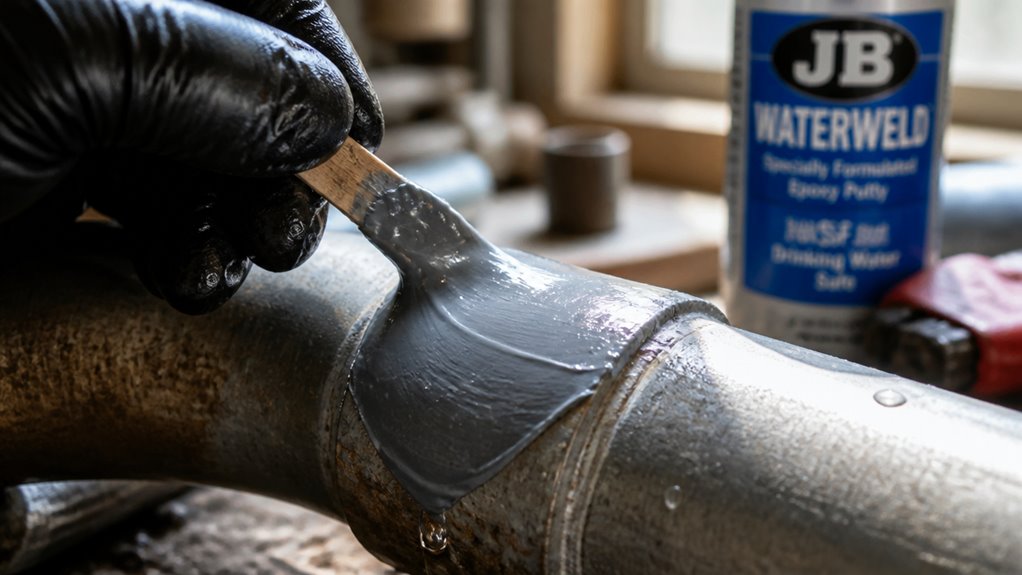
You’ll find JB WaterWeld praised for its reliable underwater curing and moldable ease of use. This makes it ideal for plumbing, pool, and wet-surface repairs.
It sets in 25 minutes and fully cures in one hour, offering longer work time than faster-setting competitors like SteelStick. WaterWeld bonds well to metals, plastics, and fiberglass, even on wet surfaces.
While not the strongest epoxy for heavy loads, it excels where moisture is unavoidable. More insights on strengths and application await you.
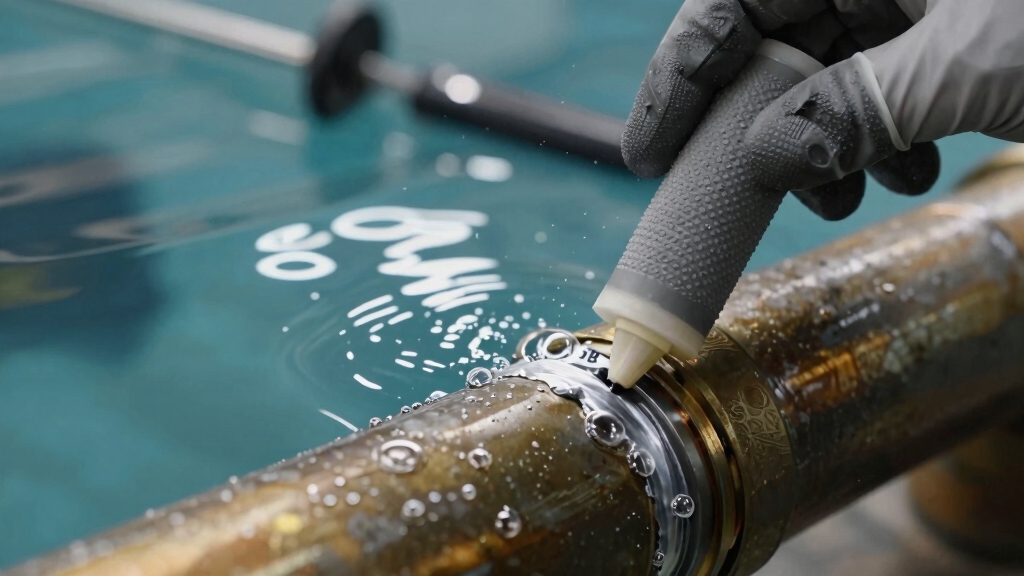
Because it cures underwater and on wet surfaces, J-B Weld WaterWeld is uniquely suited for underwater repairs where other epoxies fail.
You’ll appreciate that it sets in 25 minutes and fully cures in one hour, allowing quick and reliable fixes without drying the area first.
The putty’s lap shear strength of 1300 PSI guarantees durable bonding capable of withstanding extreme temperatures and chemical exposure.
Since it’s NSF/ANSI Standard 61 certified, you can safely use it on potable water systems.
Its moldable consistency lets you apply it easily by hand, filling cracks or holes in submerged environments.
This combination of fast curing, strong adhesion, and chemical resistance makes WaterWeld an efficient solution for underwater applications that demand both durability and safety.
Proper surface preparation and curing ensure optimal bond strength even in challenging environments.
J-B Weld WaterWeld’s ability to cure underwater opens up a wide range of repair possibilities on wet or submerged surfaces.
J-B Weld WaterWeld cures underwater, enabling reliable repairs on wet and submerged surfaces with ease.
You can confidently use it on plumbing fixtures, pool leaks, and tank repairs without needing to dry the area first.
It bonds securely with metals such as iron, stainless steel, copper, and aluminum, making it ideal for metal pipes and fittings.
Additionally, its compatibility extends to fiberglass and plastic, allowing you to fix tub cracks or seal wet PVC joints effectively.
Because it cures underwater without air exclusion, you don’t have to worry about moisture interfering with adhesion.
This versatility guarantees you can address leaks and structural damages across a variety of materials commonly exposed to wet environments.
However, keep in mind that proper surface preparation is still critical to ensure the strongest and most durable bond.
To get the best results with WaterWeld, start by cleaning and roughening the surface. This step is crucial for ensuring a strong bond—yes, even if it’s wet!
Once that’s done, knead the epoxy putty thoroughly until it reaches a uniform color. This ensures that it’ll perform its best when applied.
Now, when you’re ready to apply it, go ahead and press the putty directly onto the repair area. You can use your fingers or some tools to mold and smooth it out.
Just make sure to remove any air pockets; this will help create a durable, watertight seal. Happy repairing!
For optimal adhesion, ensure the surface is free of oils and debris by wiping it with acetone before application.
Although WaterWeld cures underwater and on wet surfaces, preparing the area properly guarantees a stronger, longer-lasting bond.
Start by removing loose debris, rust, and oils using a wire brush or sandpaper to expose a clean, rough surface.
While you don’t need to dry the area fully, minimizing excess standing water helps the putty adhere better.
For metals like iron, stainless steel, copper, or aluminum, cleaning with a degreaser improves epoxy contact.
On plastics or fiberglass, lightly sanding the repair site creates better mechanical grip.
Avoid contaminants such as grease or paint that can weaken adhesion.
Taking these steps makes certain the epoxy putty can interlock firmly with the substrate, maximizing structural strength and durability once cured underwater or on damp surfaces.
Apply the mixed epoxy promptly after preparation to ensure peak bond strength and optimal curing.
Begin by cutting or breaking off the amount of WaterWeld you need. Knead the two parts together thoroughly until the color is uniform. This guarantees proper mixing and optimal curing.
Apply the putty firmly onto the wet or underwater surface, pressing to eliminate air pockets. Shape and smooth the patch with wet fingers or tools to improve adhesion and finish. Keep in mind the 25-minute setting time to adjust the application pace accordingly.
Use consistent pressure during application to secure a solid bond. Avoid excess moisture on dry surfaces for better adhesion. For larger repairs, layer the putty in increments to maintain curing integrity.
Following these steps will help you get the best structural results with WaterWeld. Proper surface preparation and curing conditions are essential to ensure the product’s waterproof performance and long-lasting bond.
WaterWeld cures underwater in 25 minutes, allowing you to handle repairs quickly after application.
Once mixed, you’ll notice the putty begins to set, enabling initial shaping and smoothing within this timeframe.
However, to achieve full hardness and durability, you need to wait about one hour for the complete cure.
During this period, the epoxy changes from a moldable putty to a rigid, off-white solid capable of withstanding pressure and environmental stress.
This two-stage curing process guarantees you can apply and adjust the material before it hardens fully.
The ability to cure underwater without air exclusion means you don’t have to dry the surface, saving time and effort on wet repairs.
Proper curing time is critical to ensure maximum heat tolerance and bond integrity.
When comparing epoxy strength, you’ll find that J-B Weld WaterWeld offers a lap shear strength of 1300 PSI. This provides solid structural integrity for many underwater and wet surface repairs.
This strength level makes it suitable for plumbing leaks, tank patching, and metal rebuilding where water exposure is constant. However, compared to other epoxies like SteelStick, WaterWeld has lower tensile strength but excels in underwater curing capability.
Consider these points about WaterWeld’s strength:
It withstands extreme temperatures and chemical exposure, maintaining durability in harsh environments. Unlike many epoxies, it bonds securely to wet and submerged surfaces without surface drying.
Its 1300 PSI strength supports moderate structural repairs but isn’t ideal for heavy load-bearing applications. This balance of strength and versatility defines WaterWeld’s niche in epoxy repair products.
WaterWeld typically dries within hours and fully dries in 12–24 hours, which is critical for achieving its full strength and bond integrity.
When it comes to choosing between WaterWeld and SteelStick epoxy, it really depends on your specific situation. If you’re working in wet or even underwater conditions, WaterWeld is the way to go.
It cures fully in just one hour and bonds well without needing dry surfaces—super handy, right?
On the other hand, if you need something that sets quickly, SteelStick is your best bet. It sets in about 4 to 6 minutes, which is pretty fast!
Just keep in mind, though, it’s not meant for underwater use.
For best results, make sure to apply thinner layers to ensure faster curing times and stronger adhesion.
Both WaterWeld and SteelStick epoxies offer unique setting times that cater to different repair needs.
WaterWeld sets in about 25 minutes, giving you more working time to shape and position the putty.
This is ideal for intricate or underwater repairs.
SteelStick, on the other hand, sets rapidly within 4–6 minutes, making it better for quick fixes where speed is essential.
Consider these factors when choosing:
Work Time: WaterWeld’s longer set time lets you manage detailed applications without rushing.
Speed: SteelStick’s fast setting suits emergency repairs requiring immediate strength.
Cure Duration: WaterWeld fully cures in one hour, while SteelStick’s shorter set time leads to faster curing overall.
Choose based on how much time you need before the epoxy hardens.
Additionally, SteelStick cures to a steel-like hardness rated at 4000 PSI, providing durable repairs in high-temperature environments.
Choosing the right epoxy depends largely on the environment where the repair takes place. If you’re working underwater or on wet surfaces, J-B Weld WaterWeld is your best bet. It cures reliably underwater and is NSF/ANSI Standard 61 certified for potable water use.
WaterWeld suits plumbing leaks, pool repairs, and wet PVC joints where moisture is unavoidable. On the other hand, if you’re dealing with dry metal repairs requiring higher strength and faster set times, SteelStick is preferable.
With nearly triple the lap shear strength (3960 PSI vs. 1300 PSI) and a 4–6 minute set time, SteelStick excels in structural metal rebuilding. So, choose WaterWeld for wet, aquatic environments and SteelStick for rapid, high-strength repairs on dry metal surfaces.
For faster curing results, applying moderate heat after an initial set can significantly reduce drying time without compromising bond strength, making controlled heat application a useful technique in suitable repair situations.
Frequently, users highlight J-B Weld WaterWeld’s ability to cure underwater as a major advantage. This feature is especially beneficial for fixing pool leaks and plumbing pipes without needing to dry the surface first.
J-B Weld WaterWeld cures underwater, making it ideal for repairing pool leaks and plumbing without drying surfaces.
Many appreciate its easy hand mixing and moldability, allowing for precise application. However, some users note the 25-minute set time can feel lengthy in urgent repairs. Overall, WaterWeld’s reliability in wet environments and chemical resistance stands out.
Many praise its NSF/ANSI Standard 61 certification, confirming safety for potable water contact. Some mention slight delays in curing when smoothing with wet fingers, impacting timing.
Users value its strong adhesion to diverse materials like copper, aluminum, and fiberglass, enhancing versatility.
When looking to purchase J-B Weld WaterWeld, you’ll find it readily available through several popular retailers, including Amazon Live and AutoZone, as well as various online hardware stores.
These platforms provide competitive pricing and convenient shipping options. To guarantee you’re making an informed decision, check user reviews on Amazon, Reddit DIY forums, and YouTube channels showcasing practical applications like pool leak repairs and underwater pipe sealing.
Professional assessments from sites like Ricky’s Welding and Yesterday’s Tractors offer additional insights into product performance and versatility.
Reading a mix of user feedback and expert opinions helps you gauge the epoxy’s effectiveness for your specific repair needs, especially concerning cure time and durability in wet environments.
This approach guarantees you buy WaterWeld confidently and understand its real-world capabilities.
Yes, you can safely use WaterWeld on food-contact surfaces.
It’s NSF/ANSI Standard 61 certified, meaning it meets strict safety standards for potable water contact.
This certification guarantees the epoxy won’t leach harmful chemicals into drinking water or food.
You can confidently apply it to pipes or containers that handle consumables, knowing it cures underwater and maintains its integrity without contaminating your food or water supply.
You’ll appreciate that WaterWeld reaches full cure in just one hour, turning into a hard, durable finish.
Yes, you can sand it smoothly once fully cured, making it easy to shape or smooth out imperfections.
Painting is also possible after sanding, allowing you to match surfaces or protect the repaired area.
Just make sure the epoxy is completely cured before sanding or painting to guarantee the best adhesion and finish.
You can expect an unopened WaterWeld putty stick to last about two years when stored properly.
Keep it in a cool, dry place away from direct sunlight to maintain its effectiveness.
Avoid exposing it to extreme temperatures, which can degrade the epoxy components.
WaterWeld can handle elevated temperatures but isn’t ideal for surfaces consistently above 200°F.
It performs well in high and low thermal environments, but its maximum temperature resistance typically caps near 200°F.
If your application involves prolonged exposure beyond that, the epoxy might soften or degrade.
For hotter surfaces, consider a high-heat epoxy like J-B Weld SteelStick, which withstands higher temperatures and offers stronger bonding under extreme heat.
Yes, you can use WaterWeld to repair underwater plastics long-term, but there are some key points to consider.
This epoxy putty cures underwater and bonds well to plastic surfaces, creating a durable, moldable seal.
Its chemical and temperature resistance guarantees stability in wet environments.
However, for lasting repairs, you must apply and cure it properly, allowing the full one-hour cure time.
This guarantees the strongest, most reliable bond beneath the water.
You want a reliable fix, a quick cure, and a strong bond. That’s exactly what WaterWeld offers.
You’ll appreciate its versatility on wet or underwater surfaces, its ease of use, and its impressive strength compared to other epoxies.
You’ll find clear instructions, fast results, and positive user feedback all pointing to one choice.
Whether you’re tackling leaks or repairs, WaterWeld delivers confidence, durability, and peace of mind every time.