Phone:
(701)814-6992
Physical address:
6296 Donnelly Plaza
Ratkeville, Bahamas.

Phone:
(701)814-6992
Physical address:
6296 Donnelly Plaza
Ratkeville, Bahamas.

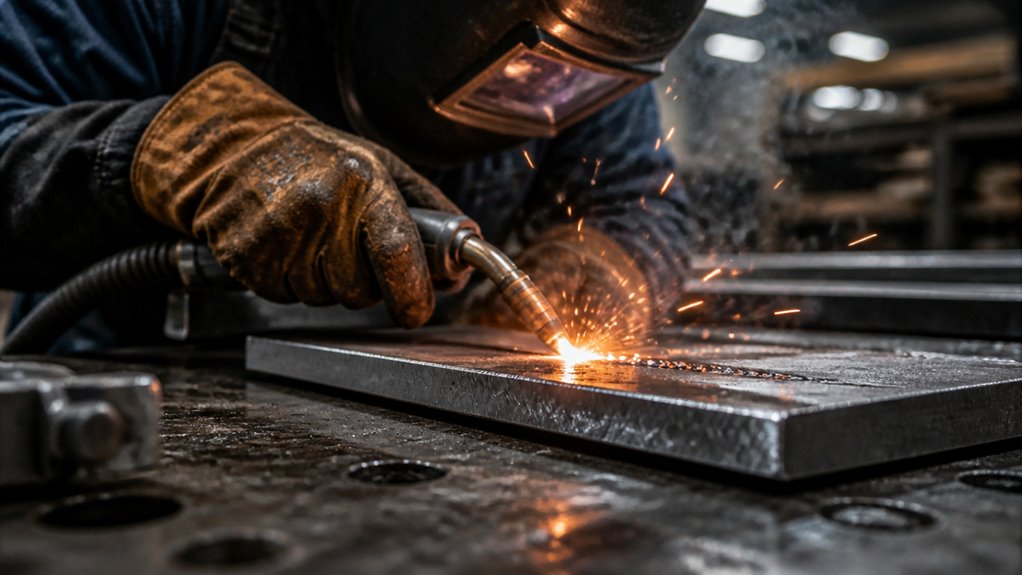
You’ll need a welder that delivers between 200 and 250 amps to weld 1/4-inch steel effectively. A 220V machine usually provides this range, enabling single-pass welds with proper penetration, especially using MIG or stick welding.
Lower amperage, like 140 amps from 110V units, requires multi-pass welds and beveling for full fusion. Wire size, prep, and welding technique also influence results. Understanding these factors guarantees strong joints and efficient welding on 1/4-inch steel.
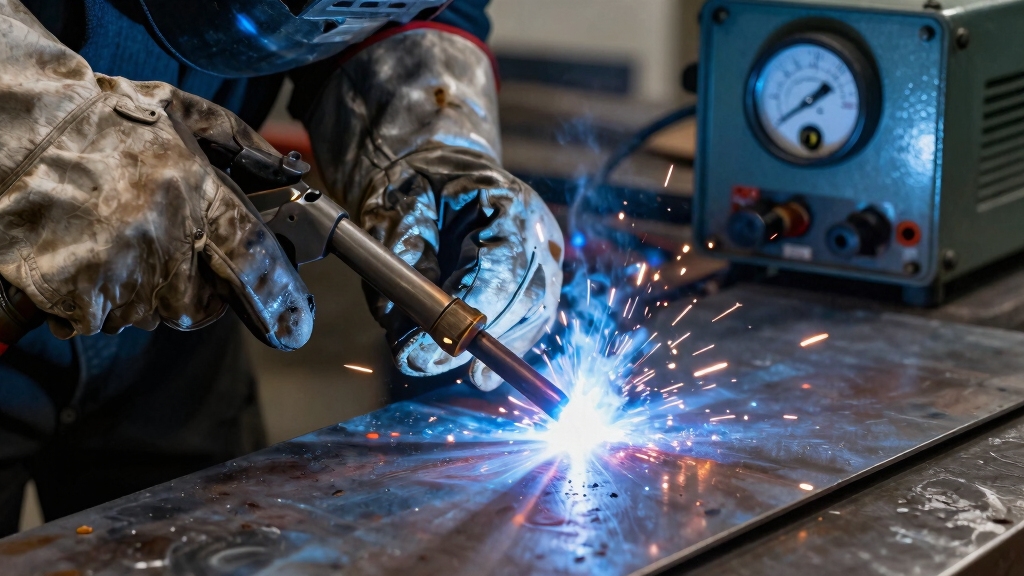
When welding 1/4-inch steel, you need to deliver approximately 250 amps for a clean single-pass weld, following the rule of 1 amp per 0.001 inch of material thickness. This amperage guarantees proper penetration and fusion without requiring multiple passes.
Welding 1/4-inch steel requires about 250 amps for clean, single-pass penetration and fusion.
If you use MIG welding with 0.035-inch wire, 180 amps can suffice for a solid weld but may need careful technique. At 140 amps, you’ll have to prepare the joint with beveling and execute multiple passes: root, fill, and cap to achieve full penetration.
A baseline of 200 amps works well across most general welding processes on this thickness. Matching amperage to material thickness is critical. Insufficient heat leads to weak joints, while excessive amperage risks burn-through or distortion.
Stick to these guidelines for optimal weld quality on 1/4-inch steel. Also, consider your machine’s duty cycle limitations to avoid overheating during prolonged welding sessions.
Selecting between 110V and 220V welders markedly impacts your ability to weld 1/4-inch steel effectively. A 220V welder typically delivers 140 amps and above, providing sufficient heat for single-pass welding on this thickness.
It guarantees proper penetration, reducing the need for multiple passes or beveling, which is vital for structural integrity. Conversely, 110V welders generally max out around 140 amps, limiting you to multi-pass techniques and precise joint preparation to achieve full fusion.
While 110V units are more accessible and easier to set up, they struggle to maintain consistent heat for thicker sections, making them less efficient for 1/4-inch steel. If your project demands robust, single-pass welds with minimal prep, a 220V welder is the technically sound choice for reliable, professional results.
For added versatility and material compatibility, consider dual-voltage MIG welders that can operate on both 110V and 220V power supplies.
To weld 1/4-inch steel effectively, it’s really important to match your amperage output to the thickness of the material. Generally, you’ll want around 250 amps for a clean single pass.
But here’s where it gets interesting: different welding processes have their own power requirements. For instance, if you’re using MIG with 0.035-inch wire, you’re looking at about 180 amps.
Now, if you’re considering multi-pass techniques, you can actually get away with using lower amperage. It’s all about understanding these process-specific power needs. When you do, you ensure proper penetration and overall weld quality. So, knowing what you need for each method can make a big difference in your results!
Selecting a machine with an appropriate duty cycle ensures you can weld consistently without overheating or downtime.
Understanding the amperage requirements for welding 1/4-inch steel is essential to achieving proper penetration and weld strength.
You’ll need approximately 250 amps for a single-pass weld on this thickness, aligning with the rule of 1 amp per 0.001 inch of material.
For MIG welding with 0.035-inch wire, 180 amps usually suffice, but multi-pass welding at 140 amps is possible with beveling and prep.
Most general welding processes perform reliably around 200 amps.
Keep in mind, 110V welders typically max out near 140 amps, requiring multiple passes.
In contrast, 220V machines can deliver the necessary heat for single-pass welds.
Matching amperage to thickness guarantees you avoid weak welds caused by under- or over-heating the steel.
Adjusting wire feed speed can help control amperage to maintain optimal heat input and weld quality.
Different welding processes demand specific power outputs to effectively join 1/4-inch steel. Matching these requirements guarantees peak penetration and weld quality.
For MIG welding with 0.035-inch wire, you’ll need around 180 amps for a strong single pass. Flux-cored welding enables multi-pass welds at slightly lower amperages but calls for precise control and beveling.
Stick welding, especially on 120V systems, requires higher amperage and often multiple passes to secure full fusion. A 220V welder delivering 200–250 amps provides the heat necessary for single-pass welds without compromise.
If you’re using 110V equipment, expect to rely on multi-pass techniques due to limited output, typically maxing out near 140 amps. Tailoring your power supply to the welding method guarantees efficiency and structural integrity on 1/4-inch steel.
Maintaining proper wire feed speed and voltage settings is crucial to achieving consistent penetration and weld quality at these amperage levels.
Selecting the right wire size directly influences your ability to weld 1/4-inch steel effectively. It determines the amperage range and penetration depth you can achieve.
Using a 0.035-inch wire, for example, typically requires around 180 amps, enabling single-pass welding with sufficient penetration. Smaller wires like 0.030-inch demand higher amperage and often multiple passes, complicating the process.
Larger wires support higher current but may reduce control and cause excessive heat input. Matching wire size to your welder’s amperage output guarantees peak fusion without compromising bead quality or causing burn-through.
For 1/4-inch steel, 0.035-inch wire strikes an effective balance. It provides consistent penetration and manageable heat, especially when paired with a 200-amp or higher power supply. This maximizes weld integrity and process efficiency.
Choosing the correct wire diameter also optimizes arc stability and reduces welding defects, ensuring a smoother welding experience.
Although 1/4-inch steel can be welded with a range of amperages and processes, proper preparation is essential to assure ideal heat distribution and penetration. You need to clean the metal thoroughly, removing rust, oil, and paint to avoid contamination.
Beveling edges with a slight bevel angle improves weld fusion, especially for multi-pass welds. Preheating the steel to 100–150°F can reduce thermal shock and cracking risks. Maintaining consistent joint fit-up ensures uniform current flow and penetration.
Balancing the welding amperage with material thickness is critical, as amperage directly controls penetration depth and heat input for strong welds, making it important to understand amperage control before setting your machine.
| Preparation Step | Recommended Practice |
|---|---|
| Surface Cleaning | Wire brush or chemical cleaner |
| Edge Beveling | 30°–45° bevel angle |
| Preheating | 100–150°F |
| Joint Fit-Up | Tight, consistent gap |
| Welding Amperage | 180–250 amps for 1/4-inch |
Follow these to optimize weld quality and penetration.
When welding 1/4-inch steel, choosing between single-pass and multi-pass techniques hinges on your equipment’s amperage and the desired weld quality. If your welder delivers around 180 amps or more, common with MIG and proper wire size, you can achieve full penetration in a single pass. This saves time and reduces distortion.
However, if your amperage maxes out near 140 amps, you’ll need multiple passes with beveling and a 1/16-inch land to ensure proper fusion. Multi-pass welding involves layering root, fill, and cap passes, improving control over heat input and minimizing defects.
You must balance your welder’s output and joint preparation to decide which technique fits your project. Single-pass favors speed and simplicity, while multi-pass offers enhanced penetration with lower amperage gear. The use of continuous wire electrode in MIG welding facilitates consistent heat and filler metal supply for both techniques.
Because structural and automotive welding demands strong, durable joints, operating within the 200–250 amp range guarantees you get sufficient heat for full penetration on 1/4-inch steel.
This amperage range enables single-pass welds, reducing prep time and minimizing defects. It suits MIG, flux-cored, and stick welding processes, providing consistent fusion and mechanical strength critical in load-bearing applications.
For thicker plates requiring multi-pass welding, managing heat input carefully is essential to prevent distortion and cracking.
| Amperage (A) | Welding Process | Application |
|---|---|---|
| 200 | MIG/Flux-cored | General structural welding |
| 220 | MIG | Automotive frame fabrication |
| 240 | Stick | Heavy-duty structural joints |
| 250 | MIG/Stick/Flux-cored | Single-pass 1/4″ steel weld |
| 180 | MIG | Multi-pass or thinner gauges |
Staying in this range guarantees robust welds with ideal penetration and mechanical integrity.
When you’re working with low-amperage welders on 1/4-inch steel, you’ll really want to focus on using multi-pass techniques to get that full penetration. It’s key!
Proper beveling and edge preparation can make a big difference. By creating a groove, you promote better fusion, which can actually help reduce the number of passes you need to make.
Controlling heat input is essential to ensure proper weld pool formation and minimize distortion during the welding process.
Mastering multi-pass welding techniques lets you effectively join 1/4-inch steel even with low-amperage machines. When your welder can’t deliver the 250 amps needed for a single pass, breaking the weld into multiple passes guarantees full penetration and strength.
Start with a root pass to establish fusion between the base metals. Follow with one or more fill passes to build up the joint, then finish with a cap pass for surface integrity. Maintain consistent bead size and heat input to prevent warping or weak spots.
Using 140 amps, expect to make 2–3 passes, adjusting travel speed to avoid undercut. Multi-pass welding compensates for amperage limits, letting you achieve structurally sound welds on 1/4-inch steel without sacrificing quality or risking burn-through.
To complement multi-pass welding on 1/4-inch steel with limited amperage, beveling the edges and preparing the joint properly can greatly enhance penetration and fusion.
When you bevel both sides with a 1/16-inch land, you create a groove that allows the weld bead to access the joint’s full thickness. This compensates for lower heat input.
Proper prep removes contaminants like rust and mill scale, ensuring consistent arc stability and reducing porosity. This preparation is vital when operating at 140 amps or below, where single-pass penetration is inadequate.
Beveling reduces the number of passes needed for full fusion, improving weld quality and structural integrity. By combining beveling with clean joint surfaces, you maximize your low-amperage welder’s effectiveness on 1/4-inch steel.
You need a welding helmet with a proper shade, usually #10–#13, to protect your eyes from intense UV and infrared rays.
Wear flame-resistant gloves and a long-sleeve jacket to shield your skin from sparks and heat.
Use safety glasses underneath for extra eye protection.
Don’t forget ear protection to prevent noise damage.
Respiratory protection, like a respirator or welding fume extractor, is essential to avoid inhaling harmful fumes while working on 1/4-inch steel.
You mightn’t realize how much ambient temperature impacts welding 1/4-inch steel until you face cracking or poor fusion.
Cold environments cool the weld too quickly, causing brittleness and increased residual stress, which leads to cracking.
Conversely, high temperatures can cause excessive oxidation and weaken the weld’s integrity.
To counter this, you’ll need preheating in cold conditions or proper ventilation and cooling strategies in hot weather to guarantee consistent, strong welds.
Yes, you can weld 1/4-inch steel outdoors in windy conditions, but you need to take precautions.
Wind disrupts shielding gas in MIG or TIG welding, causing porosity and weak welds.
Use flux-cored wire or stick welding, which are less sensitive to wind.
Also, set up windbreaks or weld in sheltered spots.
Make sure your amperage settings are correct to maintain penetration despite possible cooling from wind.
You’ll need to regularly clean the welder’s contact tips, nozzles, and wire feeders to prevent buildup and maintain consistent arc quality.
Inspect cables and connections for wear or damage, ensuring good insulation and tight fittings.
Replace consumables like tips and liners as they wear out.
Also, check gas flow and regulators for leaks or blockages.
Periodic calibration verifies amperage accuracy, keeping your 1/4-inch steel welds precise and reliable.
Steel alloys shift settings markedly. Stronger steels, like stainless or high-strength low-alloy (HSLA), demand different amperage and voltage tweaks due to varied thermal conductivity and melting points.
You’ll need to lower heat inputs to prevent warping or cracking. For example, stainless steel requires slightly higher amperage but cooler travel speeds.
Adjust shielding gases and wire types accordingly. This ensures peak fusion and penetration without compromising alloy integrity or weld quality.
When welding 1/4-inch steel, remember that “measure twice, cut once” applies to amperage selection too.
You’ll want a welder capable of delivering 200–250 amps for strong, clean welds, especially in structural or automotive work.
Whether you choose 110V or 220V, guarantee your wire size and welding process match your machine’s power.
Proper prep and understanding single versus multi-pass welding will help you achieve peak penetration and durability every time.