Phone:
(701)814-6992
Physical address:
6296 Donnelly Plaza
Ratkeville, Bahamas.

Phone:
(701)814-6992
Physical address:
6296 Donnelly Plaza
Ratkeville, Bahamas.

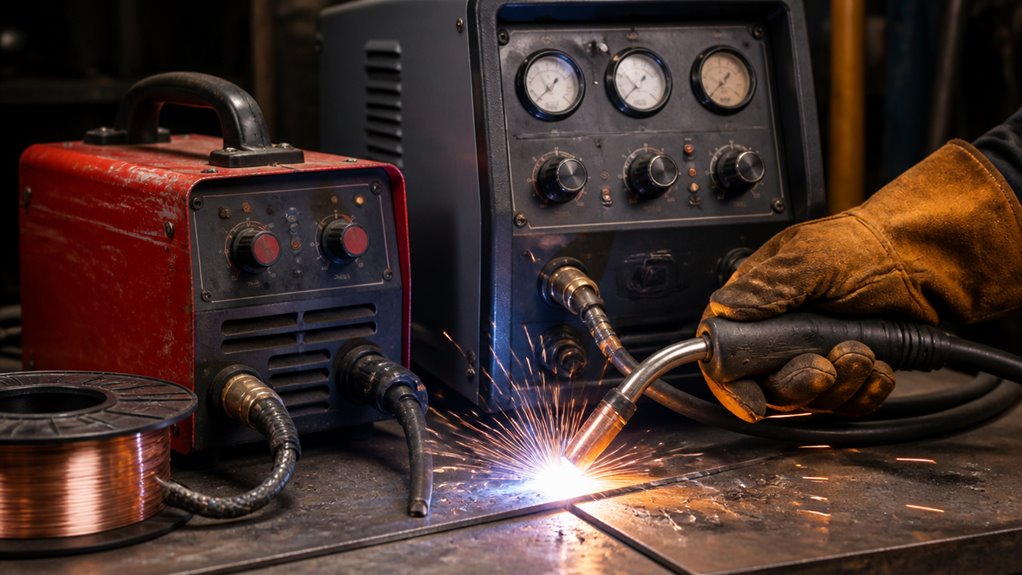
You’ll want a MIG welder that fits your project’s welding processes, power needs, and material thickness.
Solid wire with shielding gas offers cleaner welds indoors. Flux core works better outdoors without gas.
Multi-process machines provide versatility but often cost more and add complexity.
Consider dual-voltage for power flexibility and make certain the amperage matches your metal thickness.
Balancing duty cycle and portability boosts overall value.
Exploring these factors closely helps you select the ideal welder for your tasks.
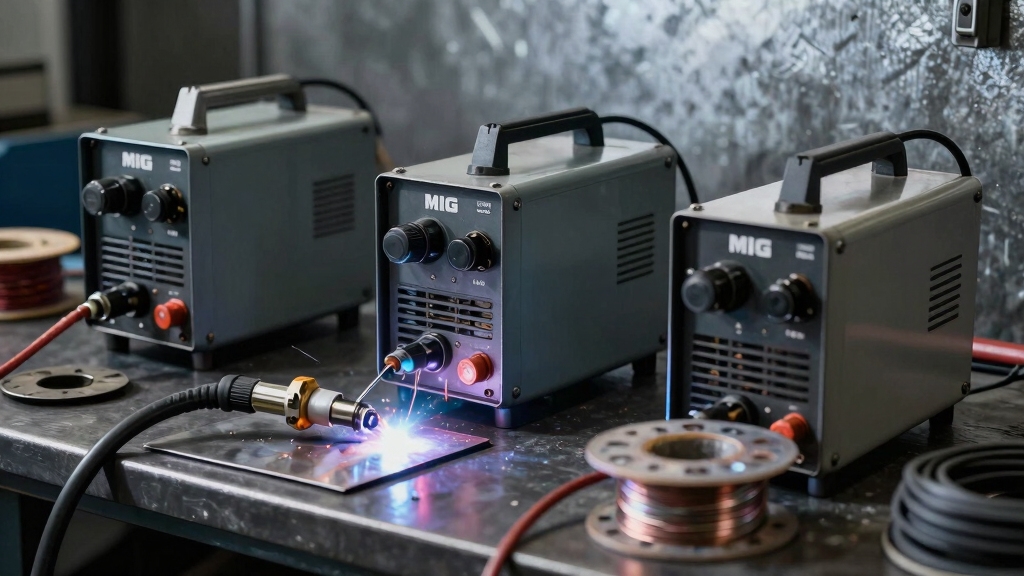
When choosing the right MIG welder, you need to take into account the types of welding processes it supports. This directly impacts your project’s versatility and material compatibility.
Most MIG welders use solid wire with shielding gas for clean, high-quality welds. However, flux core capability is essential if you work outdoors or in windy conditions without access to shielding gas.
Many modern units are multi-process machines, combining MIG, flux core, stick, and TIG modes. This expands your welding options significantly.
This process compatibility influences not just the materials you can weld but also portability and overall machine value. Evaluating these factors guarantees you select a welder tailored to your specific repair, fabrication, or hobby needs.
Optimizing performance and efficiency across diverse applications is key to successful welding. Multi-process welders also reduce equipment costs and workshop space by replacing several single-function machines, making them ideal for varied projects requiring versatile welding methods.
Although MIG welding primarily involves feeding solid wire with shielding gas, understanding the distinctions between welder types and their supported processes is essential for optimizing your results.
You’ll find that many machines combine MIG with flux core, stick, and TIG functions, enhancing versatility across applications. Flux core capability allows you to weld outdoors without shielding gas, while solid wire with gas provides cleaner welds indoors.
Multi-process welders increase your options but may affect machine size and cost.
Consider these key points:
Additionally, choosing the appropriate shielding gas is critical to achieving optimal weld quality and minimizing defects.
Because power input directly impacts welding capability and portability, choosing the right MIG welder power option requires evaluating your typical work environment and material needs.
For light-duty projects, 120V machines offer sufficient power and enhanced portability, ideal for home garages. Dual-voltage units (120V/240V) increase flexibility, allowing you to weld in diverse settings with improved output.
Portable welders often balance amperage and weight; compact models typically deliver 135A to 140A, suitable for thinner materials. Premium portable machines boost output to 200A-plus but may sacrifice some mobility.
Consider how frequently you’ll transport your welder and the required amperage for your materials. Higher amperage means heavier, less portable units but better penetration.
Analyzing power source compatibility, amperage range, and physical size ensures you select a welder that aligns precisely with your operational demands and mobility requirements. Some models, like the Power MIG 140 MP, feature tool-less drive roll changes to minimize downtime and ease maintenance.
When it comes to using your MIG welder, it’s really important to match its output and process options to the thickness of the material you’re planning to weld.
For example, if you have a lower-output machine, you can typically work with steel up to about 1/4 inch thick.
But if you’re using a dual-voltage unit, you can push that capacity a bit further—up to around 3/8 inch. That’s a nice little boost!
Just remember, it’s not all about the machine itself. Things like the type of wire you’re using, how well you prepare your joints, and even the duty cycle can really affect how thick of material you can effectively weld.
Adjusting wire feed speed and current settings based on material thickness is crucial for achieving optimal fusion and penetration.
When selecting a MIG welder, understanding its material thickness limits is essential for matching the machine to your welding tasks.
Your welder’s amperage output directly affects the thickness range it can handle efficiently. Lower-output models typically manage mild steel up to 1/4 inch.
Dual-voltage units can extend capacity to about 3/8 inch. Keep in mind that flux core and solid wire processes may influence effective thickness limits.
Key points to bear in mind include:
Understanding your machine’s duty cycle is important to avoid thermal shutdowns during extended welding on thicker materials.
This analysis guarantees you pick a MIG welder suited precisely to your material needs.
Frequently, welding capacity hinges on several critical factors beyond just a welder’s amperage rating. You must consider wire type, shielding gas, joint preparation, and duty cycle to determine the maximum material thickness your MIG welder can handle effectively.
For instance, flux core wire excels outdoors but may limit thickness range compared to solid wire with gas. Dual-voltage welders offer flexibility for thicker materials, typically up to 3/8 inch mild steel.
| Factor | Impact on Welding Capacity |
|---|---|
| Amperage Output | Higher amps enable thicker material welds |
| Wire Type | Solid wire with gas suits cleaner, thicker welds |
| Shielding Gas | Essential for preventing contamination |
| Joint Preparation | Proper prep improves penetration |
| Duty Cycle | Longer cycles allow sustained welding |
Matching the wire size to metal thickness and amperage is crucial for proper penetration and optimal weld quality.
When you’re looking to evaluate a MIG welder, there are a few key things to keep in mind. First up is the welding power and output. You really want to make sure it matches your material thickness and duty cycle needs. After all, having the right power can make a huge difference in the quality of your welds.
Next, let’s talk about versatility. This is where multi-process options come into play. If you can find a welder that goes beyond just standard MIG welding, you’re really expanding your toolkit. It’s all about finding that balance between power, versatility, and what you can do with the machine. Additionally, understanding the role of inert shielding gas is crucial for achieving clean and strong welds with MIG technology.
Understanding welding power and output is essential for selecting a MIG welder that meets your specific needs. The amperage rating directly influences the maximum material thickness you can weld and the overall arc stability.
Higher output welders provide better penetration and faster travel speeds but often sacrifice portability. Dual-voltage welders offer flexibility across various job sites, while lower-output units suit light-duty tasks and thin materials.
Duty cycle also impacts continuous welding performance, especially for extended projects. Key factors worth taking into account include:
Fine-tuning wire feed speed and voltage settings plays a crucial role in achieving consistent weld quality and arc stability.
Although power and output define a welder’s core capability, versatility and process options determine how effectively you can adapt to different welding tasks.
A great MIG welder often supports solid wire with shielding gas for clean welds. However, flux core capability is essential if you plan to weld outdoors without gas.
Multi-process machines that include MIG, flux core, stick, and TIG modes markedly expand your material compatibility and project range. This versatility enhances repair and fabrication efficiency.
When selecting a welder, consider how process options align with your typical work environment and material thickness.
Multi-process units offer greater flexibility but may come at a higher cost and complexity. Weigh your specific needs carefully to maximize value and performance in diverse welding scenarios.
Additionally, choosing models with dual voltage support allows compatibility with varied workshop power setups, ensuring greater operational flexibility.
Since MIG welders vary widely in features and performance, choosing the right model depends heavily on your budget tier. You need to balance power, process capability, and portability within your price range to meet your welding demands efficiently.
Budget welders typically offer basic MIG and flux core functions, suitable for light-duty tasks. Midrange models provide dual-voltage input, higher output, and multi-process flexibility. Premium units deliver superior arc stability, extended duty cycles, and advanced controls.
Consider these factors when evaluating your budget tier:
Input power and voltage compatibility for your workspace.
Maximum amperage output relative to material thickness.
Welding process options: MIG, flux core, stick, TIG.
Portability versus machine size and weight.
Duty cycle and thermal management features.
This analytical approach helps you pinpoint the best value welder within your financial limits. Additionally, models with synergic mode can simplify parameter settings and improve welding precision, making them valuable for both beginners and professionals.
Explore leading MIG welder models and brands that consistently deliver reliable performance and versatility across varying welding applications.
You’ll find Lincoln Electric’s Power MIG 215 MPi excelling with multi-process capability and robust arc stability. It’s ideal for professional shops.
Hobart’s Handler 140 offers budget-friendly, solid wire MIG welding with dependable duty cycles for light to medium tasks.
The Eastwood MP250i Elite stands out for its multi-purpose design and portability, suiting hobbyists and small fabricators.
For higher amperage and premium features, ESAB Rogue EM 140 and Miller models provide superior thermal management and consistent output.
When choosing, consider input power options, welding capacity, and process flexibility to match your material thickness and project scope.
These brands balance value, performance, and usability, making them benchmarks for precise, durable welds.
You maintain your MIG welder by regularly inspecting and cleaning the contact tip, nozzle, and drive rolls to guarantee consistent wire feed and arc stability.
Use compressed air to remove dust and debris from vents and internal components. Replace worn consumables promptly.
Check and tighten cable connections to avoid voltage drops. Periodically clean the wire spool and assure proper gas flow.
This routine maximizes performance, extends machine life, and prevents weld defects.
You need a welding helmet with a proper shade lens to protect your eyes from intense UV and infrared rays.
Wear flame-resistant gloves and a long-sleeve jacket to shield your skin from sparks and heat.
Respiratory protection is essential, especially when welding in enclosed spaces, to avoid inhaling fumes.
Don’t forget safety boots with steel toes and ear protection if noise levels are high.
Always prioritize full coverage and quality gear for effective protection.
Welding aluminum with a MIG welder is like piloting a river with shifting currents. You need the right setup.
You can use a MIG welder for aluminum if it supports spool gun attachment or uses push-pull wire feeding to handle soft aluminum wire.
Shielding gas, typically pure argon, is essential for clean welds. Without these, you risk poor arc stability and contamination.
Make certain your machine offers these features for successful aluminum welding.
To troubleshoot common MIG welder issues, start by checking wire feed. Guarantee proper tension and clean rollers to prevent bird-nesting.
Inspect your ground clamp for a solid connection. Verify shielding gas flow and regulator settings to avoid porosity.
If your arc is erratic, clean contact tips and check for worn liners. Adjust voltage and wire speed for stable welds.
Finally, confirm your power source matches welder specs for consistent performance.
Think of your consumables as the lifeblood of consistent MIG welding. You’ll need solid or flux-core wire suited to your project’s material and thickness, a clean shielding gas mix (often argon with CO2) for stable arcs, and contact tips matched to wire diameter to guarantee smooth feeding.
Nozzles that direct gas flow precisely are also essential. Regularly replace liners and check drive rolls to avoid feeding hiccups, maintaining steady weld quality every time.
Just as a perfect weld depends on the right combination of heat, wire, and technique, choosing your MIG welder hinges on matching power, portability, and material capacity to your specific needs.
Coincidentally, the best model often aligns with your budget tier and performance demands without compromise.
By understanding these technical factors, you’ll confidently select a MIG welder that not only meets but optimizes your welding projects with precision and efficiency.