Phone:
(701)814-6992
Physical address:
6296 Donnelly Plaza
Ratkeville, Bahamas.

Phone:
(701)814-6992
Physical address:
6296 Donnelly Plaza
Ratkeville, Bahamas.

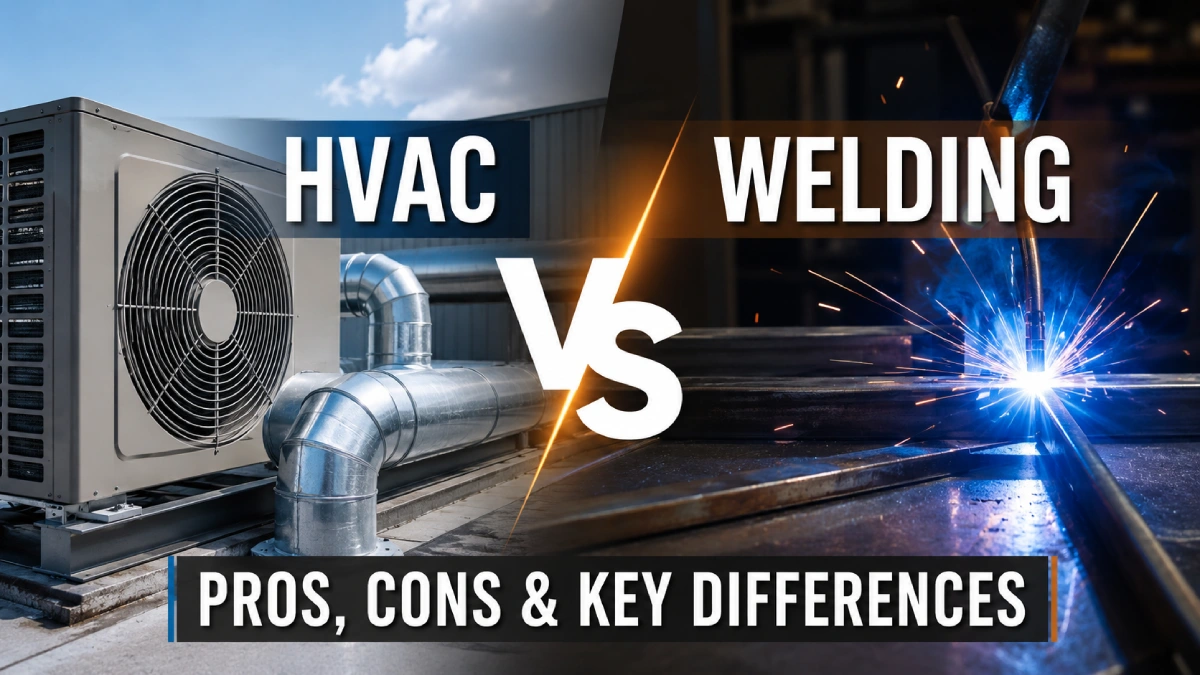
If you’re choosing between HVAC and welding, know HVAC focuses on indoor climate control systems with diagnostic and electronic skills.
Welding emphasizes metal joining using heat in varied industrial settings.
HVAC training spans six months to two years, requiring certifications like EPA 608 and offers steady growth near 5–6%.
Welding often demands shorter hands-on training but carries higher physical risks and variable growth tied to infrastructure.
Both trades offer specialized certifications boosting career paths and income.
Explore further to understand which aligns best with your goals.
| Feature | HVAC | Welding |
|---|---|---|
| Primary Focus | Heating, ventilation, and air conditioning systems | Joining and fabricating metal components |
| Typical Work Environment | Residential, commercial, and industrial buildings | Construction sites, fabrication shops, factories |
| Main Job Duties | Install, maintain, and repair HVAC systems | Cut, join, and repair metal using welding processes |
| Training Duration | 6 months–2 years | 6 months–1 year |
| Key Certifications | EPA 608, NATE | AWS Certifications |
| Technical Skills | Electrical diagnostics, refrigeration, system troubleshooting | Metal fabrication, welding techniques, blueprint reading |
| Physical Demand | Moderate | High |
| Indoor vs Outdoor Work | Mostly indoor | Indoor and outdoor |
| Job Growth | Approximately 5–6% | Approximately 3–8% |
| Entry-Level Salary | Around $40,000/year | Around $40,000/year |
| Median Annual Salary | Around $59,620 | Around $48,940 |
| Specialization Opportunities | Smart HVAC, energy management, commercial systems | Pipe welding, underwater welding, robotic welding |
| Safety Risks | Electrical hazards, refrigerants, confined spaces | Heat, sparks, UV radiation, fumes |
| Career Stability | High | High, depending on industry demand |
| Customer Interaction | Frequent | Limited |
| Best For | Problem-solvers interested in mechanical and electrical systems | Hands-on workers who enjoy metal fabrication |
| Main Advantage | Strong job demand and higher average salary | Faster training and diverse industrial opportunities |
| Main Drawback | Requires ongoing certification and technical updates | More physically demanding with higher workplace risks |
Although both HVAC and welding involve skilled trades with hands-on work, their core functions and work environments differ markedly.
You’ll find HVAC technicians focusing on installing, maintaining, and repairing heating, ventilation, and air conditioning systems. They often work indoors within residential, commercial, or industrial settings.
HVAC tasks require diagnostic skills to troubleshoot electronic controls.
Welders, in contrast, specialize in joining metal components through heat, pressure, or fusion. They work primarily in fabrication shops, construction sites, or outdoor environments.
Welding demands precision in handling various techniques under industrial conditions, often amid hazards like intense heat and fumes.
Both roles require problem-solving, but HVAC leans more on electronic diagnostics. Welding emphasizes manual dexterity and control over specialized equipment in harsher physical settings. Successful welding careers often depend on obtaining performance-based certifications that validate skills and enhance job prospects.
When you pursue a career in HVAC or welding, obtaining the right education and certifications is essential to demonstrate your technical competence and meet industry standards.
HVAC training programs typically last between six months and two years, covering system installation, regulations, and EPA certification. You must secure credentials like the EPA 608 and NATE certifications to verify your proficiency.
HVAC training spans six months to two years, including system installation, regulations, and essential EPA 608 and NATE certifications.
In welding, education spans six months to one year, focusing on hands-on application of diverse welding techniques. You’ll aim for American Welding Society (AWS) certifications to validate your skills in specific methods.
Both fields often require apprenticeships for practical experience, with state licensing varying. This structured education and credentialing guarantees you’re prepared for technical challenges and compliant with regulatory demands in either profession.
Welding certifications such as the AWS Certified Welder and Certified Welding Inspector demonstrate advanced expertise and ensure adherence to safety and quality standards.
Understanding the educational foundation sets the stage for examining the environments where HVAC technicians and welders apply their skills daily.
As an HVAC technician, you’ll primarily work indoors within residential, commercial, or industrial settings. Your focus will be on installing, maintaining, and repairing heating, ventilation, and air conditioning systems.
Your tasks demand strong diagnostic skills, especially for electronic controls.
Conversely, welders operate in fabrication shops, industrial sites, construction zones, or outdoors. They join metal parts using heat and pressure techniques like arc or gas welding.
Troubleshooting mechanical issues is common to both roles. However, welders emphasize manual dexterity and precision in metal fusion.
Your daily environment and tasks will directly reflect these technical demands. This shapes your workflow and safety protocols uniquely in each profession.
Beginners in welding often start with MIG welding due to its ease of use and adaptability to various metals and environments.
Sure! Here’s a more conversational version of the text:
—
You know, HVAC technician roles are projected to grow by about 6%. This increase is mainly due to the rising demand for energy-efficient climate systems.
On the other hand, welder positions are expected to see a growth of roughly 3%. That’s largely because of ongoing needs in infrastructure and manufacturing.
If you’re considering entry-level opportunities, welding might be a great choice. There’s a real shortage of skilled labor in that field, which means plenty of openings.
Meanwhile, HVAC offers steady, long-term employment, especially with the current focus on sustainability.
Welding training can vary widely, with basic skills often attainable in just a few months through focused hands-on training.
So, when you look at these growth rates and the market drivers behind them, it really helps you figure out which career path aligns with your goals. What’re you thinking?
—
Explore the employment growth rates for HVAC technicians and welders to gauge the future demand in each field.
HVAC technician roles are projected to grow approximately 5-6%, reflecting steady expansion driven by the need for energy-efficient climate control systems.
In contrast, welder positions show a slightly lower growth rate around 3-4%, influenced by infrastructure projects and manufacturing sector demands.
Despite the marginally slower growth, welding benefits from a shortage of skilled workers, enhancing entry-level opportunities.
These projections suggest HVAC offers more consistent long-term growth aligned with sustainability trends.
Welding provides niche, project-based growth with potential for specialization.
Understanding these rates helps you anticipate job stability and market competition.
This guides career decisions based on growth trajectories and industry dynamics rather than immediate demand fluctuations.
For those interested in aerospace applications, obtaining AWS D17.1 certification can significantly improve welding career prospects in high-demand specialized sectors.
Job growth projections for HVAC technicians and welders reflect distinct industry forces shaping demand.
For HVAC, growth hinges on rising energy efficiency standards and the integration of sustainable climate control technologies, driving a 6% job increase.
You’ll find demand concentrated in residential and commercial sectors adopting smart HVAC systems.
Welding demand, growing around 3%, is propelled by infrastructure development and advanced manufacturing requiring specialized metal joining techniques.
Shortages of skilled welders amplify opportunities, especially in industrial and construction environments.
While both fields offer job security, HVAC aligns more with green technology trends, and welding depends heavily on industrial investment cycles.
Understanding these drivers helps you anticipate market shifts and tailor skill development to where future demand solidifies.
Additionally, welders must follow strict safety protocols and obtain certifications to ensure quality and compliance in their work environments.
Although entry-level positions in both HVAC and welding require foundational skills, the availability and nature of these opportunities differ markedly.
You’ll find HVAC roles typically in residential, commercial, or industrial settings, emphasizing system installation and diagnostics with a customer-facing component.
Training spans 6 months to 2 years, with certifications like EPA 608 enhancing employability.
Welding entry-level jobs arise primarily in industrial or construction environments, focusing on hands-on metal joining techniques and often requiring AWS certifications.
Job growth projections show HVAC expanding at about 5-6%, driven by sustainability trends, while welding grows around 3-8%, fueled by infrastructure demands.
Both fields offer stable entry salaries near $40,000, but welding shortages may provide more immediate openings.
Your choice depends on environment preference, technical focus, and long-term career objectives.
Many welding apprenticeships accept candidates with no prior experience but emphasize the importance of safety protocols and certifications to ensure workplace readiness.
Understanding the salary and income potential for HVAC technicians and welders requires analyzing median wages, experience levels, and specialization premiums.
HVAC technicians earn a median annual salary of $59,620, roughly $24.32 per hour, while welders average $48,940, or about $22.60 per hour.
Entry-level salaries for both hover near $40,000 annually. As you gain experience, HVAC earnings can reach $65,000 to $90,000, influenced by specialization and location.
Welding specialists, such as underwater or pipe welders, command 50-100% higher pay, earning $60,000 to $85,000 per year.
These figures reflect the technical complexity and demand in each field, emphasizing how advanced certifications and niche skills directly enhance your income potential in both professions.
Additionally, welders must master heat-affected zones management to ensure joint durability and avoid costly defects.
Because both HVAC technicians and welders work with complex systems and materials, you must navigate distinct health and safety risks inherent to each trade.
As an HVAC technician, you face electrical hazards requiring strict adherence to lockout/tagout procedures and knowledge of electronic controls to prevent shocks.
Exposure to refrigerants and mold demands proper ventilation and respiratory protection.
In contrast, welding exposes you to extreme heat, intense UV radiation, and toxic fumes, necessitating thorough personal protective equipment, including fire-resistant clothing and respirators.
You must also implement rigorous fire prevention measures due to sparks and molten metal.
Both roles require ongoing compliance with industry safety standards to mitigate risks effectively.
However, welding demands heightened vigilance against thermal and chemical hazards, while HVAC focuses more on electrical safety and environmental exposures.
Welders also face a significantly increased risk of lung-related diseases due to prolonged exposure to toxic fumes without proper ventilation.
Maintaining safety standards lays the foundation for advancing your career in HVAC or welding. Specialization opens doors to higher earnings and greater responsibilities.
In HVAC, you can specialize in energy-efficient systems, increasing your income by 20-30% through advanced certifications. You might also move into system design, energy management, or technical education roles.
Welding offers specialization in areas like underwater, pipe, or nuclear welding, markedly boosting pay. Additionally, you can pursue forensic analysis, robotics integration, or oversee large fabrication projects.
Both fields provide pathways to supervisory roles such as project management or shop foreman positions, requiring leadership and organizational skills. Mastering multiple welding modes through a multi-process welder enhances versatility and job opportunities in welding careers.
For HVAC beginners, you’ll need a multimeter for electrical diagnostics, a refrigerant gauge set, pipe wrenches, and a vacuum pump to handle system pressures and refrigerants accurately.
In welding, essential tools include a welding helmet with auto-darkening lenses, welding gloves, a wire brush for cleaning metal surfaces, clamps for securing pieces, and a welding machine suited to your chosen technique.
Both require durable protective gear to guarantee safety.
Balancing work and life in HVAC or welding jobs often means walking a tightrope.
HVAC roles usually offer more predictable hours and indoor settings, making it easier for you to maintain steady routines.
Welding, however, can demand irregular shifts and exposure to harsher environments, which might disrupt your personal time.
Both careers require discipline, but HVAC tends to provide a more manageable schedule.
Welding may challenge your ability to clock out fully.
You can self-teach foundational welding skills through online resources and practice. However, mastering techniques requires hands-on training and safety knowledge.
HVAC skills involve complex diagnostics and handling regulated refrigerants. This makes self-teaching less effective without formal programs and certifications like EPA 608.
Both fields demand practical experience and adherence to safety standards. These elements are difficult to acquire independently, so structured training and apprenticeships are essential for proficiency and career advancement.
You might think HVAC and welding are simple trades anyone can master quickly, but both demand specialized training and certifications.
People often underestimate the diagnostic skills HVAC requires for complex electronic systems.
Similarly, welding involves more than just joining metals; it requires understanding diverse techniques and safety protocols.
You can’t ignore the physical risks and continuous learning needed to stay current with industry standards in either profession.
Weather conditions act like a double-edged sword on your daily tasks.
If you’re welding outdoors, extreme heat or cold can affect metal behavior and compromise weld quality. Wind can disperse shielding gases, causing defects.
For HVAC work, harsh weather may expose you to mold, refrigerants, or electrical hazards during system repairs or installations.
You must adapt safety protocols and equipment use precisely to maintain quality and protect yourself in varying environments.
When choosing between HVAC and welding, remember that “knowledge is power.” Each field demands specific skills, certifications, and safety awareness.
HVAC offers steady indoor work with growing specialization. Welding provides hands-on, versatile opportunities in diverse environments.
Your decision should weigh job outlook, income potential, and health risks carefully. By understanding these technical distinctions, you’ll position yourself for a career that aligns with your strengths and goals.
This approach will maximize both growth and long-term satisfaction.