Phone:
(701)814-6992
Physical address:
6296 Donnelly Plaza
Ratkeville, Bahamas.

Phone:
(701)814-6992
Physical address:
6296 Donnelly Plaza
Ratkeville, Bahamas.

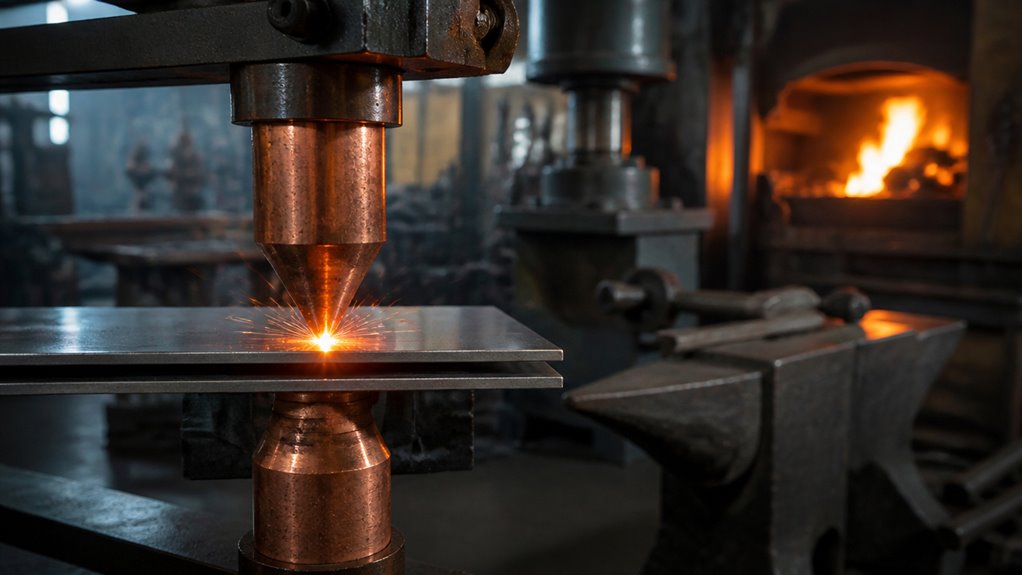
Resistance welding gives you faster, more repeatable joints than forge welding, especially in high-volume production. Its electrodes apply pressure and heat the joint with a controlled current, often completing a spot weld in 0.01 to 0.63 seconds.
You can program and monitor weld settings to reduce operator-dependent variation and avoid forge heating and handling steps. It typically needs no filler, flux, or shielding gas.
Your best choice still depends on joint design, production volume, and equipment cost; the details below clarify the trade-offs.
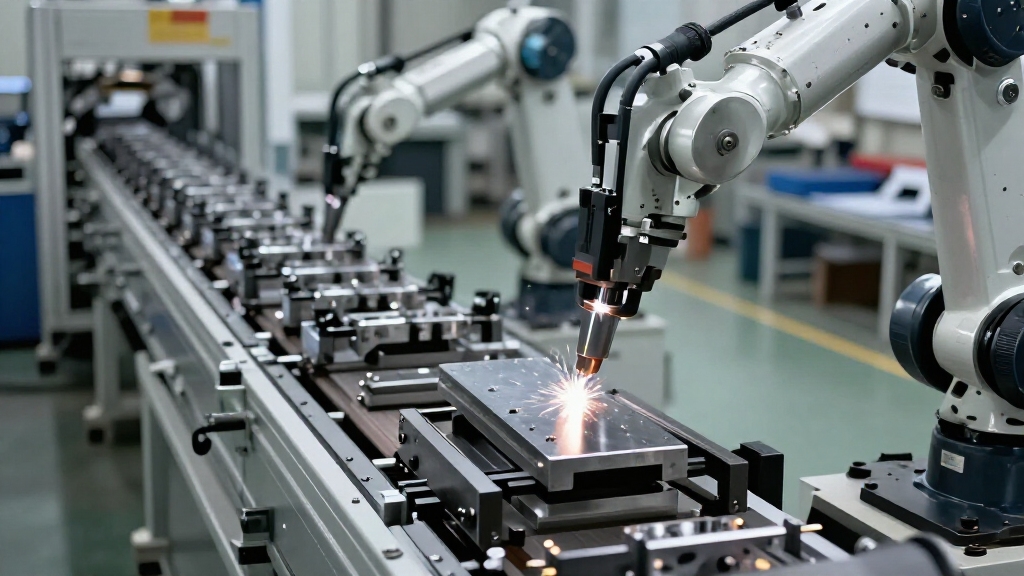
Because resistance welding can join metal in fractions of a second, it suits high-volume production where cycle time directly affects throughput.
When you compare it with forge welding, you’ll find that resistance welding avoids the separate heating and pressure stages that can extend each operation.
This difference matters when your line repeats the same joint across thousands of parts.
Shorter, predictable weld cycles help you limit bottlenecks and keep downstream stations supplied.
The process also fits sheet-metal assembly, where you need many consistent joints without interrupting material flow.
Forge welding can produce strong connections, but its slower, more hands-on sequence is less practical for repetitive factory output.
Precise control of current and force helps produce repeatable welds across high-volume production runs.
Resistance welding is pretty efficient because it generates heat right at the joint. This means you can hit that welding temperature in just a fraction of a second. Pretty impressive, right?
You can also apply pressure right away. This skips the separate heating and handling stages you usually have to deal with in forge welding. By streamlining these steps, you can really cut down on production delays.
All this means your line stays moving smoothly and efficiently. So, less downtime and more productivity! Its rapid cycle time also supports consistent, high-volume production.
By concentrating electrical current at the joint, resistance welding generates heat rapidly and can complete a weld in fractions of a second.
You can shorten production cycles because electrical resistance converts current into heat precisely where the metal surfaces meet.
This localized heating brings the joint to welding temperature without heating the entire workpiece or waiting for a forge to warm it.
Compared with forge welding, which requires broader heating before joining, resistance welding reduces thermal preparation time and limits heat transfer to surrounding material.
You can consequently move parts through repetitive operations faster, easing assembly-line bottlenecks and increasing throughput for sheet metal and other high-volume products.
A controlled current schedule also makes heating time predictable from weld to weld, supporting consistent cycle times across production batches and reducing delays caused by manual temperature judgment.
For spot welding, weld time is typically 0.01 to 0.63 seconds, depending on the sheet material and thickness.
Once the electrodes contact the workpieces, resistance welding applies pressure immediately. This completes the force step without a separate heating or handling stage.
You can coordinate electrode force with current delivery, so the joint forms within one controlled machine cycle. This sequence compresses heating, pressure, and bonding into a brief operation, often lasting fractions of a second.
By contrast, forge welding typically requires you to heat the parts first, then transfer and press or hammer them while they remain workable. That added sequence lengthens each joint’s cycle.
With resistance welding, the electrodes maintain force as electrical resistance generates heat at the interface. They then hold the joint during cooling. Maintaining pressure briefly after current stops helps the weld nugget solidify without shifting the workpieces.
You gain a compact, repeatable timing profile suited to rapid, repeated joining, without relying on a separate forge-heating interval.
Because resistance welding completes each joint in a fraction of a second, it can reduce cycle time and prevent production bottlenecks.
You can move parts through repetitive operations faster because the process applies heat and pressure rapidly, without the extended heating and handling forge welding requires.
Shorter cycles increase throughput and help you keep assembly stations supplied.
| Production factor | Resistance welding | Forge welding |
|---|---|---|
| Joint cycle | Fraction of a second | Longer heating and pressing |
| Line flow | Fewer bottlenecks | More time between joints |
| Production fit | High-volume runs | Slower repetitive output |
With machine-controlled schedules, you can also standardize weld timing across batches and reduce operator-dependent variation.
Rotating wheel electrodes apply pressure and current to form overlapping weld nuggets along the seam.
Faster joining doesn’t guarantee a delay-free line, but it gives you more capacity to meet production targets and respond to demand without expanding cycle time.
In automated resistance welding, a controller sets the current, electrode force, and weld duration for each cycle. It then monitors those parameters as the electrodes join the parts.
You can program a schedule for the material, thickness, and joint design, then call it up through the machine interface. Sensors measure electrical and mechanical conditions during the cycle.
Program weld schedules for each material, thickness, and joint design, while sensors track electrical and mechanical conditions throughout the cycle.
The control system can adjust output or flag a fault when readings leave defined limits. You can also link the welder to a production line, coordinating electrode movement with part positioning and handling equipment.
This replaces manual timing and force application with a defined sequence. Unlike forge welding, which relies on external heating and skilled pressure application, resistance welding lets you manage each operation through programmable controls, with less direct operator intervention. Consistent control can help reduce defects by limiting variation between welds.
Programmable controls improve weld consistency by holding current, electrode force, and weld time within defined limits for each cycle.
When you use resistance welding, these controlled inputs help produce a predictable heat pattern at the joint.
Closed-loop systems can monitor process signals and adjust output when line voltage or material conditions vary, limiting deviations between welds.
You can also set and repeat a qualified schedule across production runs, reducing reliance on an operator’s timing or judgment.
This repeatability supports more uniform joint formation and makes process results easier to verify against specifications.
By tracking key parameters, you can identify drift before it creates a broader quality problem.
Forge welding can produce strong joints, but its results depend more on consistent heating and pressure application by the operator.
Digital welding systems can use real-time monitoring to track process data and support timely adjustments.
Resistance welding uses fewer consumables because it typically forms the joint without filler metal, flux, or shielding gas. You pass current through the workpieces and apply pressure, generating heat at their contact surfaces to create the bond.
This direct process avoids materials that other joining methods may need to protect or build up a seam.
Forge welding also usually joins metals without filler. The difference isn’t simply filler use. In standardized resistance-welding production, you can often eliminate fluxes, rods, and shielding supplies as well.
Fewer consumables mean less purchasing, storage, and material handling across a production line. You also generate less packaging and process waste.
The resulting reduction in inventory and waste can simplify production logistics and lower operating costs, especially when you make large batches of repeatable joints. Like other welding methods, resistance welding depends on clean surfaces to support a reliable bond.
Beyond reducing consumable use, resistance welding also reduces reliance on operator skill. Machine controls regulate current, force, and weld time, so you don’t have to judge heat by eye or coordinate repeated hammer blows. That control makes training more straightforward and limits variation between operators.
| Manual forge welding | Resistance welding |
|---|---|
| You judge heat and timing | Controls set the weld schedule |
| You coordinate hammering or pressure | Equipment applies programmed force |
| Technique can vary by operator | Repeatable settings reduce variation |
For production teams, this difference can ease the pressure of maintaining consistent quality across shifts. You still need training to set parameters, position parts, and recognize defects. Automation doesn’t remove oversight. However, machine-controlled cycles reduce dependence on specialized manual technique. Compared with forge welding, where skilled handling strongly affects heat and joint formation, resistance welding lets you rely more on controlled process settings and less on individual judgment. Consistent electrode alignment helps maintain uniform contact and repeatable weld nuggets.
Choose resistance welding over forge welding when you need fast, repeatable joints across high-volume production. Its short cycle times can reduce assembly bottlenecks, especially when you join sheet metal or make repetitive parts.
You’ll benefit most when your process suits machine control. Automated systems regulate current and force, monitor weld conditions, and maintain consistent schedules across batches.
Choose this method when you need tighter quality control, lower dependence on operator technique, and fewer consumables. Resistance welding typically needs no filler, flux, or shielding gas, reducing handling and waste.
It also avoids the external heating setup required for forge welding. Forge welding may suit work that demands manual flexibility or doesn’t justify dedicated equipment.
Compare joint design, production volume, and equipment costs before choosing. If throughput and repeatability dominate, resistance welding is usually the stronger production choice. However, it still requires precise parameter control to prevent defects such as voids or incomplete bonding.
You can join most electrically conductive metals using resistance welding, including low-carbon and stainless steels, aluminum, copper, nickel alloys, and titanium.
The process also joins dissimilar metals, such as steel to copper, when their electrical and thermal properties, surface condition, and thickness suit the selected method.
You can’t directly resistance-weld insulating materials, such as plastics or ceramics, because they don’t conduct the current needed to generate heat at the joint.
You’ll encounter a bright burst of current and pressure in resistance welding’s main types: spot, seam, projection, and flash-butt welding.
Spot welding joins overlapping sheets at discrete points. Seam welding creates continuous, overlapping welds with rotating electrodes.
Projection welding concentrates current at raised features, often joining nuts or brackets. Flash-butt welding heats opposing ends through electrical resistance, then presses them together.
Each method suits different joint geometries, materials, and production needs.
You’ll need a resistance welding machine with a power supply, control unit, electrodes, and a mechanism that applies pressure.
Choose electrodes suited to your workpiece and welding process, such as spot, seam, or projection welding.
You’ll also need cables, fixtures to position and hold parts, and cooling equipment, often water circulation, to protect electrodes and machinery.
Add safety guards and appropriate personal protective equipment for reliable, safe operation.
Treat every weld as a controlled spark, not a harmless flash. Protect yourself before you energize the machine.
Wear safety glasses, suitable gloves, and flame-resistant clothing. Secure loose items and tie back long hair.
Keep hands clear of electrodes and pinch points. Use guards or interlocks.
Check cables, grounding, and cooling systems before operation.
Ventilate the area and follow lockout procedures during maintenance. Never bypass controls or exceed rated settings.
Resistance welds can develop several defects: expulsion, porosity, cracks, incomplete fusion, indentation, and weak or undersized nuggets.
You may also see sticking, excessive electrode marks, surface burning, or misalignment.
These problems often result from incorrect current, weld time, force, electrode condition, or part fit-up.
Monitor process settings and inspect welds for size, appearance, and strength.
You’ll catch inconsistent joints before they affect product performance.
Choose resistance welding over forge welding when you need repeatable joints at production speed.
Its controlled current, pressure, and timing can reduce cycle time, limit consumable use, and make automation practical.
Think of it as a metronome on an assembly line: each weld follows the same beat, while forge welding demands more hands-on control.
If your parts suit the process and volume justifies the equipment, resistance welding can deliver consistent output with less operator dependence.