Phone:
(701)814-6992
Physical address:
6296 Donnelly Plaza
Ratkeville, Bahamas.

Phone:
(701)814-6992
Physical address:
6296 Donnelly Plaza
Ratkeville, Bahamas.

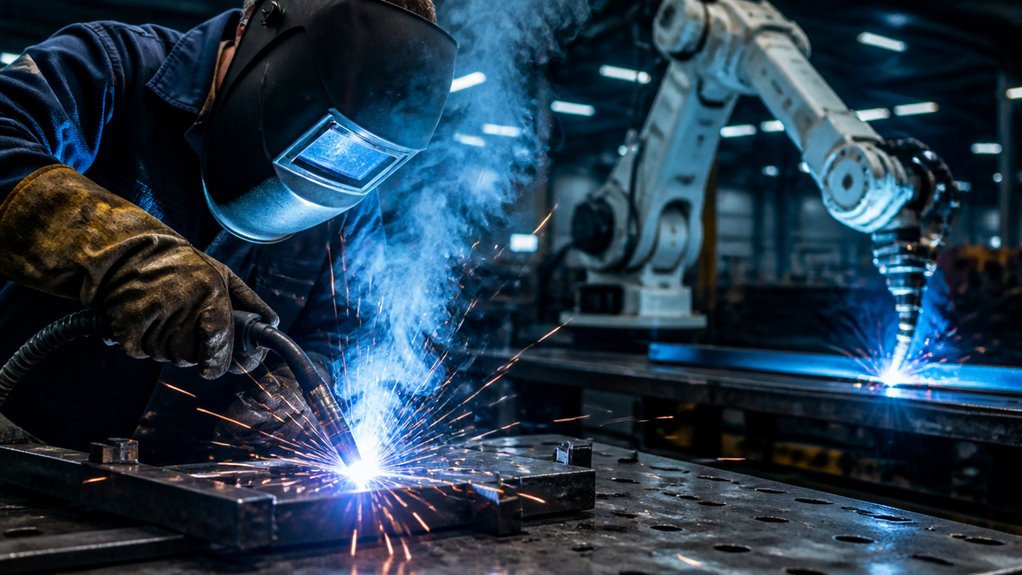
If you’re producing fewer than 10 parts, manual welding offers flexibility and quicker setup.
For volumes above 10, robotic welding excels with consistent quality, faster speeds over 100 inches per minute, and 60–80% arc-on time.
While manual welding has lower upfront costs, robots pay off in 6 to 24 months by cutting labor and material waste markedly.
You’ll also find robotic systems dramatically reduce defects and gas usage.
There’s much more to bear in mind when optimizing your welding process.
| Feature | Manual Welding | Robot Welding |
|---|---|---|
| Best Production Volume | Low-volume, prototypes, repairs | Medium to high-volume production |
| Setup Time | Faster for small jobs | Longer initial setup and programming |
| Upfront Cost | Lower | Higher |
| Return on Investment (ROI) | Lower long-term ROI | Typically 6–24 months |
| Labor Cost | High | Lower over time |
| Arc-On Time | 15–25% | 60–80% |
| Welding Speed | 10–20 inches/minute | 100+ inches/minute |
| Weld Consistency | Depends on operator skill | Highly consistent and repeatable |
| Defect Rate | About 5–10% | About 0.5–3% |
| Precision | Operator-dependent | Excellent with automated control |
| Material Waste | Higher | Lower |
| Shielding Gas Consumption | Higher | Up to 5× more efficient |
| Flexibility | Excellent for custom work | Best for repetitive tasks |
| Training Time | 6 months–2 years | 1–4 weeks (system operation) |
| Worker Safety | Higher exposure to heat, fumes, and fatigue | Reduced operator exposure and improved safety |
| Best Applications | Repairs, custom fabrication, prototypes | Automotive, manufacturing, high-volume fabrication |
| Main Advantage | Flexible, affordable, and ideal for one-off projects | Faster, more consistent, and highly efficient |
| Main Drawback | Slower with greater variability | High initial investment and less flexibility for custom jobs |
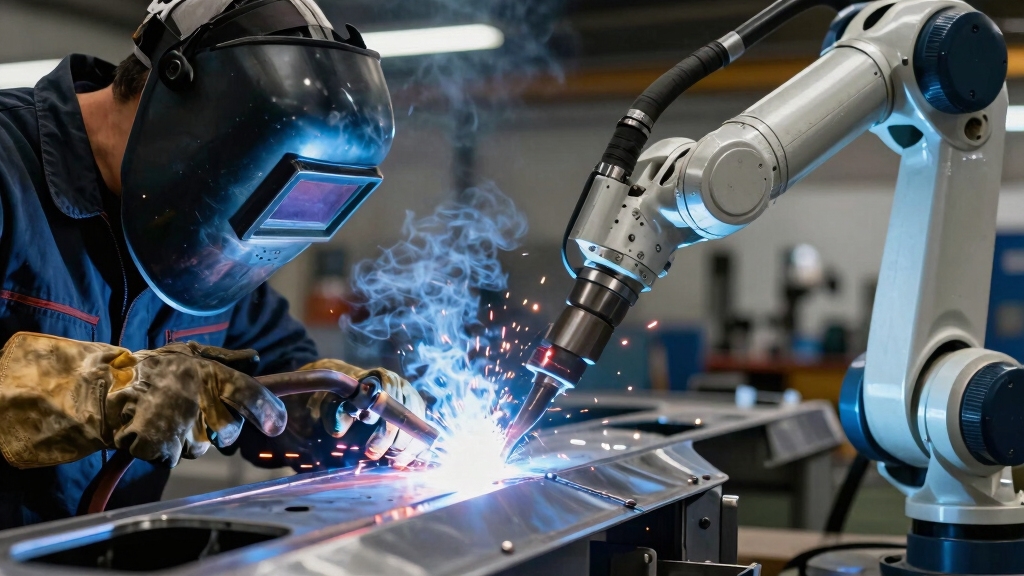
When deciding between manual and robotic welding, your production volume plays a vital role in determining the most efficient and cost-effective approach.
If your batch size is under 10 parts, manual welding offers flexibility and quicker setup, making it suitable for prototypes or repair work.
However, as your volume increases beyond 10 parts, robotic welding becomes more advantageous due to its ability to maintain consistent quality and repeatability across high production runs.
When production exceeds 10 parts, robotic welding ensures consistent quality and reliable repeatability for large runs.
Robots sustain arc-on times of 60–80%, markedly higher than the 15–25% achievable manually.
Travel speeds can exceed 100 inches per minute, enhancing throughput.
Additionally, robotic systems minimize variability caused by human fatigue, ensuring uniform welds regardless of scale.
Consequently, evaluating your production quantity upfront is essential to selecting the welding method that optimizes efficiency and output quality.
Bulk welding multiple parts into one cohesive unit can enhance stability and reduce manual welding effort, making robotic welding especially beneficial for larger production volumes.
After evaluating production volume to determine the preferred welding method, the next step is evaluating the associated costs and return on investment (ROI).
Manual welding demands an annual salary investment between $65,000 and $100,000 per welder. Overtime inflates hourly wages by at least 50%.
In contrast, robotic welding systems require upfront capital between $95,000 and $300,000, depending on complexity, but eliminate overtime costs entirely.
Robotic systems typically achieve ROI within 6 to 24 months due to higher efficiency and reduced labor expenses.
While manual welding incurs ongoing costs and variable productivity, robotic welding’s fixed investment pays off faster in high-volume settings.
This makes it more cost-effective and predictable for sustained production runs. Your decision should weigh initial outlay against long-term savings and production demands.
Additionally, using a multi process welder can help manual welders increase versatility and productivity by combining several welding methods in one machine.
Although manual welding depends heavily on the welder’s skill and endurance, it typically results in defect rates ranging from 5 to 10%. These rates can increase with fatigue.
In contrast, robotic welding systems reduce defects to between 0.5 and 3% through precise control of speed, angle, and heat input. You’ll notice these key differences:
Additionally, processes like Regulated Metal Deposition enhance robotic welding by providing microsecond control over voltage and current to reduce spatter and improve weld consistency.
Maximize productivity by understanding how welding efficiency and speed differ between manual and robotic methods.
Manual welding typically achieves arc-on time of only 15–25% due to frequent breaks and setup adjustments, with travel speeds between 10–20 inches per minute.
In contrast, robotic welding systems maintain arc-on time between 60–80%, minimizing interruptions and markedly increasing throughput.
Depending on the model, robots can travel at speeds exceeding 100 inches per minute, allowing them to outproduce manual welders by a factor of 3 to 5 for suitable parts.
This efficiency gain results from consistent heat input, steady travel speed, and reduced downtime.
Automation also enhances welding by enabling precise control of weld pool formation, improving joint quality and consistency.
Beyond speed and efficiency, material use and waste markedly impact welding operations’ overall cost-effectiveness and sustainability.
When you compare manual and robotic welding, you’ll notice significant differences in how materials are consumed and wasted.
Choosing robotic welding means you’ll minimize waste, lower material costs, and enhance sustainability in your operations.
Additionally, robotic systems enable precise control over wire feed and arc parameters, further reducing material waste and improving weld quality.
You face significant health risks with manual welding, including exposure to arc flash, toxic fumes, and repetitive stress injuries. These hazards increase your chances of injury and long-term illness.
In contrast, automated welding drastically reduces your direct exposure to dangerous environments, minimizing health risks. It also lowers insurance premiums and workers’ compensation costs by limiting workplace injuries.
You’ll need 6 months to 2 years to become proficient at manual welding, given the skill development and hands-on experience required.
In contrast, training for robotic welding systems is much shorter, typically ranging from 1 to 4 weeks depending on the system’s complexity.
This shorter training period allows you to quickly operate, program, and maintain robotic cells, accelerating your readiness for efficient, automated welding production.
If you’re tackling repair work or creating prototypes, manual welding is your go-to.
Why? Because it offers unmatched flexibility and precise control for one-off or low-volume tasks.
You won’t get bogged down by robotic system setups or programming.
Plus, manual welding lets you adapt on the fly, handling complex shapes or unique materials with ease.
You’ll find workforce reliability improves markedly with robotic welding, as it reduces exposure to hazardous conditions and repetitive stress injuries.
This leads to lower burnout and sick leave.
Manual welding often leads to higher turnover due to physical strain and fatigue.
By minimizing human involvement, robotic systems require only planned maintenance, enhancing operational consistency.
This shift decreases insurance premiums and workers’ compensation costs.
Ultimately, it stabilizes your workforce and improves overall productivity.
Think of insurance premiums as the steady river that flows smoother when rocks are fewer.
You’ll find insurance premiums lower for robotic welding operations because robots reduce human exposure to hazards like arc flash and repetitive stress injuries.
This safer environment means fewer claims and less risk for insurers.
In contrast, manual welding’s higher injury potential and workforce turnover drive premiums up, reflecting the increased operational risks you’d face.
When deciding between manual and robot welding, consider that robot welding can boost productivity by up to 30%. This increase translates into faster cycle times and improved consistency, reducing defects markedly.
While manual welding offers flexibility for low-volume or complex tasks, robot welding delivers superior efficiency and cost-effectiveness at scale.
Evaluating your production volume and quality requirements will help you optimize ROI and minimize material waste for smarter, data-driven welding decisions.