Phone:
(701)814-6992
Physical address:
6296 Donnelly Plaza
Ratkeville, Bahamas.

Phone:
(701)814-6992
Physical address:
6296 Donnelly Plaza
Ratkeville, Bahamas.

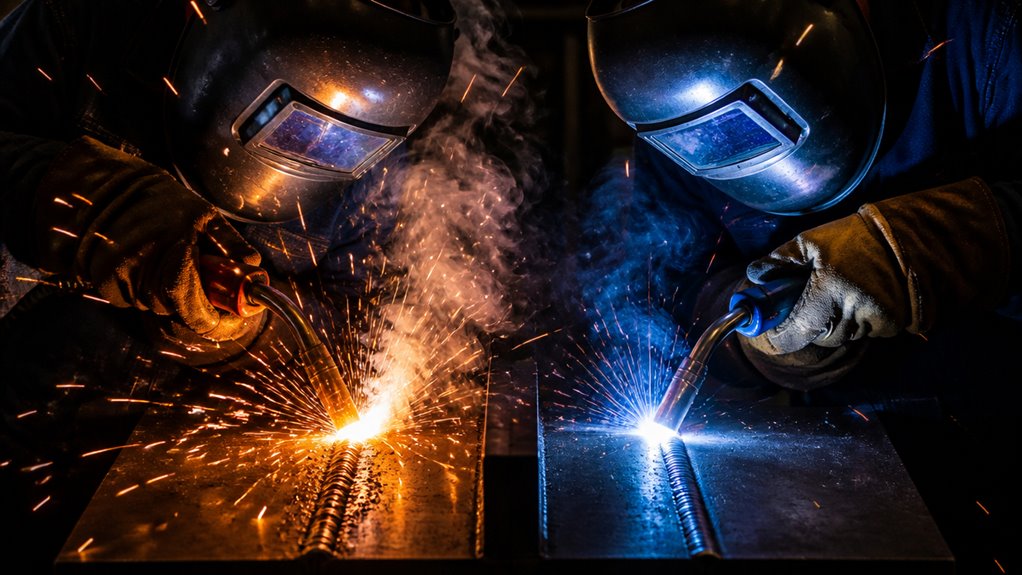
When choosing between MAG and MIG welding, you rely on MAG for cost-effective, deep penetration welds on ferrous metals using active gases like CO₂.
Despite more spatter and a rougher finish, MAG is effective for heavy-duty applications.
MIG suits non-ferrous materials such as aluminum, using inert gases like argon to produce cleaner, oxidation-free beads with precise control.
MAG handles outdoor, heavy fabrication better, while MIG excels in controlled environments and thin materials.
Understanding these trade-offs helps optimize your welding process for specific applications.
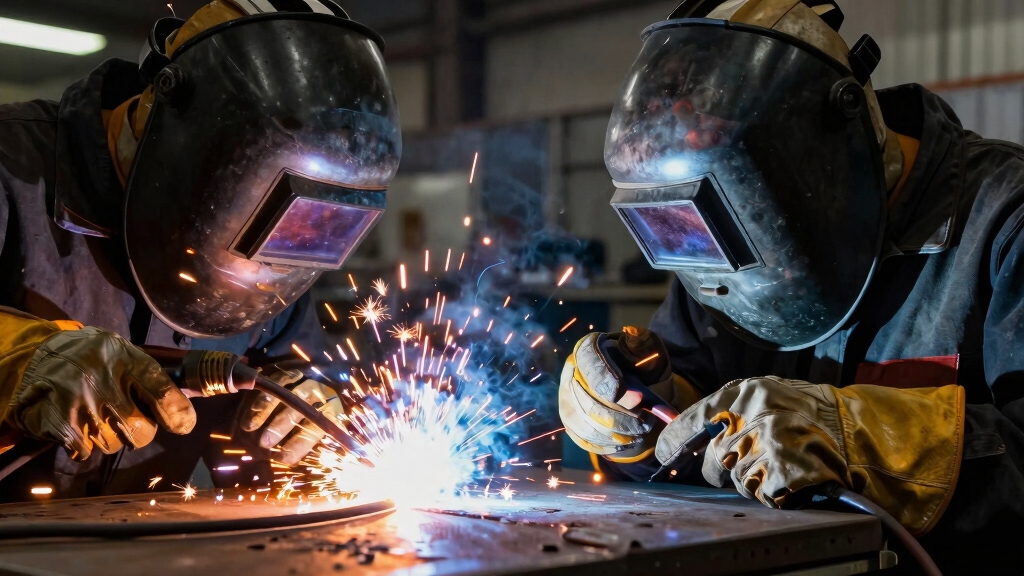
Although MAG and MIG welding both fall under the gas metal arc welding (GMAW) umbrella, they differ fundamentally in their shielding gases and applications.
MIG welding uses inert gases such as pure argon or argon-helium mixtures that protect the weld pool without chemical interaction.
MIG welding utilizes inert gases like argon to shield the weld pool without any chemical reaction.
MAG welding, on the other hand, employs active gases like carbon dioxide or argon-CO₂ blends that chemically participate in the arc, influencing weld penetration and bead characteristics.
This difference directly impacts weld quality. MIG produces cleaner, oxidation-free beads, while MAG yields deeper penetration but more spatter due to chemical reactions.
Furthermore, MAG welding is generally more cost-effective and suited for ferrous metals. MIG is preferred for non-ferrous metals requiring minimal weld alteration.
Understanding these distinctions helps you choose the best process based on material and performance requirements. Additionally, the choice between MAG and MIG welding often depends on factors such as material thickness and weld environment, which influence penetration, deposition rates, and weld cleanliness.
Choosing the right welding process depends heavily on the type of metal you’re working with.
For ferrous metals like mild and carbon steel, MAG welding is your best option. Its active shielding gases facilitate deeper penetration and stronger fusion on these steels, making it ideal for structural and industrial applications.
Conversely, if you’re working with non-ferrous metals such as aluminum, copper, or stainless steel, MIG welding suits you better. The inert gases used in MIG prevent contamination, preserving the metal’s chemical integrity and producing clean, oxidation-free welds.
However, MIG is less effective on heavy steel due to limited penetration. Consequently, analyze your metal’s composition carefully to select MAG for ferrous, load-bearing materials and MIG for precision welding of non-ferrous metals.
Using argon and helium blends in MIG welding enhances arc stability and heat input, improving weld quality on thick or high-conductivity metals.
Because shielding gases directly influence the arc chemistry and weld pool behavior, understanding their composition is essential for optimizing both MAG and MIG welding processes.
In MIG welding, inert gases like argon or helium stabilize the arc without chemical interaction. This protects the weld pool from atmospheric contamination and ensures clean, oxidation-free beads.
Conversely, MAG welding employs active gases such as CO₂ or argon-CO₂ mixtures. These partially disintegrate under arc heat, contributing oxygen and carbon to the weld pool.
This chemical activity enhances penetration and modifies bead properties but also increases spatter.
Selecting the appropriate gas mixture directly affects arc stability, weld bead appearance, and mechanical properties. Therefore, your choice of shielding gas must align with the base material and desired weld characteristics to maximize efficiency and weld quality in each process.
For example, using pure CO2 in MAG welding maximizes penetration and is beneficial for thicker materials requiring strong fusion.
When welding outdoors or in variable environments, the choice between MAG and MIG markedly impacts performance and weld quality.
Welding outdoors demands careful selection between MAG and MIG to ensure optimal weld quality and performance.
MAG welding is more tolerant of windy or inconsistent conditions due to its active gas mixtures, which provide better arc stability and penetration.
MIG welding, relying on inert gases, demands more controlled environments to prevent contamination and porosity.
Understanding these nuances can help you optimize weld integrity under challenging conditions.
MAG’s CO₂ or argon-CO₂ blends resist atmospheric disturbances better than inert gases.
MIG’s pure argon or helium shielding is vulnerable to wind-induced gas displacement.
MAG welding maintains consistent arc characteristics in fluctuating temperatures.
MIG welding requires wind shields or indoor settings for peak gas coverage.
Environmental factors directly influence spatter, penetration, and weld consistency in both methods.
Additionally, the use of external inert gas in MIG welding necessitates a controlled environment to minimize spatter and ensure a clean weld finish.
Although both MAG and MIG welding employ gas metal arc welding techniques, they deliver distinctly different weld quality and appearance due to their shielding gas compositions and chemical interactions.
You’ll notice MAG welds produce deeper penetration and stronger joints with more spatter. MIG welds offer cleaner, brighter beads with minimal oxidation.
The active gases in MAG modify the weld chemistry, enhancing mechanical properties but affecting surface finish. MIG’s inert gases preserve weld appearance but limit chemical alteration.
| Aspect | MAG Welding |
|---|---|
| Weld Penetration | Deep, robust |
| Surface Finish | Rougher, spatter-prone |
| Chemical Impact | Alters weld bead composition |
| Appearance | Dull, industrial look |
| Strength | High, suited for structural use |
Choose based on whether strength or appearance matters more. For indoor or controlled environments, the use of external shielding gas in MIG welding ensures cleaner welds with minimal spatter and slag, ideal for quality-critical applications.
Several factors influence the cost and efficiency differences between MAG and MIG welding, primarily tied to shielding gas expenses and production speed.
When you choose MAG welding, you benefit from lower-cost shielding gases like CO₂ or argon-CO₂ blends, reducing operational expenses. MAG also provides faster welding speeds, boosting productivity in structural steel fabrication.
On the other hand, MIG welding uses purer, inert gases that are pricier, which can increase overall costs, especially in large-scale applications. MIG processes typically run slower, impacting throughput.
Your decision impacts both material costs and labor efficiency.
MAG shielding gases cost markedly less than MIG’s inert gases.
MAG welding achieves higher deposition rates and faster travel speeds.
MIG welding offers cleaner welds but at increased operational cost.
MAG efficiency improves in outdoor or heavy steel applications.
MIG’s slower speed can reduce production volume and increase overhead.
Choosing the correct gas blend is crucial as it directly influences weld penetration and spatter control, affecting both quality and efficiency.
Cost savings and increased productivity make MAG welding an attractive choice for structural steel projects. When you select MAG, you leverage active shielding gases like CO₂ or argon-CO₂ blends. These promote deeper weld penetration and stronger fusion in ferrous metals.
This chemical interaction enhances weld bead integrity and load-bearing capacity, critical for structural applications. Additionally, MAG’s higher welding speeds reduce cycle times, boosting throughput without compromising quality. The equipment remains similar to MIG setups, so shifting won’t require significant investment.
While MAG generates more spatter, its robustness in outdoor and heavy fabrication environments outweighs this downside. By choosing MAG welding, you optimize both performance and cost-efficiency for structural steel. This ensures durable, high-quality welds ideal for demanding industrial conditions. Selecting the appropriate shielding gas is essential to minimize spatter and achieve optimal weld quality.
When working with aluminum or requiring highly precise welds, MIG welding offers unmatched control and cleanliness. You’ll benefit from its inert shielding gases, typically pure argon, which prevent oxidation and contamination.
MIG welding ensures precise, clean welds on aluminum through inert argon shielding that prevents oxidation.
This results in bright, spatter-free welds vital for aerospace or automotive components. MIG’s arc stability aids in maintaining consistent weld bead geometry, essential for intricate or thin materials.
However, you must guarantee proper parameter settings since aluminum’s thermal conductivity demands precise heat input control. Maintaining a spray transfer mode with specific voltage and wire feed settings ensures consistent, high-quality welds on aluminum.
You need to adjust your ventilation when using MAG welding due to active gases like CO₂ and oxygen, which can produce more harmful fumes and sparks than inert gases in MIG.
Also, expect increased spatter in MAG, so wear heavier protective gear. MIG’s inert gases pose less chemical hazard, but you still must shield yourself from UV rays and hot metal.
Both require eye protection, gloves, and flame-resistant clothing, but MAG demands stricter fume control.
You’ll find that increasing welding speed in MAG can boost joint strength by enhancing penetration. Active gases promote deeper fusion, achieving up to 25% more than inert gases in MIG.
However, pushing MIG speed too high risks surface-only welds and weaker joints. Controlling speed precisely is key: faster speeds favor MAG’s chemical activity for robust joints, while MIG needs slower speeds to maintain weld integrity and avoid porosity or insufficient bonding.
Yes, you can automate both MAG and MIG welding for robotic applications. Their consistent arc stability and wire feed mechanisms suit precise control systems well.
MAG welding’s higher deposition rates and adaptability to different gas mixtures make it especially efficient for industrial automation. Meanwhile, MIG’s clean welds benefit robotic precision in delicate tasks.
You’ll need to optimize parameters like speed, gas flow, and wire feed to maintain joint integrity under automation.
Oh, sure, who doesn’t love an unstable arc?
To fix it, you’ll want to check your shielding gas flow first. Too low invites contamination, while too high causes turbulence.
Make sure your wire feed speed matches the voltage settings precisely.
Clean your workpiece thoroughly to avoid surface impurities.
Also, verify your ground clamp is secure.
If you’re still struggling, inspect the contact tip for wear. A damaged tip can ruin arc stability instantly.
You’ll find welding wire types differ mainly by metal compatibility and alloy content.
For MIG, use wires suited to non-ferrous metals like aluminum or stainless steel, typically softer and less alloyed.
MAG wires are designed for ferrous metals, often containing alloying elements like manganese or silicon to enhance penetration and mechanical properties.
Choosing the correct wire guarantees peak arc stability, weld strength, and compatibility with shielding gas chemistry for each process.
If you think MAG and MIG welding are just minor variations, think again. Choosing the wrong method could derail your entire project.
MAG dominates structural steel with unmatched strength, while MIG excels in aluminum and precision tasks. Your welding gas and environment can make or break weld integrity.
In the end, understanding these critical differences isn’t optional. It’s essential for achieving flawless, efficient, and cost-effective results every single time.