Phone:
(701)814-6992
Physical address:
6296 Donnelly Plaza
Ratkeville, Bahamas.

Phone:
(701)814-6992
Physical address:
6296 Donnelly Plaza
Ratkeville, Bahamas.

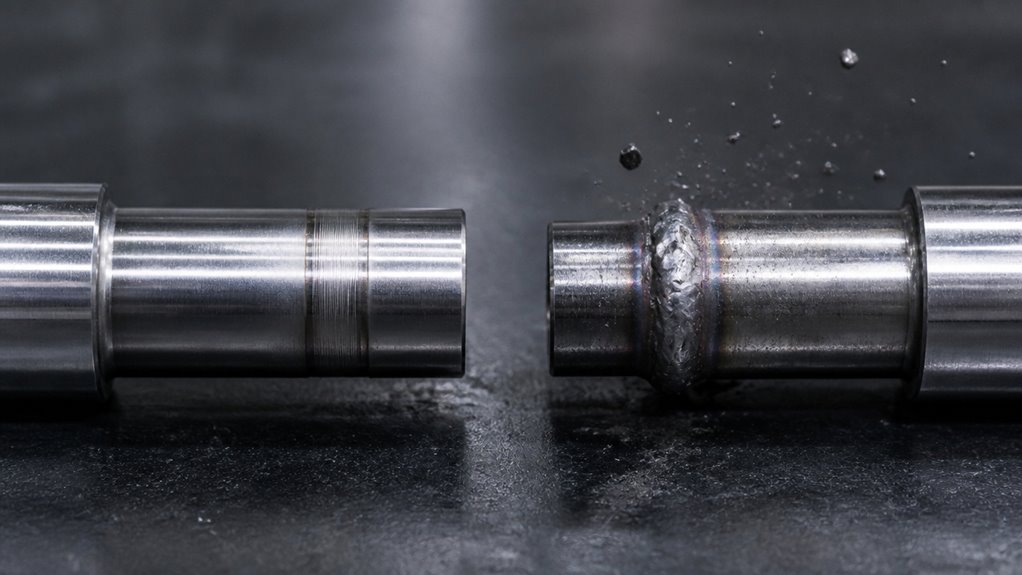
You’ll find direct drive friction welding offers precise, staged control over RPM, pressure, and time for gradual heat build-up. This makes it ideal for smaller solid parts needing fine-tuned weld quality.
Inertia welding uses a flywheel’s stored kinetic energy for rapid, constant-pressure deceleration, generating intense heat quickly. It is best for larger tubular or hollow sections with consistent, high-strength joints.
Each method’s unique heat and deformation profiles affect microstructure and weld efficiency. This guides your choice based on component size and control needs.
Further insight reveals how these differences impact joint performance and process optimization.
| Feature | Direct Drive Friction Welding | Inertia Welding |
|---|---|---|
| Energy Source | Continuous motor-driven rotation | Stored kinetic energy from a flywheel |
| Heat Generation | Gradual and controlled | Rapid and intense |
| Pressure Control | Variable during friction and forging stages | Constant during flywheel deceleration |
| Rotational Speed Control | Fully adjustable | Set by initial flywheel speed |
| Process Control | Highly adjustable | Simpler with fewer variables |
| Working Parameters | RPM, force, time, distance, braking | Pressure, flywheel inertia, rotational speed |
| Heat-Affected Zone | Slightly wider | Narrower |
| Microstructure | Axially forged pattern | Rotational forging pattern |
| Joint Strength | Excellent | Excellent |
| Weld Consistency | High with proper parameter control | Very high due to repeatable energy input |
| Cycle Time | Moderate | Faster |
| Best Component Type | Solid bars and complex geometries | Large tubular sections and hollow components |
| Production Volume | Flexible for custom applications | Ideal for high-volume production |
| Equipment Complexity | Higher | Lower |
| Best For | Precision welding with maximum control | Fast, repeatable production welding |
| Main Advantage | Fine control over every welding stage | Simple process with highly consistent welds |
| Main Drawback | More complex setup and parameter adjustment | Less flexibility once the cycle begins |
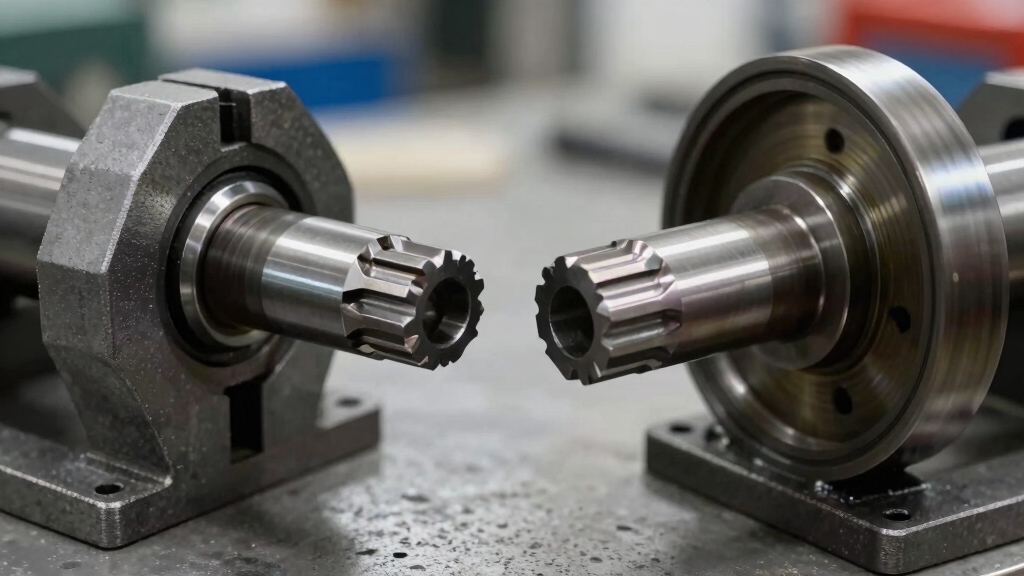
Although both direct drive and inertia friction welding rely on rotational motion to generate heat, they differ fundamentally in how energy is supplied and controlled during the process.
Direct drive and inertia friction welding both use rotation but differ in energy supply and control methods.
In direct drive, a motor continuously rotates one workpiece at low pressure to generate frictional heat. It then increases pressure during the upsetting stage to form the weld.
Conversely, inertia welding stores kinetic energy in a flywheel attached to the rotating part. This decelerates under constant pressure against the stationary section, causing upsetting as the material plastically flows.
Direct drive offers multiple adjustable parameters, including RPM, friction force, and timing. In contrast, inertia welding simplifies control to mainly rotational speed, pressure, and flywheel inertia.
This distinction impacts process stability, energy management, and weld consistency between the two methods.
Both methods achieve strong solid-state bonds by plastically deforming metals at the interface without melting, promoting atomic diffusion and mechanical interlocking for superior joint integrity.
When you examine heat generation in direct drive friction welding, you find that the motor continuously rotates one workpiece under low pressure to produce frictional heat.
This gradually raises the interface temperature.
In contrast, inertia welding relies on a flywheel storing kinetic energy, which is suddenly released to generate heat as the flywheel decelerates under constant pressure.
Key distinctions in heat generation include:
Understanding these mechanisms lets you optimize welding outcomes for each method.
Both methods benefit from precise control of friction speed, pressure, and duration to ensure plastic deformation without melting.
When it comes to direct drive welding, you have a lot of control at your fingertips. You can adjust various factors like RPM, friction, forge forces, time, and breaking duration. This flexibility lets you fine-tune the weld sequence to get it just right.
On the other hand, inertia welding isn’t quite as versatile. You mainly work with three key parameters: applied pressure, rotational speed, and flywheel inertia. Plus, during deceleration, the pressure remains constant. This means that you have some limitations in how you can control the process, which can affect the consistency of your welds and the energy input you’re able to achieve. Understanding the role of thermal profile control is crucial in optimizing weld quality despite these parameter constraints.
Controlling parameters effectively dictates the quality and consistency of friction welds in both direct drive and inertia welding processes. You must understand each method’s adjustable variables to optimize weld outcomes.
In direct drive welding, you control multiple parameters: RPM, friction and forge forces, time, distance, and break time. In contrast, inertia welding limits you mainly to three parameters, simplifying control but demanding precise calibration.
Key adjustable parameters include:
Effectively managing these controls guarantees weld integrity and repeatability across both processes. Additionally, controlling heat input and parameters is critical to minimize the heat-affected zone and ensure metallurgical bond quality in friction welding.
Mastering pressure and speed control is essential for optimizing friction welding performance in both direct drive and inertia methods.
You adjust pressure dynamically in direct drive welding, starting low during friction and increasing during upsetting. Inertia welding maintains constant pressure throughout deceleration.
Speed control varies too: direct drive motors regulate RPM continuously, while inertia relies on the flywheel’s stored energy and deceleration rate.
| Parameter | Direct Drive Control | Inertia Control |
|---|---|---|
| Pressure | Variable: friction and upset stages | Constant during deceleration |
| Speed (RPM) | Continuous motor-driven | Initial flywheel speed, then decelerates |
| Control Complexity | Higher due to multi-stage control | Simpler with fewer variables |
Precise control of pressure and timing is crucial to ensure consistent weld quality and avoid defects in both welding methods.
Building on the distinctions in pressure and speed control, the range of adjustable parameters in direct drive and inertia friction welding reveals significant differences in process flexibility and complexity.
In direct drive, you manage multiple variables such as RPM, friction and forge force, time, distance, and break time. This allows nuanced control but increases complexity.
Inertia welding simplifies your control to mainly three parameters, streamlining the process.
Key controllable parameters include:
Understanding these limitations helps you optimize weld consistency and quality according to your application’s demands.
Effective pressure application and control are essential to avoid weak fusion or burn-through during the welding process.
Although both direct drive and inertia friction welding create solid-state bonds, their microstructures differ substantially due to the distinct mechanics of heat generation and deformation during the process.
In direct drive welding, the weld zone exhibits an axially forged microstructure. This results from continuous rotation under varying pressure, with initial low friction pressure followed by a higher forge force.
Conversely, inertia welding produces a rotational-type forging pattern at the interface. This reflects the rapid deceleration of the flywheel under constant pressure, causing more extensive plastic flow and amalgamation of hot metal near weld completion.
You’ll notice inertia welds typically feature a narrower heat-affected zone due to shorter heating times. These microstructural distinctions arise directly from the contrasting energy application and deformation profiles inherent in each method’s process mechanics. Understanding the role of current adjustment is crucial for controlling heat input and microstructural outcomes in welding processes.
The distinct microstructural characteristics formed by direct drive and inertia friction welding directly influence joint strength and efficiency.
Microstructural differences in direct drive and inertia friction welding critically impact joint strength and efficiency.
You’ll find that direct drive welds often reach joint strengths exceeding 80% of the aluminum parent material, especially in dissimilar steel-aluminum joints. Inertia welding can achieve similar or slightly higher efficiencies, up to 84% of the parent alloy’s proof stress, thanks to its rotational forging pattern and efficient energy use.
Consider these key points:
Both methods yield strong, efficient joints but with distinct operational characteristics. Precise control of heat input and energy during welding, similar to regulated metal deposition, is key to minimizing defects and optimizing joint properties.
When you’re deciding between direct drive and inertia welding, it’s important to think about the geometry and size of your components. For instance, direct drive works really well with solid bars that are up to 250 mm in diameter. On the other hand, if you’re dealing with larger tubular sections, inertia welding is where it shines.
Next up, you’ll want to take a close look at your process control needs. Direct drive has the advantage here, as it allows for adjustable friction and forge stages. In contrast, inertia welding relies on a set of consistent parameters, which can be limiting but also offers its own kind of reliability.
Additionally, maintaining process parameter consistency is crucial to ensure optimal weld quality and minimize defects.
Where do you draw the line between direct drive and inertia friction welding for your specific application?
You’ll weigh factors like component geometry, process control, and energy input.
Direct drive excels with solid bars up to 250 mm diameter, offering precise control over friction and forge stages.
Inertia welding suits large tubular sections, plate-to-tube joints, and applications demanding high-energy pulses at weld initiation.
Consider these points:
Additionally, understanding the heat input control during welding is critical to minimize thermal stress and avoid brittleness in the joint.
Selecting between them hinges on these technical suitability factors.
Although both direct drive and inertia friction welding share fundamental principles, choosing the appropriate method depends heavily on your specific application’s geometric constraints, desired process control, and energy delivery requirements.
If you’re working with solid diameter bars up to 250 mm, direct drive’s ability to precisely control friction and forge forces through its two-stage process offers advantages in microstructural control and joint strength.
Conversely, inertia welding excels with large tubular sections or plate-to-tube joints, providing high-energy pulses and consistent heat input with fewer adjustable parameters, simplifying repeatability.
Consider also that inertia welding applies constant pressure during deceleration, producing narrower heat-affected zones and often higher joint efficiencies.
Ultimately, you should weigh part geometry, control complexity, and desired weld characteristics to select the most suitable welding method.
You’ll find direct drive machines require more frequent motor and clutch maintenance due to continuous motor engagement and torque variation during the weld cycle.
Inertia welding systems, however, depend heavily on the flywheel and braking mechanisms.
So, you’ll focus maintenance on those components and the consistent pressure system.
You’ll need to manage continuous motor rotation risks in direct drive welding, ensuring guards prevent contact with moving parts.
For inertia welding, you must handle stored kinetic energy safely. Secure the flywheel assembly to prevent accidental release during deceleration.
Both require strict monitoring of applied pressures and rotational speeds to avoid sudden failures.
Always follow lockout/tagout protocols before maintenance and wear appropriate PPE to guard against heat and mechanical hazards unique to each method.
You can certainly harness both direct drive and inertia welding for automated mass production.
Direct drive’s two-stage process suits precise control systems, letting you preset friction time or distance.
Inertia welding’s simplicity and fewer adjustable parameters make it a natural fit for repeatable, high-throughput setups.
Both methods integrate well with CNC controls, enabling consistent weld quality and efficient cycle times.
This perfectly aligns with industrial demands for scalable, reliable manufacturing.
You’ll find environmental factors like temperature, humidity, and contamination influence weld quality by affecting friction heat generation and material flow.
Inertia welding’s shorter heat-affected zone makes it less sensitive to ambient temperature fluctuations.
In contrast, direct drive’s longer friction stage can amplify temperature-related variability.
Contaminants such as oils or oxides impair both methods by reducing friction efficiency and bonding strength.
Maintaining clean surfaces and controlled environments is critical for consistent, high-quality welds.
You’ll find that direct drive equipment typically costs more upfront due to its complex motor and clutch systems.
However, it offers precise control over friction stages.
In contrast, inertia welding machinery is generally less expensive and simpler, relying on a heavy flywheel and minimal motor engagement.
However, inertia’s lower initial cost may come with higher maintenance for flywheel components. Weigh your priorities: precision versus simplicity affects your capital and operational expenses considerably.
When choosing between direct drive and inertia friction welding, you must weigh control versus consistency.
Direct drive offers precise, adjustable heat input, allowing you to fine-tune parameters in real-time.
Inertia welding, however, provides repeatable, stable heat generation through stored kinetic energy, minimizing variable fluctuations.
Visualize direct drive as a dimmer switch, granting you nuanced control, while inertia welding acts like a preset timer, delivering consistent output.
Your choice hinges on whether adaptability or repeatability is paramount for your application.