Phone:
(701)814-6992
Physical address:
6296 Donnelly Plaza
Ratkeville, Bahamas.

Phone:
(701)814-6992
Physical address:
6296 Donnelly Plaza
Ratkeville, Bahamas.

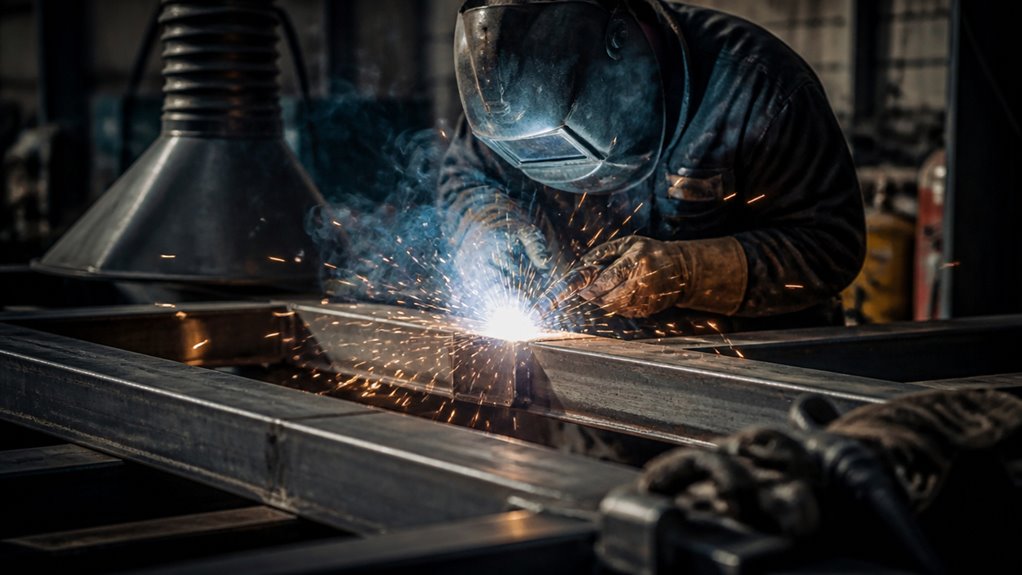
Welding gives you strong, continuous joints without fastener holes, often reducing parts, weight, and assembly time.
Automation can make production faster and more consistent.
But you’ll need accurate fit-up, qualified procedures, skilled oversight, and strict safety controls for fumes, radiation, heat, and electricity.
Weld toes and defects can initiate fatigue cracks under repeated vibration.
Permanent joints can be difficult to repair.
The sections below explain how these trade-offs affect strength, productivity, safety, and maintenance.
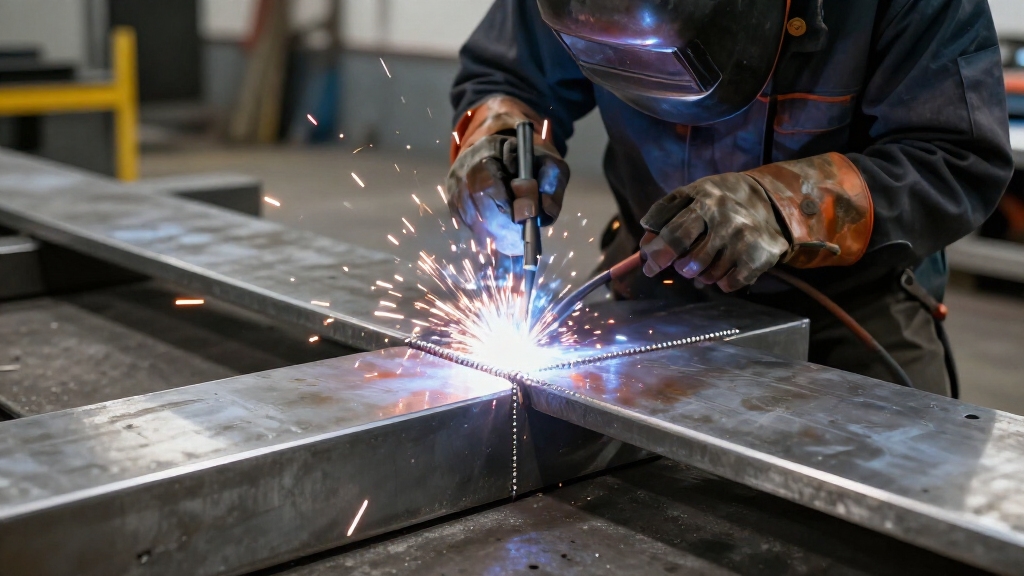
When properly designed and made, welded joints can be as strong as or stronger than the base metal. You can assess their strength by comparing the joint’s load capacity with that of the connected members.
A sound weld transfers force across the interface without requiring holes, preserving the members’ effective cross-sectional area. This can give welded connections higher joint efficiency than bolted or riveted alternatives, particularly when fastener holes would weaken a critical section.
Actual performance depends on weld size, geometry, material compatibility, and workmanship. Defects or inadequate penetration can reduce capacity, while appropriate design and inspection help guarantee the weld carries its intended loads.
For equal-leg fillet welds, the effective throat is approximately 0.707 times the leg size and is a key factor in calculating strength.
In construction, fabrication, and manufacturing, you can rely on welded joints for demanding structural applications when engineers match the connection to the loading conditions and verify its quality.
Welding speeds fabrication by joining components directly, often eliminating the time needed to drill holes, fit fasteners, and assemble multiple parts. You can also join complex shapes and configurations that would be difficult to bolt or rivet, giving you more freedom to plan the assembly and its production sequence.
In many fabrication settings, welding takes less time than riveting because you complete the connection in fewer operations. Mechanized and automated processes can increase throughput further by maintaining repeatable travel speed and reducing cycle time.
With a properly designed robotic cell, you can achieve consistent weld quality and reduce rework, spatter, and post-weld cleanup. However, automation depends on accurate fit-up and fixturing, so you’ll need to control part tolerances. Robotic welding can achieve 60–80% arc-on time, helping increase throughput in suitable production settings.
For suitable designs and production volumes, these capabilities help you shorten fabrication schedules without compromising the required joint performance.
Welds are a fantastic way to join components because they eliminate the need for bolts or rivets. This means you can use fewer separate fasteners, which is a definite plus.
Plus, unlike bolted joints, welds don’t require holes. Those holes can really cut into a member’s effective cross-sectional area, which isn’t ideal. By skipping the holes, you can lower the overall weight of the connection while still keeping its load-carrying capacity intact. So, it’s a win-win situation!
For permanent joints, properly designed full-penetration welds can match or exceed the capacity of the base metal.
Because a welded joint fuses parts directly, it often needs fewer bolts, rivets, gusset plates, or filler plates than a mechanically fastened connection. You can reduce the hardware specified for a joint while maintaining a continuous load path, provided the weld design and execution meet required strength criteria.
Fewer separate components can simplify procurement, assembly, and inspection. This may lower connection weight and cost. The comparison is practical, not automatic. Weld size, access, base-metal compatibility, and quality control determine whether the reduction is appropriate. Welded joints can also provide airtight seals where a continuous, sealed connection is needed.
| Connection choice | What you avoid |
|---|---|
| Welded joint | Sorting bags of bolts |
| Welded joint | Aligning rivet patterns |
| Welded joint | Handling extra plates |
That cleaner assembly can feel like a relief on a crowded shop floor. However, you still need qualified procedures and inspection.
Beyond reducing extra hardware, a welded connection can preserve more of each member’s cross-sectional area.
When you bolt or rivet a joint, you drill holes through the parts. Those openings remove load-bearing material and create stress concentrations around their edges.
A weld joins the members without requiring those holes, so you retain more of the section to carry tension, compression, or shear.
This advantage can improve joint efficiency, but it doesn’t guarantee greater strength. Weld quality, geometry, and base-metal properties still govern performance.
Consider three effects:
For fillet welds, the effective throat helps determine how much load the joint can carry.
When welding tasks are automated, robotic systems can increase throughput by shortening cycle times and producing consistent welds with less rework.
You can program robots to repeat qualified weld paths, reducing variation between parts and improving first-pass quality. That consistency limits repair work, material waste, and delays, while controlled deposition helps prevent over-welding.
In well-designed cells, robots can perform 85–95% of welding operations, and some setups produce up to three times the output of a human operator.
You’ll also gain more predictable cycle times, making production planning and delivery estimates more reliable.
Automation can reduce labor costs and post-weld cleanup by limiting spatter. However, you’ll need accurate fit-up, reliable fixturing, and suitable programming; poor setup can undermine repeatability and erase expected productivity gains.
Robotic systems can achieve 60–80% arc-on time, helping maintain production across long shifts.
Automation can improve weld consistency and output, but it doesn’t remove the hazards of the process.
Whether you weld manually or supervise a robotic cell, you still need to control exposure to radiation, fumes, electrical energy, and hot material.
These hazards can cause acute injury or lasting harm, so assess the work area before starting.
Regular equipment inspections can help identify damaged cables and connectors before they cause electrical hazards.
Automation changes exposure patterns, not the need for safeguards.
Follow site procedures and stop work when controls fail.
To produce sound welds and effectively control defects, you really need skilled operators. Their expertise is crucial in ensuring the quality of the welds.
Now, let’s talk about fit-up. Precise part fit-up is essential; it helps maintain joint geometry and directly impacts weld quality. If the parts don’t fit together well, the weld can suffer.
Accurate measurements and blueprint interpretation help welders achieve the correct joint dimensions and alignment.
And if you’re considering automated processes, keep in mind that they require consistent fixturing tolerances. Often, these tolerances are tighter than what manual welding allows, which adds another layer of complexity.
Because weld quality depends on precise execution, operators need strong process knowledge and hands-on skill to produce sound joints. You must select suitable settings, control the torch or electrode, and maintain a consistent travel speed.
Small deviations can cause defects, reduce strength, or require costly rework. Your operator’s expertise also affects how reliably a process performs across different materials and joint designs.
A skilled welder must be able to:
You can use automation to improve repeatability, but it doesn’t eliminate the need for qualified oversight. Complex work still demands sound judgment, process discipline, and the ability to respond to changing conditions. Maintaining a steady travel speed helps prevent uneven puddle buildup and weak fusion.
Before welding begins, parts must fit within specified tolerances so the joint has the correct gap, alignment, and contact. You need to verify these conditions against the joint design and welding procedure.
Excessive root gaps, mismatched edges, or poor alignment can alter penetration, bead shape, and heat distribution. Those changes may cause incomplete fusion, burn-through, distortion, or defects that require repair.
Fit-up also affects how much filler metal you’ll need and whether the weld can achieve its specified strength. You must identify dimensional variation, prepare edges accurately, and position components without forcing them into place.
When you weld, control heat input and sequence to limit movement that could change joint geometry. Automated processes can be especially sensitive to fit-up variation, so accurate preparation helps maintain reliable weld quality.
Proper fit-up supports sound joints but doesn’t replace inspection or qualified welding practice. Secure components with clamps or magnets to prevent movement during welding.
Accurate fit-up depends on fixtures that hold parts in consistent positions throughout welding. You need to control gaps, alignment, and restraint.
Variation can shift the joint, alter penetration, and increase distortion.
Automated welding cells demand tighter tolerances than skilled manual work. A robot follows its programmed path, so it can’t compensate reliably for misplaced parts.
Before production, verify fixture condition and establish measurable acceptance limits.
Check these three fit-up factors:
You’ll also need to inspect incoming components, detect wear, and correct setup errors.
Consistent fixturing improves repeatability, reduces rework, and helps maintain sound welds across production runs.
How do vibration and fatigue affect welds? Repeated vibration subjects a welded joint to cyclic loading, even when each load remains below the metal’s static strength. Over time, these stress cycles can initiate small cracks, especially at weld toes, roots, or defects where geometry concentrates stress.
As the cracks grow, the joint loses stiffness and load-carrying capacity, increasing the risk of sudden failure. You can reduce this risk by selecting a suitable weld design, controlling stress concentrations, and ensuring sound workmanship.
Match the weld size and profile to the expected load spectrum, and avoid abrupt shifts that intensify local stress. Inspect critical joints for cracks at intervals appropriate to service conditions.
Material choice, residual stress, corrosion, and operating frequency also influence fatigue life, so assess them together rather than treating vibration as an isolated factor.
Because welded joints form permanent bonds, repairing them often requires cutting or grinding out the damaged area before welding it again. You can’t simply loosen a fastener and replace one component.
The repair may also affect surrounding material, joint geometry, and structural integrity, so you must assess the cause and extent of damage first.
A sound repair typically requires you to:
Access can complicate each step, especially in enclosed or assembled structures. Heat from repair welding may distort parts or alter material properties.
Poor technique can introduce new defects. You’ll often need skilled labor, suitable equipment, and nondestructive testing to verify the repair.
You can’t identify one best welding process without defining your project’s materials, thickness, joint design, position, production volume, quality requirements, and budget.
Choose MIG for fast, versatile fabrication.
Opt for TIG for precise, clean welds on thin sections or nonferrous metals.
Stick is suitable for outdoor work and less controlled conditions.
Submerged arc is ideal for high-volume, thick steel.
Compare required strength, access, operator skill, equipment, and safety controls.
Then validate your choice with procedure testing.
You can weld an astonishing range of materials, but compatibility depends on the process, alloy, and joint design.
Common choices include carbon steel, stainless steel, aluminum, nickel alloys, titanium, and copper alloys.
You can also join some thermoplastics using specialized welding methods.
Dissimilar metals may be weldable, but differences in melting point, thermal expansion, and chemistry can cause cracking or brittle phases.
Select compatible filler metal and control heat input carefully.
You can expect welding equipment to cost roughly $200–$1,000 for a basic hobby setup, $1,000–$5,000 for capable shop equipment, and $10,000 or more for industrial or automated systems.
Your total depends on process, output, duty cycle, and included accessories.
Budget separately for a helmet, protective clothing, gas, wire or electrodes, and ventilation.
Prices vary by region and supplier, so compare specifications and operating costs before you buy.
To verify weld quality, you’ll use visual inspection, dimensional checks, and nondestructive testing. Examine weld profiles, surface defects, size, and alignment visually.
Verify dimensions against drawings with gauges.
For hidden flaws, select liquid penetrant or magnetic particle testing for surface cracks. Use ultrasonic testing for internal discontinuities or radiography for volumetric defects.
You’ll also review procedure qualifications, welder certifications, and inspection records.
Apply acceptance criteria from the governing code or project specification consistently.
Choose a bolted joint when you need to disassemble, inspect, replace, or modify components later.
Bolts also suit sites where welding access, power, ventilation, or qualified welders aren’t available.
They can reduce heat-related distortion or damage to sensitive materials.
For structures exposed to vibration or fatigue, select bolts only with suitable locking and design checks.
Verify load capacity, slip resistance, corrosion protection, and maintenance needs before specifying the connection.
Welding gives you strong, compact joints and can speed fabrication, reduce material use, and support automation.
But you must account for hazards, skilled fit-up, fatigue, and difficult repairs. A weld can hold a tremendous load, yet no joint is invincible: performance depends on sound design, preparation, procedure, and inspection.
Choose welding when its benefits suit your application, and control its limitations with qualified workers, appropriate safety measures, and regular checks.
That balance helps you build reliable structures without overlooking risk.