Phone:
(701)814-6992
Physical address:
6296 Donnelly Plaza
Ratkeville, Bahamas.

Phone:
(701)814-6992
Physical address:
6296 Donnelly Plaza
Ratkeville, Bahamas.

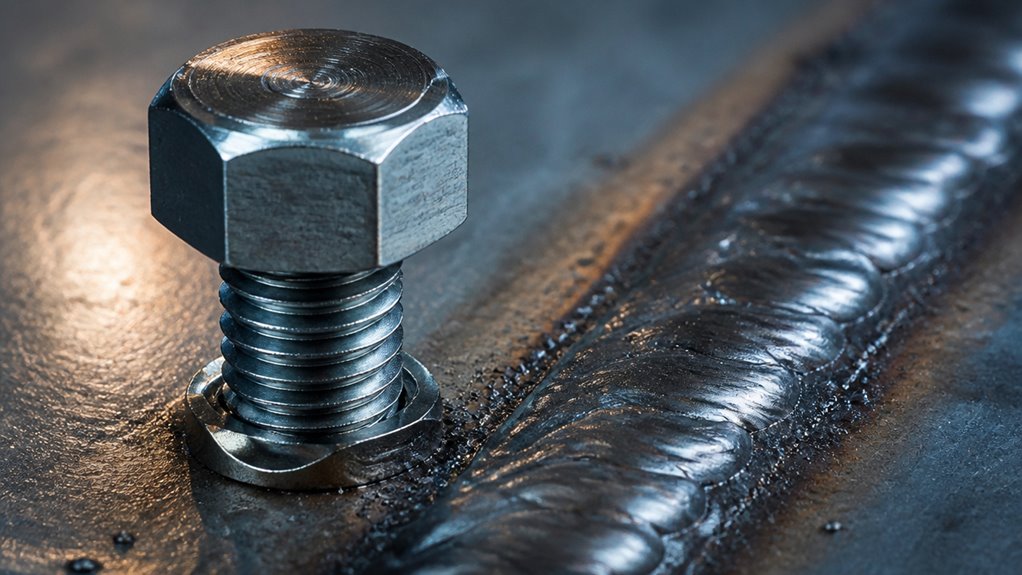
When deciding between bolts and welds, consider that welds provide continuous, rigid joints with higher stiffness and strength. They are ideal for permanent, high-load connections.
Bolts enable faster, flexible assembly with easier inspection and future disassembly. However, they introduce stress points from holes.
Welding demands skilled labor and controlled conditions, while bolting suits field work and quick installation.
You’ll find the best choice depends on your project’s load demands, fabrication complexity, and maintenance needs. Combined use often optimizes performance.
| Feature | Bolted Connections | Welded Connections |
|---|---|---|
| Joining Method | Mechanical fastening with bolts, nuts, and washers | Metallurgical fusion using heat |
| Joint Type | Removable | Permanent |
| Strength | High, but affected by bolt holes | Generally higher for properly designed welds |
| Stiffness | Good | Excellent |
| Installation Speed | Faster | Slower |
| Field Installation | Excellent | More difficult |
| Labor Skill | Moderate | High; requires skilled welders |
| Fabrication | Requires drilling and fitting | Requires cleaning, welding, and cooling |
| Heat Effects | None | Can cause distortion and residual stresses |
| Load Transfer | Immediate after proper tightening | Requires cooling and inspection |
| Inspection | Visual checks and torque verification | Often requires non-destructive testing |
| Maintenance | Easy to disassemble and adjust | More difficult to modify or repair |
| Future Modification | Excellent | Limited |
| Part Count | Higher due to hardware | Lower |
| Environmental Concerns | Bolts can experience localized corrosion | Welds can face oxidation and thermal degradation |
| Recyclability | Excellent; easier to disassemble | Lower; cutting or grinding is usually required |
| Best For | Fast field assembly, adjustable structures, and future disassembly | Permanent, rigid, high-load connections |
| Main Advantage | Fast installation and easy disassembly | Superior stiffness and continuous load transfer |
| Main Drawback | Bolt holes create stress concentrations | Requires skilled labor, inspection, and heat control |
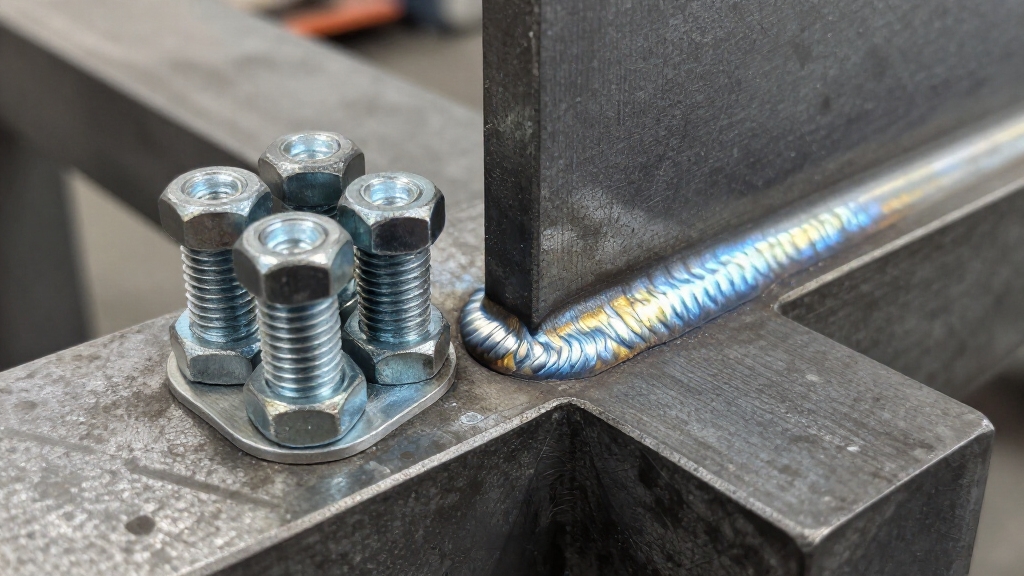
When you join steel members in structural applications, you’ll typically choose between bolted and welded connections. Each offers distinct mechanical and performance characteristics.
Bolted connections rely on mechanical fastening with bolts, nuts, and washers through pre-drilled holes. This enables removability and ease of assembly.
In contrast, welded connections fuse steel members metallurgically using heat. This forms a continuous joint without fasteners.
This difference influences joint behavior: bolting introduces stress concentrations due to holes and allows disassembly. Welding creates monolithic joints with no discontinuities.
Both methods are prevalent in steel structures, but your selection depends on project requirements, structural detailing, and fabrication capabilities.
Understanding these fundamental distinctions prepares you to optimize connection design for safety, efficiency, and serviceability in your steel framework. Welding is a critical step within the broader fabrication workflow that ensures permanent metal bonds and structural integrity.
Although both bolted and welded connections serve critical roles in steel structures, welds typically offer greater stiffness due to their continuous, uninterrupted bond. This eliminates the stress concentrations caused by bolt holes.
When strength is the priority, properly designed full-penetration welds can match or exceed the base metal’s capacity. Bolted joints, however, introduce holes that reduce the net cross-section and create stress risers.
High-strength bolts can prevent slip effectively but won’t match the inherent rigidity of welded joints.
Consider these key points:
Your choice depends on balancing these mechanical performance factors. Additionally, the joint type and loading direction significantly influence weld strength and must be considered when comparing bolted versus welded connections.
In evaluating cost and fabrication, you’ll find that welding can reduce part counts and sometimes lower expenses for complex geometries by eliminating the need for additional components like bolts and washers.
However, welding demands skilled labor and careful heat management to avoid distortion. Bolted connections, while requiring drilled holes and precision hardware, minimize heat effects but may increase fabrication steps and costs.
| Factor | Bolted Connections | Welded Connections |
|---|---|---|
| Part Count | Higher (bolts, nuts, washers) | Lower (fewer components) |
| Fabrication Steps | Drilling, fitting, tightening | Cleaning, welding, cooling |
| Heat Effects | None | Distortion and residual stresses |
| Labor Skill | Moderate | High (specialized welders) |
| Cost Drivers | Hardware, hole prep | Labor, distortion control |
Proper welding technique and equipment maintenance are essential to control heat input and reduce defects during welding.
You must weigh these trade-offs based on project complexity and resources.
When it comes to installation speed, bolted connections usually have the upper hand. They can be put in place quickly because they don’t need specialized labor. Plus, once they’re tightened, you can transfer loads right away.
On the flip side, welding requires skilled operators and specific conditions, which can really slow things down on site. So, if you’re planning a project, knowing these differences can help you optimize your schedule and make better use of your resources. MIG welding, with its semi-automatic operation, can improve efficiency but still demands precise control and preparation.
Frequently, bolted connections install faster than welded ones during field erection. They allow steel members to be quickly aligned and mechanically fastened on site without requiring specialized labor or equipment.
You can immediately transfer loads once bolts are tightened, speeding up progress. Welding demands controlled conditions, power supply, and skilled welders, which can slow the schedule.
Also, welding requires cooling time and quality inspections that extend field work.
Consider these points for field erection speed:
Choosing bolted connections often accelerates your field erection phase. However, welding ensures strong seam formation and long-term joint integrity critical for high-pressure applications.
Mastering the installation of bolted and welded connections demands distinct skill sets that directly impact project timelines.
When you work with bolted connections, the labor skill requirement is generally lower. Crews need basic mechanical skills to align members, insert bolts, and apply proper tension. This allows for quicker training and more flexible staffing.
In contrast, welding requires highly skilled labor familiar with welding procedures, equipment setup, and quality control. You must ensure proper technique to avoid defects like incomplete penetration or slag inclusion, which can compromise joint integrity.
Welding also demands controlled conditions and power supply, further complicating site logistics. Ultimately, your choice hinges on available labor expertise.
Bolting accelerates installation with less specialized skills, while welding demands experienced welders, potentially extending timelines if such resources are scarce. Additionally, practicing steady torch control is essential for welders to maintain high-quality welds and avoid defects.
While bolted connections require less specialized labor, their design also influences how quickly they can bear loads once installed.
Bolted joints transfer load immediately after proper tightening, enabling faster structural assembly and early load application.
In contrast, welded connections need cooling and inspection time before reaching full strength, which delays load transfer despite their continuous joint advantages.
Consider these points for immediate load transfer:
Choosing between bolted and welded connections impacts your project schedule and load management strategies directly.
Additionally, the necessity of post-weld inspections ensures weld quality and safety before load application.
A thorough inspection and maintenance routine guarantees the long-term integrity of both bolted and welded connections.
You need to visually check bolted joints for loosening, corrosion, or damage to washers and nuts.
Use torque wrenches to verify bolt preload, as improper tightening or friction variations can degrade connection performance.
For welded joints, rely on non-destructive testing methods like ultrasonic or radiographic inspection to detect subsurface defects such as incomplete penetration or slag inclusions.
Regularly monitor welds for cracks or corrosion, especially in fatigue-prone areas.
Maintenance schedules must address potential loosening in bolts and degradation in weld quality due to environmental exposure or cyclic loading.
Adhering to a Welding Procedure Specification ensures weld quality consistency and reduces the risk of defects that could compromise structural integrity.
Regular inspection and maintenance highlight the practical demands you’ll face when selecting connection types. You need to weigh factors such as load requirements, installation environment, and future accessibility.
Welding offers superior stiffness and strength for permanent joints. Bolting allows easier disassembly and quicker field assembly. Take into account fabrication capabilities and cost implications. Welding requires skilled labor and can induce distortion, whereas bolting demands precise hole preparation.
Key factors to take into account include:
Additionally, understanding and controlling heat input during welding is crucial to maintain joint integrity and minimize distortion.
When it comes to placing bolted and welded connections, it’s all about strategy. You want to optimize both structural performance and ease of assembly. Think of it this way: balancing welds for rigidity while using bolts for flexibility lets you control how stress is distributed throughout the structure. Plus, it leaves room for any future modifications you might need. Choosing the right welding joint type is essential to ensure optimal strength and load distribution in combined connections.
When optimizing structural steel connections, strategically combining bolted and welded joints leverages the strengths of both methods to enhance overall performance and constructability.
Position welds where rigid, continuous load paths are critical and use bolts where ease of assembly, inspection, or future disassembly is desired. This hybrid approach helps mitigate distortion risks and expedites field erection.
Consider these key factors when placing connections:
This strategic placement guarantees you get the best from both joining techniques.
Although welded connections offer superior stiffness and continuity, combining them with bolted joints provides a strategic balance between strength and flexibility in structural steel assemblies.
You can use welds to achieve rigid, continuous joints where load transfer demands minimal deformation.
Bolted connections accommodate slight movements, ease inspection, and allow for future adjustments or disassembly.
By selectively welding primary load paths and bolting secondary or adjustable components, you optimize structural behavior and maintenance access.
This hybrid approach mitigates stress concentrations from bolt holes and reduces distortion risks from extensive welding.
When designing, analyze load demands, installation conditions, and maintenance needs to determine which connection type suits each joint.
Integrating both methods thoughtfully enhances overall performance, ensuring the structure withstands dynamic loads while maintaining adaptability.
You’ll find welded connections generally better withstand seismic activity due to their continuous, stiff joints, which reduce stress concentrations and avoid bolt-hole weaknesses.
However, properly designed and installed high-strength bolted connections with slip-critical bolts can perform well by allowing controlled movement and energy dissipation.
Ultimately, your choice depends on design specifics, detailing, and material quality rather than just the joining method alone for seismic resilience.
Environmental conditions accelerate bolt corrosion through moisture and chlorides that attack exposed threads and interfaces, compromising preload and joint integrity.
Welds degrade mainly via oxidation and thermal cycling, leading to cracks or embrittlement, especially if protective coatings fail.
You’ll find bolts more susceptible to localized corrosion, while welds face metallurgical changes.
Proper protective measures and material selection are vital to mitigate degradation and guarantee durability in harsh environments.
Yes, you’ll find differences in fire resistance between bolted and welded joints.
Welded joints typically maintain structural integrity longer under fire because the continuous fusion reduces weak points.
Bolted joints, however, can lose strength faster as heat affects bolt tension and can cause loosening or failure at connections.
Consequently, in fire-prone environments, you’ll want to take into account welds for enhanced joint stability and reduced risk of sudden connection loss.
You might be surprised how differently noise and vibration behave in bolted versus welded connections.
Welded joints, being continuous and stiffer, generally dampen vibrations better and reduce noise transmission.
Bolted joints, however, can loosen under cyclic loads, causing micro-movements that amplify noise and vibration over time.
You’ll find bolted connections more recyclable since bolts can be removed, allowing steel members to be separated and reused with minimal damage.
Welded connections require cutting or grinding to separate parts, causing more material loss and reducing reuse potential.
If recyclability is a priority, bolted joints offer greater flexibility and sustainability by facilitating disassembly and preserving material integrity during deconstruction.
When deciding between bolted and welded connections, consider that bolted joints can be up to 30% faster to install, markedly cutting project time.
Welding offers superior stiffness but demands skilled labor and more inspection.
You’ll want to weigh cost, fabrication complexity, and maintenance needs carefully.
By understanding these trade-offs and combining both methods thoughtfully, you can optimize your steel structure’s performance and durability for your specific project requirements.