Phone:
(701)814-6992
Physical address:
6296 Donnelly Plaza
Ratkeville, Bahamas.

Phone:
(701)814-6992
Physical address:
6296 Donnelly Plaza
Ratkeville, Bahamas.

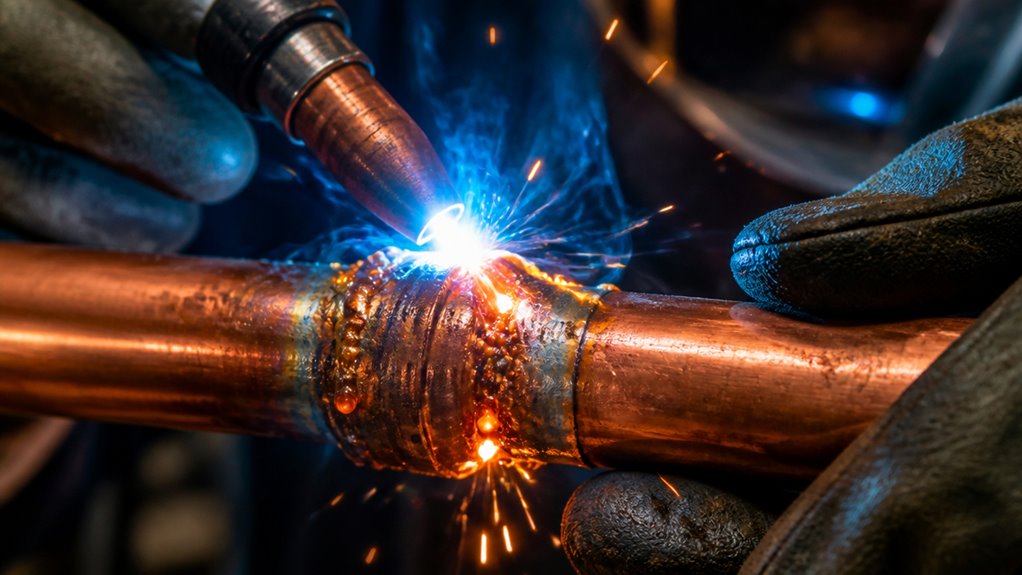
You can weld copper, but it demands precise heat control due to its high thermal conductivity and expansion. This increases distortion and cracking risks.
You’ll need exceptional shielding with inert gases like argon or helium to prevent oxidation and porosity. Proper surface cleaning and compatible filler materials are essential to avoid defects such as porosity and incomplete fusion.
Managing heat input, preheating thick sections, and using appropriate welding methods will improve outcomes. Exploring these techniques reveals how to master copper welding effectively.
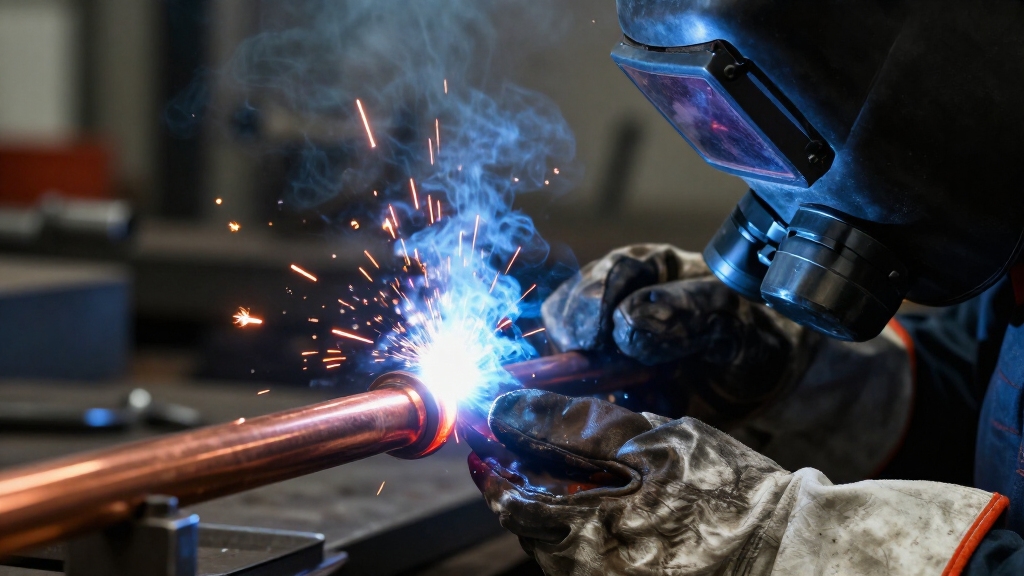
Although welding copper presents unique challenges due to its high thermal conductivity and tendency to oxidize, you can successfully weld copper using specialized techniques.
Welding copper requires specialized techniques to manage its heat conductivity and oxidation challenges effectively.
You’ll find TIG welding preferred for its precise heat control and quality, while MIG suits thicker sections requiring faster work.
Stick welding is less common because controlling heat input is more difficult.
For thin copper, oxy-acetylene welding can be effective but is generally limited to non-structural applications.
To optimize results, you must ensure the copper is clean and free of oxygen contamination.
Use appropriate shielding gases like argon or helium and often preheat the material to counter rapid heat dissipation.
Selecting suitable copper or copper-alloy fillers further enhances fusion quality.
These controlled approaches enable you to overcome copper’s welding challenges with consistent, reliable joints.
Preheating to around 650°F is often necessary for thicker copper to minimize thermal gradients and oxidation, improving weld quality and reducing distortion from copper’s high thermal conductivity.
Welding copper poses greater challenges than welding steel due to its distinct physical and chemical properties.
Copper’s high thermal conductivity rapidly dissipates heat from the weld zone, demanding more heat input to maintain fusion.
Its high thermal expansion increases distortion and cracking risks during cooling.
Additionally, copper oxidizes quickly at welding temperatures, promoting porosity and weakening the weld.
Copper’s affinity for atmospheric gases further complicates shielding, increasing defects.
| Property | Effect on Welding |
|---|---|
| Thermal Conductivity | Rapid heat dissipation |
| Thermal Expansion | Distortion and cracking risk |
| Oxidation Tendency | Porosity and weak welds |
| Gas Absorption | Increased porosity |
Copper’s superior thermal conductivity also enables faster heat dissipation, which helps protect surrounding materials and maintain weld integrity under heavy heat loads, highlighting the importance of understanding its thermal conductivity.
The challenges posed by copper’s physical properties make thorough preparation a key step before applying heat.
You must start by cleaning the copper surface meticulously to remove oxides, oils, and contaminants. Even minor impurities increase porosity and reduce weld quality.
Begin with meticulous cleaning to eliminate oxides and oils, ensuring weld quality and reducing porosity.
Mechanical cleaning with abrasive pads or chemical pickling solutions guarantees a pristine surface. Next, consider preheating the copper to counteract its high thermal conductivity, which rapidly dissipates heat from the weld zone.
This risks incomplete fusion. Preheating reduces thermal gradients, minimizing distortion and cracking risks. Additionally, select appropriate filler materials compatible with the copper alloy.
Finally, secure an inert shielding gas environment, typically argon or helium, to prevent atmospheric oxidation during welding. These steps collectively optimize the weld’s structural integrity and appearance.
Using tungsten electrodes instead of standard copper tips further enhances weld quality by managing heat concentration and electrode wear.
Choose your welding method for copper carefully, as each offers distinct advantages and challenges based on material thickness, desired weld quality, and production speed.
TIG welding provides excellent heat control and superior weld quality, especially for thinner sections. MIG suits thicker copper and faster throughput but sacrifices some precision.
Stick welding is less common due to control difficulties. Oxy-acetylene welding works for thin copper but is less precise.
| Welding Method | Best Use Case |
|---|---|
| TIG | Thin to medium thickness, high-quality welds |
| MIG | Thick sections, faster production |
| Stick | Repair work, limited precision |
| Oxy-acetylene | Thin, non-structural copper |
Selecting the right method matches your project’s technical requirements and efficiency needs. Brazing copper to other metals is often preferred over welding due to thermal expansion challenges that can cause distortion and weak joints.
Because copper’s high thermal conductivity and oxidation tendency demand careful atmospheric control, selecting the right shielding gas is vital to achieving clean, defect-free welds.
You need a gas that minimizes oxidation while supporting stable arc characteristics and sufficient heat input. Argon is the most common choice, providing excellent protection and arc stability.
Adding helium enhances heat transfer, essential for thicker copper sections, but raises costs. Avoid active gases like CO₂ or oxygen, as they increase oxidation and porosity risks.
Consider these points when choosing shielding gases for copper welding:
When welding copper, managing heat input is crucial due to its high thermal conductivity. This property rapidly dissipates heat and can lead to uneven temperature distribution.
You need to apply heat carefully to maintain a stable weld pool without overheating surrounding areas. Preheating the copper helps reduce thermal gradients, minimizing stress concentrations that cause distortion.
Additionally, controlling travel speed and using pulsed welding techniques can localize heat, reducing warpage. Clamping and fixture support are essential to hold parts firmly, counteracting expansion and contraction forces.
Post-weld cooling should be gradual to prevent thermal shock and cracking. By precisely balancing heat input and mechanical restraint, you’ll effectively mitigate distortion risks and maintain dimensional stability throughout the welding process.
Proper surface preparation accounting for about 90% of a successful joint is critical to ensure strong bonding and minimize defects during welding.
Although welding copper presents unique challenges due to its thermal and chemical properties, you must remain vigilant for several common defects that can compromise weld integrity.
Copper’s high thermal conductivity and oxidation tendency increase risks of porosity and incomplete fusion. If you don’t carefully control heat input and shielding gas, defects will arise that weaken the weld.
Watch for these key issues:
Porosity: Gas entrapment caused by oxidation or atmospheric contamination.
Incomplete fusion: Insufficient heat or poor technique prevents full joint bonding.
Burn-through: Excessive heat on thin sections causes holes and loss of material.
Cracking: Thermal stresses and impurities induce microcracks, especially in thicker or alloyed copper.
Maintaining exceptional shielding during welding is essential to prevent contamination and ensure weld quality.
Recognizing and addressing these defects guarantees a structurally sound and reliable copper weld.
In applications where full-strength fusion is unnecessary or where heat management poses significant challenges, brazing and soldering offer practical alternatives to welding copper.
You should opt for brazing when joining thin sections or dissimilar metals, as it requires lower temperatures and reduces distortion risk caused by copper’s high thermal expansion.
Brazing also minimizes oxidation and porosity issues since it avoids melting the base metal.
Soldering suits low-stress joints and plumbing connections where mechanical strength is less critical.
Both methods allow for better control of heat input, which is vital given copper’s high thermal conductivity that rapidly dissipates heat during welding.
When you face complex geometries or sensitive components, brazing or soldering helps maintain joint integrity without the risks associated with full fusion welding.
Additionally, using an inert gas shield during welding is crucial to protect the weld pool from atmospheric contamination and ensure high-quality joints.
You’ll often see copper welding in places like electrical components, heat exchangers, and plumbing systems. It’s all about creating those strong, conductive joints that are so essential.
Now, while TIG and MIG welding are the go-to methods for most copper applications, don’t forget about brazing and soldering! These techniques can be great alternatives, especially for less demanding tasks or thinner sections of copper.
Understanding the different methods really helps you choose the best one. Think about what you need in terms of strength, the thickness of the material, and how complex the joint is. Each situation calls for a different approach, so it’s good to know your options!
Proper heat management during welding is crucial to reducing thermal stress and preventing cracking in copper alloys.
Copper welding frequently appears in applications demanding excellent electrical and thermal conductivity combined with corrosion resistance. When you weld copper, you’ll often be working on components where these properties are essential, such as in electrical systems or heat exchangers.
The technique lets you create strong, conductive joints that withstand harsh environments.
Common uses include:
Effective copper welding requires precise control of heat input to avoid defects such as porosity and cracking, which can compromise joint quality and performance, highlighting the importance of heat control techniques.
When welding poses challenges due to copper’s thermal and metallurgical properties, alternative joining methods step in as practical solutions.
Brazing and soldering offer reliable options when full fusion isn’t necessary, enabling you to join copper with lower heat input and reduced distortion risk.
Brazing uses a filler metal with a melting point below copper’s, providing strong, leak-proof joints ideal for plumbing or HVAC applications.
Soldering suits low-stress connections, using even lower temperatures to fuse copper components without compromising base material integrity.
These methods minimize oxidation and porosity issues commonly seen in welding.
Additionally, mechanical fastening or adhesive bonding might serve in specific applications where thermal effects are unacceptable.
When welding copper, managing its high thermal conductivity requires precise control similar to the demands seen in aluminum spot welding to avoid excessive heat loss and ensure joint integrity.
You need a welding helmet with proper shade to protect your eyes from intense UV and IR radiation.
Wear flame-resistant gloves and a long-sleeve jacket to shield against sparks, hot metal, and UV exposure.
Use a respirator or guarantee adequate ventilation to avoid inhaling copper fumes and oxides.
Safety boots with steel toes and ear protection are also essential to guard against physical hazards and noise during welding operations.
Welding copper can subtly reduce its electrical conductivity, and here’s why you should pay close attention.
The heat from welding alters the metal’s microstructure, potentially causing grain growth and oxidation, which disrupt electron flow.
Impurities and porosity introduced during welding further impede conductivity.
To minimize these effects, you need precise heat control, clean materials, and proper shielding gas.
Otherwise, the copper’s hallmark conductivity might degrade enough to impact electrical performance.
You can automate copper welding in home workshops, but it’s challenging. Automated systems require precise control over heat input and shielding gas to prevent defects like porosity and cracking.
Small-scale CNC or robotic MIG/TIG setups exist, but they’re costly and complex. You’ll need proper ventilation, clean copper, and preheating capabilities.
While feasible, automation demands advanced equipment and expertise. This makes manual TIG welding often more practical for home use.
Just as copper demands precise heat control, you need to maintain your welding gear meticulously.
Regularly clean the torch tips and check for gas leaks to prevent contamination.
Replace worn electrodes and inspect shielding gas lines for blockages or damage.
Keep cooling systems functioning efficiently to avoid overheating.
Consistent calibration of amperage settings guarantees accurate heat input.
Neglecting these can cause porosity or incomplete fusion, directly compromising weld quality and equipment longevity.
Yes, you can adopt environmentally friendly practices for copper welding.
Use argon-helium gas blends to reduce greenhouse impacts and avoid toxic fluxes.
Maintain equipment to minimize leaks and energy waste.
Opt for efficient welding techniques like TIG for precise heat control, reducing rework and material waste.
Proper ventilation captures fumes, protecting air quality.
Finally, recycle scrap copper and responsibly dispose of consumables to limit environmental harm during your welding process.
Welding copper isn’t a walk in the park. It demands meticulous preparation, precise heat control, and the right techniques to avoid common pitfalls.
While it may not be as straightforward as welding steel, mastering copper welding opens doors to specialized applications. Sometimes, opting for brazing or soldering can be a more graceful solution, depending on your project’s demands.
Embrace the challenge, and you’ll find copper welding a rewarding, if occasionally delicate, craft.