Phone:
(701)814-6992
Physical address:
6296 Donnelly Plaza
Ratkeville, Bahamas.

Phone:
(701)814-6992
Physical address:
6296 Donnelly Plaza
Ratkeville, Bahamas.

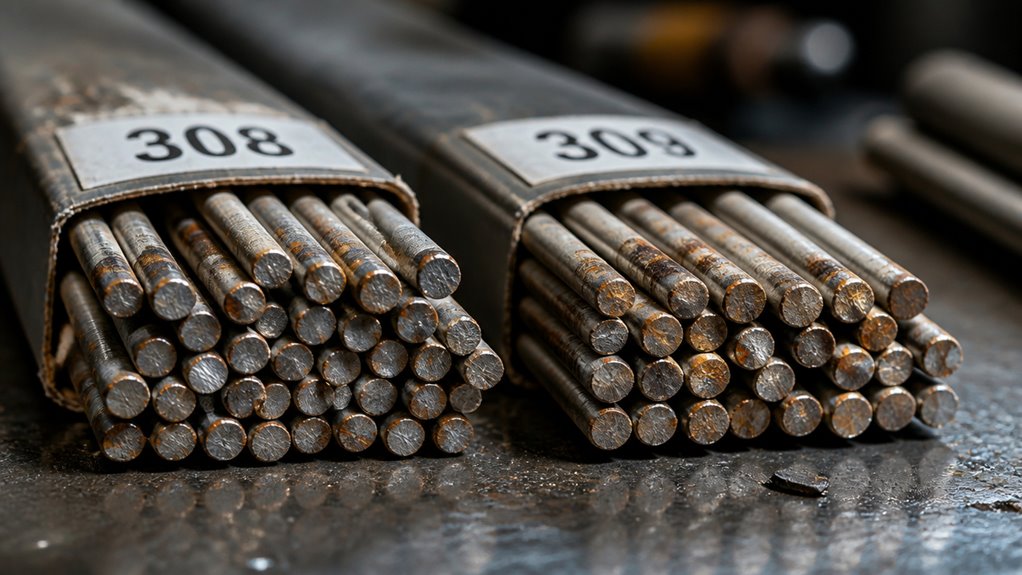
When choosing between 308 and 309 welding rods, you’ll pick 308 for welding similar stainless steels like 304 or 304L. Its lower ferrite (about 4–9 FN) matches corrosion resistance and metallurgical properties.
You’d use 309 with higher ferrite content (12–18 FN) and elevated chromium-nickel levels for dissimilar metals or high-dilution conditions. This enhances crack resistance and strength.
Understanding these differences helps optimize weld integrity and performance under varying stresses. Explore further to refine your selection process.
| Feature | 308 Welding Rod | 309 Welding Rod |
|---|---|---|
| Chromium Content | About 19% | About 23% |
| Nickel Content | About 9% | About 13% |
| Ferrite Content | 4–9 FN | 12–18 FN |
| Best Base Metals | 304/304L stainless steel | Stainless to carbon or low-alloy steel |
| Corrosion Matching | Excellent for similar stainless steels | More versatile for mixed metals |
| Dilution Tolerance | Lower | Higher |
| Crack Resistance | Standard | Improved |
| Mechanical Strength | Minimum 80 ksi tensile strength | Minimum 80 ksi, with stronger performance in dissimilar joints |
| Solidification Crack Resistance | Good | Superior |
| High-Dilution Welding | Less suitable | Better suited |
| Buttering Applications | Limited | Excellent |
| Clad-Steel Repairs | Less suitable | Well suited |
| Unknown Base Metals | Less versatile | More forgiving |
| Typical Cost | Lower | About 10–20% higher |
| Main Advantage | Excellent corrosion match for 304/304L stainless | Better crack resistance and dilution tolerance |
| Main Drawback | Less suitable for dissimilar or high-dilution joints | Higher cost and less focused on corrosion-matched stainless joints |
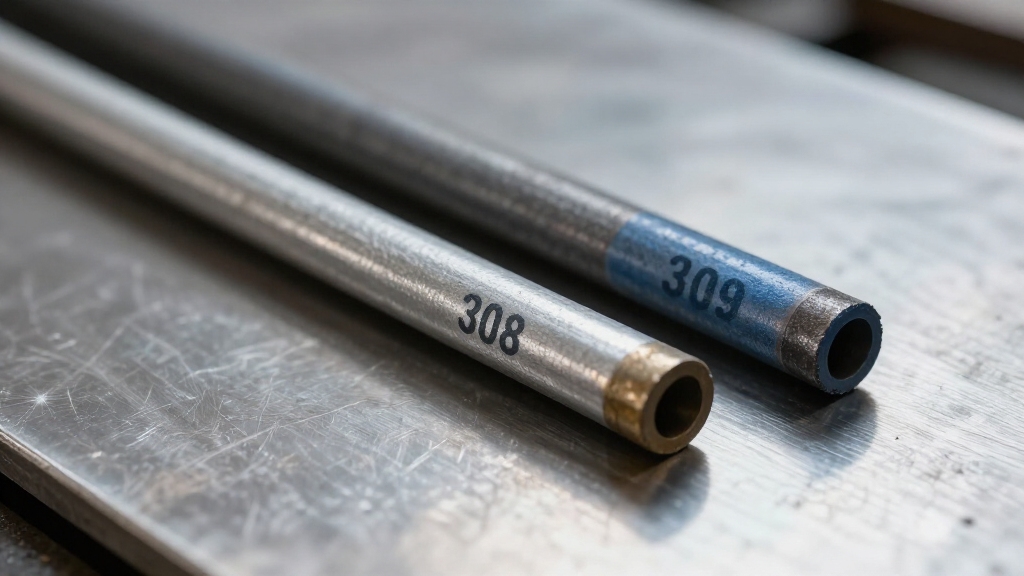
Because alloy composition directly influences welding rod performance, understanding the differences between 308 and 309 rods is crucial for best joint integrity.
You’ll find that 308 typically contains about 19% chromium and 9% nickel, aligning it closely with 304-series stainless steels for corrosion resistance and weld compatibility.
In contrast, 309’s elevated chromium (around 23%) and nickel (about 13%) content enhance its ability to tolerate higher dilution from carbon or low-alloy steels, improving crack resistance.
When you weld dissimilar metals, 309’s robust alloy makeup helps maintain mechanical strength and prevents brittle zones. This is unlike 308, which suits similar stainless steel joints where corrosion matching is critical.
Selecting the correct alloy guarantees weld durability and reduces failure risk in service conditions involving mixed metals or thermal stresses.
The use of ER309L filler metal is widely recommended due to its balanced chromium and nickel content, which helps control weld metal properties and ensure corrosion resistance in dissimilar metal welding.
When you evaluate the ferrite content in 308 and 309 welding rods, you’ll notice that 309 generally contains a higher ferrite percentage, typically ranging from 12 to 18 FN, compared to 308’s lower range of about 4 to 9 FN.
This higher ferrite content in 309 enhances its resistance to solidification cracking, especially in dissimilar metal welds where dilution is significant. Conversely, 308’s lower ferrite levels align with its use in similar stainless steel joints, maintaining compatibility with the austenitic microstructure of base metals like 304 and 304L.
Understanding these ferrite differences helps you select the appropriate rod based on weld composition and expected thermal or metallurgical stresses. This ensures optimum weld integrity and performance without compromising corrosion resistance or mechanical properties.
For stainless steel welding, it is important to select electrodes like E308L or E309L to match the corrosion resistance of the base metal and improve joint durability.
The higher ferrite content in 309 welding rods plays a significant role in enhancing their resistance to solidification cracking, especially in welds exposed to greater dilution or mixed-metal conditions.
You’ll find that 309’s elevated chromium and nickel levels, combined with ferrite numbers typically between 12 and 18 FN, improve crack resistance by reducing the formation of brittle phases during cooling.
In contrast, 308 rods, with ferrite numbers around 4 to 9 FN, offer adequate strength but are more susceptible to cracking under high dilution scenarios.
Both rods maintain a minimum tensile strength of 80 ksi, but 309’s microstructure gives it superior mechanical performance in dissimilar metal welds.
When strength and crack resistance are critical under variable dilution, 309 welding rods provide a more robust solution than 308.
However, it is important to consider that improper heat control during welding can alter the microstructure and potentially reduce the effectiveness of even the best rods, emphasizing the need for strict heat control.
Although both 308 and 309 welding rods share similar tensile strength requirements, your choice depends heavily on the metals involved and the welding conditions.
You’ll use 308 primarily for welding similar stainless steels, especially 304, 304L, 301, or 302, where corrosion resistance and metallurgical compatibility are critical.
In contrast, 309 excels in dissimilar metal joints, such as stainless steel to carbon or low-alloy steel, due to its higher chromium and nickel content that improves crack resistance and dilution tolerance.
You’ll also prefer 309 for buttering layers, clad-steel overlays, and repairs involving unknown base metals, where versatility and enhanced mechanical properties matter.
Ultimately, 308 suits corrosion-matched stainless welds, while 309 addresses mixed-metal challenges requiring superior crack resistance and fusion boundary robustness.
To ensure consistent weld quality when using these rods, adherence to a qualified Welding Procedure Specification is essential.
Since selecting the appropriate welding rod directly impacts joint integrity, you must evaluate the base metals involved, corrosion requirements, and expected dilution levels to determine whether 308 or 309 is suitable.
Use 308 for stainless-to-stainless joints prioritizing corrosion resistance, especially with 304/304L. Opt for 309 when welding stainless to carbon or low-alloy steel, or when higher dilution is expected.
Consider mechanical properties and crack resistance as well.
| Criteria | 308 Welding Rod | 309 Welding Rod |
|---|---|---|
| Base Metal | Stainless steel (304/304L) | Stainless to carbon/low-alloy steel |
| Corrosion Resistance | High, corrosion-matched | Moderate, versatile |
| Dilution Tolerance | Lower | Higher |
| Crack Resistance | Standard | Improved in mixed-metal joints |
| Ferrite Content (FN) | 4–9 | 12–18 |
Proper filler selection is critical to accommodate differences in thermal expansion and reduce cracking risk when welding dissimilar metals like stainless steel and carbon steel, highlighting the importance of nickel alloy advantages.
You can interchange 308 and 309 welding rods in emergency repairs, but you should proceed with caution.
Using 309 in place of 308 offers better crack resistance and handles higher dilution, especially for dissimilar metals.
However, substituting 308 for 309 may risk brittle welds under higher dilution or mixed-metal conditions.
Evaluate the metals involved and service conditions carefully before choosing to interchange these rods to avoid compromising weld integrity.
You should store both 308 and 309 welding rods in a dry, temperature-controlled environment to prevent moisture absorption, which can cause hydrogen-induced cracking.
Keep them sealed in their original packaging until use and avoid exposure to humidity above 50%.
If rods absorb moisture, bake them according to manufacturer specs, typically between 250°C and 350°C.
Proper storage guarantees consistent weld quality and mechanical performance, especially in critical applications.
Imagine welding a 304 stainless steel tank with 308 rods. Post-weld heat treatment (PWHT) mainly focuses on relieving stresses and preserving corrosion resistance, as 308 aligns well with the base metal.
With 309 rods, used on dissimilar joints, PWHT must address higher thermal stresses and potential brittleness due to increased chromium and nickel. You’ll need a carefully controlled PWHT cycle to optimize toughness and minimize cracking in 309 welds.
Yes, you’ll adjust your welding technique slightly between 308 and 309 rods.
With 309’s higher alloy content and ferrite, you’ll often use slightly higher heat input to prevent cracking and accommodate dilution.
For 308, you can weld with standard parameters focusing on corrosion matching.
Controlling interpass temperature and bead sequence matters more with 309 to manage thermal stress in dissimilar metal joints.
Both require careful cleaning and shielding gas control.
You’ll typically find 309 welding rods cost about 10-20% more than 308 rods due to their higher chromium and nickel content.
This increased alloy concentration raises production expenses, reflecting the enhanced crack resistance and versatility 309 offers.
If your project demands dissimilar metal welding or higher dilution tolerance, investing in 309 rods justifies the premium.
For standard stainless-to-stainless joints, 308 rods provide a more cost-effective solution without compromising quality.
When choosing between 308 and 309 welding rods, you’re not just picking a tool. You’re selecting the backbone of your weld’s integrity.
Understanding their alloy differences, ferrite content, and crack resistance helps you match performance to purpose with precision. Like a key fitting a lock, the right rod guarantees strength and durability where you need it most.
So, don’t guess. Choose analytically to weld with confidence every time.