Phone:
(701)814-6992
Physical address:
6296 Donnelly Plaza
Ratkeville, Bahamas.

Phone:
(701)814-6992
Physical address:
6296 Donnelly Plaza
Ratkeville, Bahamas.

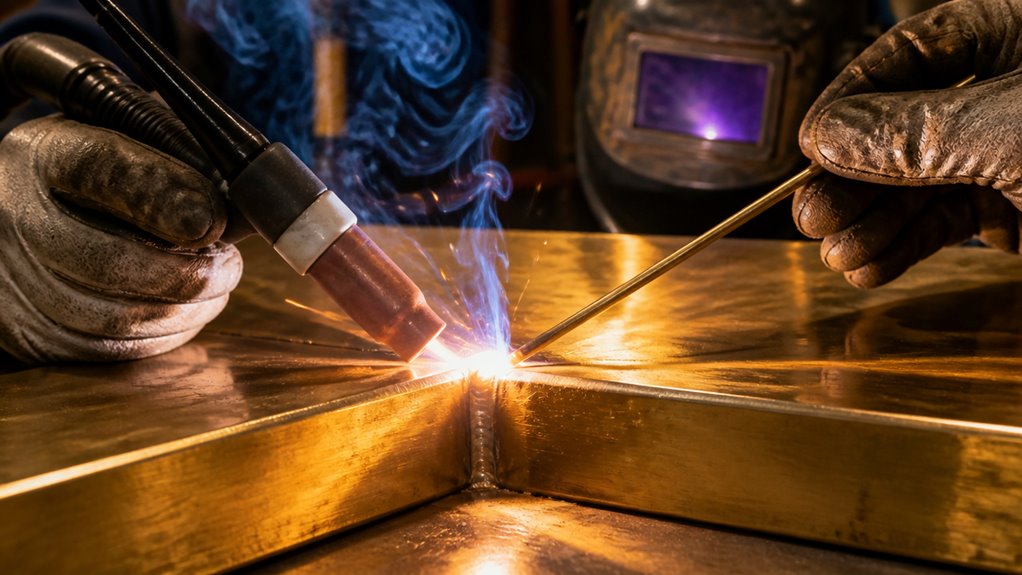
To brass weld effectively, you need to control heat carefully to avoid zinc volatilization, which causes porosity and fumes.
Clean the brass thoroughly using stainless steel brushes and solvents to remove oxides and contaminants.
Use zinc-free filler metals and argon shielding gas to protect the weld pool from oxidation.
Choose a welding method like TIG for thin parts or MIG for thicker sections, adjusting heat input accordingly.
Master these basics, and you’ll better understand optimizing techniques and safety protocols.
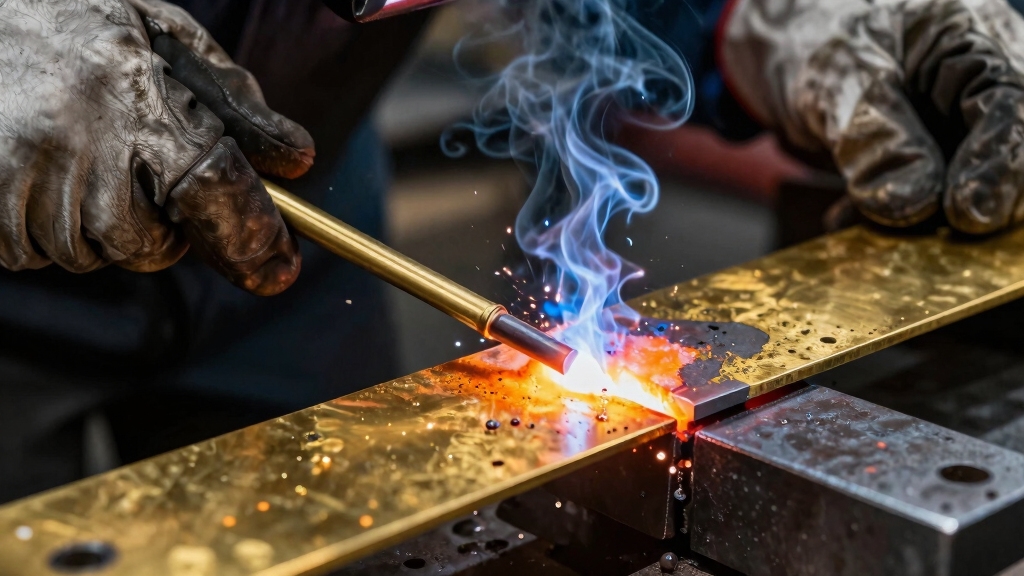
Although brass is widely used for its corrosion resistance and aesthetic appeal, welding it presents significant challenges due to its unique composition.
You must manage the differing melting points of copper and zinc. Zinc volatilizes at a much lower temperature, producing fumes and causing porosity that weakens joints.
High-zinc brass compounds this issue, while low-zinc alloys weld more reliably. Leaded brass poses additional difficulties, increasing cracking risk and often ruling out electric welding.
Selecting the appropriate welding method, such as TIG, MIG, stick, oxy-acetylene, or laser, depends heavily on part thickness and joint requirements.
Controlling heat input and choosing suitable filler metals are critical to prevent defects and maintain joint integrity in your brass welding projects.
Because of these challenges, brazing with silver-based alloys is often preferred over welding to achieve strong, reliable brass-to-steel joints.
Before you start welding brass, there’s an important step: cleaning the surface. You really want to make sure you remove any oxides, oils, and other contaminants. These can lead to weld defects, so don’t skip this part! When you properly prepare the surface, you’re setting yourself up for strong fusion and less porosity in your weld.
Now, if you’re working with thicker sections of brass, consider controlled preheating. Keeping the material at a temperature between 94–316°C can help reduce thermal stress and the risk of cracking during the welding process. It’s a simple step that can make a big difference in the quality of your weld!
Proper cleaning techniques prevent damaging the protective oxide film, which is crucial to maintaining the material’s integrity during welding.
Ensuring a clean, contaminant-free surface is critical when preparing brass for welding to prevent defects like porosity and weak joints.
Begin by thoroughly removing oils, grease, and dirt using a suitable solvent or degreaser. Next, mechanically clean the weld area with a stainless steel wire brush or fine abrasive pad to strip away oxidation and surface impurities.
Avoid using carbon steel brushes, as they may introduce contamination. After cleaning, wipe the surface with a lint-free cloth soaked in acetone or isopropyl alcohol to eliminate any residual particles.
Proper surface preparation minimizes zinc volatilization and guarantees optimal weld quality. Maintain cleanliness until welding begins to prevent recontamination.
This disciplined approach to cleaning and surface prep directly enhances weld integrity and reduces the risk of fusion defects in brass joints.
Be sure to avoid delays between cleaning and welding to prevent recontamination and ensure the best weld results.
Managing the temperature of brass sections prior to welding plays a crucial role in achieving strong, defect-free joints. You should preheat thicker brass above 1.5 mm to around 94–316°C to minimize thermal shock, reduce cracking, and improve penetration. Avoid overheating to prevent zinc volatilization, which weakens the weld and produces hazardous fumes. Thin brass typically doesn’t require preheating.
| Thickness (mm) | Preheat Temp (°C) | Purpose |
|---|---|---|
| < 1.5 | None | Avoid distortion |
| 1.5 – 5 | 94 – 316 | Reduce cracking, improve fusion |
| > 5 | Controlled, gradual | Prevent thermal stress |
Use an even, gradual heat source and monitor temperature carefully to guarantee peak weld quality. Proper control of heat input during preheating is essential to prevent thermal stresses that could compromise joint integrity.
When it comes to welding brass, choosing the right method is crucial. You want to make sure it aligns with your brass alloy’s composition and thickness. Plus, keeping a close eye on heat control is essential to avoid issues like zinc volatilization and weak joints.
Now, let’s talk about the different welding techniques. TIG, MIG, and oxy-acetylene each have their own perks, depending on how complex your project is and how compatible they’re with your materials. So, it’s worth considering which one will work best for you.
And don’t forget about the details! Prioritizing proper shielding, selecting the right filler, and managing temperature effectively are all key steps. These practices help ensure you achieve top-notch weld integrity while minimizing defects.
For more reliable joints, understanding thermal conductivity and managing heat input precisely is essential in brass welding applications.
Selecting the best welding technique for brass requires understanding the alloy’s unique challenges, including zinc volatilization and heat sensitivity. You must carefully balance heat input and filler selection to avoid porosity and cracking. Here’s a concise overview:
1. TIG Welding
Offers precise heat control and clean welds. Ideal for thin or intricate brass parts.
2. MIG Welding
Suitable for thicker sections. Faster but less precise, it requires careful heat and shielding management.
3. Oxy-Acetylene Welding
Uses flux to protect the joint. Effective for certain thicknesses but demands skillful flame control.
4. Laser Welding
Provides minimal distortion and high precision. It needs specialized equipment.
Controlling heat input through short, controlled passes is essential to minimize thermal stress and avoid weld defects in brass.
Because brass contains zinc, which vaporizes at relatively low temperatures, controlling heat input is critical to prevent weld defects such as porosity, cracking, and weakened joints.
You need to apply just enough heat to achieve fusion without overheating the zinc component. Excessive heat causes zinc volatilization, creating hazardous fumes and compromising joint integrity.
Techniques like TIG welding give you superior heat control, minimizing distortion and oxidation. Use low heat settings, short arc lengths, and adequate shielding gas; argon is preferred to limit oxidation.
Preheating thicker sections in the 94–316°C range can improve penetration and reduce cracking risk. Avoid prolonged heat exposure and select zinc-free filler metals where possible.
Because oxygen causes oxidation and weld contamination, it is essential to use inert shielding gases like argon to ensure weld quality and prevent defects.
Managing heat effectively sets the stage for choosing the most suitable welding method for brass. You must consider the alloy composition. High zinc content increases the risk of volatilization and porosity, while leaded brass can cause cracking.
Selecting a welding process that controls heat input and provides proper shielding is critical to preserve joint integrity.
Focus on these key compatibility factors:
Additionally, understanding the thermal conductivity differences in brass alloys helps optimize heat management and prevent distortion during welding.
When welding brass with TIG, you need to control heat input carefully to prevent zinc volatilization and maintain joint integrity.
Use a low amperage setting tailored to the brass thickness, typically avoiding excessive heat buildup.
Select a zinc-free filler rod to reduce porosity and cracking risks.
For brass thinner than 1.5 mm, you may not need filler metal.
However, thicker sections benefit from preheating between 94–316°C to enhance penetration and minimize thermal stress.
Employ argon shielding gas to protect the weld pool from oxidation.
Maintain a short arc length and steady travel speed to assure consistent fusion without overheating.
Proper joint fit-up and clean surfaces are critical to achieving strong, defect-free welds when TIG welding brass.
In addition, controlled heat input is essential to prevent thermal distortion and ensure weld quality.
How do you effectively MIG weld brass without compromising the material’s integrity? You must control heat input carefully since brass’s zinc content vaporizes easily, causing porosity and brittleness.
Effective MIG welding of brass requires careful heat control to prevent zinc vaporization and material defects.
MIG welding suits thicker brass sections where faster deposition matters, but it demands precision in settings.
Argon is recommended as the primary shielding gas due to its excellent arc stability and inert properties that protect the weld area.
Although oxy-acetylene welding requires careful heat control to prevent zinc volatilization, it remains a versatile method for joining brass, especially when combined with appropriate fluxes.
You’ll typically apply a braze-welding flux as a paste to protect the joint area from oxidation and contamination. Use a larger torch tip than for similar steel thicknesses because brass’s high thermal conductivity demands greater heat input.
Employ a forehand technique to maintain consistent heat and avoid overheating. For brazing, select filler rods compatible with the base metal, often with boric acid flux or carbon backing to improve joint integrity.
This process suits thicker or complex brass components where precise TIG control is less critical. You must balance heat and protection to minimize zinc loss and guarantee strong, defect-free welds.
In managing brass welding, controlling heat input is critical to prevent zinc volatilization. This compromises joint strength and produces hazardous fumes.
You need to apply the minimum effective heat to avoid overheating. Overheating causes porosity and brittleness.
Use argon shielding gas to limit oxidation and protect the weld pool. Zinc-free filler rods reduce contamination risks.
Make certain of proper ventilation to protect against toxic zinc fumes.
Keep these four safety and control essentials in mind:
Master these to weld brass safely and effectively.
You can perform brass welding underwater or in extreme environments, but it’s challenging.
Controlling heat input is vital to avoid zinc volatilization and weakening the joint.
Specialized underwater welding techniques, like wet or dry hyperbaric welding, require advanced equipment and strict safety protocols.
You’ll need to manage shielding gases and fumes carefully.
Due to brass’s sensitivity, these conditions increase complexity.
Make certain you have the right expertise and equipment for reliable results.
Picture your welding torch cooling down, still glowing faintly as you finish the job.
After welding brass, you need to clean the torch tips and nozzles carefully to remove any zinc residue and flux.
Check and replace shielding gas cylinders if low.
Inspect cables and connections for heat damage or wear.
Regularly calibrate your welding machine to maintain precise heat control.
Proper maintenance guarantees consistent performance and extends your equipment’s lifespan.
Welding brass reduces its electrical conductivity because heat alters the alloy’s microstructure and can cause zinc volatilization. This can lead to porosity and embrittlement.
You’ll find the welded joint less conductive than the base metal, especially if excessive heat causes zinc depletion or oxidation. Using proper heat control and shielding gas helps minimize conductivity loss.
However, expect some degradation compared to unwelded brass due to metallurgical changes in the weld zone.
Yes, you should perform post-weld treatments on brass to enhance durability.
Stress relieving through controlled heat treatment reduces residual stresses and cracking risk.
You can also apply light polishing to remove oxidation and surface imperfections.
Additionally, applying corrosion-resistant coatings or sealants helps protect the weld area from environmental damage.
Always cool the weld slowly to minimize brittleness and avoid rapid quenching, which can induce microstructural weaknesses.
Like polishing a gem, common cosmetic finishes after brass welding include buffing to restore shine, followed by chemical patination to create uniform coloration.
You’ll often use mild abrasive polishing compounds and protective clear coatings, such as lacquer or wax, to prevent tarnishing.
Electroplating or brushing can also enhance appearance. Each finish demands careful surface prep to avoid highlighting weld seams or heat discoloration, ensuring a flawless, professional look.
Welding brass is like conducting a symphony. Each element, from preparation to heat control, must harmonize perfectly.
You can’t rush the process or ignore the nuances without risking a flawed joint. By mastering the right techniques and respecting brass’s unique properties, you guarantee a strong, clean weld every time.
Approach brass welding with precision and care. You’ll transform a challenging task into a seamless performance of metalwork excellence.