Phone:
(701)814-6992
Physical address:
6296 Donnelly Plaza
Ratkeville, Bahamas.

Phone:
(701)814-6992
Physical address:
6296 Donnelly Plaza
Ratkeville, Bahamas.

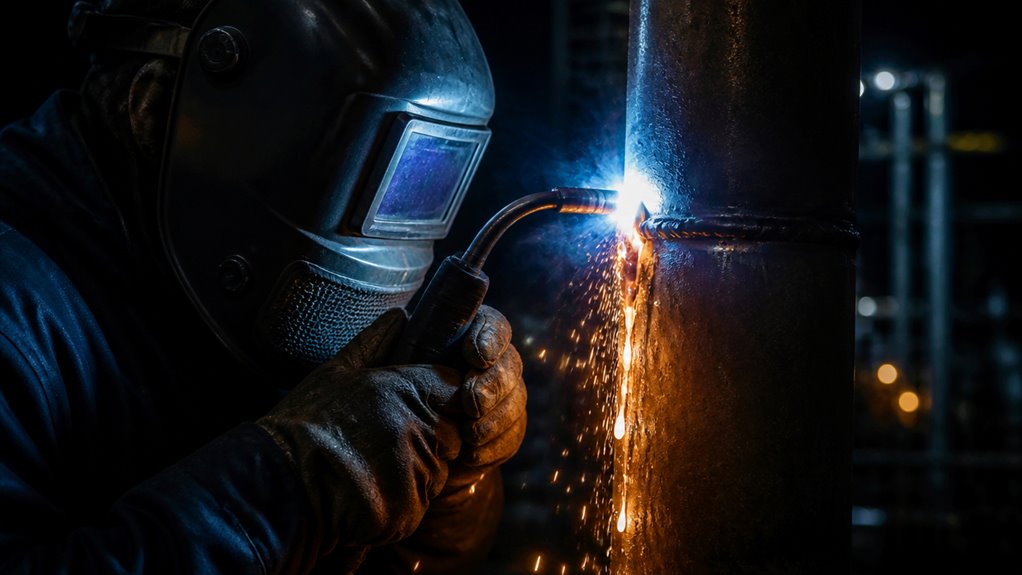
You’ll find AWS D1.1 and API 1104 are the primary codes specific to downhill welding.
Use AWS D1.1 for structural steel applications, where changing travel direction requires requalification.
API 1104 governs pipeline welding, explicitly permitting downhill for root passes to optimize speed and efficiency.
Both codes set strict procedure qualifications and inspection criteria to guarantee weld integrity.
Understanding how these codes apply to your project and materials will clarify when and how downhill welding is appropriate.
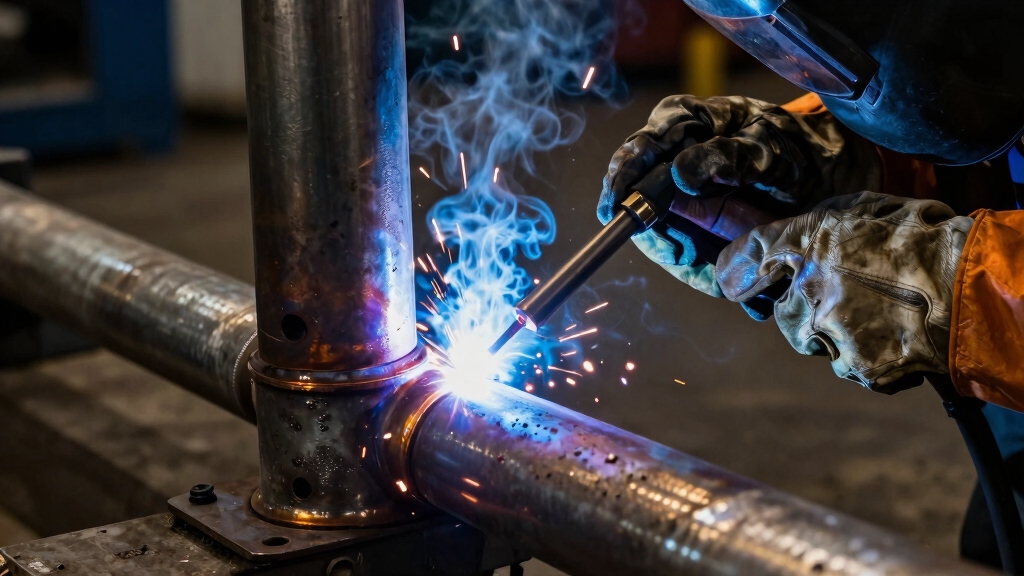
Although downhill welding isn’t universally prohibited, its acceptance and control depend heavily on the governing welding codes relevant to your project.
You’ll find AWS D1.1 and API 1104 as the primary codes addressing downhill welding.
AWS D1.1 treats changing welding direction from uphill to downhill as an essential variable, requiring procedure requalification to guarantee joint integrity and compliance with inspection criteria.
It doesn’t ban downhill welding but controls it through qualified welding procedure specifications (WPS).
Meanwhile, API 1104 specifically accommodates downhill progression in pipeline welding, emphasizing speed and efficiency, particularly for root passes.
Your choice of code depends on the application: structural steel work typically follows AWS D1.1, while pipeline projects align with API 1104.
Consequently, the governing code, procedure qualification, and service conditions collectively dictate downhill welding’s acceptability.
Understanding the importance of welding position certifications like the 5G can enhance a welder’s ability to meet these code requirements effectively.
Sure! Here’s a more conversational version of your text:
—
When you switch from uphill to downhill welding, it’s really important to understand that you need to requalify your procedure. Codes like AWS D1.1 require this step to keep everything valid.
Requalifying ensures that your welding procedure specification meets all the necessary performance and inspection criteria that are specific to downhill welding. If you skip this qualification, you can’t really guarantee the weld’s compliance and structural integrity.
This is especially critical because downhill welding involves faster travel speeds and different heat input control, which significantly affect weld quality and defect potential.
When switching between uphill and downhill welding progression, procedure requalification plays a critical role in maintaining weld integrity and compliance with applicable codes. You must requalify the welding procedure specification (WPS) to guarantee the change in travel direction doesn’t compromise joint performance. AWS D1.1 treats this progression change as an essential variable, necessitating retesting.
Key considerations include:
Due to the rapid travel speeds and unique heat input control required, downhill welding demands careful attention during requalification to ensure weld quality and heat input remain within acceptable limits.
Procedure qualification directly determines whether downhill welding can be permitted for a given application by validating that the welding process produces acceptable mechanical properties and joint integrity.
When you qualify a welding procedure, you must consider travel direction as an essential variable, particularly under AWS D1.1 and API 1104 codes.
A change from uphill to downhill progression mandates requalification to ensure the weld meets strength, toughness, and inspection criteria.
Without this, the procedure’s validity is compromised, risking weld failure or rejection.
You should evaluate factors such as penetration, heat input, and welder skill during qualification tests.
Ultimately, the qualified procedure specification (WPS/PQR) controls whether downhill welding is acceptable for your specific structural or pipeline project, guaranteeing compliance and safe service performance.
Maintaining detailed records and continuity requirements is essential to preserve the validity of the downhill welding procedure qualification over time.
Although AWS D1.1 doesn’t outright prohibit downhill welding, it treats any change in welding progression from uphill to downhill or vice versa as an essential variable that mandates requalification of the welding procedure specification (WPS).
You must understand that AWS D1.1 governs downhill welding through strict procedure qualification rather than blanket acceptance or prohibition. Before employing downhill welding, consider the following:
This ensures that the welding procedure maintains consistent weld quality and meets the required mechanical and metallurgical standards.
Because pipeline welding demands both speed and consistent quality, API 1104 plays a crucial role in regulating downhill welding practices specific to this industry.
API 1104 ensures fast, high-quality downhill welding tailored for the unique demands of pipeline construction.
You’ll find that API 1104 explicitly permits downhill welding, particularly for pipe root passes, where efficiency and controlled penetration are critical.
This code establishes the qualification requirements for welding procedures, guaranteeing that downhill techniques meet stringent performance and inspection criteria.
Unlike structural codes, API 1104 accommodates downhill progression as an accepted method when properly qualified, reflecting pipeline construction’s unique operational needs.
By adhering to API 1104, you assure your downhill welding procedures align with industry standards, optimizing productivity without compromising weld integrity or safety.
This focus makes API 1104 indispensable for consistent, code-compliant downhill pipeline welding.
Additionally, ensuring the correct breaker size and matching conductor gauge per duty cycle is essential to maintain welding equipment performance and safety during downhill operations.
When it comes to downhill welding in structural steel, it’s really important to stick to a qualified welding procedure specification. This ensures that things like penetration and joint fit are up to standard.
Now, let’s talk about the welder’s skill. Evaluating their expertise is crucial if you want to maintain high weld quality in these situations.
In the end, only with the right qualifications and control can downhill welding live up to those structural performance standards we all expect.
Maintaining certification by performing the qualified process regularly is essential to ensure ongoing welding quality and safety.
When a welding procedure involves downhill progression in structural steel, you must ensure the procedure is thoroughly qualified according to AWS D1.1 requirements.
This code treats the change from uphill to downhill welding as an essential variable, requiring requalification of the welding procedure specification (WPS).
You’ll need to confirm the procedure meets strict performance and inspection criteria. Key qualification requirements include:
Only after satisfying these criteria can you apply downhill welding in structural steel per AWS D1.1’s qualified procedure framework. AWS’s role in setting these standards ensures welding procedure qualification consistency and safety across the industry.
Although downhill welding can offer speed advantages, it demands careful consideration of penetration depth and joint fit to guarantee structural integrity.
Downhill progression typically produces shallower penetration compared to uphill welding, which may affect weld strength in structural steel applications.
Consequently, you must make certain that the joint fit-up tolerances are tightly controlled to minimize gaps and prevent insufficient fusion.
A properly prepared joint with precise alignment reduces the risk of defects associated with reduced penetration.
Additionally, your welding procedure specification (WPS) must explicitly address these factors and demonstrate through procedure qualification records (PQR) that the resultant weld meets the mechanical and inspection requirements of AWS D1.1.
Only with proper control of penetration and joint fit can downhill welding be safely employed in structural steel work under code compliance.
Selecting the appropriate shielding gases is also crucial to maintain arc stability and weld quality during downhill welding.
Mastering downhill welding in structural steel demands a welder with refined skill and steady technique. The method’s faster travel speed and reduced penetration leave little room for error.
You must guarantee strict control over the welding parameters and adapt to joint fit-up variations to maintain weld integrity. Before employing downhill welding, consider these critical skill factors:
Meeting AWS D1.1 qualification requirements hinges on your ability to execute the procedure consistently under these conditions. This validates downhill welding suitability in structural applications.
Consistent hands-on practice is essential to develop the muscle memory and precision required for dependable downhill welding performance.
Because downhill welding typically produces less penetration and is favored for thinner materials, you must carefully assess the base metal properties and thickness before qualifying a downhill welding procedure.
Evaluate the steel grade, chemical composition, and heat-affected zone susceptibility to make certain compatibility with downhill welding’s thermal profile. Thinner sections reduce burn-through risk but demand stricter control of joint fit-up and root opening.
Consider the material’s mechanical properties, including tensile strength and toughness, as these influence weld integrity under downhill conditions. Additionally, verify that the welding procedure specification (WPS) accounts for the specific material conditions and that any essential variables, such as joint design and preheat requirements, align with the governing code, AWS D1.1 or API 1104.
This rigorous assessment guarantees the qualified procedure delivers sound welds without compromising performance.
When selecting electrodes for downhill stick welding, prioritize those that provide stable arc characteristics and controlled penetration to accommodate the faster travel speeds and thinner materials typical of this technique.
Electrodes suited for downhill welding typically minimize burn-through risks while maintaining weld integrity. Common choices include:
E6010: Offers deep penetration and a stable arc ideal for root passes.
E6011: Provides similar characteristics to E6010 but works better with AC power sources.
E7018: Used selectively for fill or cap passes requiring low hydrogen and improved mechanical properties.
Cellulosic electrodes: Facilitate fast freezing slag and efficient slag removal in vertical-down positions.
Though downhill welding techniques share common characteristics, the choice of applicable welding code depends primarily on your specific application and service requirements.
For structural steel, AWS D1.1 governs downhill welding. It requires procedure requalification when switching travel direction.
In pipeline work, API 1104 often applies. It permits downhill welding for root passes and enhances production efficiency.
Pressure-boundary applications may involve other codes with stricter restrictions.
| Application | Common Code | Downhill Welding Considerations |
|---|---|---|
| Structural Steel | AWS D1.1 | Procedure qualification required; not banned |
| Pipeline | API 1104 | Permitted for root passes; speed advantage |
| Pressure Boundaries | Varies | Dependent on specific code and service criteria |
Choose codes aligned with your project’s service conditions and joint requirements.
Before implementing downhill welding in your project, you must evaluate several critical factors to guarantee compliance and weld integrity.
The chosen welding code, whether AWS D1.1 for structural steel or API 1104 for pipelines, governs procedure qualification and acceptance.
Downhill welding requires strict adherence to qualified procedures to ensure proper performance. Key checks before proceeding include:
These steps help maintain code compliance and ensure structural soundness when using downhill welding.
You can use downhill welding for pressure vessel fabrication only if the welding procedure is thoroughly qualified and meets the governing code’s requirements.
Typically, pressure vessel codes emphasize procedure qualification and joint integrity, often favoring uphill welding for better penetration.
However, if your qualified welding procedure specification (WPS) demonstrates adequate mechanical properties and inspection criteria using downhill progression, you may employ it cautiously under strict quality control.
Like a sudden chill altering metal’s internal structure, downhill welding can influence post-weld heat treatment (PWHT) needs by producing faster cooling rates and less penetration.
This affects residual stresses and hardness distribution, potentially necessitating modified PWHT parameters to ensure proper stress relief and toughness.
Always evaluate weld metallurgy and procedure qualification to determine if standard PWHT cycles remain sufficient or require adjustment for downhill welds.
You’ll commonly encounter defects like lack of fusion, insufficient penetration, and slag inclusions in downhill welding.
Because this technique uses faster travel speeds and less heat input, you risk incomplete joint fusion and porosity.
Also, you might see undercutting due to the steep angle and rapid progression.
To minimize these, guarantee proper procedure qualification, control your heat input, and maintain correct electrode manipulation during welding.
You won’t find a universal “yes” for downhill welding underwater; it’s as rare as finding a needle in a haystack.
Generally, downhill welding is discouraged underwater due to poor control over heat input and potential for defects like porosity and slag inclusion.
Most underwater welding procedures prefer uphill progression to guarantee better penetration and fusion.
However, specific project requirements and procedure qualifications ultimately determine if downhill methods are allowed in your underwater application.
You must understand that welding position directly influences inspector qualifications. Inspectors need specialized knowledge of downhill weld characteristics and potential defects.
Downhill welding’s faster travel and shallower penetration require inspectors to be proficient in detecting issues like lack of fusion or undercut.
Consequently, your inspection personnel should hold qualifications aligned with the specific welding position and procedure. This ensures they can accurately assess weld integrity in downhill applications.
You’d think downhill welding, being quicker and often simpler, would have its own easy code.
Yet, ironically, you must navigate the complexities of AWS D1.1, API 1104, and others, each with strict qualifications and material rules.
So, before you rush downhill, remember: the “easy” path demands precise adherence to established codes and procedures.
Skipping that step won’t speed things up; it’ll only complicate your project further.