Phone:
(701)814-6992
Physical address:
6296 Donnelly Plaza
Ratkeville, Bahamas.

Phone:
(701)814-6992
Physical address:
6296 Donnelly Plaza
Ratkeville, Bahamas.

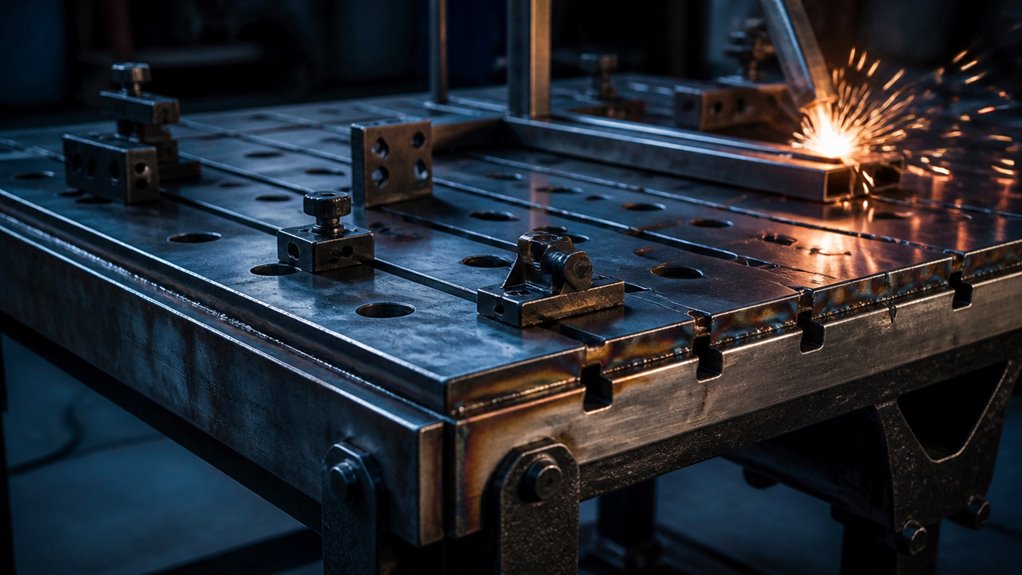
You’ll want a weld table sized to fit your project scale. Typically, this means 2-3 feet for small jobs and 4×4 feet or more for larger workpieces.
Opt for a durable steel surface with a flat milled finish and a perforated hole grid for precise, repeatable clamping and stable grounding.
Choose between fixed or portable tables based on your workspace needs. Ensure proper electrical connections to prevent defects.
Keeping your table clean and protected maximizes lifespan and weld quality. Explore practical tips to optimize your setup and safety.
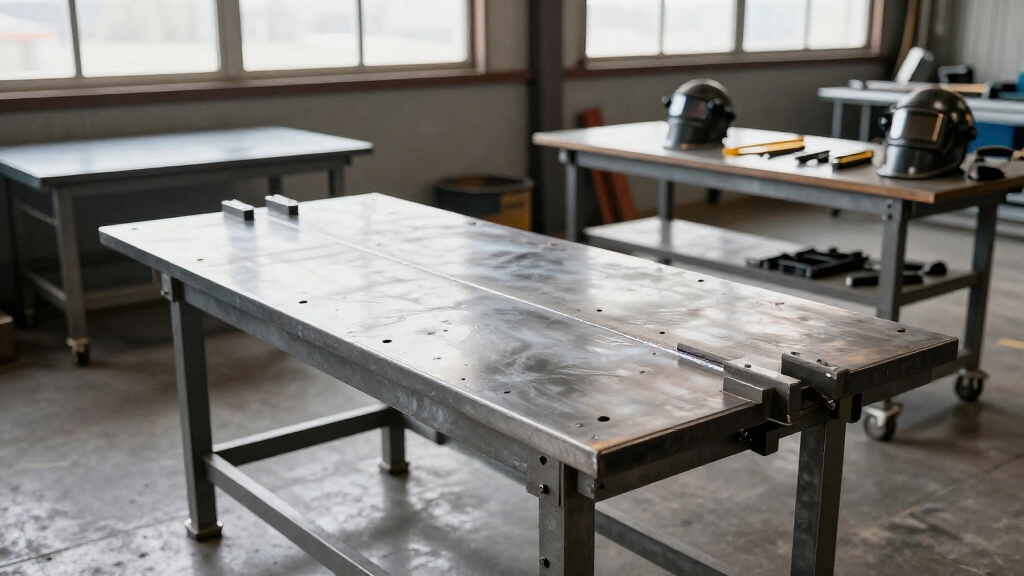
When selecting the right weld table size, you need to take into account the dimensions of your typical projects. This ensures adequate workspace and support.
For smaller workpieces, tables around 2 to 3 feet in length and width, such as 36 x 24 inches, offer sufficient space without overcrowding your work area.
Larger projects require tables at least 4 feet by 4 feet to accommodate oversized components safely and efficiently.
Aim for a tabletop height between 30 and 36 inches to maintain ergonomic standing posture during welding.
Maintain a tabletop height of 30 to 36 inches for comfortable, ergonomic standing while welding.
Remember that overly large tables can reduce maneuverability, while undersized tables limit clamping options and stability.
Assess your workflow and project scale carefully to balance workspace flexibility, support capacity, and ease of movement for optimum fabrication precision.
Ensure the table surface is made of a nonflammable material like metal to provide a safe and durable workspace.
When you’re deciding whether to go with steel or other materials for your weld table, the first thing to think about is durability and heat resistance. Steel really shines here—it can handle high temperatures and impacts better than most alternatives out there.
And let’s not forget about electrical conductivity. Steel has a conductive surface that helps create safer and more stable welding conditions. That’s super important when you’re working with high voltages and currents.
Now, maintenance is another key factor. Steel tables often need coatings to keep rust at bay and to reduce that pesky slag buildup. So, while steel might require a bit of upkeep, the benefits it brings to the table—literally—make it a strong contender for your welding needs. Additionally, having an organized welding bed can improve workflow and tool accessibility when using steel tables.
Although various materials exist for welding tables, steel remains the most effective choice due to its superior durability and heat resistance.
When you work with steel tables, you benefit from a surface that withstands high temperatures without warping or melting. This is critical for maintaining flatness and alignment during welding.
Steel’s toughness resists dents, scratches, and impacts common in shop environments, ensuring long-term stability.
Other materials like aluminum or wood lack the necessary heat tolerance and can deform or catch fire, compromising safety and precision.
Steel’s ability to absorb and dissipate heat also prevents localized overheating, safeguarding your workpieces and clamps.
Choosing steel means you get a reliable, rugged platform that endures the intense conditions welding creates. This helps you maintain accuracy and efficiency throughout your projects.
Additionally, controlling heat input during welding on steel tables is essential to prevent thermal distortion and maintain the integrity of both the table and the workpiece.
How does electrical conductivity impact the performance of a weld table? You need a surface that effectively conducts electricity to guarantee proper grounding and minimize voltage leaks during welding.
Steel excels here due to its balanced conductivity and durability, providing a stable electrical path that supports consistent arc performance.
Alternatives like aluminum offer higher conductivity but lack steel’s strength and heat resistance, making them less practical for heavy-duty welding.
Copper conducts electricity exceptionally well but is costly and softer, leading to faster wear under shop conditions.
When choosing your weld table material, prioritize steel for its reliable electrical conductivity combined with robustness.
This guarantees both safety and precision, helping you maintain stable welding conditions without sacrificing durability or functionality in demanding fabrication environments.
Additionally, using heavy-duty steel deck plates can provide extreme rigidity and resistance to warping under welding stresses, enhancing both conductivity and structural integrity.
Protecting and maintaining your weld table surface is essential to ensuring longevity and consistent performance in demanding fabrication environments.
Steel tables outperform alternatives due to superior heat resistance, durability, and ease of maintenance.
To keep your steel weld table in prime condition, follow these critical steps:
Additionally, understanding the importance of multi-process welding skills helps operators select the best welding process to minimize wear and damage to the table surface.
If you’re looking to enhance your welding setup, having a perforated hole grid on your weld table is a game changer. It really allows for flexible clamping and makes repositioning clamps and stops a breeze.
Now, let’s talk about the surface itself. You definitely want a flat milled surface. This is key for maintaining precise alignment and minimizing distortion while you’re welding.
When you combine these features, you’ll notice a significant improvement in both your setup versatility and fabrication accuracy. It just makes the whole process smoother!
Proper surface preparation, such as cleaning and deburring, is essential for ensuring strong, leak-free joints and can be applied similarly when preparing your welding setup.
A perforated hole grid on a welding table provides a precise and adaptable framework for clamping your workpieces securely. This design features evenly spaced holes, typically arranged in standard bore patterns, allowing you to position clamps, stops, and squares exactly where needed.
You gain exceptional flexibility and repeatability, essential for accurate fabrication.
Consider these key benefits:
Using a table with a perforated grid also helps maintain precise alignment during welding, which is crucial for stable wire feed and consistent weld quality.
Flat milled surfaces provide an exceptionally smooth and level foundation that enhances both clamping versatility and welding accuracy.
By machining the steel tabletop flat within tight tolerances, you eliminate surface irregularities that cause misalignment and distortion during welding.
This precision allows you to position workpieces reliably, ensuring consistent angular and dimensional accuracy.
The flat surface also supports flexible clamping setups, accommodating various clamps and fixtures without uneven pressure points.
When combined with a system-based layout or perforated hole grid, a milled surface maximizes repeatability and adaptability in your workflow.
Additionally, the flat finish resists slag buildup and simplifies cleaning, maintaining an ideal working condition.
Incorporating a flat milled surface is essential if you prioritize precision, stability, and versatility in your welding table design.
To maintain long-term durability and safe operation, it is important to use durable materials and coatings on the table surface to protect against corrosion and wear.
When deciding between fixed and portable weld tables, consider how your workflow and project demands affect stability, weight capacity, and workspace flexibility.
Fixed tables offer superior stability and higher weight limits, making them ideal for heavy-duty, precision projects.
Portable tables excel in versatility, allowing you to move your work easily or save space in compact shops.
Evaluate your needs by asking:
Choosing wisely guarantees your weld table matches your production demands without compromise.
Consider also integrating your weld table into a welding plant setup to streamline your workflow and improve efficiency.
Because welding involves high currents and intense heat, maintaining your weld table’s electrical integrity and safety is critical to both performance and operator protection.
Start by ensuring the table is properly grounded to prevent voltage leaks that could cause shocks or equipment damage. Use tables constructed from conductive steel with uniform surfaces to support stable current flow and reduce electromagnetic interference.
Inspect welding cables and clamps regularly for wear and secure connections to avoid arcing or shorts. Keep the workspace clean, removing slag and debris that can create unintended conductive paths.
Avoid rust buildup by applying protective coatings or zinc plating, which maintain electrical continuity and surface hardness.
Test ground connection resistance with a multimeter regularly to ensure near zero ohms resistance and reliable conductivity before welding.
Although a solid weld table provides the foundation for your work, incorporating the right accessories can markedly enhance efficiency and precision.
Adding practical tools lets you focus on welding without constant adjustments or searching for gear.
Consider these must-have accessories:
These features boost productivity by minimizing setup times and maximizing workspace organization.
This lets you weld faster with more accuracy.
To keep your weld table performing at its best, regularly cleaning and protecting its surface is essential.
After each use, remove slag, spatter, and debris with a wire brush or grinder to prevent buildup that can affect clamping and alignment.
Apply a light coat of machine oil or rust inhibitor to steel surfaces to minimize corrosion, especially if your table lacks zinc plating or protective coatings.
Inspect perforated holes and slots for obstructions to maintain flexible clamping.
Avoid using harsh chemicals that could degrade surface hardness or conductive properties.
If your table has a grounding system, verify connections are secure to guarantee electrical safety.
Consistent maintenance preserves surface flatness and hardness, extending your table’s lifespan and ensuring precision and stability during welding tasks.
Welding table height directly impacts your ergonomics by influencing posture and reducing fatigue.
If the table’s too low, you’ll hunch, straining your back and neck. Too high, and you’ll overreach, stressing shoulders and arms.
Ideally, the table height should keep your elbows near a 90-degree angle while standing, around 30 to 36 inches, depending on your height.
This setup maximizes comfort, precision, and safety during welding tasks.
You might think welding tables are one-size-fits-all, but they can definitely be customized for your specific welding process.
You can choose surface designs like perforated grids or flat milled tops to improve clamping and alignment based on your technique.
Adjust the table size, height, and accessories like built-in clamps or grounding systems to enhance stability, precision, and safety tailored to MIG, TIG, or stick welding demands.
To ground your welding table effectively, connect a dedicated grounding cable directly from the table’s steel frame to a verified earth ground point.
Use heavy-gauge copper wire or grounding straps to guarantee low resistance. Avoid paint or coatings at contact points for solid metal-to-metal contact.
Regularly inspect connections for corrosion or looseness. Proper grounding reduces electrical hazards, minimizes voltage leaks, and stabilizes welding currents, enhancing safety and weld quality.
Think of welding spatter as sticky raindrops splattering your table’s surface.
To reduce buildup, you should use a zinc-plated or coated steel surface that resists slag adhesion.
Regularly clean the table to prevent hardened deposits.
Employ magnetic or removable spatter guards to protect key areas.
Maintaining a smooth, hardened surface reduces spatter sticking.
Proper grounding minimizes electrical arcs that cause excessive spatter.
These steps keep your table clean and efficient.
Yes, welding tables designed for outdoor use exist.
You’ll find them made from heavy-duty, galvanized or zinc-plated steel to resist rust and corrosion from weather exposure.
They often feature sealed surfaces to prevent moisture damage and may include adjustable legs or casters for uneven ground.
These tables maintain stability and durability outdoors, ensuring safe, precise welding even in variable conditions.
Consider models with protective coatings and portability for versatile outdoor applications.
Choosing the right weld table can boost your efficiency. Did you know that using a properly designed clamping surface can improve weld accuracy by up to 30%?
Whether you pick steel for durability or a portable model for flexibility, keeping your table safe and well-maintained is vital.
Investing in essential accessories and routine care guarantees your weld table stays precise and reliable. This ultimately enhances the quality and speed of your projects.