Phone:
(701)814-6992
Physical address:
6296 Donnelly Plaza
Ratkeville, Bahamas.

Phone:
(701)814-6992
Physical address:
6296 Donnelly Plaza
Ratkeville, Bahamas.

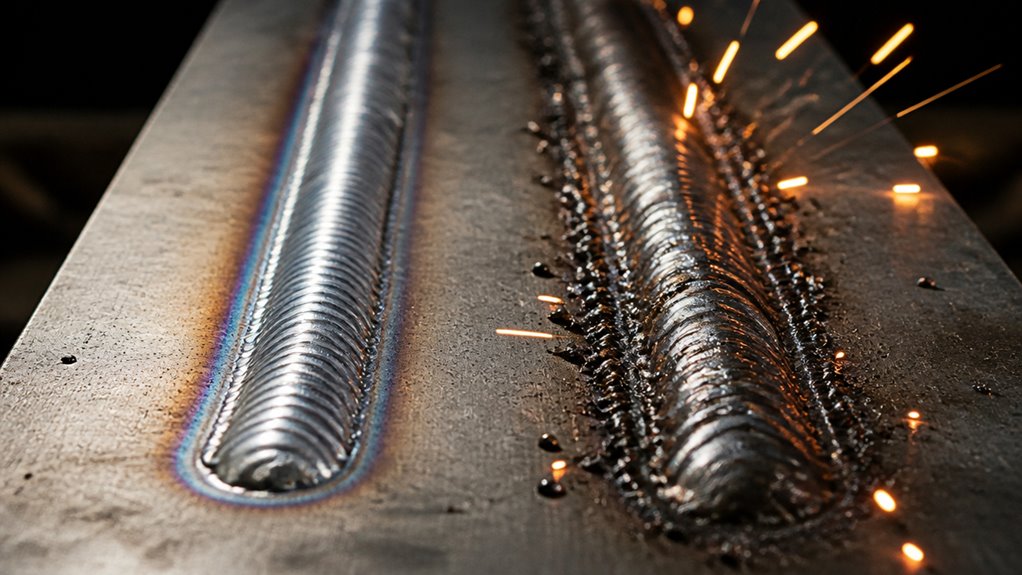
When comparing MIG and TIG welding strength, you’ll find TIG welds generally offer higher tensile strength and cleaner joints due to precise heat control and a focused arc.
This minimizes the heat-affected zone and reduces residual stress, making TIG ideal for thin or high-stress materials.
MIG provides faster deposition and suits thicker sections but may risk larger heat-affected zones if not optimized.
Understanding material and technique nuances will clarify which method best fits your project’s strength needs.
| Feature | MIG Welding | TIG Welding |
|---|---|---|
| Primary Strength | Fast, productive welding | Higher tensile strength and weld integrity |
| Typical Tensile Strength | Generally lower than TIG | About 12–25% higher than MIG according to the article |
| Arc Type | Broader heat input | Narrow, focused arc |
| Heat Control | Good, but less precise | Highly precise |
| Heat-Affected Zone | Generally larger | Narrower |
| Residual Stress | Can be higher if heat is not optimized | Lower with controlled heat input |
| Penetration | Good, especially on thicker sections | Deep and consistent |
| Weld Quality | Strong with proper setup | Cleaner and defect-minimized |
| Porosity/Defects | Can increase with poor settings | Precise control helps minimize defects |
| Deposition Rate | Higher | Slower |
| Thick Materials | Well suited | Less productivity-focused |
| Thin Materials | More difficult to control heat | Excellent |
| Reactive Metals | Suitable with proper setup | Particularly well suited |
| Fatigue Resistance | Good when properly executed | Enhanced through lower defects and controlled heat |
| Finish Quality | Good | Cleaner and more precise |
| Skill Requirement | Easier to learn | Requires greater skill and coordination |
| Beginner Friendly | Generally easier | More demanding |
| Equipment Cost | Generally lower | Generally higher |
| Maintenance | Wire feed and nozzle cleaning | More meticulous torch, tungsten, and gas-system maintenance |
| Outdoor Welding | Generally more effective in windy conditions | More sensitive to wind and gas contamination |
| Spatter | Higher risk if poorly configured | Lower |
| Best Application | Fast production and thicker sections | Thin, high-stress, visible, or precision-critical components |
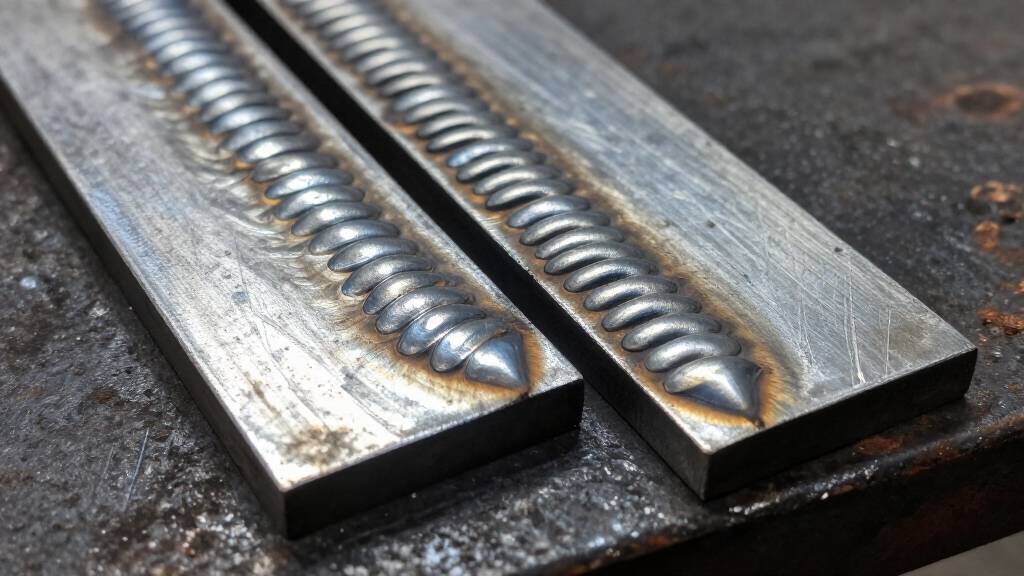
While both TIG and MIG welding can produce strong joints, TIG welding generally delivers higher tensile strength and superior weld integrity when performed correctly.
You’ll find TIG’s narrow, focused arc provides better penetration and a smaller heat-affected zone, reducing residual stress and preserving joint quality.
Studies show TIG welds can exhibit tensile strengths 12% to 25% higher than MIG equivalents, especially on stainless and low-carbon steels.
However, the strength gap narrows when MIG technique is optimized, as MIG can still achieve robust, code-compliant welds.
You must consider that TIG’s precise heat control minimizes defects like porosity, while MIG’s higher deposition rate may increase spatter risk if poorly set.
Ultimately, you’ll reach stronger, cleaner welds with TIG, but skill and setup heavily influence outcomes for both methods.
For maximum weld strength, it is critical to use full-penetration joint designs and match filler metals to base metals regardless of the welding method.
Understanding how material properties and welding technique influence joint strength is essential for achieving ideal results with both TIG and MIG welding.
Mastering material properties and welding techniques is key to strong, reliable TIG and MIG welds.
You must consider alloy composition, thickness, and thermal conductivity, as these affect heat input and cooling rates. For example, TIG’s precise heat control suits thin or reactive metals, minimizing grain growth and residual stress.
Conversely, MIG’s higher deposition rate excels with thicker sections but risks larger heat-affected zones and potential brittleness if not managed properly.
Technique-wise, penetration depth, filler selection, and bead profile impact structural integrity. Proper joint preparation and welder skill also play critical roles.
Poor technique can introduce defects like porosity or inclusions, weakening the weld regardless of process. Ultimately, controlling both material traits and technique parameters guarantees peak strength in your welded joints.
Additionally, using the correct shielding gas is crucial to protect the weld pool and ensure optimal weld quality and strength.
Because TIG welding offers precise heat control and a narrow, focused arc, it produces welds with less heat-affected zone and finer grain structure. This directly enhances joint strength.
TIG’s lower heat input minimizes residual stresses and limits grain growth, preserving the metal’s mechanical properties. Its focused arc also enables deeper, more consistent penetration, reducing porosity and inclusions that can act as stress concentrators.
When you control the process carefully, TIG welding yields cleaner weld beads with fewer defects, further improving fatigue resistance.
Additionally, TIG’s versatility with thin materials and reactive alloys allows you to maintain joint integrity where MIG’s higher heat input might cause distortion or brittleness.
These factors collectively explain why TIG often produces stronger, more reliable welds in demanding applications.
Moreover, the use of inert gas shielding in TIG welding protects the weld pool from atmospheric contamination, ensuring defect-free and corrosion-resistant joints.
The way heat is applied during welding directly influences the microstructure and mechanical properties of the joint. Excessive heat input can enlarge the heat-affected zone, leading to grain growth and residual stresses that weaken the weld.
Conversely, controlled heat input preserves microstructural integrity and enhances strength. Weld quality factors such as penetration depth, defect presence, and bead uniformity critically determine joint performance.
Defects like porosity or inclusions create stress concentrators, reducing fatigue resistance and tensile strength.
Key considerations include:
Managing the heat-affected zone through proper parameters is essential to maintaining weld integrity and joint strength.
When selecting between TIG and MIG welding for your project, you’ll need to weigh factors like material thickness, required weld strength, and production speed.
TIG excels in precision, offering superior control over heat input and a narrower heat-affected zone. This makes it ideal for thin materials or high-stress applications where fatigue resistance matters.
MIG welding, while potentially producing slightly lower tensile strength, provides faster deposition rates and better productivity on thicker sections.
You should consider joint complexity and required finish quality. TIG yields cleaner, defect-minimized welds suited for visible or critical components.
However, with proper setup and technique, MIG can achieve comparable strength in structural steel and heavy fabrication.
Ultimately, your choice hinges on balancing strength needs, efficiency, and material characteristics rather than relying solely on the welding process label.
MIG welding uses a continuous wire electrode and inert shielding gas to protect the weld pool, enabling high-quality welds across various metals.
You’ll find TIG welding costs higher for beginners due to pricier equipment, slower welding speeds, and more consumables like tungsten electrodes and shielding gas.
MIG setups are generally cheaper, simpler, and faster to learn, making initial investment and running costs lower.
However, TIG’s precision can reduce rework expenses long-term.
Weigh upfront equipment and consumable costs against your skill development pace and project complexity to choose wisely.
You’ll notice that TIG welding demands stricter eye protection due to its intense, focused arc producing more ultraviolet radiation.
You must wear a darker shade lens and full face shield.
MIG welding, while still hazardous, generates more spatter and requires you to secure loose clothing carefully to avoid burns.
Both require gloves and ventilation, but TIG’s lower fumes mean you might manage with less aggressive ventilation than the usually higher-fume MIG process.
You might think TIG welding, with its precise control, is easier to learn, but actually, MIG welding is generally simpler for hobbyists.
MIG uses a continuous wire feed, making it more forgiving and faster to master.
TIG requires coordinating a foot pedal and filler rod simultaneously, demanding more skill and patience.
You can perform both TIG and MIG welding outdoors, but MIG is generally more effective in windy or drafty conditions due to its shielding gas delivery and higher deposition rate.
TIG welding’s precise arc and gas coverage are more sensitive to wind, which can cause contamination and porosity.
To weld outdoors effectively, you’ll need windshields or enclosures, proper gas flow settings, and careful technique, especially if you choose TIG for its precision.
You’ll find TIG welding equipment demands more meticulous maintenance, especially cleaning the torch’s tungsten electrode and ensuring gas flow systems remain uncontaminated to preserve arc stability.
MIG gear requires regular wire feed inspection and nozzle cleaning to prevent spatter buildup, which can disrupt shielding gas coverage.
Both need frequent checks on cables and connections, but TIG’s precision work makes even minor contamination more impactful.
You’ll spend extra time maintaining it for consistent performance.
When you weigh MIG’s speed against TIG’s precision, you realize strength isn’t just about power. It’s about control.
MIG welds may get the job done faster, but TIG’s meticulous technique guarantees superior joint integrity.
Your project’s success hinges on this choice: rapid convenience or lasting strength.
By understanding how heat and material interact, you can confidently select the method that delivers not just a weld, but a structurally sound connection built to endure.