Phone:
(701)814-6992
Physical address:
6296 Donnelly Plaza
Ratkeville, Bahamas.

Phone:
(701)814-6992
Physical address:
6296 Donnelly Plaza
Ratkeville, Bahamas.

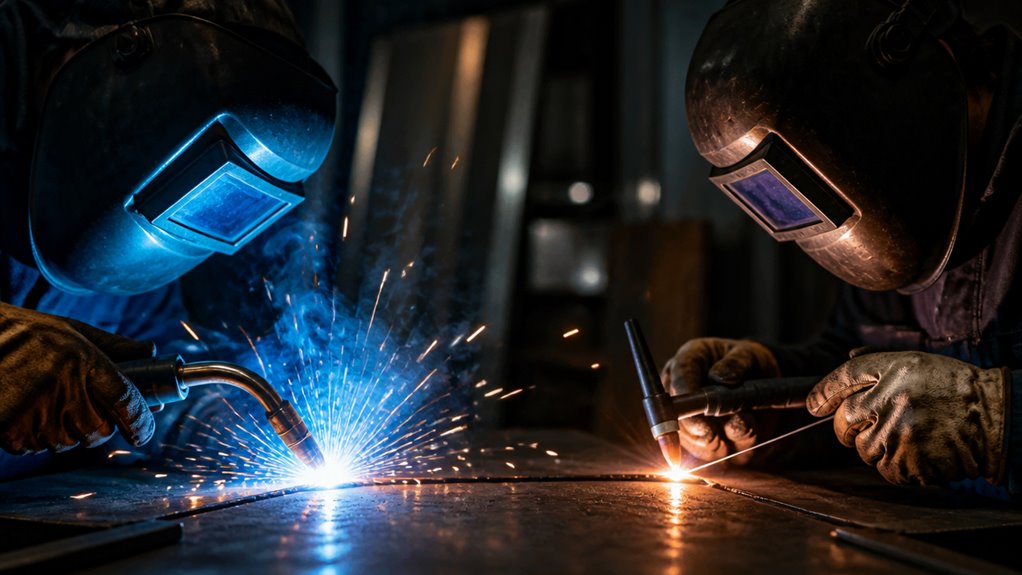
If you need faster, stronger welds on thicker metals, MIG welding offers automated wire feed for speed and consistent penetration with less skill required.
TIG welding, however, demands advanced coordination to deliver precise, clean welds on thin or exotic metals, prioritizing aesthetics and minimal distortion.
Costs and complexity differ, so your choice hinges on metal type, project scale, and quality needs.
Exploring these factors will reveal which method best fits your welding demands.
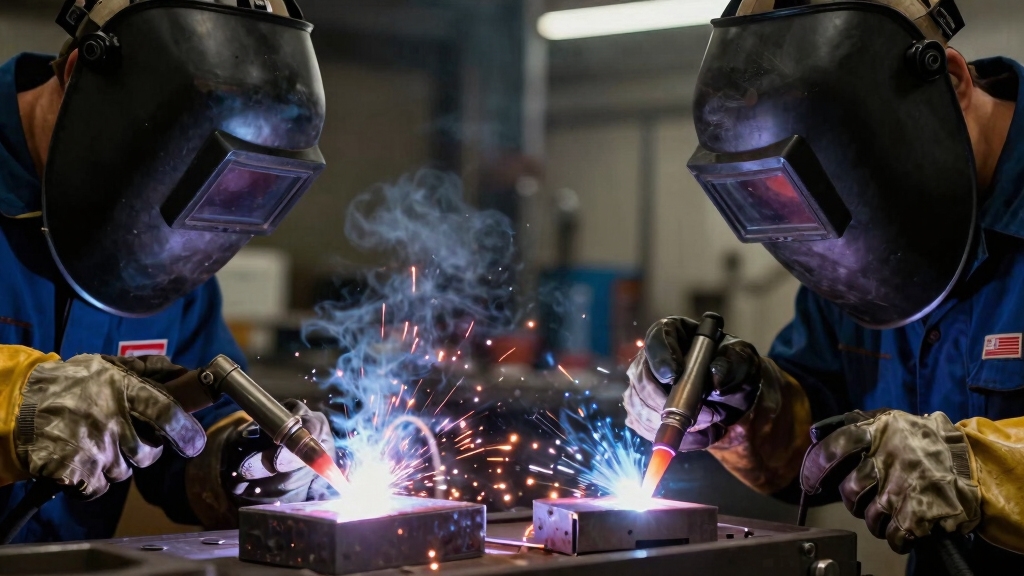
Although both MIG and TIG welding join metals through electric arcs, their process mechanisms differ markedly in operation and control.
MIG and TIG welding both use electric arcs but differ significantly in their operation and control.
When you use MIG welding, a motor-driven system continuously feeds a consumable wire electrode through a single hand-held torch. This allows rapid weld completion via backward wire thrust.
In contrast, TIG welding requires you to handle a non-consumable tungsten electrode with one hand while manually adding filler rods with the other. This demands greater dexterity and coordination.
This dual-handed operation grants you precise control over heat input and filler placement, essential for detailed work.
MIG’s automated wire feed enhances speed and consistency, whereas TIG’s manual process prioritizes accuracy and meticulous weld quality.
Understanding these fundamental operational differences is critical for selecting the appropriate welding method in your applications.
Additionally, MIG welding typically uses shielding gas to protect the weld pool, which can be sensitive to wind and outdoor conditions.
MIG welding consistently outpaces TIG welding in speed, completing standard production jobs three to four times faster due to its automated wire feed and continuous operation.
You benefit from the motor-driven wire feed that eliminates manual filler addition, enabling rapid, uninterrupted welds. This automation markedly reduces labor time and energy consumption, especially on large-scale projects.
In contrast, TIG welding demands manual filler rod control and dual-hand coordination, slowing the process. While TIG offers superior precision, its slower pace limits efficiency in high-volume production.
MIG’s backward thrust on the wire guarantees deep penetration and consistent deposition, further enhancing throughput.
If your priority is speed and efficiency in industrial assembly or thick material welding, MIG welding presents a clear advantage over TIG’s meticulous, time-intensive technique.
However, it is essential to control heat input during welding to prevent weak joints and ensure strong fusion, regardless of the welding method used.
MIG welding is generally easier to get the hang of, which is great if you’re looking to pick up a new skill quickly. It requires less manual coordination, so you won’t need to spend as much time in training.
On the other hand, TIG welding is a bit more challenging. It demands advanced hand-eye coordination since you have to control both the torch and the filler rod at the same time. So, if you’re planning to dive into TIG, be prepared to invest quite a bit more time to really master it and produce professional-quality welds.
Proficiency in TIG welding often requires 30–100 hours of dedicated practice to develop defect-free welds.
Typically, welders find learning TIG welding more demanding due to its requirement for advanced hand-eye coordination and simultaneous management of heat and filler material.
In contrast, MIG welding offers a more accessible entry point, with fundamentals you can grasp within weeks. The automated wire feed reduces manual input, letting you focus on torch control and weld consistency.
TIG’s steep learning curve demands patience and practice, as you balance torch angle, heat, and filler rod addition precisely.
Consider these key ease-of-learning factors:
Choosing between them depends on your available training time and desired proficiency level.
Although welding proficiency varies between processes, mastering TIG demands substantially higher coordination than MIG due to its requirement to simultaneously manage torch angle, heat input, and manual filler rod addition.
When you TIG weld, you must precisely control the torch with one hand while steadily feeding the filler rod with the other, maintaining consistent heat to avoid warping or burn-through.
In contrast, MIG welding automates wire feed, allowing you to focus primarily on torch positioning, which reduces hand-eye coordination complexity.
Consequently, MIG welders typically achieve acceptable results faster with less manual dexterity.
TIG’s steep learning curve stems from this multitasking demand, requiring refined motor skills and acute spatial awareness.
You’ll need significant practice to synchronize these elements flawlessly, highlighting why TIG welding suits those seeking precision over speed.
Additionally, mastering TIG welding involves attention to tungsten electrode grinding techniques, which directly impact arc stability and weld quality.
Mastering MIG welding demands considerably less time than TIG due to its automated wire feed and simpler torch control. This allows beginners to achieve functional proficiency within a few weeks.
MIG’s motor-driven wire feed and single-handed operation reduce complexity, enabling faster skill acquisition.
TIG welding, however, requires several months of dedicated training since you must coordinate torch handling and manual filler rod addition simultaneously. This demands superior hand-eye coordination and precise heat management.
MIG welding basics are accessible quickly, making it ideal for entry-level welders.
TIG demands advanced manual dexterity and extensive practice to produce consistent, high-quality welds.
The steep TIG learning curve necessitates more time before achieving professional-grade results.
Understanding these differences helps you allocate training resources efficiently based on project requirements.
Additionally, TIG welding requires meticulous maintenance and careful monitoring of shielding gas flow for optimal weld quality.
When budgeting for welding equipment, you’ll find that MIG welders generally demand a lower upfront investment. Starter kits are available around $500.
These kits include the wire feed system and basic shielding gas setup, making them cost-effective for beginners and large projects. In contrast, TIG welders start near $1,000, reflecting the advanced technology required for precise arc control and superior weld quality.
Additionally, TIG consumables, such as pure tungsten electrodes and high-grade shielding gases, raise ongoing costs. MIG consumables, including wire and common shielding gases, are more affordable and readily available.
Over time, if you prioritize efficiency and lower material expenses, MIG offers a better return. However, TIG’s higher equipment and consumable costs align with its specialized application and superior weld aesthetics. MIG welding’s use of inert shielding gas helps protect weld quality while keeping costs manageable.
When it comes to welding, MIG welding really shines when you’re working with thicker metals like steel and aluminum. It’s got this great ability to penetrate and deposit material quickly, making it a go-to for heavy-duty projects.
On the flip side, if you’re dealing with thinner materials or even some exotic metals, TIG welding is where you want to be. It offers fantastic precision and control, which means you get minimal heat distortion.
Additionally, MIG welding requires external shielding gas, which provides a cleaner weld with less spatter compared to flux-cored options, especially in controlled environments with thinner metals and cleaner weld quality.
Typically, MIG welding excels with thicker metals like steel and aluminum, delivering deep penetration and efficient deposition in single passes.
You’ll find MIG ideal when working on robust steel frames or aluminum structures that demand strong, rapid welds. Conversely, TIG welding suits you best for thin, delicate metals requiring precision and minimal distortion.
TIG’s controlled heat input lets you weld stainless steel and exotic alloys with high detail.
Consider these points when matching metal types:
MIG handles carbon steel, aluminum, and mild alloys efficiently, especially at greater thicknesses.
TIG excels in stainless steel, magnesium, and thin aluminum, providing superior surface finish and control.
For exotic metals like titanium, TIG’s precision is indispensable to maintain material integrity.
Understanding metal compatibility guides you to select the right welding method for your project’s requirements.
Additionally, MIG welding’s semiautomatic wire feeding mechanism ensures consistent deposition rates, enhancing productivity on thicker materials.
Selecting the appropriate welding technique hinges largely on the material thickness you’re working with.
MIG welding excels with thicker metals due to its superior penetration and ability to deposit substantial filler in a single pass. It’s ideal for steel, aluminum, and alloys exceeding 1/8 inch thickness.
Conversely, TIG welding is better suited for thin materials, typically under 1/8 inch, where precise heat control prevents warping and burn-through.
TIG’s lower penetration and manual filler addition allow delicate handling of stainless steel, exotic metals, and thin aluminum sheets.
If you need speed and strength on heavy sections, MIG is optimal.
For detailed, thin-gauge work requiring high aesthetic quality and minimal distortion, TIG is the preferred choice.
Match your welding method to material thickness for best results.
How does weld quality differ between MIG and TIG processes? When you weld with TIG, you get cleaner, more precise welds with minimal spatter. This is ideal for projects demanding superior aesthetics and strength.
MIG welding, while faster, often results in visible discoloration, heavier spatter, and a less uniform finish unless expertly handled.
Consider these points:
TIG welds exhibit higher tensile strength and durability, making them structurally superior.
MIG welds have a rougher appearance but excel in faster production and thicker materials.
TIG’s meticulous heat and filler control yield consistent, refined weld beads with excellent fusion.
When evaluating welding options for your project, consider the specific demands of material type, thickness, production speed, and desired weld quality.
Choose MIG welding if you need rapid production on thicker metals like steel or aluminum. It offers high penetration and efficiency.
MIG’s automated wire feed simplifies operation and reduces labor time, making it cost-effective for large-scale jobs.
Opt for TIG welding when precision and aesthetics are paramount, especially on thin or exotic metals such as stainless steel.
TIG’s manual filler control and superior weld quality provide higher tensile strength and cleaner finishes. However, it requires advanced skills and longer cycle times.
Balance equipment costs, your skill level, and project scale to select the process that aligns with your technical and economic requirements.
Additionally, maintaining a clean, well-ventilated workspace and proper grounding are essential for safe and effective welding practices, as outlined in workspace preparation.
You can weld outdoors with both MIG and TIG, but you’ll face challenges.
MIG’s shielding gas is easily blown away by wind, causing contamination and weak welds unless you use windshields or flux-cored wire.
TIG welding demands even more controlled conditions because its inert gas is highly sensitive to drafts.
To guarantee safety and weld quality outside, you must minimize wind exposure, use appropriate shielding, and maintain stable environmental conditions.
Like a shield protecting a knight, your essential safety gear includes a welding helmet with an auto-darkening lens to guard your eyes from intense UV and IR radiation.
Wear flame-resistant gloves and a long-sleeve jacket to prevent burns from sparks. Use respiratory protection if ventilation is poor.
Safety boots and ear protection are also vital. This gear guarantees you maintain precision and avoid injury during welding operations.
Welding affects metal corrosion resistance by altering the metal’s microstructure and heat-affected zones. This can increase susceptibility to corrosion if not controlled properly.
You need to manage heat input and choose appropriate filler materials to maintain corrosion resistance. Post-weld treatments like passivation or coating help restore protective layers.
Improper welding can create galvanic cells or residual stresses, accelerating corrosion. Precise control and material compatibility are essential for durable, corrosion-resistant welds.
You should clean your MIG welder’s wire feed system regularly to prevent jams and ensure steady feeding.
For TIG welders, keep the tungsten electrode sharp and free of contamination for precise arcs.
Both require checking and replacing gas hoses and regulators to avoid leaks.
Inspect cables and connections routinely for wear.
Proper maintenance extends equipment life, improves weld quality, and reduces downtime.
Neglecting upkeep leads to performance degradation over time.
Yes, you can combine MIG and TIG welding in one project to leverage their strengths.
Use MIG for thick sections needing rapid, strong welds and TIG for thin materials or detailed areas requiring precision.
This hybrid approach optimizes efficiency and weld quality.
Just make certain proper sequencing to avoid contamination and adjust equipment settings accordingly.
Combining these methods demands skillful planning but yields superior structural integrity and aesthetic results.
When deciding between MIG and TIG welding, remember that “measure twice, cut once” applies well here.
MIG offers speed and ease for thicker materials, while TIG provides superior precision and finish on thinner metals.
Your choice hinges on project demands, skill level, and budget.
By analyzing these factors carefully, you’ll optimize efficiency and weld quality.
This ensures your work meets exact technical standards without unnecessary expense or time wasted.
[…] using the correct shielding gas is crucial to protect the weld pool and ensure optimal weld quality and […]